Employer of Record

Employer of Record (EOR) Croatia

Hire compliantly, pay accurately, expand confidently.

Global Payroll Team
Written by Global Payroll Team
Published on September 29, 2026
Last updated September 29, 2026
Expert Reviewed

An Employer of Record (EOR) in Croatia acts as the official employer for workers, often referred to as a Global Professional Employer Organization (Global PEO). This role encompasses a broad range of employment functions, ensuring full compliance with local labor laws and regulations, managing payroll, administering taxes, providing legally required benefits, and handling employment contracts.

Key Responsibilities of an Employer of Record (EOR) in Croatia:
  • Ensuring employment terms are fully compliant with Croatia’s Labour Act (Zakon o radu).
  • Overseeing and processing local payroll in Euro (EUR), Croatia’s official currency since 1 January 2023.
  • Managing pension (Pillar I & II), health insurance, and other statutory contributions.
  • Issuing compliant payslips and disbursing salary payments in accordance with Croatian standards.
  • Handling work permits and immigration compliance for non-EU hires under Croatia’s evolving Law on Foreigners.

With our Employer of Record (EOR) services, expanding your business into Croatia becomes easier and more efficient. Our solution eliminates the need for setting up a local entity, providing a seamless path to establish a legal presence in Croatia. We ensure full legal compliance, manage payroll, protect your intellectual property, and handle work permits, so you can focus on growing your business and building your workforce in this EU, Eurozone, and Schengen member state.

Things you need to know before hiring in Croatia

Croatia’s 2025–2026 Minimum Wage and Parental Leave Updates

Croatia’s gross minimum wage rose to EUR 1,050 per month from 1 January 2026, up from EUR 970 in 2025 — part of a longer trend that has seen the minimum wage more than double since 2016. Separately, paternity leave was significantly enhanced effective 2025, doubling from 10 to 20 working days of fully paid leave for a single child (30 days for twins or multiple births). On the immigration side, the EU Blue Card’s validity was extended from 24 to 48 months, while Croatia’s Law on Foreigners was amended in March 2025 with further reforms taking effect in mid-2026, tightening some permit procedures even as the country’s labor shortage continues to deepen. Employers should reconfirm the current minimum wage, parental leave entitlements, and permit requirements at least annually.

Employment Contracts in Croatia

Croatian labor relations are governed by the Labour Act (Zakon o radu). An indefinite-term contract is the default and presumed form of employment, while a fixed-term contract is treated as the exception.

Indefinite-Term Contracts

The standard, presumed form of employment in Croatia. Employment contracts must be in writing.

Fixed-Term Contracts

Permitted only for objectively justified reasons, such as replacing an absent employee or completing a specific project, and capped at a cumulative maximum of 3 years including renewals.

Probation Period

Up to 6 months for both indefinite and fixed-term contracts. A minimum 7-day notice period applies if either party terminates during probation.

Mandatory Contract Terms

Employment contracts must specify the parties’ identities, job title, workplace, start date, duration (if fixed-term), remuneration, and working hours, among other required terms.

Working Hours

The standard legal working week in Croatia is 40 hours, structured as 8 hours per day.

Severance Pay for Length of Service

Employees dismissed after at least 2 years of continuous service are generally entitled to severance pay of a minimum 1/3 of their average monthly salary (based on the prior 3 months) per completed year of service, typically capped at 6 average monthly salaries unless a more generous contractual or collective agreement provision applies.

Key Points on Overtime

Overtime Cap
Overtime is generally capped at 180 hours per year, extendable to 250 hours with employee consent under a collective agreement, or up to 280 hours in documented periods of temporary increased workload.
Overtime Premium
The Labour Act does not set a blanket statutory minimum premium for ordinary overtime — the rate is fixed by the employment contract or collective agreement, with a 50% supplement being common market practice. A 50% minimum supplement is, however, an explicit statutory requirement for work performed on Sundays or public holidays.
Weekly Hours Limit
Overtime is capped at 10 hours per week, meaning total weekly working time (ordinary hours plus overtime) generally cannot exceed 50 hours.

Termination and Severance Pay

Termination in Croatia generally requires a lawful ground, appropriate notice, and any severance payment tied to the reason for termination and the employee’s length of service.

Notice of Termination

Statutory notice periods scale with length of service, ranging from 2 weeks for less than 1 year of service up to 3 months for long-serving employees, with an additional 2 weeks to 1 month for employees aged 50 or 55+ with at least 20 years of continuous service. During the notice period, employees are entitled to at least 4 paid hours per week to seek new employment.

Severance Pay

As described above, severance is generally owed after 2+ years of continuous service, calculated as at least 1/3 of average monthly salary per year of service, typically capped at 6 average monthly salaries.

Protected Categories

Pregnant employees and parents on approved parental leave generally benefit from enhanced dismissal protection under the Labour Act.

Compensation for Unused Leave

Any accrued but unused annual leave must be paid out on termination.

Employees vs Independent Contractors

Croatian authorities — the Tax Administration, the Labour Inspectorate, and the courts — apply a subordination and substance-over-form test: control over how, when, and where work is performed, integration into the organization’s schedules and supervision structure, and the absence of a right to delegate or substitute all point toward an employment relationship, regardless of how the contract is labeled. Genuine independent contractors instead operate under the Civil Obligations Act (Zakon o obveznim odnosima) rather than the Labour Act.

Misclassifying employees as independent contractors is a recognized enforcement risk in Croatia, exposing the engaging company to back taxes, back social security contributions, and penalties.

Comparison Table: Employee vs Independent Contractor

Factor Employee Independent Contractor
Governing Law Labour Act (Zakon o radu) Civil Obligations Act (Zakon o obveznim odnosima)
Control & Subordination Works under the employer’s direction, schedule, and supervision Controls own working hours and methods
Registration Registered by the employer for pension and health insurance Not registered as an employment contract
Payment Structure Fixed monthly salary via payroll Paid per project, milestone, or invoice
Statutory Benefits Entitled to paid leave, severance, and social insurance coverage No statutory employment benefits
Misclassification Risk Not applicable High risk if the relationship shows subordination; authorities actively pursue reclassification

Understanding these differences is essential for ensuring compliance and correctly determining entitlements such as leave, severance, and social security contributions.

Social Security Contributions in Croatia

Croatia operates a two-pillar mandatory pension system alongside employer-funded health and other insurance contributions.

Contribution Employer Employee
Pension – Pillar I (pay-as-you-go) — 15%
Pension – Pillar II (funded individual account) — 5%
Health Insurance, Workplace Injury & Unemployment 16.5% —

Employee pension contributions are calculated up to a monthly base cap of approximately EUR 11,958 (annual cap approximately EUR 143,496 for 2025); employer contributions are uncapped. A reduced contribution base formula applies to gross salaries up to EUR 1,300/month. Mercans confirms the current caps and rates for each engagement.

Payroll in Croatia

Minimum Wage

Croatia’s gross national minimum wage is EUR 1,050 per month, effective 1 January 2026, set annually by government decree; by law, the minimum wage cannot be decreased year over year.

Payroll Cycle

Salaries in Croatia are paid monthly in Euro, with employers required to provide employees with an itemized payslip showing gross pay, statutory deductions, and net pay. A 13th or 14th month salary is not legally mandated, but Christmas bonuses and vacation/holiday allowances are common market practice, often paid up to certain tax-favorable thresholds.

Overtime Pay

Overtime pay is provided when an employee works beyond the standard 40-hour week, subject to annual and weekly caps.

Overtime Premium

No blanket statutory minimum applies to ordinary overtime, though 50% is common market practice; a statutory minimum 50% supplement applies to work on Sundays or public holidays.

Annual Overtime Cap

Overtime is capped at 180 hours per calendar year by default, extendable to 250 hours with employee consent under a collective agreement, or up to 280 hours in documented periods of temporary increased workload.

Overtime rules can vary depending on the applicable collective bargaining agreement.

Mercans’ payroll capabilities

Payroll Cycle Management in Croatia
Mercans delivers efficient, seamless payroll cycle management tailored to Croatian requirements, including Euro-denominated payroll and municipal income tax rate variation. We ensure that both employees and contractors are paid accurately and on time, providing a smooth and compliant payroll experience aligned with Croatian standards.
Payroll Setup, Processing, and Administration
Mercans offers a complete range of payroll services from start to finish. Whether it’s setting up your payroll system, processing payments, or managing ongoing administration, we take care of every detail, ensuring accuracy, compliance, and efficiency so you can focus on running your business.
Statutory Filings and Payments
Navigating Croatia’s regulatory framework can be complex, particularly given municipal-level income tax variation and evolving immigration rules, but with Mercans, you’re in safe hands. We manage all statutory filings and payments, ensuring your business remains fully compliant with Croatian tax laws and employment regulations.

Personal Income Tax in Croatia

Croatia applies a two-bracket national income tax system: 20% on annual income up to EUR 60,000 (EUR 5,000/month), and 30% above that threshold. Since a January 2024 reform abolished the old national surtax system, municipalities and cities now set their own local tax rates layered on top of the national rates, producing combined rates that range roughly from 15% to 23% on the lower bracket and 25% to 33% on the upper bracket depending on where the employee is registered — Zagreb applies rates at the top of both ranges. The basic personal allowance is EUR 600 per month (EUR 7,200 per year).

Croatia Employee Hiring Cost

When hiring an employee in Croatia, employers must budget for gross salary plus mandatory employer contributions of 16.5% of gross salary for health insurance, workplace injury, and unemployment coverage.

Salary Details Amount (EUR)
Gross Monthly Salary 2,000
Employer Contributions (16.5%) 330
Estimated Total Monthly Cost 2,330

Employee Benefits in Croatia

Croatian employees are entitled to a combination of mandatory statutory benefits and, increasingly, supplementary benefits offered at the employer’s discretion.

  • Annual Leave: A minimum of 20 working days per year, often extended by collective agreement, generally vesting after 6 months of continuous employment.
  • Public Holidays: Croatia observes 13–14 national holidays, including New Year’s Day, Easter Sunday and Monday, Labour Day, Statehood Day, Anti-Fascist Struggle Day, Victory and Homeland Thanksgiving Day, Assumption of Mary, All Saints’ Day, and Christmas and St. Stephen’s Day.
  • Sick Leave: The employer pays the first 42 days at a minimum of 70% of the average base salary; from day 43, the national health insurance fund (HZZO) takes over at a comparable rate.
  • Maternity Leave: Mandatory leave from 28 days before birth through 70 days after, extendable until the child turns 6 months, generally paid at 100% via HZZO.
  • Paternity Leave: 20 working days of fully paid leave for a single child (30 days for twins or multiple births), enhanced from 10 days effective 2025, to be taken as one continuous block before the child’s 6-month mark.
  • Severance Pay: A statutory entitlement after 2+ years of service, described above.
  • Parental Leave: Up to 4 months per parent for the first two children (up to 15 months for twins or subsequent children), usable until the child’s 8th birthday.
  • Two-Pillar Pension Coverage: Mandatory pay-as-you-go (Pillar I) and funded individual account (Pillar II) pension contributions, described above.
  • Christmas & Vacation Bonuses: Common non-mandatory benefits provided by many employers, often paid within tax-favorable thresholds.
  • Workplace Wellness Programs: Companies are enhancing the workplace experience with wellness initiatives, including mental health support.
  • Flexible Work Options: Employers are increasingly offering flexible or hybrid working arrangements where operationally feasible.
  • Team-Building Activities: Employers are introducing more team-building and employee engagement activities.
  • Discount Programs: Some companies offer group discounts on shopping, travel, and leisure activities.

Essential Benefits for Employees in Croatia
  • Annual Leave: A minimum of 20 working days per year, often extended by collective agreement, generally vesting after 6 months of continuous employment.
  • Public Holidays: Croatia observes 13–14 national holidays, including New Year’s Day, Easter Sunday and Monday, Labour Day, Statehood Day, Anti-Fascist Struggle Day, Victory and Homeland Thanksgiving Day, Assumption of Mary, All Saints’ Day, and Christmas and St. Stephen’s Day.
  • Sick Leave: The employer pays the first 42 days at a minimum of 70% of the average base salary; from day 43, the national health insurance fund (HZZO) takes over at a comparable rate.
  • Maternity Leave: Mandatory leave from 28 days before birth through 70 days after, extendable until the child turns 6 months, generally paid at 100% via HZZO.
  • Paternity Leave: 20 working days of fully paid leave for a single child (30 days for twins or multiple births), enhanced from 10 days effective 2025, to be taken as one continuous block before the child’s 6-month mark.

Additional Employee Benefits
  • Severance Pay: A statutory entitlement after 2+ years of service, described above.
  • Parental Leave: Up to 4 months per parent for the first two children (up to 15 months for twins or subsequent children), usable until the child’s 8th birthday.
  • Two-Pillar Pension Coverage: Mandatory pay-as-you-go (Pillar I) and funded individual account (Pillar II) pension contributions, described above.
  • Christmas & Vacation Bonuses: Common non-mandatory benefits provided by many employers, often paid within tax-favorable thresholds.

Perks & Wellness Initiatives
  • Workplace Wellness Programs: Companies are enhancing the workplace experience with wellness initiatives, including mental health support.
  • Flexible Work Options: Employers are increasingly offering flexible or hybrid working arrangements where operationally feasible.
  • Team-Building Activities: Employers are introducing more team-building and employee engagement activities.
  • Discount Programs: Some companies offer group discounts on shopping, travel, and leisure activities.

Work Permit in Croatia

Work authorization requirements in Croatia depend on the foreign national’s nationality.

EU, EEA, and Swiss Nationals

Nationals of EU, EEA, and Swiss member states benefit from free movement rights and do not require a work permit — only local residence registration is required for stays beyond 90 days.

Third-Country Nationals — Single Permit

Nationals from outside the EU/EEA/Switzerland generally require a “jedinstvena dozvola” (single permit), a combined work-and-residence authorization. This route generally requires a labor market test conducted by the Croatian Employment Service, which must respond within 15 days; overall permit issuance can take up to 90 days.

EU Blue Card

Highly qualified third-country nationals may instead qualify for an EU Blue Card, which is exempt from the labor market test and offers a faster pathway for skilled talent. The Blue Card’s validity was extended from 24 to 48 months under 2025 reforms.

Important Considerations for Employers

Employer Sponsorship

A registered legal entity in Croatia is required to sponsor a foreign employee’s single permit or Blue Card application — an EOR partner such as Mercans allows companies without a local entity to still hire and sponsor talent compliantly, which matters given Croatia’s deepening labor shortage.

EU Talent Mobility

Businesses hiring across the European Union can take advantage of free movement rights for EU, EEA, and Swiss nationals into Croatia.
Understanding these pathways can streamline the hiring process, allowing employers to bring skilled talent into their Croatia-based operations effectively.

EOR Solutions in Croatia

EOR Solutions for Prospective Employees in Croatia
Mercans provides efficient Employer of Record (EOR) services for businesses that have already identified their ideal candidates in Croatia. Our comprehensive services cover the entire employee lifecycle, ensuring full compliance with Croatian labor laws, tax regulations, and employment standards, so you can focus on your business growth without the administrative burden.
EOR + Recruitment: Streamlined Talent Acquisition
For businesses seeking assistance with talent acquisition, our EOR and recruitment solutions offer a complete, end-to-end service, helping you find, hire, and retain top talent in Croatia while ensuring all recruitment and compliance requirements are met.
Visa Sponsorship and Global Mobility Solutions
Navigating the complexities of expatriate employment becomes straightforward with our visa sponsorship and global mobility services. Mercans ensures a smooth relocation process for your international workforce, handling all aspects of Croatian immigration and employment laws to guarantee compliance.
AOR Services for Contractor Payments
For businesses managing contractor payments in Croatia, Mercans offers Agent of Record (AOR) services, handling the complexities of independent contractor payments to ensure accurate, timely, and fully compliant payments while managing misclassification risk.
Converting Freelancers to Employees in Croatia
Mercans supports businesses transitioning freelancers and contractors to full-time employees in Croatia, ensuring a smooth, legally compliant conversion process.
HCM Integration for Enhanced Workforce Management
Integrate Mercans’ EOR services with your Human Capital Management (HCM) system for a unified, real-time approach to data exchange, compliance tracking, and payroll management in Croatia.

Best Employer of Record Croatia

Mercans stands out as a leading Employer of Record (EOR) provider in Croatia for several key reasons:

  • Full Compliance with Croatian Labor Laws: Mercans ensures strict compliance with Croatia’s Labour Act and evolving immigration rules, keeping your business aligned with local labor law and protecting you from potential legal risk.
  • Independent Operations: As a fully independent entity, Mercans operates without external affiliations, delivering reliable, customized employment services tailored to your business requirements in Croatia.
  • Supports All Employment Types: Whether you’re hiring employees, contractors, or expatriates, Mercans offers flexible solutions across a variety of workforce models.
  • Designed for Large Enterprises: Our scalable solutions meet the demands of enterprise-level organizations, integrating with your broader global business goals.
  • Multi-Currency Payroll Management: Mercans handles multi-currency payroll, simplifying salary management across multiple countries alongside Croatia.
  • Global Network and Multi-Country Payroll Expertise: With a robust global presence, Mercans manages multi-country payroll seamlessly across the European Union and beyond, handling local tax regulations and compliance requirements wherever your teams are based.
  • Certified Data Protection and Security Standards: Mercans adheres to stringent data protection protocols, including GDPR certification and SOC 1 & SOC 2 compliance.
  • ISO-Certified Service Quality and Security: Mercans holds ISO 20000 and ISO 27001 certifications, reflecting our commitment to excellence in IT service management and information security.
  • OWASP ASVS 3.0 Compliant: We adhere to OWASP ASVS 3.0 standards, protecting your business through secure software development and management practices.
  • Mercans HRBlizz: Our proprietary global payroll and talent management SaaS platform simplifies payroll while ensuring full compliance with local labor laws in Croatia, backed by a team of in-country specialists.
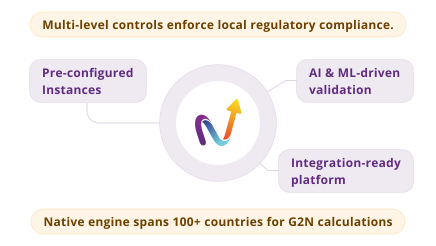
  • G2N Nova: Our advanced gross-to-net payroll engine, available in over 100 countries, integrates with major HCM and Workforce Management systems for a unified global payroll process.

Conclusion

Mercans provides comprehensive Employer of Record (EOR) services in Croatia, ensuring accuracy, compliance, and efficiency in managing your workforce in this EU, Eurozone, and Schengen member state. Our end-to-end solutions simplify payroll and employment processes, making us a trusted partner for businesses navigating the complexities of the Croatian labor market. With Mercans by your side, your expansion into Croatia will be smooth, compliant, and successful, allowing you to focus on growing your business with confidence.

This document was prepared for informational purposes only. As local laws & regulations keeps on changing. Please consult your tax & legal advisors as well.
Contact Sales
Let's get this conversation started. Tell us a bit about your requirement, and we'll get in touch a soon as we can.

    Sample message

    1. We want to expand in $country

    2. We want you to employ 'X' number of employees on our behalf

    3. Contract duration – 3/6/9/12/18/24 months

    4. Number of legal entities (if any exist today)

    5. Employment type: EOR employee or contractor?

    6. Any benefits requirement or “standard statutory only”?

    FAQs

    What is an Employer of Record (EOR) in Croatia?

    An Employer of Record (EOR) in Croatia is a third-party organization that legally employs workers on behalf of another company, handling payroll, pension and health insurance contributions, tax withholding, and compliance with Croatia’s Labour Act, without the client company needing to set up a local entity.

    Can a foreign company hire employees in Croatia without a local entity?

    Yes. By partnering with an EOR such as Mercans, a foreign company can hire employees in Croatia without registering a local branch or subsidiary. The EOR acts as the legal employer, managing contracts, payroll, social security registration, and statutory compliance on the company’s behalf.

    What currency is payroll run in for employees in Croatia?

    Croatia adopted the Euro as its official currency on 1 January 2023, alongside joining the Schengen Area. Payroll is run in Euro (EUR).

    What compliance, payroll, and HR services does an EOR manage in Croatia?

    An EOR manages drafting and executing compliant employment contracts, monthly payroll processing in Euro, pension and health insurance registration, personal income tax withholding, issuing compliant payslips, and administering statutory leave and benefits in line with Croatian labor law.

    How much does an EOR service cost in Croatia?

    EOR pricing varies by provider and the scope of services required, and is typically charged as a flat monthly fee per employee or a percentage of payroll. Mercans provides tailored pricing based on your specific hiring needs in Croatia.

    Is EOR suitable for expanding into Croatia?

    Yes. EOR is well suited to companies testing the Croatian market, hiring a small number of employees, or needing to move quickly without the time and cost of setting up a local entity, particularly given Croatia’s tightening labor market and evolving immigration procedures for non-EU hires.

    Ready to hire in Croatia?

    No local entity needed. Our experts handle payroll, compliance, and onboarding.

    Talk to an expert
    Proven expertise in global payroll.