Employer of Record

Employer of Record (EOR) Hungary

Hire compliantly, pay accurately, expand confidently.

Global Payroll Team
Written by Global Payroll Team
Last updated April 22, 2026
Expert Reviewed

An Employer of Record (EOR) in Hungary serves as the official employer for workers within the country. This role involves overseeing all aspects of employment compliance, including adherence to local labor laws, managing payroll intricacies, ensuring accurate tax filings, handling mandatory benefits, and crafting employment contracts.

Key responsibilities of the Employer of Record (EOR) include:
  • Ensuring strict compliance with Hungary’s employment laws and regulations.
  • Managing the local payroll process with precision and timeliness.
  • Expertly handling the filing of employment-related taxes and necessary documentation.
  • Providing employees with clear and timely payslips.
  • Ensuring prompt distribution of employee salary payments.

Elevate your global expansion strategy with our comprehensive Global PEO services, eliminating the complexities of setting up a legal entity. Our Employer of Record (EOR) in Hungary guarantees compliance, legal presence, and Intellectual Property (IP) protection, allowing your business to concentrate fully on core activities. Streamline global mobility, including managing work visas, while cultivating a diverse and efficient global workforce.

Things you need to know before hiring in Hungary

Employment Contracts in Hungary

At Mercans, we emphasize the crucial elements that must be included in an employment contract in Hungary to ensure compliance and clarity for both employers and employees.

Concept of Employment Contract

The employment relationship in Hungary is established through an employment contract, which serves as the foundation of rights and responsibilities between the employer and the employee. According to law, this contract must outline:

  • The obligation of the employee to perform work under the direction of the employer.
  • The obligation of the employer to provide employment and pay wages.

Mandatory Elements of the Employment Contract

Key components that must be clearly specified in the employment contract include:

  • Employer’s company details and employee’s personal information.
  • Basic salary and job title of the employee.
  • Duration of the probationary period, if applicable.
  • Terms defining the duration of the employment relationship; in the absence of specific terms, the relationship defaults to indefinite.
  • Definition of the workplace; typically, this is where the employee performs their duties unless otherwise agreed.
  • Terms of general full-time employment unless otherwise specified.

Employer Information Requirements

Within the statutory deadline following the commencement of employment, the employer must provide written information accompanying the employment contract. This document should detail:

  • Daily working hours and any deviations.
  • Breakdown of wages including benefits beyond the basic salary.
  • Method and frequency of wage payments.
  • Calculation and allocation of leave entitlements.
  • Notice periods applicable to both employer and employee.
  • Collective agreements and the authority within the employer’s jurisdiction.

Concept of Job Description

The job description forms an integral part of the employment contract, outlining:

  • Work processes, activities, tasks, and functions.
  • Connection systems including objectives, primary responsibilities, and work conditions.

A comprehensive job description ensures clarity regarding the employee’s role and responsibilities within the organization.

Working Hours

In Hungary, full-time employment entails working 40 hours per week, typically spread over 5 days with 8 hours per day unless otherwise arranged lawfully. Variations are common, especially in service sectors like hospitality and retail, where evening shifts or weekend hours are standard for roles such as waiters, shop attendants, and drivers.

To accommodate varying work patterns, employers may apply working time banking in accordance with the Labour Code and any applicable collective agreement. However, daily work hours cannot generally exceed 12 hours, and weekly hours are capped at 48 including overtime.

Part-time employment is also common, offering flexibility with weekly hours ranging below full-time norms. Employers may also hire temporary workers for short-term assignments or keep standby personnel available as needed.

At Mercans, we ensure that employers understand and comply with these regulations, facilitating efficient workforce management tailored to the needs of businesses operating in Hungary.

Probation Period

In the context of Hungarian employment contracts, employers and employees have the option to include a probationary period lasting up to three months from the start of employment. If a shorter probation period is agreed upon initially, it can be extended once by mutual consent. However, under all circumstances, the probation period cannot exceed three months.

The probation period can be specified in both fixed-term and permanent employment contracts, providing a period for both parties to assess the fit and performance expectations. This stipulation must be clearly outlined within the employment contract itself to ensure transparency and mutual understanding.

At Mercans, we ensure that probationary terms are structured to meet legal requirements and serve the best interests of both employers and employees in Hungary.

13th Month Salary

In Hungary, while there is no requirement for a 13th-month salary, employers have the option to provide discretionary bonuses.

Termination, Severance Pay and Notice Period

In Hungary, the termination, severance, and notice period guidelines are established by the Labour Code (Act I of 2012), ensuring a structured approach to employment cessation.

Termination Process

Termination of employment in Hungary can occur through:

  • Termination by Notice (Ordinary Termination): Requires written notice specifying the termination date.
  • Termination for Cause (Immediate Termination): Immediate termination due to serious misconduct, material breach, or other statutory grounds.
  • Mutual Agreement: Both parties agree to terminate the employment.

Severance Pay

Severance pay in Hungary serves as compensation for employees dismissed under specific circumstances outlined in the Labour Code. To qualify, an employee must generally have continuous service of at least three years. Severance pay is calculated based on the employee’s years of service and absence fee, ranging from one month’s pay for 3-5 years to six months’ pay for over 25 years. Exceptions where severance pay is not applicable include termination due to employee conduct or when the employee qualifies as a pensioner under the applicable rules.

Notice Periods

Under Hungarian law, notice periods are determined based on the length of the employee’s service:

  • 0-3 years: 30 days
  • Up to 5 years: 45 days
  • Up to 10 years: 50 days
  • 10-15 years: 55 days
  • 15-18 years: 60 days
  • 18-20 years: 70 days
  • Over 20 years: 90 days

Employers and employees may agree on different notice periods in the employment contract, provided it is not less than 30 days and not more than six months. Exceptions include termination for cause and mutual agreement for immediate termination.

Employees vs Independent Contractors

Here’s a comparison table outlining the distinctions between Independent Contractors and Employment Guidelines in Hungary:

AspectEmployment RelationshipIndependent Contractor
RegulationGoverned primarily by the Labour Code.Usually governed by the Civil Code and the specific civil-law contract used.
Nature of RelationshipA subordinate relationship: the employer directs, organizes, and controls the work.An independent relationship: the contractor decides how to perform the task, subject to the agreed result and contract terms.
Agreement TypeEmployment contract.Typically a service contract or mandate contract under civil law.
Contract DurationUsually indefinite, but fixed-term employment is possible; the maximum total fixed-term duration is generally 5 years, including extensions.Can be fixed-term or indefinite, depending on the contract and the project or service arrangement.
Qualification CriteriaTypical indicators are personal work obligation, subordination, employer control, and integration into the employer’s organization.Typical indicators are independence, control over methods and scheduling, and bearing one’s own business/contractual risk.
Minimum Age RequirementStandard employment generally starts at 16; special youth-work exceptions can apply. A 2026 government agreement also lowered the minimum working age for certain student work to 15.Not governed by labour-law minimum-age rules in the same way; general civil-law legal-capacity rules still apply.
Educational and Other CriteriaDepends on the role; legal, qualification, licence, or language requirements may apply for certain jobs.Usually depends on the contract and the service required; there is generally no universal labour-law qualification rule.
Workplace and EquipmentThe employer typically organizes the workplace and often provides the tools/equipment needed for the job.The contractor typically uses their own tools, resources, and methods, unless the contract provides otherwise.
RemunerationRegular wage or salary paid under payroll rules.Remuneration is based on the contract, often per task, milestone, service period, or invoice. It should not be described generally as “can work without remuneration.”
Tax and Insurance ResponsibilitiesThe employer withholds and pays payroll taxes/contributions and handles employment-related reporting.The contractor is generally responsible for their own tax and contribution position, depending on their status and tax regime.
Benefits and LiabilitiesEmployees are entitled to labour-law protections and statutory benefits under the Labour Code and social-security framework.Contractors are not entitled to employee benefits as such; their rights come from the contract and the Civil Code.
Compensation upon TerminationMay include employment-law entitlements such as notice-related rights and, where conditions are met, severance and payment for unused leave.Termination compensation depends on the contract and civil-law rules, not on employment-law severance rules.

This table highlights the key differences between an employment relationship and a mandate agreement (independent contractor) in Hungary, covering regulatory aspects, contractual terms, qualification criteria, and obligations regarding taxes, benefits, and termination compensation.

Social Security in Hungary

Social Security in Hungary is a comprehensive system designed to provide financial protection and support to individuals in various stages of life, ensuring a safety net for both employees and self-employed individuals. Managed by the Hungarian government, the system encompasses a range of benefits and services aimed at promoting social welfare and economic stability.

Key components of Hungary’s Social Security system include contributions towards pension schemes, health insurance, and various other social assistance programs. These contributions are mandatory for both employees and employers, with rates and regulations governed by Hungarian legislation.

The Social Security framework in Hungary plays a crucial role in safeguarding the well-being of its workforce, offering security during periods of employment, retirement, illness, disability, and certain other situations. Understanding and complying with these regulations are essential for businesses and individuals operating within Hungary, ensuring access to necessary benefits and maintaining legal compliance with national social policies.

Employee Social Security Contributions

Social security contributions in Hungary play a pivotal role in the country’s welfare system, ensuring financial support and access to essential benefits for both employees and self-employed individuals.

Employers are required to pay employment-related taxes and social security contributions, known as social contribution tax. This tax is calculated based on the applicable tax base, with a fixed rate of 13%.

Social Security Contribution Rates and Calculation

In Hungary, social security contributions are based on the gross income paid to employees. As of 2026, employers are obligated to contribute at a rate of 13%, known as the social contribution tax. Employees themselves contribute 18.5% of their gross income towards social security.

Minimum Wage Requirements

Effective from 1 January 2026, the minimum wage stands at HUF 322,800 per month. For roles requiring at least secondary education or vocational qualification, the guaranteed wage minimum is HUF 373,200 per month. Employers based in Hungary are responsible for making required payments and electronically filing monthly declarations. Similarly, non-Hungarian employers operating in Hungary may also have Hungarian compliance obligations depending on the facts of the employment.

Healthcare Contribution and Responsibilities

Individuals who are not otherwise insured may need to pay a healthcare service contribution under the applicable rules in order to remain entitled to healthcare services. The exact amount should be checked for the current year when needed.

Social Tax Allowances

Employers may apply certain social contribution tax allowances where the legal conditions are met. These are intended to alleviate employment costs for categories such as jobseekers, mothers with young children, individuals with reduced work capacity, and certain researchers. The eligibility and amount of these allowances hinge on the employee’s situation.

Social Security Contributions for Foreign Nationals

Determining the applicability of Hungarian social security contributions to foreign nationals necessitates careful review of both local regulations and international agreements. Generally, foreign nationals may be subject to Hungarian social charges where Hungarian social security legislation applies, unless EU coordination rules or an applicable social security treaty provide otherwise.

Payroll in Hungary

Minimum Wages

The minimum wage rates in Hungary, effective from 1 January 2026, are as follows:

Minimum Wage:

  • Per Hour: HUF 2,145.00
  • Per Day: HUF 17,160.00
  • Per Week: HUF 85,800.00
  • Per Month: HUF 322,800.00

Minimum Wage for Professional Workers:

  • Per Hour: HUF 2,481.00
  • Per Day: HUF 19,850.00
  • Per Week: HUF 99,300.00
  • Per Month: HUF 373,200.00

These amounts are denominated in Hungarian Forint (HUF) and are applicable before tax deductions.

Payroll Cycle

Employees in Hungary receive their payments on a monthly basis, typically by the 10th day of the following month, covering work performed from the first to the last day of the previous month unless a more favorable pay date is agreed.

Overtime Pay

Overtime in Hungary refers to extraordinary working time performed beyond scheduled working hours or beyond the working time frame.

Employees can be required to work overtime, but mandatory rest periods must be observed.

The maximum annual overtime limit is typically 250 hours, which can increase to 300 hours with a collective agreement or up to 400 hours where the legal conditions for voluntary overtime are met.

Overtime pay generally includes a 50% surcharge on regular working days.

On weekly rest days and public holidays, employees are generally entitled to either a 100% wage supplement or compensatory time off with the applicable supplement under the Labour Code.

Mercans’ payroll capabilities

Payroll Cycle

  • Pay employees and contractors in the local currency: Experience the efficiency of Mercans’ payroll services in Hungary, ensuring timely and accurate payments to both employees and contractors in Hungarian Forint (HUF).
  • Payroll Setup, Payroll Processing, and Payroll Administration: Mercans offers comprehensive payroll solutions tailored for Hungary. From meticulous setup of payroll systems to precise processing and efficient administration, we handle every step with a commitment to accuracy and compliance.
  • Statutory Filings and Payments: Navigate Hungary’s regulatory landscape seamlessly with Mercans. Our dedicated team manages statutory filings and payments, ensuring your business remains compliant with all legal requirements. Trust Mercans for accurate and timely submissions, providing peace of mind in meeting your statutory obligations.
  • Payroll Processing Schedule: In Hungary, payroll is typically processed monthly. The specific pay date is stipulated in individual employment contracts, with payments to employees and contractors due no later than the 10th day of the month following the respective pay period.

Personal Income Tax in Hungary

Hungarian personal income tax (PIT) applies to both domestic and foreign income received by residents.

  • Taxes on Personal Income: PIT covers domestic-source income earned within Hungary and foreign-source income for residents.
  • Personal Income Tax (PIT) Rate: The standard rate is 15% of taxable gross income.
  • Residence: Tax residency is determined under Hungarian tax law and treaty rules, not solely by a single 183-day rule.
  • Deductions: Various tax base allowances and tax reliefs may apply, including family-related and age-based allowances where the legal conditions are met.
  • Tax Administration: Managed by the Hungarian Tax and Customs Administration (NAV).

Hungary Employee Hiring Cost

Employing staff in Hungary involves understanding both the direct salary paid to employees and the additional employer costs mandated by local regulations. Here’s a detailed example to illustrate the total costs:

Salary Details:

  • Gross Annual Salary: HUF 1,000,000.00

Annual Employer Costs:

  • Social Contribution Tax: HUF 130,000.00

Total Annual Cost:

  • Total Cost to Employer: HUF 1,130,000.00

Explanation: In Hungary, the cost of hiring includes more than just the employee’s gross salary. Employers are required to contribute social contribution tax and may also incur other employment-related costs depending on the facts. These costs ensure that employees receive social benefits and contribute to the overall employment framework.

Breakdown of Costs:

Breakdown of CostsAmount
Gross annual salaryHUF 1,000,000.00
Social contribution tax (13%)HUF 130,000.00
Annual employer costsHUF 130,000.00
Total annual costHUF 1,130,000.00

The Gross Annual Salary represents the amount paid directly to the employee before any deductions. Employers also incur additional costs, such as the Social Contribution Tax, which together form the total annual employer costs.

Employee Benefits in Hungary

Hungary’s pension system is now centered primarily on the state pension system, while voluntary retirement savings vehicles continue to exist alongside it. Employers may also offer supplementary benefits in addition to statutory entitlements.

Types of Pension:

  • State Pension System: The main statutory pension framework.
  • Voluntary Pension Savings: Voluntary private retirement savings remain available.
  • Other Supplementary Savings Options: Additional savings products may be offered depending on employer policy and individual choice.

Retirement Age

The retirement age in Hungary is 65.

Legislated Leaves

Employees are entitled to statutory paid annual leave and additional leave based on age and specific conditions. Additional paid leave is also provided for parental responsibilities and certain other situations defined by law.

Healthcare Benefits

Healthcare benefits include maternity and paternity related protections, health insurance coverage under the social security system, and family-related allowances where the legal conditions are met.

Cafeteria System

Employers may offer tax-favored or otherwise structured fringe benefits through a cafeteria system, including SZÉP card benefits and certain other items subject to the current tax rules.

Supplementary Employee Benefits

Additional benefits such as voluntary retirement pension insurance, private healthcare and medical insurance, and group life, accident, and health insurance are common offerings by employers. These benefits may include preventive screenings, outpatient services, and coverage for accidents and critical illnesses.

Taxation of Benefits

Most employee benefits are taxable unless a specific exemption or preferential tax treatment applies. The applicable tax treatment depends on the type of benefit provided.

Employee Perks

Sports passes, wellness programs, and other perks are popular employer offerings, though their tax treatment depends on how they are structured.

Work Permit in Hungary

Employment of EEA Nationals

Citizens of EEA countries and Switzerland can generally work in Hungary without a work permit, subject to the applicable registration and residence rules.

Third-Country Nationals

Third-country nationals generally need the appropriate immigration status to work in Hungary. Under the current framework, this is usually handled through the relevant residence permit for employment, such as a residence permit for employment, guest worker status, or another applicable permit category depending on the case. The exact route depends on the nationality, job role, employer, and intended duration of stay.

For short-term employment, longer-term employment, or specific categories of foreign nationals, different rules and exemptions may apply. Employers should review the current immigration framework before hiring.

Self-Employment

Citizens of EEA countries have the right to be self-employed in Hungary without needing a work permit, subject to the applicable business and residence rules.

Posted Workers

Posted workers from EEA states can work in Hungary under cross-border service provisions, subject to the applicable notification and posting requirements. Compliance with Hungarian labor standards for posted workers must also be observed where relevant.

Contact Mercans for Global Mobility Assistance

Navigating the complexities of work permits and global mobility can be challenging. Mercans is here to assist with obtaining the appropriate work authorization for foreign employees, ensuring compliance with local regulations, and facilitating smooth transitions for your workforce. Reach out to us today to learn how we can support your global mobility needs.

EOR Solutions in Hungary

Mercans offers comprehensive Employer of Record (EOR) solutions tailored specifically for businesses entering the Hungarian market. Our services span the entire employee lifecycle, ensuring strict adherence to Hungary’s labor laws and regulations.

  • EOR and Recruitment Services: For organizations requiring assistance in talent acquisition, our EOR and recruitment services provide an integrated solution. Leveraging our extensive network and expertise, we support sourcing, onboarding, and retaining top talent, facilitating your market entry into Hungary.
  • Visa Sponsorship and Global Mobility: Simplify the complexities of expatriate employment with our visa sponsorship and global mobility services. We manage the relocation of your international workforce, ensuring full compliance with Hungarian immigration and employment regulations.
  • AOR for Contractor Payments: Our Assistance on Record (AOR) services are designed to effectively manage contractor payments. We handle the intricacies of contractor payroll, ensuring precision and compliance with local laws.
  • Freelancer to Employee Conversion: Mercans facilitates the transition from freelance status to full-time employment in Hungary. Our expertise ensures a seamless conversion process while meeting all legal requirements.
  • HCM Integration: Integrate Mercans’ EOR services seamlessly with your Human Capital Management (HCM) system in Hungary. This integration enables real-time data exchange, enhances compliance, and improves operational efficiency. Trust our expertise for unified and compliant workforce management, enhancing your payroll operations.

Best Employer of Record Hungary

Mercans Stands Out as the Leading Employer of Record in Hungary for the Following Reasons:

  • Regulatory Compliance: Mercans ensures full compliance with all regulations set by the relevant Hungarian labor, tax, and immigration authorities. It strictly adheres to Hungary’s employment laws and standards, guaranteeing full legal compliance.
  • Independent Operation: Operating as a distinct entity, Mercans offers reliable and customised employment services tailored to the unique needs of businesses in Hungary.
  • Diverse Employment Support: Mercans efficiently manages various forms of employment, including employees, freelancers, contractors, and expatriates, providing flexible solutions to meet a wide range of workforce needs.
  • Enterprise-Focused Solutions: Specifically designed to cater to large enterprises, Mercans delivers scalable and sophisticated services that accommodate complex organisational structures.
  • Multi-Currency Payroll Management: Mercans facilitates payroll processing in multiple currencies, ensuring seamless financial operations for businesses operating in Hungary and internationally.
  • Global Reach and Payroll Expertise: With a robust international presence, Mercans excels in managing multi-country payroll, enabling smooth operations across borders.
  • Data Protection and Compliance: Mercans adheres to rigorous data protection standards, including GDPR compliance and SOC 1 & SOC 2 certifications, ensuring the highest levels of data security.
  • ISO Certifications: Mercans holds ISO 20000 and ISO 27001 certifications, reflecting its commitment to excellence in IT service management and information security.
  • Security Standards Compliance: Mercans meets the OWASP ASVS 3.0 standards, ensuring strong security practices in application development and management.
  • HR Blizz Platform: The proprietary HR Blizz platform is a global payroll and talent management SaaS suite that streamlines payroll processes while ensuring compliance with Hungarian regulations. With over 1,000 local experts, it provides in-depth knowledge of employment laws and business practices.
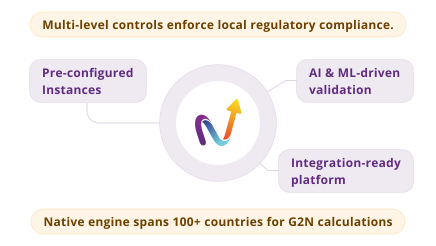
  • G2N Nova Payroll Engine: G2N Nova offers global gross-to-net payroll processing across more than 100 countries, making it one of the most advanced payroll engines available. It can be deployed as a SaaS solution or integrated seamlessly with major Human Capital Management and Workforce Management systems.

Conclusion

Opting for Employer of Record (EOR) solutions in Hungary offers a streamlined approach to managing an international workforce, ensuring compliance with local regulations and seamless operations. Our comprehensive services cover legal, payroll, and HR functions, allowing businesses to confidently expand into Hungary’s market with flexibility and efficiency. EOR solutions provide a strategic and hassle-free approach for companies seeking success in Hungary’s competitive business landscape.

This document was prepared for informational purposes only. As local laws & regulations keeps on changing. Please consult your tax & legal advisors as well.
Contact Sales
Let's get this conversation started. Tell us a bit about your requirement, and we'll get in touch a soon as we can.

    FAQs

    What is an Employer of Record (EOR) in Hungary?

    An Employer of Record (EOR) in Hungary is a third-party service provider that legally employs workers on behalf of another company. The EOR manages all employment-related responsibilities, including contracts, payroll, taxes, benefits, and compliance with Hungarian labor laws, enabling businesses to hire employees without establishing a local entity.

    How can foreign companies hire employees in Hungary without establishing a local entity?

    Foreign companies can engage an EOR to hire employees in Hungary. The EOR assumes the legal employer role, handling all statutory obligations, while the client company manages the employee’s daily tasks. This approach allows businesses to operate in Hungary without the need for a local branch or subsidiary.

    What compliance, payroll, and HR services does an EOR in Hungary manage?

    An EOR in Hungary ensures compliance with local labor laws by managing employment contracts, processing payroll, withholding and remitting taxes, making statutory contributions, administering mandatory benefits, and completing statutory filings. They also handle work permits and visa sponsorship for expatriate employees.

    What are the advantages of using EOR services in Hungary?

    Utilizing an EOR in Hungary offers several advantages: it simplifies market entry by eliminating the need for a local entity, ensures compliance with complex labor laws, reduces administrative burdens, mitigates legal risks, and accelerates the hiring process.

    How much does it cost to hire employees through an EOR in Hungary?

    The cost of hiring through an EOR in Hungary varies depending on the provider and the services included. Generally, fees can range from $500 to $2,000 per employee per month. It’s advisable to consult with the EOR provider for a detailed pricing structure.

    Is an EOR the best solution for expanding a business into Hungary?

    An EOR is an effective solution for businesses looking to expand into Hungary without the complexities of setting up a local entity. It provides a compliant and efficient way to hire employees, allowing companies to focus on their core operations while the EOR manages employment-related tasks.

    Ready to hire in Hungary?

    No local entity needed. Our experts handle payroll, compliance, and onboarding.

    Talk to an expert
    Proven expertise in global payroll.