Employer of Record

Employer of Record (EOR) in Italy

Hire compliantly, pay accurately, expand confidently.

Global Payroll Team
Written by Global Payroll Team
Last updated April 24, 2026
Expert Reviewed

An Employer of Record is the legal employer of a worker in Italy. Often referred to as a Global Professional Employer Organization (Global PEO), this role involves comprehensive management of employment responsibilities, ensuring full compliance with Italy’s labor laws and regulations.

The responsibilities of the Employer of Record (EOR) in Italy include:
  • Ensuring compliance with local employment regulations.
  • Managing payroll operations in accordance with Italian laws.
  • Handling the filing of employment taxes and essential documentation.
  • Issuing accurate payslips to employees.
  • Ensuring timely salary payments to workers.

Streamline your global expansion with our Global PEO services in Italy, offering a hassle-free solution without the need to establish a local entity. As your Employer of Record (EOR) in Italy, we ensure legal compliance, establish a local presence, and protect your intellectual property, allowing you to focus on your core business activities. Experience a smooth global mobility process, including work visas, while building a diverse and skilled workforce.

Things you need to know before hiring in Italy

Employment Contracts in Italy

Employment contracts in Italy are a cornerstone of the employer-employee relationship, shaped by a well-defined legal framework that prioritizes worker rights and benefits. Italian labor laws require employers to provide information on the essential terms of employment, including job duties, compensation, working hours, and other key conditions, while collective bargaining agreements in many industries continue to play a central role. Understanding these contractual requirements is essential for both employers and employees, as compliance supports fair practices and a secure working environment.

Dependent Employment Relationship (Legislative Decree No. 81/2015)

In Italy, the subordinate employment relationship is characterized by the employee’s obligation to work under the direction of an employer in exchange for remuneration. This relationship is governed by Legislative Decree no. 81/2015, which outlines various forms of employment:

Permanent Employment Relationship

This is the most stable employment form, characterized by its indefinite duration. It can only be terminated in accordance with Italian dismissal rules, including justified reason or just cause where applicable.

Fixed-term Employment Contract

This type of contract may generally last up to 12 months without specific justification and may extend to a maximum overall duration of 24 months where the conditions set by law or applicable collective agreements are met, such as:

  • Temporary and objective needs unrelated to regular business activities.
  • Replacement of absent employees.
  • Specific needs identified by the applicable collective agreement.
Part-time Work
Employees may also work part-time under either a permanent or fixed-term contract. Part-time arrangements can be:

Horizontally: Working fewer hours each day.

Vertically: Working full-time only on certain days.

Mixed: A combination of both approaches.

Apprenticeship Training
This is a subordinate contract aimed at training young individuals, divided into three types:

For professional qualifications and diplomas for ages 15-25.

Professional apprenticeships for ages 18-29.

Further education and research training for higher qualifications for ages 18-29.

Intermittent Employment Contract

This fixed-term or open-ended contract allows employees to work on an intermittent basis as per the employer’s needs, subject to legal and collective agreement requirements. It is commonly used for activities identified by law or collective agreements and can also be used with individuals under 24, provided the work is performed before the age of 25, or over 55. Statutory limits on the number of days worked may apply.

Temporary Employment Contract

This involves a tripartite relationship where an authorized agency (employment agency), a company (user), and the employee (temporary worker) are involved. It includes both a commercial supply agreement and an employment contract.

Semi-Subordinate Employment

Parasubordinated work represents a hybrid employment model situated between subordinate employment and self-employment. This type of work allows for continuous collaboration that is coordinated with the employer’s organizational structure but does not establish a direct subordinate relationship. It enables flexibility while still ensuring some level of integration within the employer’s operations.

Independent Work

Self-employed individuals operate independently, providing services to clients without entering into a subordinate relationship. The primary types of self-employment in Italy include:

  • Employment Contracts with VAT Number: This arrangement applies to professionals who issue invoices for their services.
  • Occasional Service Contracts: These are limited engagements for genuinely autonomous occasional work. While the €5,000 threshold is often relevant for social security purposes, it is not a general legal ceiling that automatically defines whether a relationship is validly occasional.

Conditions and Provisions of Individual Employment Contracts According to Italian Law (Contratto di Lavoro in Italia)

The individual employment contract in Italy, as defined under Article 2094 of the Civil Code, entails the employee’s commitment to work under the employer’s supervision for remuneration. For a contract to be valid, the following elements must be present:

  • Consent of the Parties: Both employer and employee must have the legal capacity to enter the agreement, typically attained at the minimum working age permitted by law. The consent must be free from error, coercion, or fraud.
  • Lawful Purpose: The purpose of the contract must be legal and adhere to public policy and morality.
  • Description of Activity: The contract must clearly outline the job description, ensuring that it is:
    • Lawful: Complying with existing laws.
    • Possible: Feasible based on the employee’s qualifications.
    • Determined or Determinable: Clearly defined or able to be defined by reference to collective agreements.
  • Favorable Conditions: The contractual conditions must not be less favorable than those stipulated in national collective agreements (Contratti Collettivi Nazionali di Lavoro, CCNL).

Italian Employment Contract Concludes

Typically, prior to formal employment, the employer issues a hiring letter or written employment document that sets out the principal terms of the relationship. This should include crucial information such as:

  • Identification of the parties involved.
  • Job location and start date.
  • Job classification and description.
  • Details on the probationary period, salary, holidays, working hours, and notice periods.

While a written contract is strongly recommended to ensure clarity, Italian employers are in any case required to provide written information on the essential elements of the employment relationship.

The Collective Labor Agreement (CCNL) and Its Impact on Employees, Regardless of Union Membership

In Italy, the CCNL serves as a key instrument regulating employment conditions. While primarily negotiated between employer associations and trade unions, case law and employment practice often use the CCNL as a benchmark for fair and sufficient remuneration under Article 36 of the Constitution. This means employers commonly rely on the applicable CCNL to set minimum standards on pay, classification, notice, leave, and other employment terms.

Working Hours

The standard working time is established at 40 hours per week. However, collective labor agreements may specify a shorter duration and can link normal working time to average hours worked over a reference period, subject to statutory limits.

Probation Period

In Italy, the duration of the probation period is generally determined by the applicable CCNL and the employee’s classification. It is usually shorter for non-executive roles and longer for executives, provided the probation clause is agreed in writing.

13th Month Salary

In Italy, the 13th-month salary is a standard entitlement under many national collective bargaining agreements, representing a significant benefit offered by numerous employers. This additional payment, known as the tredicesima, is typically disbursed around the Christmas holidays and generally equates to one extra monthly salary at the end of the year.

The amount of the tredicesima is usually calculated based on the employee’s accrued entitlement during the year. A common formula is:

Tredicesima = Gross monthly salary x Number of months worked ÷ 12

Termination, Severance Pay, and Notice Period

Severance Pay

According to Section 2120 of the Italian Civil Code, employees are entitled to receive a severance indemnity, known as Trattamento di Fine Rapporto (TFR), upon termination of their employment, regardless of the reason for the termination. The annual TFR accrual is generally calculated by taking the employee’s yearly remuneration and dividing it by 13.5, subject to the applicable revaluation rules.

Notice Period for Redundancy

The notice period an employer must provide before terminating an employment relationship is generally determined by the applicable collective bargaining agreement (CCNL), the employee’s classification, and length of service. Notice periods are therefore not uniform across all employers in Italy and should always be checked against the relevant CCNL.

For employees with up to 5 years of seniority:

  • Notice periods vary according to the applicable CCNL and employee level.

For employees with over 5 years and up to 10 years of seniority:

  • Notice periods vary according to the applicable CCNL and employee level.

For employees with more than 10 years of seniority:

  • Notice periods vary according to the applicable CCNL and employee level.

Overtime Pay

Employers are required to compensate employees for any overtime hours worked, as specified in the employment contract and the applicable collective bargaining agreement (CCNL). Overtime premiums are usually set by the relevant CCNL and can vary depending on whether the overtime is performed during daytime, nighttime, weekends, or holidays. In general, overtime is subject to statutory and collective agreement limits.

Employees vs Independent Contractors

In Italy, the distinction between employees and contractors is crucial for understanding workers’ rights, obligations, and benefits. While both groups contribute to the workforce, their working conditions, relationships with employers, and legal entitlements differ significantly. This overview aims to clarify these differences by comparing key aspects of employees and contractors in Italy, enabling better insights into the implications of each classification.

Aspect Contractors Employees
Level of control Generally more autonomy in how the work is performed; if the client organizes the work in a personal, continuous and client-directed way, the relationship may be treated as employment Employer has managerial, organizational and disciplinary power over how work is performed
Equipment ownership Often use and organize their own tools and equipment, though this is not decisive on its own Often use tools and equipment provided or organized by the employer
Integration Normally less integrated into the client’s organization; works independently for a task, project or professional activity Typically integrated into the employer’s organization and business structure
Benefits entitlement No general entitlement to employee protections such as paid leave, dismissal protection, or standard employee benefits; protections depend on the specific contractor category Entitled to statutory employment protections and applicable contractual rights, such as paid leave and other employee safeguards
Engagement duration May be project-based, recurring, or open-ended depending on the contract; duration alone does not determine status Can be fixed-term or indefinite; indefinite employment is common but not required for employee status
Risk of loss Normally bears own business/professional risk and is responsible for the economic organization of the activity Does not normally bear the business risk of the enterprise
Service exclusivity May work for multiple clients unless the contract restricts it May work exclusively or non-exclusively depending on contract and duty-of-loyalty rules; exclusivity is not automatic in every case

Social Security in Italy

Social security in Italy is a comprehensive system designed to provide financial protection to individuals against various life risks such as unemployment, illness, disability, and retirement. The Italian social security system is primarily governed by the National Social Security Institute (Istituto Nazionale della Previdenza Sociale – INPS), which oversees the collection of contributions and distribution of benefits.

Structure of the Social Security System

Mandatory Contributions

  • Social security contributions are compulsory for both employees and self-employed individuals. These contributions ensure that workers are insured against events that could prevent them from performing their work, such as illness, disability, maternity, unemployment, or retirement.
  • Contributions are paid periodically and can be deducted from salaries for employees, while self-employed individuals must manage their own payments in accordance with the rules of the relevant scheme.

Contribution Allocation

  • For employed workers, the employer pays a significant portion of the social security contributions, while the employee contributes a smaller portion through payroll withholding. The exact split depends on sector, qualification, and the applicable insurance scheme.
  • Self-employed workers are responsible for paying their contributions directly to INPS or to the relevant professional fund, based on their income and status.

Benefits Provided

The contributions collected fund a variety of benefits, including:

  • Pensions: Social security contributions play a crucial role in providing retirement benefits, calculated based on the total contributions made over an individual’s working life.
  • Sick Leave and Maternity Pay: Workers are entitled to benefits during periods of illness or maternity leave, subject to the applicable rules.
  • Unemployment Benefits: The system provides financial assistance to eligible individuals who lose their jobs.

Contribution Calculation

The amount of social security contributions is determined by several factors, including:

  • Type of Employment: Employees and self-employed individuals have different contribution rates. For standard subordinate employment, the overall contribution cost is often around 30% to 40% of gross salary when employer and employee portions are combined, but actual rates vary by sector, company classification, and employee status.
  • Minimum Wage Regulations: Contributions cannot be lower than those calculated on the minimum contributory earnings set annually by INPS, ensuring that all workers receive a fair level of coverage.

Payment Deadlines

  • For Employees: Employers must remit social security contributions by the 16th of the month following the pay period. This ensures timely payments and avoids penalties for late contributions.
  • For Self-Employed Workers: Payments are made directly by the workers, with deadlines depending on the applicable contribution regime.

Importance of Supplementary Pensions

Given the evolving nature of public pensions and the increasing focus on long-term retirement planning, many workers are encouraged to consider supplementary pension options. These additional plans can help bridge the gap between expected retirement income and actual living expenses, ensuring greater financial stability in retirement.

Payroll in Italy

Italy has a comprehensive regulatory framework governing employment, payroll, social security, and benefits. This framework ensures compliance with national laws and protects the rights of employees while providing businesses with clear guidelines on their obligations. Below is an overview of the key requirements and processes involved.

Government Requirements

Registration Requirements

Chamber of Commerce and Tax Office
  • Businesses carrying out commercial, industrial, or other relevant activities in Italy generally need to complete the appropriate registrations with the competent authorities, including the Chamber of Commerce and the Italian tax authorities, in order to obtain the necessary tax positions, such as a VAT number where applicable.
  • Failure to register, or late registration, may lead to penalties.
Social Security Authority (INPS)
  • Companies planning to hire employees must register with the Istituto Nazionale della Previdenza Sociale (INPS) to obtain the relevant employer position. This enables INPS to track the company’s social security contributions for employees.
  • Different contribution rates apply based on the company’s sector and employee classification.
Labor Office (Centro per l’Impiego)
Companies must also use the mandatory communications system for submitting notifications related to employee hiring, variation, and termination.
Mandatory Notifications
  • Hiring Notifications: Must be submitted electronically through the mandatory communications system by the day before employment begins, except in limited urgent cases.
  • Termination Notifications: Must be submitted electronically within five days after the end of employment. Late notifications can incur penalties.
Insurance Against Workplace Injuries (INAIL)
  • Before commencing work activities with employees, companies must register with INAIL for insurance against workplace injuries and occupational diseases where applicable.
  • Companies are assigned a specific risk classification and contribution rate based on the type of activities performed.
  • Both late registration and late payment of premiums result in penalties.

Ongoing Compliance Requirements

Payment of Withholding Taxes
  • Employers are responsible for withholding income taxes from employees’ salaries on a monthly basis, calculated according to the applicable income tax brackets.
  • Regional and municipal taxes are also applicable based on the employee’s residence. The tax treatment of benefits in kind can change from year to year and should be verified against the current tax rules and budget law.
Annual Income Certification
  • At the end of the fiscal year or upon employment termination, employers must calculate the balance of taxes owed based on actual income paid. Any overpayments may be refunded or underpayments withheld through payroll, where applicable.
  • By 16 March of the following year, employers must issue the “Certificazione Unica” (CU), detailing income paid, taxes withheld, benefits in kind, and severance indemnity.
Annual Statement of Tax Withheld (770 Form)
Withholding tax agents must electronically submit the 770 form, detailing taxes withheld and paid on behalf of employees, typically by the statutory deadline set each year. Late submissions incur penalties.
Payment of Monthly Social Security Contributions
Employers must pay social security contributions to INPS monthly using the F24 form. Employee contributions are withheld through payroll, while employer contributions vary by sector and employee status. Late payments result in penalties.

Pension Requirements

Registration with Integrative Health Funds
Companies and employees can opt to register with integrative health funds, which supplement the national healthcare system. These can be open or closed depending on the fund and the applicable CCNL.
Registration with Integrative Pension Funds
Similar to health funds, integrative pension funds provide additional retirement benefits. Registration follows the regulations of the applicable CCNL or fund rules.
Ongoing Compliance for Pension Contributions
Contributions to health and pension funds are deducted through payroll, with payment schedules varying by fund regulations.

Employment Obligations

Minimum Salaries
National Collective Labor Agreements (CCNLs) establish minimum salaries based on employee rank and classification. Italy does not currently have a single statutory national minimum wage applicable across all sectors, so employers must comply with the relevant CCNL.
Severance Indemnity (TFR)
The Trattamento di Fine Rapporto (TFR) is a severance payment accrued over time and paid out upon termination of employment. It is generally calculated by taking the annual remuneration and dividing it by 13.5, subject to revaluation rules.
Mandatory Hiring of Disabled People
Companies with 15 or more employees are subject to mandatory hiring obligations under the disability employment rules, with the quota depending on the size of the workforce.
Gender Equality Report
Companies with more than 50 employees must submit the biennial report on the situation of male and female personnel. For the 2024-2025 reporting period, the filing deadline is 30 April 2026.
Declaration of Regular Contributive Position (DURC)
Companies must maintain a DURC certificate, proving compliance with social security and insurance contribution obligations, to be eligible for certain subsidies and contracts.

Payroll Requirements

  • Monthly Payroll Processing: Payroll is generally processed monthly, with employees often receiving their salaries in 13 or 14 installments, depending on the applicable CCNL. The payment date depends on company practice and collective agreement rules.
  • Pay Slips: Employees must receive payslips on the same day as salary payments, and electronic delivery is generally accepted where properly managed.

Banking Requirements Related to Payroll

Salary Payment Methods

  • Net salaries are generally paid through traceable methods such as bank transfer or other permitted payment instruments. Cash salary payments are generally prohibited.
  • An Italian bank account is commonly required for paying taxes and social security contributions.

Personal Income Tax in Italy

The Personal Income Tax (PIT), known as Imposta sui redditi delle persone fisiche (IRPEF) in Italian, is a key component of the Italian tax system. It is levied on the income of individuals, encompassing various sources of income, and is characterized by a progressive tax rate structure.

Tax Structure

Tax Rates

The PIT is applied at progressive rates, meaning that higher income levels are taxed at higher rates. For the fiscal year 2026, the rates are as follows:

  • 0 to 28,000 EUR: 23%
  • 28,001 to 50,000 EUR: 33%
  • Over 50,000 EUR: 43%

Calculation of Taxable Income:

Taxable income includes various types of income, such as:

  • Employment income
  • Business income
  • Income from property (e.g., rental income)
  • Capital gains
  • Foreign income (for tax residents)

Tax Residents vs. Non-Tax Residents:

  • Tax Residents: Individuals who are tax resident in Italy are generally taxed on their worldwide income.
  • Non-Tax Residents: Individuals who are not tax resident in Italy are generally taxed only on income sourced in Italy.

Additional Tax Considerations

Wealth Tax
Tax residents may also be subject to taxes on foreign real estate and certain foreign financial assets, together with related reporting obligations in the Italian tax return.
Tax Regime for Neo-Domiciled Individuals
Individuals transferring their tax residency to Italy may opt for the substitute tax regime for certain foreign income, subject to the applicable conditions. The standard annual substitute tax remains €200,000, while qualifying family members may opt in separately at the reduced amount provided by law.
Additional Tax on Variable Compensation
Variable compensation for executives in the financial sector may be subject to specific tax rules. The applicable treatment should be reviewed in light of the current legislation and facts of the case.
Productivity Bonus
A productivity bonus paid to employees can benefit from a reduced substitute tax where the statutory conditions are met. For 2026, the substitute tax remains 5% on qualifying bonuses within the legal cap and income threshold set by current law.

Regional and Municipal Income Taxes

In addition to the national income tax, individuals are also subject to:

  • Regional Income Tax: Rates vary by region of residence and applicable local rules.
  • Municipal Income Tax: Rates vary by municipality, with local authorities able to set their own rates within legal limits.

Filing Requirements

  • Tax residents must file an Italian tax return annually where required, declaring all relevant sources of income, both domestic and foreign.
  • Non-residents are generally only required to report income sourced in Italy when filing is required.

Employee Benefits in Italy

Italy, with its complex labor laws and diverse workforce, offers a variety of employee benefits that are essential for attracting and retaining talent. At Mercans, we understand the importance of navigating the intricacies of employee benefits in Italy, which can vary based on sector, employee demographics, and regional regulations. Here’s a comprehensive overview of the employee benefits landscape in Italy.

Mandatory Employee Benefits

In Italy, certain benefits are mandated by law and are applicable to all employees. These include:

National Health System (Servizio Sanitario Nazionale – SSN)

Employees and residents with access rights under Italian law are entitled to healthcare services funded through the national system.

Pension Contributions

Employees are required to make pension contributions that can differ by profession or activity type. These contributions support the national pension system and are shared between employers and employees.

Workplace Accident Insurance

Employees must be covered by state-mandated insurance for workplace accidents, managed by the Istituto Nazionale per l’Assicurazione contro gli Infortuni sul Lavoro (INAIL).

Sickness Benefits

Employees are entitled to sickness protections, but the employer and INPS treatment can vary depending on the worker category and the applicable collective agreement. The specific pay percentages and waiting days should therefore be checked against the relevant rules and CCNL.

Sector-Specific Requirements

Individual labor contracts in specific sectors may impose additional mandatory benefits, such as specialized insurance coverage.

Supplementary Employee Benefits

In addition to mandatory benefits, many employers in Italy provide supplementary benefits, often guided by collective labor agreements specific to their industry. These benefits enhance employee satisfaction and contribute to a competitive employment package.

Key Sectors Influencing Employee Benefits

  • Manufacturing: Includes sectors like pharmaceuticals.
  • Commerce: Encompasses technical services and IT.

Employee Groups Impacting Benefit Design

  • Executives
  • Middle Managers
  • Employees
  • Blue-Collar Workers

Sector-Specific Benefits

Executives

Industrial Sector
  • Life Insurance: Coverage levels depend on the applicable executive collective agreement and insurance arrangement.
  • Personal Accident Insurance: Coverage is often required or market standard for executives, with levels depending on the applicable arrangements.
  • Medical Insurance: Enrollment in the FASI fund commonly applies for qualifying executives in the industrial sector.
  • Retirement Plans: Employers with over 50 employees must manage TFR in accordance with the applicable legal rules, including transfer to the Treasury Fund or pension fund where required.
Commerce Sector
  • Life Insurance: Amounts vary based on the applicable collective agreement and policy terms.
  • Medical Insurance: Enrollment in the FASDAC fund commonly applies for qualifying executives in the commerce sector.
  • Retirement Plans: Contribution obligations depend on the applicable executive agreement and pension arrangements.

Middle Managers, Employees, and Blue-Collar Workers

  • In both sectors, mandatory benefit requirements depend heavily on law and the applicable CCNL. Pension and TFR obligations continue to apply where required.

Importance of Collective Agreements

Collective labor agreements are crucial in defining employee benefits across various sectors in Italy. These agreements ensure that employees receive fair treatment and adequate compensation tailored to their specific roles and industries. Employers must stay informed about the relevant agreements affecting their workforce to ensure compliance and competitiveness in the labor market.

Work Permit in Italy

If your company is expanding its operations into Italy, understanding the work permit process is essential for successfully relocating employees or hiring new talent. Italy has specific requirements and regulations that must be adhered to for foreign workers to legally live and work in the country.

Types of Work Permits

In Italy, non-EU nationals generally require prior work authorization, typically through a Nulla Osta al lavoro, together with the appropriate work visa and residence permit, unless they qualify for a specific exemption. Citizens of EU, EEA, and Swiss states can generally work in Italy without a work permit.

Requirements for a Work Permit

To obtain a work permit in Italy, employees must usually have a confirmed job offer. The employer is responsible for initiating the application process, which includes securing the Nulla Osta where required. Here are the key requirements:

  • Job Offer: Candidates must generally have a job offer in Italy before applying.
  • Supporting Documents: The employee will need to provide various documents, including:
    • A signed employment contract or contractual offer.
    • The original and a copy of the Nulla Osta, where applicable.
    • A valid passport.
    • Recent passport-sized photos.
    • A completed long-stay visa application form.
    • Proof of accommodation in Italy, where required.
    • Proof of payment for the visa fee.
    • Relevant diplomas and certificates, where required for the role or visa category.
    • Supporting documents requested by the relevant consulate or immigration office.
  • Application Process: The employer normally applies through the competent immigration channel in Italy. Once the authorization is issued, the employee applies for the work visa at the competent Italian embassy or consulate, if visa-required.

Duration and Renewal

The work authorization is typically linked to the employment arrangement and immigration category. After arrival in Italy, employees must also apply for a permesso di soggiorno within the deadline set by law.

Additional Considerations

  • Quota System: Italy operates an annual quota system under the decreto flussi for many categories of non-EU workers. For 2026, the authorized entries include 76,200 for non-seasonal subordinate work, 650 for self-employment, and 88,000 for seasonal subordinate work.
  • Highly Skilled Workers: Certain categories of highly skilled workers may use alternative immigration routes and may not be subject to the ordinary quota limits, depending on the permit category.

Get Professional Assistance

Navigating the intricacies of work permits in Italy can be complex and time-consuming. That’s where Mercans comes in. Our team of experts can assist your organization with the entire process, ensuring compliance with all regulations and streamlining the transition for your employees. Whether you’re relocating existing staff or hiring new talent, Mercans can provide the support you need to facilitate a smooth and efficient move to Italy.

EOR Solutions in Italy

EOR Services for Employees
Mercans offers best-in-class Employer of Record (EOR) solutions in Italy, streamlining the employment process from candidate selection onward. Our services encompass payroll, benefits, tax compliance, and HR administration, ensuring a compliant and efficient transition. With a solid understanding of Italian labor regulations, we handle contracts, salaries, and benefits seamlessly, so you can focus on growing your team with confidence.
EOR and Recruitment Assistance
Mercans provides unmatched EOR solutions across Italy, simplifying the hiring and onboarding process for top talent. Our dedicated team manages all stages, from candidate selection to integration, handling essential functions like contracts, payroll, benefits, tax compliance, and HR administration for a hassle-free onboarding experience.
Expedited Visa Sponsorship and Mobility
As part of our EOR solutions, Mercans facilitates visa sponsorship for expatriates and oversees global mobility in Italy. Our expertise streamlines the visa process and ensures compliance with Italian immigration regulations, creating a smooth transition for expatriate employees to join your team efficiently.
Agent of Record (AOR) in Italys
Serving as an Agent of Record (AOR), Mercans offers compliant, documentation-ready contractor payment solutions across Italy. Our EOR expertise ensures efficient, legally compliant transactions, making us the trusted choice for contractor payments.
Transitioning Independent Contractors to Employees
Mercans’ EOR services in Italy support companies in converting independent contractors to permanent employees, handling the intricate regulatory aspects smoothly. Our technology-driven, efficient solutions focus on compliance and accuracy for a seamless employment transition.
HCM Integration
Integrate Mercans’ EOR services with your Human Capital Management (HCM) systems in Italy, facilitating real-time data flow, enhanced compliance, and cost-effective operations. Our integration support enhances workforce management and payroll processes.
Employment in Italy
Italy’s employment market, with its unique regulations and evolving landscape, requires insight and precision. With Mercans’ EOR solutions, you gain comprehensive support in understanding Italy’s labor laws, including complex compliance and regulatory matters.
Differentiating Employees and Contractors
Precision in distinguishing employees from independent contractors in Italy’s EOR landscape is vital. While employees under EOR enjoy labor protections, including tax and insurance management, independent contractors operate autonomously without employment benefits. Mercans’ EOR services provide comprehensive support and precise workforce classification, helping you navigate Italy’s labor regulations.
Hiring and Recruitment Solutions in Italy
To facilitate hiring in Italy, Mercans offers a tailored recruitment solution to streamline sourcing, assessment, and onboarding. Our tool ensures a compliant, efficient recruitment experience in Italy’s competitive job market, especially within in-demand fields like sales, IT, finance, and marketing.

Best Employer of Record Italy

Mercans is the Leading Employer of Record Services in Italy because:

  • Compliant with The Italian Ministry of Labour and Social Policies (Ministero del Lavoro e delle Politiche Sociali): Mercans ensures strict adherence to regulations set by Italy’s Ministry of Labour and Social Policies, maintaining full compliance in employment practices, payroll, benefits, and HR administration.
  • Independent Entity: Operating independently in Italy, Mercans delivers reliable and consistent employment services, providing tailored support without third-party reliance.
  • Supports All Employment Types: Mercans expertly manages diverse employment categories, including full-time employees, freelancers, contractors, and expats, ensuring flexibility for various workforce requirements.
  • Ideal for Large Enterprises: With sophisticated, scalable services, Mercans is designed to meet the unique needs of large enterprises in Italy, effectively supporting complex organizational structures.
  • Payroll in Multiple Currencies: Facilitating multi-currency payroll, Mercans provides smooth, accurate financial operations, catering to global businesses operating in Italy.
  • Global Reach with Multi-Country Payroll Expertise: Through an extensive network, Mercans manages multi-country payroll, ensuring seamless and compliant operations for international companies expanding into Italy.
  • GDPR, SOC 1 & SOC 2 Compliant: Mercans prioritizes data security, adhering to GDPR, SOC 1, and SOC 2 standards to safeguard both employee and client information.
  • ISO 20000 & ISO 27001 Certified: Holding ISO 20000 and ISO 27001 certifications, Mercans ensures the highest standards in IT service management and information security.
  • OWASP ASVS 3.0 Standards Compliance: Mercans employs robust security practices in application development, meeting OWASP ASVS 3.0 standards to enhance data protection.
  • HRBlizz: Streamlined Payroll and Talent Management: Mercans’ proprietary HR Blizz platform provides payroll and talent management solutions, seamlessly aligned with Italian labor laws and regulations. With 1,000+ specialists, it brings deep local knowledge to clients.
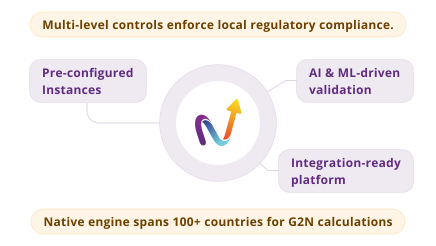
  • G2N Nova: Advanced Global Payroll Processing: G2N Nova, Mercans’ global payroll engine, offers gross-to-net payroll processing in over 100 countries and integrates smoothly with HCM and Workforce Management systems.

Conclusion

In conclusion, Mercans stands as a trusted, comprehensive solution for Employer of Record (EOR) services in Italy. With in-depth expertise in Italian labor regulations, full compliance with the Italian Ministry of Labour and Social Policies, and robust technological solutions like HR Blizz and G2N Nova, Mercans empowers businesses to expand confidently in Italy’s complex employment landscape. From managing multi-currency payroll and diverse employment types to adhering to strict data security standards, Mercans is equipped to support enterprises of all sizes. For organizations aiming for seamless, compliant, and efficient global expansion, Mercans provides the strategic partnership and local expertise needed to thrive in Italy’s evolving market.

This document was prepared for informational purposes only. As local laws & regulations keeps on changing. Please consult your tax & legal advisors as well.
Contact Sales
Let's get this conversation started. Tell us a bit about your requirement, and we'll get in touch a soon as we can.

    Sample message

    1. We want to expand in $country

    2. We want you to employ 'X' number of employees on our behalf

    3. Contract duration – 3/6/9/12/18/24 months

    4. Number of legal entities (if any exist today)

    5. Employment type: EOR employee or contractor?

    6. Any benefits requirement or “standard statutory only”?

    FAQs

    What is an Employer of Record in Italy, and what roles do they fulfill?

    An Employer of Record in Italy acts as the legal employer for your workforce. They manage contracts, payroll, benefits, taxes, and compliance, while your company directs day-to-day work.

    Is using an EOR in Italy legal, and what obligations must they meet?

    Yes. EORs must comply with labor laws, tax rules, and social security obligations. They handle filings, contributions, and ensure statutory compliance.

    How does an EOR manage TFR and other mandatory benefits in Italy?

    The EOR calculates and administers Trattamento di Fine Rapporto (TFR) along with pensions, healthcare, paid leave, and social security.

    What are the advantages of using an EOR in Italy versus establishing a local legal entity?

    It allows fast, compliant hiring without setting up an entity. The EOR reduces risk, manages HR admin, and provides local expertise.

    Do EOR providers in Italy handle compliance with Collective Bargaining Agreements?

    Yes. They ensure compliance with CBAs, covering pay, hours, overtime, and employee protections.

    Ready to hire in Italy?

    No local entity needed. Our experts handle payroll, compliance, and onboarding.

    Talk to an expert
    Proven expertise in global payroll.