Employer of Record

Employer of Record (EOR) Chile

Hire compliantly, pay accurately, expand confidently.

Global Payroll Team
Written by Global Payroll Team
Published on September 16, 2026
Last updated September 23, 2026
Expert Reviewed

An Employer of Record (EOR) in Chile acts as the official employer for workers, often referred to as a Global Professional Employer Organization (Global PEO). This role encompasses a broad range of employment functions, ensuring full compliance with local labor laws and regulations, managing payroll, administering taxes, providing legally required benefits, and handling employment contracts.

Key Responsibilities of an Employer of Record (EOR) in Chile:
  • Ensuring employment terms are fully compliant with Chile’s Código del Trabajo (Labor Code) and Dirección del Trabajo (DT) requirements.
  • Overseeing and processing local payroll in Chilean Pesos (CLP), including UF- and UTM-indexed calculations.
  • Managing AFP pension, health, unemployment insurance, and work-accident insurance contributions.
  • Calculating and disbursing the mandatory gratificación legal (statutory profit-share bonus) and years-of-service severance where applicable.
  • Issuing compliant payslips (liquidaciones de sueldo) and disbursing salary payments in accordance with Chilean standards.

With our Employer of Record (EOR) services, expanding your business into Chile becomes easier and more efficient. Our solution eliminates the need for setting up a local entity, providing a seamless path to establish a legal presence in Chile. We ensure full legal compliance, manage payroll, protect your intellectual property, and handle work permits, so you can focus on growing your business and building your workforce in one of Latin America’s most stable, OECD-member economies.

Things you need to know before hiring in Chile

Chile’s 2025–2026 Labor Reforms: 40-Hour Workweek and Pension Contributions

Chile is mid-way through two of its most significant labor reforms in decades. Under Ley 21.561 (the “40-hour law”), the standard workweek is being phased down from 45 hours: it dropped to 44 hours in April 2024, and drops again to 42 hours from 26 April 2026, before reaching 40 hours in April 2028 — all without any reduction in pay. Separately, the pension reform Ley 21.735, published in March 2025, introduces a new employer-only pension contribution that started at 1% of wages in August 2025 and rises to 3.5% from 1 August 2026, on a path toward a much higher rate by the mid-2030s. Employers hiring in Chile should reconfirm both the applicable weekly hours cap and the current employer pension contribution rate at the start of each cycle, since both are actively phasing in.

Employment Contracts in Chile

Chilean labor relations are governed by the Código del Trabajo, enforced by the Dirección del Trabajo (DT). An indefinite-term contract (contrato indefinido) is the standard form of employment.

Indefinite-Term Contracts

The standard, presumed form of employment in Chile. Notably, Chile has no general statutory probationary period for ordinary indefinite contracts.

Fixed-Term Contracts

Automatically converts to an indefinite contract if the employee keeps working past the term with the employer’s knowledge, or if the contract is renewed a second time.

Task-Based Contracts

A contrato por obra o faena ties the contract term to completion of a specific job or project rather than a calendar date.

Mandatory Contract Terms

Employment contracts must be put in writing within 15 days of the start date (5 days for contracts under 30 days), specifying the parties, job duties, workplace, remuneration, and working hours.

Working Hours

The standard legal working week in Chile is being phased down under Ley 21.561: currently 44 hours, dropping to 42 hours from 26 April 2026, and to 40 hours from April 2028.

Severance for Years of Service

Chile’s signature severance entitlement — indemnización por años de servicio — applies when an employee is terminated under Article 161 (“necesidades de la empresa”): 30 days of the employee’s last salary per year of service, capped at 11 years (330 days), with the monthly salary base itself capped at 90 UF. If a labor court later finds the dismissal unjustified, additional surcharges of 30% to 100% can apply on top of this severance, depending on the grounds improperly invoked.

Key Points on Overtime

Weekly Hours Cap
The statutory weekly hours cap is currently 44 hours, falling to 42 hours from 26 April 2026 and to 40 hours from April 2028, under the phased Ley 21.561 reform.
Overtime Premium
Overtime is compensated at a minimum 50% surcharge on the employee’s normal hourly rate.
Overtime Cap
Overtime is generally capped at 2 hours per day beyond the applicable weekly hours limit.

Termination and Severance Pay

Termination in Chile depends heavily on the legal ground invoked, ranging from no-fault terminations with no severance to business-needs terminations that trigger the years-of-service severance described above.

Notice of Termination

A termination for “necesidades de la empresa” (Art. 161) requires 30 days’ prior written notice, with a copy to the DT, or payment in lieu of notice equal to 30 days’ last salary. Resignation by the employee requires 30 days’ notice. No notice is required for termination for serious misconduct (Art. 160) or other no-fault grounds (Art. 159).

Severance Pay

Beyond the notice (or payment in lieu), employees terminated under Art. 161 are entitled to the years-of-service severance described above. If a labor court later rules the dismissal unjustified, surcharges of 30% (improper Art. 161 grounds), 50% (improper Art. 159 grounds or no cause cited), 80% (improper Art. 160 grounds), or up to 100% (improper invocation of the most serious Art. 160 grounds) apply on top of the base severance.

Protected Categories

Pregnant employees and those on maternity leave benefit from “fuero maternal” — job protection from the start of pregnancy until one year after postnatal leave ends, during which dismissal generally requires prior judicial authorization.

Compensation for Unused Leave

Any accrued but unused annual leave (feriado legal) must be paid out on termination.

Employees vs Independent Contractors

Chilean law applies a subordination-and-dependency test (“vínculo de subordinación y dependencia”): personal, remunerated services rendered under the direction and control of another party are presumed to be an employment relationship, regardless of how the arrangement is labeled (“primacía de la realidad”). Genuine independent contractors instead bill via a boleta de honorarios, governed by civil rather than labor rules.

Misclassifying employees as independent contractors is a recognized enforcement risk: the Dirección del Trabajo or labor courts can reclassify a “boleta” relationship as employment, triggering retroactive social security contributions, severance, and fines. Chile has also extended targeted labor protections to platform workers under Ley 21.431 (the “Uber law”), covering delivery and ride-hailing platform workers with minimum pay guarantees and other rights regardless of their employee or independent classification.

Comparison Table: Employee vs Independent Contractor

Factor Employee Independent Contractor
Governing Law Código del Trabajo Civil / commercial law (boleta de honorarios)
Control & Subordination Works under the employer’s direction, schedule, and supervision Controls own working hours and methods
Registration Registered by the employer with AFP, health, and unemployment insurance schemes Self-manages own social security contributions, if any
Payment Structure Fixed monthly salary via payroll, evidenced by a liquidación de sueldo Paid per invoice (boleta de honorarios) or project
Statutory Benefits Entitled to paid leave, severance, and social security coverage No statutory employment benefits
Misclassification Risk Not applicable High risk if subordination is shown; the DT and labor courts actively pursue reclassification under “primacía de la realidad”

Understanding these differences is essential for ensuring compliance and correctly determining entitlements such as leave, severance, and social security contributions.

Social Security Contributions in Chile

Chile operates a privatized, individual-account social security system. Employees contribute to their chosen AFP (pension fund administrator) and health scheme, while employers fund unemployment insurance, work-accident insurance, and a new pension contribution introduced by the 2025 pension reform.

Contribution Employer Employee
AFP Pension (individual account) — 10% + AFP admin commission (~0.44%–1.45%)
Health (FONASA / ISAPRE) — 7%
Unemployment Insurance (indefinite contracts) 2.4% 0.6%
Work Accident Insurance (Mutual/ISL) ~0.93% + variable risk surcharge —
New Pension Contribution (Ley 21.735, phasing in) 3.5% (from Aug 2026, rising over time) —

AFP and health contributions are calculated up to a monthly cap of 90 UF; unemployment insurance uses a higher cap of approximately 135.2 UF. The new pension-reform employer contribution is scheduled to keep rising through the mid-2030s — Mercans confirms the current rate and contribution structure for each engagement.

Payroll in Chile

Minimum Wage

Chile’s national minimum wage (ingreso mínimo mensual) is CLP 553,553 per month, effective 1 May 2026, up from CLP 553,553 at the start of the year. A reduced rate of CLP 412,938 applies to workers under 18 or over 65.

Payroll Cycle

Salaries in Chile are paid in Chilean Pesos (CLP) at least monthly, evidenced by an itemized liquidación de sueldo showing gross pay, statutory deductions, and net pay. Many statutory caps and thresholds are indexed to the UF (an inflation-linked unit recalculated daily) or the UTM (a monthly tax unit), so peso amounts should be treated as approximate and reconfirmed each pay period. Employers also owe a gratificación legal (statutory profit-share bonus) of 25% of monthly taxable pay, capped at 4.75 monthly minimum wages per year, payable monthly or annually depending on the method chosen.

Overtime Pay

Overtime pay is provided when an employee works beyond the applicable statutory weekly hours cap.

Overtime Premium

Overtime is paid at a minimum 50% surcharge on the employee’s normal hourly rate.

Overtime Cap

Overtime is generally capped at 2 hours per day.

The applicable weekly hours cap is itself changing under the phased Ley 21.561 reform, so overtime calculations should be reconfirmed each year through 2028.

Mercans’ payroll capabilities

Payroll Cycle Management in Chile
Mercans delivers efficient, seamless payroll cycle management tailored to Chilean requirements, including UF- and UTM-indexed calculations and the ongoing 40-hour workweek and pension reform transitions. We ensure that both employees and contractors are paid accurately and on time, providing a smooth and compliant payroll experience aligned with Chilean standards.
Payroll Setup, Processing, and Administration
Mercans offers a complete range of payroll services from start to finish. Whether it’s setting up your payroll system, processing payments, or managing ongoing administration, we take care of every detail, ensuring accuracy, compliance, and efficiency so you can focus on running your business.
Statutory Filings and Payments
Navigating Chile’s regulatory framework can be complex, particularly during the ongoing 40-hour workweek and pension reform transitions, but with Mercans, you’re in safe hands. We manage all statutory filings and payments, ensuring your business remains fully compliant with Chilean tax laws and employment regulations.

Personal Income Tax in Chile

Employment income in Chile is taxed monthly through the progressive Impuesto Único de Segunda Categoría, calculated in UTM (Unidad Tributaria Mensual, a monthly tax unit set by the SII). Monthly taxable income up to 13.5 UTM is exempt; above that threshold, 8 progressive brackets apply, rising to a top marginal rate of 40%. Because the UTM value is updated monthly, peso-denominated bracket thresholds change slightly each month.

Chile Employee Hiring Cost

When hiring an employee in Chile, employers must budget for gross salary plus mandatory employer contributions for unemployment insurance, work-accident insurance, and the new pension-reform contribution — AFP pension and health contributions are employee-paid and already reflected in the employee’s gross-to-net calculation.

Salary Details Amount (CLP)
Gross Monthly Salary 1,000,000
Employer Unemployment, Work-Accident & Pension-Reform Contributions (~6.8%) ~68,000
Estimated Total Monthly Cost ~1,068,000*

*Excludes the industry-rated portion of work-accident insurance, which varies by sector; Mercans confirms the full employer cost, including the currently phasing-in pension-reform contribution, for each engagement.

Employee Benefits in Chile

Chilean employees are entitled to a combination of mandatory statutory benefits and, increasingly, supplementary benefits offered at the employer’s discretion.

  • Annual Leave: 15 working days of paid feriado legal after 1 year of service, plus feriado progresivo — 1 additional day per 3 years of service once 10 years’ cumulative service is reached.
  • Public Holidays: Chile observes national holidays including New Year’s Day, Semana Santa (Good Friday and Holy Saturday), Labour Day, Fiestas Patrias (18–19 September), Encuentro de Dos Mundos (12 October), All Saints’ Day, and Christmas Day.
  • Sick Leave: Funded through a state or insurer subsidy (Subsidio de Incapacidad Laboral) via FONASA or the employee’s ISAPRE rather than by the employer, subject to a short unpaid waiting period for shorter licenses.
  • Maternity Leave: 6 weeks pre-natal plus 12 weeks post-natal (18 weeks total), plus an additional postnatal parental leave of up to 12 weeks full-time (or longer part-time), all funded via state subsidy rather than the employer.
  • Paternity Leave: 5 business days of paid, employer-funded leave, to be taken within the first month after birth.
  • Gratificación Legal: A mandatory statutory bonus of 25% of monthly taxable pay, capped at 4.75 monthly minimum wages per year, described above.
  • Fuero Maternal: Job protection from the start of pregnancy until one year after postnatal leave ends, during which dismissal generally requires prior judicial authorization.
  • AFP & Health Coverage: Individual-account pension savings and health coverage funded primarily through employee contributions, supplemented by employer contributions under the ongoing pension reform.
  • Unemployment Insurance: A jointly-funded individual account plus solidarity fund, providing income support between jobs.
  • Workplace Wellness Programs: Companies are enhancing the workplace experience with wellness initiatives, including mental health support.
  • Flexible Work Options: Employers are increasingly offering flexible or hybrid working arrangements where operationally feasible.
  • Team-Building Activities: Employers are introducing more team-building and employee engagement activities.
  • Discount Programs: Some companies offer group discounts on shopping, travel, and leisure activities.

Essential Benefits for Employees in Chile
  • Annual Leave: 15 working days of paid feriado legal after 1 year of service, plus feriado progresivo — 1 additional day per 3 years of service once 10 years’ cumulative service is reached.
  • Public Holidays: Chile observes national holidays including New Year’s Day, Semana Santa (Good Friday and Holy Saturday), Labour Day, Fiestas Patrias (18–19 September), Encuentro de Dos Mundos (12 October), All Saints’ Day, and Christmas Day.
  • Sick Leave: Funded through a state or insurer subsidy (Subsidio de Incapacidad Laboral) via FONASA or the employee’s ISAPRE rather than by the employer, subject to a short unpaid waiting period for shorter licenses.
  • Maternity Leave: 6 weeks pre-natal plus 12 weeks post-natal (18 weeks total), plus an additional postnatal parental leave of up to 12 weeks full-time (or longer part-time), all funded via state subsidy rather than the employer.
  • Paternity Leave: 5 business days of paid, employer-funded leave, to be taken within the first month after birth.

Additional Employee Benefits
  • Gratificación Legal: A mandatory statutory bonus of 25% of monthly taxable pay, capped at 4.75 monthly minimum wages per year, described above.
  • Fuero Maternal: Job protection from the start of pregnancy until one year after postnatal leave ends, during which dismissal generally requires prior judicial authorization.
  • AFP & Health Coverage: Individual-account pension savings and health coverage funded primarily through employee contributions, supplemented by employer contributions under the ongoing pension reform.
  • Unemployment Insurance: A jointly-funded individual account plus solidarity fund, providing income support between jobs.

Perks & Wellness Initiatives
  • Workplace Wellness Programs: Companies are enhancing the workplace experience with wellness initiatives, including mental health support.
  • Flexible Work Options: Employers are increasingly offering flexible or hybrid working arrangements where operationally feasible.
  • Team-Building Activities: Employers are introducing more team-building and employee engagement activities.
  • Discount Programs: Some companies offer group discounts on shopping, travel, and leisure activities.

Work Permit in Chile

Foreign nationals working in Chile require an appropriate residence and work authorization under Ley 21.325 (the Migration and Foreign Nationals Law).

Residencia Temporal (Work-Linked Temporary Residence)

Work-linked residence applications are processed through the Servicio Nacional de Migraciones’ SERMIG digital portal, requiring employer registration and supporting documentation. Processing times have lengthened materially since the 2022 migration law reform, and employers should generally budget for several months rather than weeks.

The 85% Chilean Workforce Rule

Under Article 19 of the Labor Code, employers with more than 25 employees must ensure at least 85% of their workforce are Chilean nationals (foreign nationals resident in Chile for 5+ years count as Chilean for this purpose). Specialized technical personnel who cannot be replaced by local staff are excluded from the ratio.

Important Considerations for Employers

Employer Sponsorship

A registered entity in Chile is generally required to sponsor a foreign employee’s work-linked residence application — an EOR partner such as Mercans allows companies without a local entity to still hire and sponsor talent compliantly.

Specialized Technical Staff Exception

Businesses hiring specialized technical talent that falls outside the 85% workforce quota can structure their Chilean hiring accordingly, with Mercans confirming eligibility for each role.
Understanding these pathways can streamline the hiring process, allowing employers to bring skilled talent into their Chile-based operations effectively.

EOR Solutions in Chile

EOR Solutions for Prospective Employees in Chile
Mercans provides efficient Employer of Record (EOR) services for businesses that have already identified their ideal candidates in Chile. Our comprehensive services cover the entire employee lifecycle, ensuring full compliance with Chilean labor laws, tax regulations, and employment standards, so you can focus on your business growth without the administrative burden.
EOR + Recruitment: Streamlined Talent Acquisition
For businesses seeking assistance with talent acquisition, our EOR and recruitment solutions offer a complete, end-to-end service, helping you find, hire, and retain top talent in Chile while ensuring all recruitment and compliance requirements are met.
Visa Sponsorship and Global Mobility Solutions
Navigating the complexities of expatriate employment becomes straightforward with our visa sponsorship and global mobility services. Mercans ensures a smooth relocation process for your international workforce, handling all aspects of Chilean immigration and employment laws to guarantee compliance.
AOR Services for Contractor Payments
For businesses managing contractor payments in Chile, Mercans offers Agent of Record (AOR) services, handling the complexities of independent contractor payments to ensure accurate, timely, and fully compliant payments while managing misclassification risk.
Converting Freelancers to Employees in Chile
Mercans supports businesses transitioning freelancers and contractors to full-time employees in Chile, ensuring a smooth, legally compliant conversion process.
HCM Integration for Enhanced Workforce Management
Integrate Mercans’ EOR services with your Human Capital Management (HCM) system for a unified, real-time approach to data exchange, compliance tracking, and payroll management in Chile.

Best Employer of Record Chile

Mercans stands out as a leading Employer of Record (EOR) provider in Chile for several key reasons:

  • Full Compliance with Chilean Labor Laws: Mercans ensures strict compliance with Chile’s Labor Code, including the ongoing 40-hour workweek and pension reform transitions, keeping your business aligned with local labor law and protecting you from potential legal risk.
  • Independent Operations: As a fully independent entity, Mercans operates without external affiliations, delivering reliable, customized employment services tailored to your business requirements in Chile.
  • Supports All Employment Types: Whether you’re hiring employees, contractors, or expatriates, Mercans offers flexible solutions across a variety of workforce models.
  • Designed for Large Enterprises: Our scalable solutions meet the demands of enterprise-level organizations, integrating with your broader global business goals.
  • Multi-Currency Payroll Management: Mercans handles multi-currency payroll, including CLP, UF, and UTM-indexed calculations, simplifying salary management across multiple countries alongside Chile.
  • Global Network and Multi-Country Payroll Expertise: With a robust global presence, Mercans manages multi-country payroll seamlessly across Latin America and beyond, handling local tax regulations and compliance requirements wherever your teams are based.
  • Certified Data Protection and Security Standards: Mercans adheres to stringent data protection protocols, including GDPR certification and SOC 1 & SOC 2 compliance.
  • ISO-Certified Service Quality and Security: Mercans holds ISO 20000 and ISO 27001 certifications, reflecting our commitment to excellence in IT service management and information security.
  • OWASP ASVS 3.0 Compliant: We adhere to OWASP ASVS 3.0 standards, protecting your business through secure software development and management practices.
  • Mercans HRBlizz: Our proprietary global payroll and talent management SaaS platform simplifies payroll while ensuring full compliance with local labor laws in Chile, backed by a team of in-country specialists.
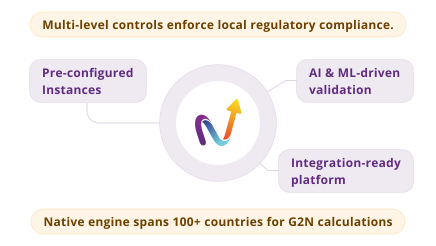
  • G2N Nova: Our advanced gross-to-net payroll engine, available in over 100 countries, integrates with major HCM and Workforce Management systems for a unified global payroll process.

Conclusion

Mercans provides comprehensive Employer of Record (EOR) services in Chile, ensuring accuracy, compliance, and efficiency in managing your workforce through its 40-hour workweek and pension reform transitions. Our end-to-end solutions simplify payroll and employment processes, making us a trusted partner for businesses navigating the complexities of the Chilean labor market. With Mercans by your side, your expansion into Chile will be smooth, compliant, and successful, allowing you to focus on growing your business with confidence.

This document was prepared for informational purposes only. As local laws & regulations keeps on changing. Please consult your tax & legal advisors as well.
Contact Sales
Let's get this conversation started. Tell us a bit about your requirement, and we'll get in touch a soon as we can.

    Sample message

    1. We want to expand in $country

    2. We want you to employ 'X' number of employees on our behalf

    3. Contract duration – 3/6/9/12/18/24 months

    4. Number of legal entities (if any exist today)

    5. Employment type: EOR employee or contractor?

    6. Any benefits requirement or “standard statutory only”?

    FAQs

    What is an Employer of Record (EOR) in Chile?

    An Employer of Record (EOR) in Chile is a third-party organization that legally employs workers on behalf of another company, handling payroll, AFP pension, health and unemployment insurance contributions, tax withholding, and compliance with Chile’s Código del Trabajo, without the client company needing to set up a local entity.

    Can a foreign company hire employees in Chile without a local entity?

    Yes. By partnering with an EOR such as Mercans, a foreign company can hire employees in Chile without registering a local branch or subsidiary. The EOR acts as the legal employer, managing contracts, payroll, social security registration, and statutory compliance on the company’s behalf.

    How is the 40-hour workweek reform affecting payroll in Chile?

    Chile is phasing down its statutory workweek under Ley 21.561, from 45 hours to 44 hours (already in force), 42 hours from 26 April 2026, and 40 hours from April 2028, without any reduction in pay. An EOR tracks these phased changes and adjusts overtime calculations accordingly.

    What compliance, payroll, and HR services does an EOR manage in Chile?

    An EOR manages drafting and executing compliant employment contracts, monthly payroll processing in CLP, AFP/health/unemployment insurance registration and contributions, the mandatory gratificación legal bonus, years-of-service severance calculations, issuing compliant payslips, and administering statutory leave and benefits in line with Chilean labor law.

    How much does an EOR service cost in Chile?

    EOR pricing varies by provider and the scope of services required, and is typically charged as a flat monthly fee per employee or a percentage of payroll. Mercans provides tailored pricing based on your specific hiring needs in Chile.

    Is EOR suitable for expanding into Chile?

    Yes. EOR is well suited to companies testing the Chilean market, hiring a small number of employees, or needing to move quickly without the time and cost of setting up a local entity, while staying compliant with Chile’s evolving 40-hour workweek and pension reform requirements.

    Ready to hire in Chile?

    No local entity needed. Our experts handle payroll, compliance, and onboarding.

    Talk to an expert
    Proven expertise in global payroll.