Employer of Record

Employer of Record (EOR) Peru

Hire compliantly, pay accurately, expand confidently.

Global Payroll Team
Written by Global Payroll Team
Last updated April 24, 2026
Expert Reviewed

An Employer of Record (EOR) serves as the legal employer for workers in Peru, often acting as a Global Professional Employer Organization (Global PEO). This essential role involves comprehensive management of employment affairs, ensuring full compliance with Peru’s labor laws and regulations. The Employer of Record in Peru oversees key responsibilities such as payroll processing, tax submissions, statutory benefits, and employment contract management.

The primary duties of the Employer of Record in Peru include:
  • Ensuring full compliance with Peru’s employment regulations.
  • Managing the complexities of local payroll systems.
  • Accurately handling employment tax submissions and necessary documentation.
  • Providing workers with precise and timely payslips.
  • Facilitating seamless salary disbursements to employees.

Expand globally with ease using our Global PEO services, offering a simplified solution that eliminates the need for entity establishment. Our Employer of Record services in Peru ensure legal compliance, secure market presence, and protect intellectual property, enabling your business to focus on its core strengths. We streamline global mobility, support expedited work visa processes, and promote a diverse and efficient global workforce. Trust Mercans as your Employer of Record in Peru to deliver a compliant, seamless, and effective employment experience for your international team.

Things you need to know before hiring in Peru

Employment Contracts in Peru

In Peru, employment contracts are governed by specific modalities that cater to various business needs and types of work. These contracts are defined by the Labor Law and regulated through various Supreme Decrees, ensuring that both employers and employees are clear about their rights and obligations. Below is a detailed look at the various types of employment contracts in Peru and their conditions, referencing the respective articles for each type of contract.

Types of Employment Contracts

  • Accidental Contract (Article 53, Supreme Decree No. 003-97-TR): This type of contract is used for situations where temporary, unforeseen, or exceptional work is required, not falling within the regular business operations. The accidental nature of the work defines the short-term need, and the contract can be renewed up to the legal maximum framework for temporary contracts.
  • Temporary Contract for Market Needs (Article 54, Supreme Decree No. 003-97-TR): Employers can hire employees on a temporary basis when there is a substantial increase in production due to market demand. While the tasks may be part of the company’s regular operations, they cannot be covered by permanent staff. These contracts are typically valid for a period of up to five years within the general legal cap for subject-to-modality contracts.
  • Contract for New Activities (Article 55, Supreme Decree No. 003-97-TR): A contract of this nature is used when a business starts new activities, establishes new markets, or increases its current production. It is typically valid for a period of up to three years.
  • Business Conversion Contract (Article 57, Supreme Decree No. 003-97-TR): This contract is applicable when a business undergoes changes such as a shift in operations, expansion, or introduction of new technology. It helps companies adapt to technological or procedural shifts and is usually subject to the legal limits established for this modality.
  • Seasonal Contract (Article 72, Supreme Decree No. 003-97-TR): Seasonal contracts are made to meet the needs of a company’s production that occurs only during specific times of the year. These contracts are often related to industries like agriculture, tourism, or retail, where work is cyclical. The terms of seasonal contracts must be written and clearly define the season’s duration and conditions.
  • Occasional Contract (Article 61, Supreme Decree No. 003-97-TR): This contract is used to cover temporary and irregular needs that arise unexpectedly, usually outside the normal scope of work. It is commonly applied to tasks that do not form part of the usual operations but require attention for a short period.
  • Emergency Contract (Article 62, Supreme Decree No. 003-97-TR): Designed to address situations arising from force majeure or unforeseen circumstances, emergency contracts are typically short-term and cover needs that cannot be anticipated. Their duration depends on the specific nature of the emergency.
  • Substitution Contract (Article 63, Supreme Decree No. 003-97-TR): Substitution contracts are entered into when an employee is temporarily replaced due to absence or leave. This type of contract is valid only as long as the employee being replaced is absent, and the substitute’s contract ends once the original worker resumes their position.
  • Intermittent Contract (Article 64, Supreme Decree No. 003-97-TR): These contracts are used for employees who work intermittently or on an irregular basis. These contracts may be renewed automatically without the need for a new agreement and are generally for tasks that do not require constant attention but may arise sporadically.
  • Contract for Specific Work or Service (Article 63 and related provisions, Supreme Decree No. 003-97-TR): A contract for specific work or service is used when the task to be completed is clearly defined, and its duration is based on the completion of the specific work. The contract ends once the work or service has been completed.

General Contract Conditions

All employment contracts subject to a specific modality must meet certain formal requirements. They must be written in triplicate, specifying:

  • Duration of the contract
  • Objective reasons justifying the contract’s temporary nature
  • The specific work or services to be performed
  • Other conditions of the employment relationship (Article 72 and following, Supreme Decree No. 003-97-TR).

Renewals and Extensions

For most contracts, such as those for market needs or new activities, renewals can be done but must not exceed the maximum duration established by law. Successive contracts may be signed with the same employee, but the total duration cannot surpass the established limits (Article 74, Supreme Decree No. 003-97-TR).

Termination and Rehiring

If an employee continues to work after the expiration of a temporary contract without a renewal, the contract will automatically be considered as indefinite. Permanent workers cannot generally be rehired under temporary modalities unless the legal conditions are met (Article 77 and 78, Supreme Decree No. 003-97-TR).

Compensation and Legal Protections

If an employer arbitrarily terminates a contract, they must compensate the worker. This compensation is calculated based on the number of months the worker would have worked until the contract’s natural expiration, with a cap of 12 months. Additionally, if the employer falsely simulates the need for temporary work, the employee can claim permanent employment status (Article 77, Supreme Decree No. 003-97-TR).

Working Hours

The Constitution establishes a standard workday of 8 hours per day or 48 hours per week, as outlined in Article 25.

13th Month Salary/ Bonus

In Peru, a bonus is an additional financial benefit provided to private sector workers twice annually, typically in July for Fiestas Patrias and in December for Christmas. Governed by Law No. 27735, this bonus is generally equivalent to a full month’s salary and is exempt from pension-related deductions. In addition, employers generally pay an extraordinary bonus linked to the health contribution regime, instead of the ordinary EsSalud contribution on that amount. This benefit is also exempt from income tax under the special legal rules applicable to gratificaciones.

Similarly, a Christmas bonus is granted to public sector employees in July and December under the Public Sector Budget Law. Unlike the private sector bonus, the public-sector amount is set by the government through the annual budget framework and should be verified for the current fiscal year.

Probation Period, Termination and Severance Pay

Probation Period

Labor regulations establish that the trial period is generally limited to 3 months. However, for certain exceptions, such as for skilled or confidential employees, the trial period can be extended to 6 months if both parties have a formal written agreement. For management-level employees, the trial period may be extended up to one year, provided there is an express written agreement in place beforehand.

Termination and Severance Pay

Termination

In Peru, employment termination is governed by Legislative Decree No. 728, or the Labour Productivity and Competitiveness Law (Supreme Decree No. 003-97-TR), which outlines specific grounds for ending an employment contract. Termination may occur for various reasons:

  • Standard Causes: Contracts may end due to events like the worker’s or employer’s death (for sole proprietorships), employee resignation, retirement, or mutual agreement. Contracts also end automatically upon the completion of specific projects, the fulfillment of contract terms, or permanent disability.
  • Dismissals:
    • Individual Dismissal: A worker may be dismissed for “just cause,” which could relate to either the employee’s performance or conduct. Grounds for dismissal include gross negligence, refusal to perform assigned tasks, unauthorized absences, revealing trade secrets, or violent behavior. If a dismissed employee challenges the termination in court, the employer is required to provide proof of the just cause.
    • Collective Dismissal: Employers may dismiss groups of employees for objective reasons, such as financial distress, technological or structural adjustments, or unforeseen events, provided these terminations are processed in accordance with the applicable administrative labor procedures.

Severance Pay

Employees dismissed without a legally justified reason may be entitled to compensation, with the amount determined by their employment contract type:

  • For Indefinite Contracts: Severance pay is calculated at 1.5 times the monthly salary per completed year of service, capped at a total of 12 months’ pay.
  • For Fixed-Term Contracts: Compensation is equivalent to 1.5 times the monthly salary for each remaining month of the contract, also capped at 12 months.

The severance payment is based on the employee’s salary at the time of dismissal, with additional income such as commissions averaged over the previous six months included if received regularly. Employees may alternatively pursue reinstatement, along with compensation for damages, unless they hold a position of trust, in which case the company may end their employment due to a loss of confidence.

Employees vs Independent Contractors

In Peru, there are key distinctions between employees and independent contractors, each with specific legal and operational requirements. Employees are generally hired on an indefinite basis, with contracts that can be verbal or written, and these contracts are structured to ensure protections and benefits outlined by Peruvian labor laws. Employees may also be hired on a fixed-term basis, though only under specific circumstances, such as temporary increases in workload or project-based work, with strict guidelines that prevent long-term or indefinite use of fixed-term contracts for the same employee. If a fixed-term contract is extended beyond allowable limits, the employee is reclassified as an indefinite-term employee.

Independent contractors, by contrast, operate as autonomous service providers and do not have the same legal protections or benefits that employees receive. Contractors are engaged by foreign or local entities on a project basis and are expected to maintain control over how they perform their work. This autonomy is essential to their classification; otherwise, if the contractor’s role aligns too closely with that of an employee, it may be redefined under Peruvian law.

Below is a table outlining the primary differences between employees and independent contractors in Peru:

CategoryEmployeeIndependent contractor
Contract typeEmployment contract; can be indefinite, fixed-term, or part-time depending on the arrangement. If there is no valid fixed-term contract from the start, the relationship is generally treated as indefinite. (gob.pe)Civil/service contract for independent services, not an employment contract.
Permitted durationIndefinite is common; fixed-term is allowed only under specific legal grounds and formalities. (gob.pe)Usually tied to the agreed service, project, or professional engagement.
Statutory benefitsEntitled to employee labor benefits under the applicable labor regime. (gob.pe)Not entitled to employee labor benefits as such.
TerminationSubject to labor-law rules and protections.Governed mainly by the service contract and civil rules.
Control over workWork is performed in a relationship of dependence/subordination. (Renta 2019)Services are provided without subordination.
Probation periodStandard probation period is 3 months; the worker must still be registered on payroll from day one even during probation. (gob.pe)No labor-law probation period as an employee concept.
Tax obligationsEmployer withholds and reports fifth-category income through payroll. (Renta 2019)Contractor generally handles fourth-category income obligations; monthly declaration/payment applies only above SUNAT thresholds. For 2026, the monthly threshold shown by SUNAT is S/ 4,010.
Reclassification riskLower if the relationship is genuinely one of employment and documented correctly.High if the “contractor” actually works under subordination, schedule/place control, and employer-provided tools. SUNAT expressly notes that even civil service contracts can be treated as fifth-category employment income when the service is rendered at the employer’s place and schedule and the employer provides work elements and bears the costs. (orientacion.sunat.gob.pe)

Social Security in Peru

In Peru, both employers and employees are required to contribute to the social security and pension system, ensuring access to healthcare and retirement benefits.

Health Contributions

Employers are responsible for making monthly contributions to the national health system, EsSalud, which amounts to 9% of the total compensation paid to employees. Employees, on the other hand, may also be covered through the private EPS model where applicable. If an employee is covered through an EPS plan, part of the employer contribution can be credited against the EsSalud contribution under the applicable rules.

Pension Contributions

Employers must withhold and remit pension contributions on a monthly basis, with the rate varying depending on the pension system the employee is affiliated with:

  • National Pension System (SNP): Employers must withhold and contribute 13% of the employee’s salary to the state-managed pension system.
  • Private Pension System (SPP): Contributions vary depending on the AFP, since they include the mandatory personal contribution plus insurance premium and management fee. The employee contribution is therefore not a single fixed statutory percentage across all AFPs.

For foreign workers, the treatment of pension contributions depends on the pension system chosen, the contract structure, and whether the worker later terminates employment in Peru.

Payroll in Peru

Minimum Wages

The minimum wage in Peru, known as the Minimum Vital Remuneration (RMV), is set at PEN 1,130 per month.

Payroll Cycle

The payroll cycle in Peru is the period during which an organization compensates its employees, typically on a monthly basis. Apart from the regular monthly salary, employers are obligated to provide two additional payments each year, one in July and another in December. These extra payments are commonly referred to as the 13th and 14th-month payments in business practice.

Overtime Pay

Overtime for employees must be paid alongside their regular wages, and the corresponding amount should be clearly documented on both their payroll and payslip.

Under current regulations, when overtime occurs during the standard working hours, employers are required to pay an additional surcharge. Specifically, for the first two hours of overtime, the surcharge is 25% of the employee’s regular hourly rate. For any overtime beyond the second hour, the surcharge increases to 35% of the hourly rate.

It’s important to note that, as stated in Article 2 of Supreme Decree No. 012-2002-TR, the calculation of overtime hours for surcharge purposes is based on any work performed beyond the employee’s regular daily working hours.

To illustrate, let’s consider an example where an employee with a monthly salary of S/2500 works four extra hours in one day.

DetailsAmount
Monthly salaryS/ 2,500.00
Hourly rate (Salary ÷ 30 days ÷ 8 hours)S/ 10.42
Overtime rate for first 2 hours (25% surcharge)S/ 13.02 per hour
Overtime pay for first 2 hoursS/ 26.04
Overtime rate for next 2 hours (35% surcharge)S/ 14.06 per hour
Overtime pay for next 2 hoursS/ 28.12
Total overtime pay for 4 hoursS/ 54.16

Total Overtime Payment for 4 Hours = S/12.50

Mercans’ payroll capabilities

  • Payroll Cycle Management in Peru: Mercans offers a streamlined payroll cycle management service designed to ensure accurate and timely payments for both employees and independent contractors in Peru, using the local currency. Rely on Mercans to handle all aspects of your payroll cycle, making it a smooth, efficient, and localized process for your business.
  • Payroll Setup, Processing, and Administration: Mercans provides comprehensive payroll solutions, covering everything from the initial setup to precise processing and ongoing administration. We handle each step with a focus on accuracy, efficiency, and legal compliance. By entrusting Mercans with your payroll, you free up valuable time to focus on driving your core business operations.
  • Compliance with Statutory Filings and Payments: Mercans ensures that your business stays fully compliant with Peru’s regulatory requirements. Our team expertly manages statutory filings and payments, keeping your business up-to-date with all legal obligations. With Mercans handling the details, you can rest assured that your statutory submissions will be accurate and timely, giving you peace of mind and allowing you to focus on growth.

Personal Income Tax in Peru

In Peru, individual income tax is determined by domicile rather than residency. Domiciled individuals are subject to taxation on their worldwide income, while non-domiciled individuals are only taxed on their income generated within Peru.

Personal Income Tax Rates

The tax rates for labor income and foreign earnings of domiciled individuals in Peru follow a progressive scale, as outlined below:

Income BracketReference in Soles (2026)Tax Rate (%)
FirstUp to S/ 27,5008
SecondMore than S/ 27,500 up to S/ 110,00014
ThirdMore than S/ 110,000 up to S/ 192,50017
FourthMore than S/ 192,500 up to S/ 247,50020
FifthMore than S/ 247,50030

Note: For 2025, one tax unit is equivalent to S/ 5,350. The first seven tax units are exempt from tax, and individuals who meet specific criteria may deduct up to three additional tax units for qualifying expenses under the applicable rules.

Non-domiciled individuals are taxed at a flat rate of 30% on their gross income sourced from Peru, without the ability to claim deductions or credits.

Additional Tax Details

Capital gains derived from the sale of stocks by domiciled individuals are generally taxed at the applicable capital income rate, while rental income is also taxed under its corresponding regime. If no withholding tax is required, income tax must be paid when filing the annual tax return.

Peru Employee Hiring Cost

Hiring employees in Peru involves various costs beyond the gross salary paid to the employee. Employers must account for statutory contributions, such as social security, health insurance, bonus payments, CTS, paid leave, and other mandatory benefits, which increase the overall expense of employment.

For example, if an employee’s gross salary is PEN 100,000 annually, the total cost to the employer will be higher due to additional employer contributions. Here’s a breakdown of the total annual employment cost:

Salary detailsAmount (PEN)
Gross annual salary100,000.00
Annual employer costs36,889
Total annual cost136,889

In this example, the employer’s annual costs depend on the employee’s compensation structure and statutory benefits, including contributions for health insurance and other labor obligations.

Employee Benefits in Peru

Peru provides a robust system of employee benefits designed to ensure the financial and physical well-being of workers. These benefits include social security, health coverage, pension contributions, mandatory leaves, and insurance plans. Employers are required by law to offer these benefits to their employees.

  • Pension Systems: Employees in Peru can choose between two pension systems: the National Pension System (SNP) and the Private Pension System (SPP). The SNP requires a 13% employee contribution. The SPP uses a variable structure because the total withheld amount depends on the AFP commission and insurance premium in addition to the individual capitalization contribution. When a worker starts a new job, the employer provides information to help them choose between these systems, unless the employee is already registered in one of them.
  • Social Security and Health Insurance: Under Peru’s social security laws, employees are insured through the Public Health Insurance system (EsSalud), with employers responsible for contributing 9% of an employee’s salary. In industries that involve high-risk activities such as mining or construction, employers are also required to provide additional insurance coverage for workers exposed to these risks.
  • Healthcare and Life Insurance: Employees are entitled to a life insurance policy under the current legal regime, and employers should verify the timing and scope of Vida Ley coverage under the current rules and any insurance implementation requirements.
  • Mandatory Leave: Employees are entitled to paid rest on public holidays and annual leave. Peru’s public holidays include New Year’s Day, Labor Day, National Holidays, Christmas, and others. In addition to public holidays, employees are entitled to paid annual leave, which is another key benefit they receive throughout their employment.
  • Maternity and Paternity Leave: Female workers are entitled to 49 days of prenatal leave and 49 days of postnatal leave, with an additional 30 days if the birth is multiple or if the child has a disability. Postnatal leave can be deferred and combined with prenatal leave upon the employee’s decision. In addition, breastfeeding leave is granted for one hour per day until the child reaches one year of age. Male employees are entitled to 10 consecutive calendar days of paternity leave, which can be extended under certain circumstances, such as multiple births or complications during birth.
  • Sickness and Disability Leave: Employees who suffer illness or injury are generally paid by the employer for the first 20 days of incapacity, after which the applicable EsSalud subsidy rules may apply.
  • Retirement Pensions: In Peru, there are two options for retirement: the National Pension System (SNP) and the Private Pension System (SPP). To retire under the SNP, employees must meet the legal age and contribution requirements. If an employee is part of the SPP, the retirement pension depends on the accumulated individual account and the chosen retirement modality.

Work Permit in Peru

When expanding your business into Peru, it’s essential to understand the process of obtaining work authorization for your employees. Whether you’re transferring existing team members or hiring new talent, obtaining the right immigration status ensures a smooth transition and compliance with Peruvian law. Below is an overview of work-related immigration options, requirements, and important considerations for your business operations in Peru.

Work Visa Categories in Peru

Peru offers several immigration categories depending on the nature of the employee’s stay and purpose. The most common work-related options include:

  • Temporary stay categories such as tourist or business status for non-labor purposes
  • Resident Worker Immigration Status
  • Other specific categories depending on the purpose of stay

Employees who will work in Peru generally require the resident worker immigration status rather than relying on tourist or business entry.

Documentation Needed for Work Visa Application

To apply for the resident worker immigration status in Peru, documents typically required include:

  • A passport with the required validity
  • Copies of the identity pages of the passport
  • Completed immigration application forms
  • A valid employment contract, administrative relationship document, or service contract in Peru
  • Additional supporting documents requested by Migraciones

Step-by-Step Application Process

Employees generally apply through the Peruvian immigration authority, Migraciones, under the worker resident immigration procedure. If applying from abroad, the process may involve a consular stage depending on nationality and immigration route. If applying from within Peru, the foreign national must follow the status-change or resident application process allowed by law.

Employer Sponsorship and Workforce Composition Requirements

Peruvian labor law has historically included limits regarding the hiring of foreign personnel, but those rules are subject to exceptions, approvals, and sector-specific practice. Employers should review the current foreign hiring rules and contract approval requirements based on the employee’s role and company profile rather than relying on a fixed general percentage without case-specific analysis.

Key Considerations for Work Permits

Employers should carefully plan the visa and work permit application process to avoid delays that may disrupt employee timelines. Compliance with Peru’s employment and immigration regulations is vital to ensure a smooth operation as you scale your business. Properly handling work authorization will ensure that your international workforce can contribute to the success of your business in Peru.

EOR Solutions in Peru

  • EOR for Prospective Employees: Mercans provides comprehensive Employer of Record (EOR) services for businesses that have identified their ideal candidates in Peru. Our solutions cover every phase of the employee lifecycle, ensuring full compliance with Peruvian labor laws and regulations while simplifying the hiring process for international employers.
  • EOR + Recruitment: For companies looking for assistance in talent acquisition, Mercans offers a combined EOR and recruitment service. We leverage our broad network and industry expertise to help you find, hire, and retain top talent, making your market entry into Peru seamless and efficient.
  • Visa Sponsorship and Global Mobility: Our visa sponsorship and global mobility services streamline the process of relocating your international employees to Peru. We manage the complexities of immigration, ensuring that your expatriates meet all legal requirements to work and reside in the country.
  • AOR for Contractor Payments: Mercans’ Assistance on Record (AOR) services help businesses manage contractor payments with accuracy and compliance. We handle the intricacies of contractor payment processing, ensuring timely and correct payments in line with Peruvian laws.
  • Converting Freelancers to Employees: Transitioning freelancers into permanent employees in Peru is made simple with Mercans. We provide expert support throughout the conversion process, ensuring all legal steps are followed for a smooth transition while maintaining compliance with local employment laws.
  • HCM Integration: We offer seamless integration of Mercans’ EOR services with your Human Capital Management (HCM) system in Peru. This enables real-time data synchronization, improved compliance, and enhanced operational efficiency, streamlining your payroll and workforce management processes for better results.

Best Employer of Record Peru

  • Full Compliance with Local Regulations: Mercans ensures full compliance with Peruvian labor laws, including the requirements set by the Ministry of Labor and Promotion of Employment (Spanish: Ministerio de Trabajo y Promoción del Empleo), Social Security, and other relevant government bodies.
  • Independent Operations: Mercans operates as an independent entity, offering customized and reliable employment services tailored to the specific needs of each client.
  • Versatile Employment Solutions: Whether you have employees, freelancers, contractors, or expatriates, Mercans is equipped to manage all types of employment, providing flexible solutions that suit various workforce structures.
  • Designed for Enterprises: Mercans is ideal for large corporations and enterprises, offering scalable, sophisticated services that address the complex needs of large organizations, including multi-department and multi-location structures.
  • Multi-Currency Payroll Management: We offer payroll services in multiple currencies, ensuring that global and multi-national businesses can streamline their financial operations seamlessly across borders.
  • Global Reach with Multi-Country Expertise: With a broad international presence, Mercans specializes in managing payroll across multiple countries, ensuring smooth operations for businesses with a global footprint.
  • Data Protection & Security Compliance: Mercans adheres to the highest standards of data protection and security, including GDPR compliance and SOC 1 & SOC 2 certifications, ensuring the privacy and integrity of all client information.
  • ISO Certifications: Mercans is ISO 20000 and ISO 27001 certified, reflecting our commitment to delivering high-quality IT service management and robust information security practices.
  • Security Standards Compliance: Mercans meets OWASP ASVS 3.0 security standards, ensuring that our software development and management processes follow industry-leading practices in safeguarding applications.
  • HRBlizz: Our proprietary HRBlizz platform is a global payroll and talent management solution that streamlines payroll operations while ensuring compliance with local regulations. Backed by a network of over 1,000 in-country experts, it provides deep knowledge of Peruvian labor laws and business protocols.
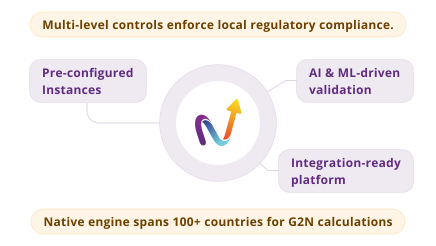
  • G2N Nova: G2N Nova, our advanced global payroll engine, handles gross-to-net payroll processing in over 100 countries. Available as a SaaS or service delivery platform, it integrates seamlessly with major HCM and workforce management systems, providing a comprehensive and flexible payroll solution.

Conclusion

In conclusion, Mercans offers a comprehensive suite of Employer of Record (EOR) services in Peru, ensuring seamless compliance with local regulations, including those set by the Ministry of Labor and Promotion of Employment. Whether you are managing employees, contractors, or expanding your workforce internationally, Mercans provides tailored solutions that meet the needs of businesses of all sizes. With our expertise in multi-country payroll, data security, and local labor laws, we streamline the process of hiring and managing talent, enabling you to focus on growth and operations. Trust Mercans to be your partner in navigating the complexities of the Peruvian market and beyond, ensuring smooth, efficient, and compliant workforce management.

This document was prepared for informational purposes only. As local laws & regulations keeps on changing. Please consult your tax & legal advisors as well.
Contact Sales
Let's get this conversation started. Tell us a bit about your requirement, and we'll get in touch a soon as we can.

    FAQs

    What is an Employer of Record (EOR) in Peru?

    An Employer of Record in Peru is a professional service that legally employs workers on behalf of a foreign company. The EOR manages employment contracts, payroll, taxes, benefits, and ensures compliance with Peruvian labor laws, allowing companies to hire locally without establishing a Peruvian entity.

    How can foreign companies hire employees in Peru without establishing a local entity?

    Foreign companies can work with an EOR, which serves as the legal employer while the client company supervises day-to-day work. This allows businesses to operate in Peru without creating a branch or subsidiary.

    What compliance, payroll, and HR services does an EOR in Peru provide?

    An EOR in Peru handles employment contracts, payroll processing, tax withholdings, social security contributions, mandatory benefits, and government reporting. They can also assist with work permits and visas for international hires.

    What are the benefits of using EOR services in Peru?

    Using an EOR simplifies market entry, ensures compliance with local labor regulations, reduces administrative burden, mitigates legal risks, and speeds up the hiring process.

    How much does it cost to hire employees through an EOR in Peru?

    Fees typically range from $500 to $2,000 per employee per month depending on the services provided. Companies should consult the EOR provider for a precise pricing structure.

    Is an EOR the right solution for expanding a business into Peru?

    An EOR is ideal for businesses expanding into Peru without establishing a local entity. It allows companies to focus on core operations while the EOR manages employment, payroll, and compliance responsibilities.

    Ready to hire in Peru?

    No local entity needed. Our experts handle payroll, compliance, and onboarding.

    Talk to an expert
    Proven expertise in global payroll.