Employer of Record

Employer of Record (EOR) Argentina

Hire compliantly, pay accurately, expand confidently.

Global Payroll Team
Written by Global Payroll Team
Last updated July 29, 2026
Expert Reviewed

An Employer of Record (EOR) in Argentina acts as the official employer for workers, often referred to as a Global Professional Employer Organization (Global PEO). This role encompasses a broad range of employment functions, ensuring full compliance with local labor laws and regulations, managing payroll, administering taxes, providing legally required benefits, and handling employment contracts.

Key Responsibilities of an Employer of Record (EOR) in Argentina:
  • Ensuring employment terms are fully compliant with Argentine labor laws.
  • Overseeing and processing local payroll in Argentine Pesos (ARS).
  • Managing the filing of employment-related taxes and social security (ARCA) contributions.
  • Issuing compliant payslips (recibo de sueldo) to employees.
  • Disbursing salary payments, including the mandatory SAC (13th-month) instalments, in accordance with Argentine standards.

With our Employer of Record (EOR) services, expanding your business into Argentina becomes easier and more efficient. Our solution eliminates the need for setting up a local entity, providing a seamless path to establish a legal presence in Argentina. We ensure full legal compliance, manage payroll, protect your intellectual property, and handle work permits, so you can focus on growing your business and building your workforce in Latin America.

Things you need to know before hiring in Argentina

Employment Contracts in Argentina

Argentine labor relations are governed by the Ley de Contrato de Trabajo (LCT), most recently and significantly amended by Law No. 27.802, the “Ley de Modernización Laboral,” enacted by Congress in February 2026, published on 6 March 2026, and regulated in mid-2026. This is the most consequential labor reform in Argentina in years, and it affects trial periods, registration, and severance calculations, among other areas.

Indefinite-Term and Fixed-Term Contracts

The indefinite-term contract is the default and standard form of employment in Argentina. A fixed-term contract (contrato a plazo fijo) is the exception and must be justified by the objective nature of the task or activity.

Indefinite-Term Contracts

The standard, presumed form of employment in Argentina under the LCT. Employers must register the employment relationship electronically with ARCA (Agencia de Recaudación y Control Aduanero, formerly AFIP) from day one.

Fixed-Term Contracts

Permitted only where objectively justified by the nature of the task. Must be in writing, in duplicate, and cannot exceed a total duration of 5 years including renewals. Failure to meet these requirements converts the contract to indefinite-term.

Trial Period (Período de Prueba)

Following the 2026 reform, the general trial period is 6 months, extendable to 8 months for employers with 6–100 employees, or up to 1 year for employers with up to 5 employees. Either party may terminate without cause during this period, and the reform removed the notice (preaviso) requirement during trial.

Registration Requirements

Law 27.802 centralized registration through ARCA’s electronic system, replacing the prior requirement for a separate rubricated salary book as the core national registration mechanism. Employer registration is mandatory from the first day of employment.

Working Hours

The standard legal working week in Argentina is 48 hours, structured as 8 hours per day (Ley 11544). This has not changed under the 2026 reform.

SAC (13th-Month Salary / “Aguinaldo”)

Argentina requires a mandatory 13th-month payment known as the Sueldo Anual Complementario (SAC), or “aguinaldo,” paid in two instalments: the first by 30 June and the second by 18 December each year. Each instalment equals 50% of the employee’s highest gross monthly remuneration earned during that six-month period, prorated for partial periods worked.
Under Law 27.802, the SAC is now excluded from the base used to calculate severance pay (indemnización por antigüedad), a notable change from the prior regime.

Key Points on Overtime

Overtime Premiums
Overtime is compensated at +50% on ordinary working days (Monday to Saturday until 1pm), and +100% for hours worked on Saturday afternoons, Sundays, and public holidays.
Overtime Caps
Overtime is generally capped at 30 hours per month and 200 hours per year without requiring prior administrative authorization.
Banco de Horas (New in 2026)
Law 27.802 introduces an optional “hours banking” mechanism, allowing employer and employee to agree to compensate overtime with time off instead of a salary premium, as an alternative to the traditional surcharge system.

Termination and Severance Pay

Termination in Argentina involves several components: notice of termination (preaviso), severance pay based on seniority (indemnización por antigüedad), and additional payments tied to the timing of the dismissal.

Notice of Termination (Preaviso)

Employees with up to 5 years of seniority are entitled to 1 month’s notice; employees with more than 5 years of seniority are entitled to 2 months’ notice. No notice is required during the trial period following the 2026 reform.

Severance Pay (Indemnización por Antigüedad)

The core severance formula was not changed by the 2026 reform: one month’s salary per year of service, or fraction of service greater than 3 months, based on the employee’s best normal monthly remuneration in the last year worked. The Supreme Court’s “Vizzoti” doctrine — that this base cannot be reduced by more than 33% relative to the employee’s actual best salary — has now been expressly written into the statute.

Law 27.802 also refined how the base is calculated: a pay concept only counts as “habitual” if earned in at least 6 months of the last calendar year, and the SAC and non-monthly extraordinary bonuses are now excluded from the calculation.

Other Termination Payments

In addition to severance, a dismissed employee is generally entitled to integración del mes de despido (pay for the remainder of the dismissal month) and payment for proportional accrued, unused vacation days.

Optional Severance Fund (Fondo de Cese Laboral)

Law 27.802 also authorizes, via collective bargaining agreement, an optional alternative to the traditional severance formula: an ongoing employer-funded severance fund, modeled on the construction industry’s existing regime, from which the accumulated balance is paid to the employee on termination for any reason. Adoption of this system is optional, not automatic.

Employees vs Independent Contractors

Argentina recognizes independent contractor arrangements, typically structured through the simplified “monotributo” tax regime (monotributista) or as a registered self-employed professional (autónomo). However, Argentine courts apply the doctrine of “primacía de la realidad” (primacy of reality) — actual working conditions such as subordination, exclusivity, fixed schedules, and integration into the business determine employment status, regardless of how the relationship is invoiced.

Misclassifying an employee as a monotributista to avoid social security contributions and severance obligations (“falso monotributista”) is treated as labor fraud and carries a meaningful compliance risk, particularly on prolonged or exclusive engagements. Under the 2026 reform, invoicing via monotributo alone no longer automatically creates a presumption of employment where a properly documented civil or commercial contract exists — a pro-employer clarification, though the underlying substance-over-form test still applies.

Comparison Table: Employee vs Independent Contractor

Factor Employee Independent Contractor (Monotributista)
Governing Law Ley de Contrato de Trabajo (LCT) Civil / commercial contract, monotributo tax regime
Control & Subordination Works under the employer’s direction, schedule, and supervision Controls own working hours and methods
Registration Registered by the employer with ARCA Self-registered under the monotributo or autónomo regime
Payment Structure Fixed monthly salary plus mandatory SAC Paid per invoice, project, or milestone
Statutory Benefits Entitled to paid leave, SAC, severance, and social security coverage No statutory employment benefits
Misclassification Risk Not applicable High risk if the relationship shows subordination; courts apply “primacía de la realidad”

Understanding these differences is essential for ensuring compliance and correctly determining entitlements such as SAC, severance, and social security contributions.

Social Security in Argentina

Argentina’s social security system covers retirement (SIPA), health insurance (obra social), the PAMI healthcare programme for retirees, and family allowances, funded through combined employer and employee contributions calculated on gross remuneration.

Contribution Employer Employee
Retirement (SIPA) ~16% 11%
PAMI / INSSJP ~1.5% 3%
Family Allowances ~7.5%
Health Insurance (Obra Social) ~6% 3%
Total (approximate) 18% – 20.4%* ~17%

*Employer contribution rates depend on the employer’s size and sector: approximately 18% for employers holding current MiPyME (small/medium enterprise) certification, and approximately 20.4% for larger employers in services and commerce exceeding the MiPyME thresholds. Contributions are calculated up to a periodically updated monthly taxable salary cap. In addition, employers must separately fund ART (workers’-compensation insurance) at a market-negotiated premium that varies by industry risk classification, plus a fixed per-employee monthly fee.

Payroll in Argentina

Minimum Wages

Argentina’s national minimum wage, the Salario Mínimo, Vital y Móvil (SMVM), is set by the Consejo Nacional del Empleo, la Productividad y el Salario Mínimo, Vital y Móvil and adjusted frequently in response to inflation — recently on a near-monthly or quarterly cadence. As it changes often, employers should confirm the exact current figure with Mercans before running payroll; as a recent reference point, the SMVM stood at ARS 372,400 per month in July 2026.

Payroll Cycle

Salaries in Argentina are paid monthly in Argentine Pesos (ARS), with employers required to issue an itemized payslip (recibo de sueldo) each pay period showing gross pay, all statutory deductions, and net pay. Argentina’s historical currency controls (the “cepo cambiario”) were substantially eased starting in 2025 under a currency band system, materially changing the foreign-exchange environment for businesses operating in the country; employers should confirm the current exchange control position before structuring any cross-border payment arrangements.

Overtime Pay

Overtime pay is provided when an employee works beyond the standard 48-hour week. The premium depends on when the overtime is worked.

Overtime on Regular Work Days

Overtime worked Monday to Saturday until 1pm is paid at a 50% premium above the normal hourly rate.

Overtime on Rest Days and Holidays

Overtime worked on Saturday afternoons, Sundays, or public holidays is paid at a 100% premium above the normal hourly rate.

Overtime Caps

Overtime is generally capped at 30 hours per month and 200 hours per year without requiring prior administrative authorization, though an optional “banco de horas” time-off arrangement is now available under the 2026 reform as an alternative to cash premiums.

Overtime rules can vary depending on the applicable collective bargaining agreement.

Mercans’ payroll capabilities

Payroll Cycle Management in Argentina
Mercans delivers efficient, seamless payroll cycle management tailored to Argentine requirements, including the mandatory SAC instalments. We ensure that both employees and contractors are paid accurately and on time, in Argentine Pesos, providing a smooth and compliant payroll experience aligned with Argentine standards.
Payroll Setup, Processing, and Administration
Mercans offers a complete range of payroll services from start to finish. Whether it’s setting up your payroll system, processing payments, or managing ongoing administration, we take care of every detail, ensuring accuracy, compliance, and efficiency so you can focus on running your business.
Statutory Filings and Payments
Navigating Argentina’s fast-evolving regulatory framework can be complex, but with Mercans, you’re in safe hands. We manage all statutory filings and payments, including ARCA registration and social security contributions, ensuring your business remains fully compliant with Argentine tax laws and employment regulations, including the 2026 labor reform.

Personal Income Tax in Argentina

Personal income tax on salaries in Argentina, known as Impuesto a las Ganancias (4th category), is administered by ARCA (formerly AFIP) and applies progressively on income above a non-taxable minimum threshold.

Income Tax Rates in Argentina

Income tax is charged on a progressive scale ranging from 5% up to 35% of net taxable income, applied via ARCA’s Article 94 tables.

Tax Bracket Rate
Lowest bracket 5%
Intermediate brackets 9% – 31%, progressive
Highest bracket 35%

Because Argentina updates the non-taxable minimum and bracket thresholds roughly every six months (typically January and July) to keep pace with inflation, Mercans confirms the exact current thresholds and deduction amounts — which also vary based on dependents — before processing payroll for any engagement.

Argentina Employee Hiring Cost

When hiring an employee in Argentina, employers must budget for gross salary, mandatory employer social security contributions, SAC provisioning, vacation accrual, and ART workers’-compensation insurance. As a directional estimate, the fully-loaded employer cost in Argentina is often approximated at around 1.4 times the employee’s gross salary, though the exact figure depends on the employer’s size, sector, and ART risk classification.

Salary Details Amount (ARS)
Gross Monthly Salary 1,000,000
Employer Social Security Contributions (~18–20.4%) ~180,000 – 204,000
SAC Provisioning (accrued 13th-month, ~8.33%) ~83,300
Estimated Total Monthly Cost ~1,270,000 – 1,290,000

Employee Benefits in Argentina

Argentine employees are entitled to a combination of mandatory statutory benefits and, increasingly, supplementary benefits offered at the employer’s discretion.

  • Annual Leave: Tiered by seniority — 14 calendar days (under 5 years), 21 days (5–10 years), 28 days (10–20 years), and 35 days (over 20 years).
  • Public Holidays: Argentina observes 19 national public holidays each year, plus additional “días no laborables” bridge days declared by the government.
  • Sick Leave: Ranges from 3 months (under 5 years’ seniority, no dependents) up to 12 months (5+ years’ seniority, with family dependents) of paid leave under Article 208 of the LCT.
  • Maternity Leave: 90 days total, flexibly split as 45 days before / 45 days after birth, or 30 days before / 60 days after birth.
  • Paternity Leave: 2 consecutive calendar days by law (a pending bill proposes extending this to 30 days, but it is not yet in force).
  • SAC (Aguinaldo): A mandatory 13th-month payment split into two instalments each year, equal to 50% of the highest monthly salary earned in each semester.
  • Supplementary Health Coverage: Many employers offer upgraded private health plans (medicina prepaga) on top of the mandatory obra social coverage.
  • Meal & Transport Allowances: Common non-mandatory benefits provided by many employers.
  • Professional Development: Some companies offer financial assistance for continuing education and training.
  • Workplace Wellness Programs: Companies are enhancing the workplace experience with wellness initiatives, including mental health support.
  • Flexible Work Options: Employers are increasingly offering flexible or hybrid working arrangements where operationally feasible.
  • Team-Building Activities: Employers are introducing more team-building and employee engagement activities.
  • Discount Programs: Some companies offer group discounts on shopping, travel, and leisure activities.

Essential Benefits for Employees in Argentina
  • Annual Leave: Tiered by seniority — 14 calendar days (under 5 years), 21 days (5–10 years), 28 days (10–20 years), and 35 days (over 20 years).
  • Public Holidays: Argentina observes 19 national public holidays each year, plus additional “días no laborables” bridge days declared by the government.
  • Sick Leave: Ranges from 3 months (under 5 years’ seniority, no dependents) up to 12 months (5+ years’ seniority, with family dependents) of paid leave under Article 208 of the LCT.
  • Maternity Leave: 90 days total, flexibly split as 45 days before / 45 days after birth, or 30 days before / 60 days after birth.
  • Paternity Leave: 2 consecutive calendar days by law (a pending bill proposes extending this to 30 days, but it is not yet in force).

Additional Employee Benefits
  • SAC (Aguinaldo): A mandatory 13th-month payment split into two instalments each year, equal to 50% of the highest monthly salary earned in each semester.
  • Supplementary Health Coverage: Many employers offer upgraded private health plans (medicina prepaga) on top of the mandatory obra social coverage.
  • Meal & Transport Allowances: Common non-mandatory benefits provided by many employers.
  • Professional Development: Some companies offer financial assistance for continuing education and training.

Perks & Wellness Initiatives
  • Workplace Wellness Programs: Companies are enhancing the workplace experience with wellness initiatives, including mental health support.
  • Flexible Work Options: Employers are increasingly offering flexible or hybrid working arrangements where operationally feasible.
  • Team-Building Activities: Employers are introducing more team-building and employee engagement activities.
  • Discount Programs: Some companies offer group discounts on shopping, travel, and leisure activities.

Work Permit in Argentina

Foreign nationals generally need a temporary work-residency visa to work legally in Argentina, though the requirements differ significantly depending on nationality.

Primary Pathways for Foreign Worker Authorization

MERCOSUR Nationals

Nationals of MERCOSUR member and associate states (including Brazil, Paraguay, Uruguay, Bolivia, Chile, Peru, Colombia, and Ecuador) benefit from a simplified MERCOSUR temporary residency process, valid for 2 years, which grants work authorization based on nationality and a clean criminal record, without requiring employer sponsorship or a specific job offer.

Non-MERCOSUR Nationals

Nationals from other countries apply for temporary residency under Argentina’s Migration Law based on a demonstrated employment relationship, which in practice requires employer sponsorship through the Dirección Nacional de Migraciones (DNM).

Processing Time

Applications typically take 2–6 months to process. Applicants generally receive “residencia precaria” (provisional status), which allows them to work legally in Argentina from the start of the application process.

Path to Permanent Residency

After 2 years of continuous temporary residency under a work visa or MERCOSUR status, foreign nationals may apply for permanent residency.

Important Considerations for Employers

Employer Sponsorship

For non-MERCOSUR nationals, a registered legal entity in Argentina is required to sponsor a foreign employee’s work authorization — an EOR partner such as Mercans allows companies without a local entity to still hire and sponsor talent compliantly.

Regional Mobility

Businesses hiring across Latin America can take advantage of Argentina’s simplified MERCOSUR pathway for regional talent mobility.
Understanding these pathways can streamline the hiring process, allowing employers to bring skilled talent into their Argentina-based operations effectively.

EOR Solutions in Argentina

EOR Solutions for Prospective Employees in Argentina
Mercans provides efficient Employer of Record (EOR) services for businesses that have already identified their ideal candidates in Argentina. Our comprehensive services cover the entire employee lifecycle, ensuring full compliance with Argentine labor laws, tax regulations, and employment standards, so you can focus on your business growth without the administrative burden.
EOR + Recruitment: Streamlined Talent Acquisition
For businesses seeking assistance with talent acquisition, our EOR and recruitment solutions offer a complete, end-to-end service, helping you find, hire, and retain top talent in Argentina while ensuring all recruitment and compliance requirements are met.
Visa Sponsorship and Global Mobility Solutions
Navigating the complexities of expatriate employment becomes straightforward with our visa sponsorship and global mobility services. Mercans ensures a smooth relocation process for your international workforce, handling all aspects of Argentine immigration and employment laws to guarantee compliance.
AOR Services for Contractor Payments
For businesses managing contractor payments in Argentina, Mercans offers Agent of Record (AOR) services, handling the complexities of monotributista and independent contractor payments to ensure accurate, timely, and fully compliant payments while managing misclassification risk.
Converting Freelancers to Employees in Argentina
Mercans supports businesses transitioning freelancers and monotributistas to full-time employees in Argentina, ensuring a smooth, legally compliant conversion process.
HCM Integration for Enhanced Workforce Management
Integrate Mercans’ EOR services with your Human Capital Management (HCM) system for a unified, real-time approach to data exchange, compliance tracking, and payroll management in Argentina.

Best Employer of Record Argentina

Mercans stands out as a leading Employer of Record (EOR) provider in Argentina for several key reasons:

  • Full Compliance with Argentine Labor Laws: Mercans ensures strict compliance with Argentina’s evolving employment regulations, including the 2026 labor reform, keeping your business aligned with local labor law and protecting you from potential legal risk.
  • Independent Operations: As a fully independent entity, Mercans operates without external affiliations, delivering reliable, customized employment services tailored to your business requirements in Argentina.
  • Supports All Employment Types: Whether you’re hiring employees, contractors, or expatriates, Mercans offers flexible solutions across a variety of workforce models.
  • Designed for Large Enterprises: Our scalable solutions meet the demands of enterprise-level organizations, integrating with your broader global business goals.
  • Multi-Currency Payroll Management: Mercans handles multi-currency payroll, simplifying salary management across multiple countries alongside Argentina.
  • Global Network and Multi-Country Payroll Expertise: With a robust global presence, Mercans manages multi-country payroll seamlessly across Latin America and beyond, handling local tax regulations and compliance requirements wherever your teams are based.
  • Certified Data Protection and Security Standards: Mercans adheres to stringent data protection protocols, including GDPR alignment and SOC 1 & SOC 2 compliance.
  • ISO-Certified Service Quality and Security: Mercans holds ISO 20000 and ISO 27001 certifications, reflecting our commitment to excellence in IT service management and information security.
  • OWASP ASVS 3.0 Compliant: We adhere to OWASP ASVS 3.0 standards, protecting your business through secure software development and management practices.
  • Mercans HRBlizz: Our proprietary global payroll and talent management SaaS platform simplifies payroll while ensuring full compliance with local labor laws in Argentina, backed by a team of in-country specialists.
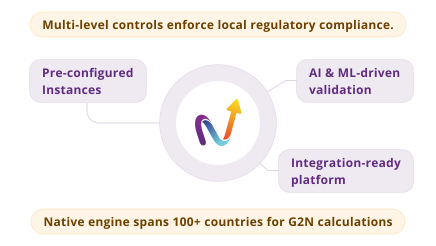
  • G2N Nova: Our advanced gross-to-net payroll engine, available in over 100 countries, integrates with major HCM and Workforce Management systems for a unified global payroll process.

Conclusion

Mercans provides comprehensive Employer of Record (EOR) services in Argentina, ensuring accuracy, compliance, and efficiency in managing your workforce through a period of significant labor law reform. Our end-to-end solutions simplify payroll and employment processes, making us a trusted partner for businesses navigating the complexities of the Argentine labor market. With Mercans by your side, your expansion into Argentina will be smooth, compliant, and successful, allowing you to focus on growing your business with confidence.

This document was prepared for informational purposes only. As local laws & regulations keeps on changing. Please consult your tax & legal advisors as well.
Contact Sales
Let's get this conversation started. Tell us a bit about your requirement, and we'll get in touch a soon as we can.

    Sample message

    1. We want to expand in $country

    2. We want you to employ 'X' number of employees on our behalf

    3. Contract duration – 3/6/9/12/18/24 months

    4. Number of legal entities (if any exist today)

    5. Employment type: EOR employee or contractor?

    6. Any benefits requirement or “standard statutory only”?

    FAQs

    What is an Employer of Record (EOR) in Argentina?

    An Employer of Record (EOR) in Argentina is a third-party organization that legally employs workers on behalf of another company, handling payroll, ARCA social security contributions, SAC payments, employment contracts, and compliance with Argentine labor law, so the client company does not need to set up its own local entity.

    Can a foreign company hire employees in Argentina without a local entity?

    Yes. By partnering with an EOR such as Mercans, a foreign company can hire employees in Argentina without registering a local branch or subsidiary. The EOR acts as the legal employer of record while the client company directs the employee’s day-to-day work.

    How does Argentina's 2026 labor reform affect employers?

    Law 27.802, in force since March 2026, updated several areas of employment law, including extended and more flexible trial periods for smaller employers, centralized ARCA-based registration, refined rules for calculating severance pay, and an optional employer-funded severance fund as an alternative to the traditional formula. Mercans keeps client engagements aligned with these changes as they continue to be implemented.

    What compliance, payroll, and HR services does an EOR manage in Argentina?

    An EOR manages drafting and executing compliant employment contracts, monthly payroll processing in Argentine Pesos, SAC (13th-month) instalments, ARCA social security registration and contributions, statutory leave and benefits administration, and lawful termination procedures including severance calculations.

    How much does an EOR service cost in Argentina?

    EOR pricing varies by provider and the scope of services required, and is typically charged as a flat monthly fee per employee or a percentage of payroll. Contact Mercans for a tailored quote based on your specific hiring needs in Argentina.

    Is EOR suitable for expanding into Argentina?

    Yes. EOR is well suited to companies testing the Argentine market, hiring a small number of employees, or needing to move quickly without the time and cost of incorporating a local entity, while remaining fully compliant with Argentina’s labor and tax law, including its recent 2026 reform.

    Ready to hire in Argentina?

    No local entity needed. Our experts handle payroll, compliance, and onboarding.

    Talk to an expert
    Proven expertise in global payroll.