Employer of Record

Employer of Record (EOR) Colombia

Hire compliantly, pay accurately, expand confidently.

Global Payroll Team
Written by Global Payroll Team
Last updated April 24, 2026
Expert Reviewed

An Employer of Record (EOR) serves as the legal employer of a worker in Colombia. This role, also referred to as a Global Professional Employer Organization (Global PEO), involves managing various aspects of employment. This includes ensuring compliance with local labor laws and regulations, overseeing payroll, handling taxes, providing legally required benefits, and creating employment agreements.

The Employer of Record (EOR) is accountable for:
  • Ensuring that the worker’s employment complies with Colombian laws.
  • Accurately managing the local payroll process.
  • Overseeing the filing of employment-related taxes and essential documentation.
  • Supplying employees with clear and detailed payslips.
  • Timely distribution of salary payments to employees.

Simplify your global expansion with our Global PEO services, a seamless solution that eliminates the need for entity setup. Our Employer of Record (EOR) in Colombia ensures legal presence, compliance, and protection of intellectual property (IP), allowing your business to focus on its core activities. Facilitate smooth global mobility and work visas while cultivating a diverse and efficient global workforce. Partner with us as your Employer of Record in Colombia for a compliant and effective employment experience for your international team.

Things you need to know before hiring in Colombia

EOR Solutions in Colombia

EOR for Prospective Employees

Mercans offers seamless Employer of Record (EOR) solutions for businesses that have already identified their ideal candidates in Colombia. Our services encompass every aspect of the employee lifecycle, ensuring compliance with Colombia labor laws and regulations.

EOR + Recruitment

For those seeking assistance in talent acquisition, our EOR and recruitment services provide a holistic solution. We tap into our extensive network and expertise to help you find, onboard, and retain top talent, streamlining your expansion into the Colombia market.

Visa Sponsorship and Global Mobility

Navigating the intricacies of expatriate employment is simplified through our visa sponsorship and global mobility services. We facilitate the relocation of your international workforce, ensuring compliance with Colombia immigration and employment laws.

AOR for Contractor Payments

Businesses grappling with contractor payments can leverage our Assistance on Record (AOR) services. We handle the complexities of contractor payments, guaranteeing accuracy and compliance.

Converting Freelancers to Employees

Mercans supports the transition from independent contractors to permanent employees in Colombia. Our expertise ensures smooth conversions while adhering to legal requirements.

HCM Integration

Integrate Mercans’ EOR services seamlessly with your HCM system in Colombia for real-time data exchange, enhanced compliance, and cost-efficiency. Trust our expertise for a unified, compliant, and efficient approach, elevating your workforce management and payroll operations.

Employees vs Independent Contractor Compliance

When it comes to workforce management, understanding the distinction between employees and independent contractors is crucial for businesses. Both play vital roles in an organization’s success, yet they are governed by different legal frameworks, rights, and responsibilities. Employees are typically engaged in a more permanent, structured relationship with their employer, enjoying benefits such as job security, health insurance, and retirement plans. In contrast, independent contractors operate with greater autonomy, often working on a project basis and retaining control over how they complete their tasks. This section will explore the key differences between these two classifications, highlighting their implications for employers, legal compliance, and overall business strategy.

ConsiderationEmployeesIndependent Contractors
Written Agreement RequirementEmployment contract required (can be written or verbal, but written strongly recommended)Service contract required in practice (civil/commercial contract)
Factors for ClassificationSubordination (control), fixed schedule, ongoing relationship, salary paymentIndependence, no subordination, project-based, invoicing structure
Reporting Payments to AuthoritiesMandatory payroll reporting, withholding taxes, social security contributionsNot payroll-reported; contractor invoices; tax self-declared
Regulation of PaymentsSubject to labor law, payroll systems, and statutory benefitsGoverned by commercial terms; fewer labor restrictions
Intellectual Property OwnershipTypically employer-owned if created during employmentContractor retains ownership unless contract assigns it
Payroll Tax ObligationsEmployer withholds taxes and pays social security (~21–28% employer cost) (Nearshore Biz Solutions)Contractor responsible for own taxes and social security payments
Legal Accountability for MisclassificationEmployer liable for benefits, back pay, penaltiesRisk of reclassification; authorities may impose fines and liabilities
Duration of RelationshipUsually ongoing (indefinite contracts increasingly standard in 2026 reforms) (Serviap Global)Typically fixed-term or project-based
Nature of Work PerformedCore business activities under employer controlIndependent services, not under direct supervision
Reimbursement of ExpensesCan be regulated and reimbursed under employment termsTypically included in contract price unless agreed otherwise

This comparison outlines key considerations between hiring employees and independent contractors in Colombia. It emphasizes factors such as written agreements, classification criteria, reporting obligations, payment regulations, intellectual property ownership, payroll tax enforcement, legal accountability, and considerations related to the nature and duration of the working relationship. Employers should carefully evaluate these factors to ensure proper compliance with Colombian laws and regulations.

Employment Contracts in Colombia

Navigating employment law in Colombia can be intricate, especially for foreigners. The complexity lies not only in legal requirements but also in the variety of contract and compensation options available. The key is to comprehend the nuances to make informed decisions that align with business strategies.

Types of Employment Contracts:

Distinguishing contract types is crucial, as potential severance payments in case of disputes significantly differ. Colombian labor law ensures equal opportunities for local and foreign workers, emphasizing an employment relationship when personal service, subordination, and payment are established. Contract options vary mainly in duration:

Indefinite/Open-Ended Contract
  • Permanent, verbal or written.
  • Entails benefits, vacation, social security contributions, and statutory labor rights.
  • Terminable by either party, with compensation based on salary and service duration when terminated without just cause.
Fixed Term Contract (contrato a término fijo)
  • Limited duration, renewable but requires written non-renewal notice.
  • Must be in writing and is automatically extended if timely notice is not given.
Contract for Duration of Work
  • Tied to a specific project, with a defined end upon project completion.
  • Clear definition of expected duties is crucial.
Occasional Contract
  • Temporary agreement, verbal or written, for casual jobs.
  • Limited to a maximum of one month and intended for activities different from the employer’s normal business.
Registration and Contributions
  • Employers are responsible for registering employees in the Colombian Social Security System.
  • Contributions generally include pension, health care, labor risk, compensation fund, and applicable withholding tax.

Understanding the intricacies of employment contracts in Colombia is essential for compliance and risk mitigation. Each situation should be assessed independently, considering local regulations to ensure a comprehensive understanding of employment relationships.

Working Hours

In Colombia, ordinary daytime working hours run from 6:00 a.m. to 7:00 p.m., and nighttime working hours run from 7:00 p.m. to 6:00 a.m. The legal maximum weekly working time is currently 44 hours, and it will be reduced to 42 hours per week from July 15, 2026, under the gradual reduction schedule. Overtime remains subject to legal limits and business needs.

Probation Period

The Substantive Labour Code outlines a probation period aimed at assessing the employee’s skills and familiarizing them with working conditions. The law specifies a maximum probationary duration of 15 days for domestic workers and two months for other employees. During probation, employees receive full labor rights, and termination is possible without notice.

Payroll in Colombia

Successfully managing payroll in Colombia requires a thorough understanding of local regulations and compliance standards. The Colombian labor market is governed by specific laws that dictate how payroll must be processed, including employee rights, tax obligations, and benefits administration. Employers must navigate these complexities to ensure accurate and timely compensation for their employees while adhering to legal mandates. This section outlines the essential requirements for running payroll in Colombia, covering topics such as employee classification, payroll frequency, mandatory deductions, and the necessary documentation. By understanding these requirements, businesses can ensure compliance, avoid legal pitfalls, and foster a positive working relationship with their employees.

Payroll Essentials for Colombia

Government Regulations for Companies in Colombia

Company Registration Process

To establish a business in Colombia, you must first register with the Single Tax Register (RUT) through the Colombian Tax and Customs Authority (DIAN). This registration is essential for tax purposes and compliance with local laws.

Additionally, acquiring a registration certificate from the Chamber of Commerce is crucial. This document contains important details about the business and its owners, serving as a legal acknowledgment of the company’s existence.

Social Security Registration

All companies are mandated to affiliate with social security systems and contribute monthly to the following entities:

  • ARL (Professional Risk Administrator)
  • EPS (Health Promotion Entities)
  • AFP or Colpensiones (Pension Administrators)

These registrations ensure that employees have access to essential services and protections as outlined by Colombian law. Required documents for registration include:

  • Certificate of existence and legal representation
  • Photocopy of the RUT
  • ID of the legal representative

Ongoing Compliance Obligations

Companies must ensure timely payments of social security contributions based on employee income. Contributions to EPS, pension, ARL, and parafiscal obligations must be settled according to deadlines defined by the company’s Tax ID (NIT). The maximum contribution base for pension, health, and labor risk is generally 25 SMMLV.

Payments are managed through a PILA information operator, responsible for distributing contributions to the respective entities.

ARL (Professional Risk Administrator)

Affiliation with an ARL is compulsory for all employees in Colombia to protect them from work-related accidents or diseases. The employer’s contribution varies based on the risk classification assigned by the ARL, ranging from 0.522% to 6.960% depending on the risk category of the business.

EPS (Health Promotion Entities)

EPS affiliation is mandatory for all employees in the contributory health system. Contributions total 12.5% of the employee’s base salary, divided as follows:

  • Employer: 8.5%
  • Employee: 4%

This contribution provides health coverage for employees and their families, contingent on their affiliation with the chosen EPS. Certain employers may qualify for legal exemptions from the employer health contribution in specific cases.

AFP (Pension Administrators)

All employees must register with a pension administrator for retirement and disability coverage. Contributions total 16% of the employee’s base salary, with the employer contributing 12% and the employee 4%. Additional solidarity contributions apply for higher earners based on salary brackets.

Fiscal Contributions

Many employers must also pay parafiscal contributions equivalent to 9% of payroll, allocated among:

  • 4% to the Family Compensation Fund
  • 3% to the Colombian Institute of Family Welfare (ICBF)
  • 2% to the National Learning Service (SENA)

These obligations may not apply in the same way to all employers, depending on tax status and the salary level of the employee.

Local Payroll Tax

Employers may also be responsible for local payroll-related taxes or municipal obligations depending on the city and the nature of the business.

Tax Residency in Colombia

Both local and foreign individuals are subject to income tax on local-source income and capital gains. Foreigners residing in Colombia may be taxed on local and worldwide income depending on their tax residency status. Tax residency is generally established after a continuous or discontinuous presence in Colombia for more than 183 calendar days within any period of 365 consecutive days.

Tax resident employees are taxed on their global income using progressive rates measured in UVT. Non-residents are generally subject to a flat 20% rate on employment income from Colombian sources unless a treaty or special rule applies.

Year-End Compliance Requirements

  • Income and Retention Certificate: Employers must provide an annual certificate detailing employee income and contributions for the previous year.
  • Information Reporting: Employers may be required to submit annual tax information reports detailing income, social security, and withholdings for the prior fiscal year.

Pension Regulations

Pension Registration Requirements

Colombia operates under a pension system that includes public and private administrators:

  • Public Regime: Colpensiones, subject to the legal retirement age and required contribution conditions.
  • Private Pension Regime: Private pension funds where retirement depends on the rules applicable to accumulated savings and pension eligibility.
Contribution Structure

The pension system is designed to ensure individuals save enough for retirement, with contributions calculated based on the employee’s salary.

Employee Obligations

  • Minimum Salary and Transport Subsidy For 2026, the salary decrees set the monthly minimum salary at COP 1,750,905 and the transport subsidy at COP 249,095 for eligible employees, producing a combined monthly labor floor of COP 2,000,000 for workers who qualify for the subsidy. Employers should verify current enforceability in light of 2026 judicial proceedings concerning the minimum wage decree.
  • Severance Payments Upon termination, employees are entitled to severance pay equivalent to one month’s salary for each year worked, with proportional compensation for partial years. Calculations are based on the last salary received.
  • Interest on Severance Payments Employers must pay 12% annual interest on severance amounts as of December 31 each year. Payments are due in January of the following year or upon the employee’s retirement or severance liquidation.
  • Service Premium Employers must pay a service premium equivalent to 15 days’ salary to employees working the full half-year, distributed before the end of June and by December 20.
  • Vacation Entitlement Employees with at least one year of service are entitled to 15 business days of paid vacation. Employers must maintain records of vacation days taken.
  • Vacation Record Keeping Employers are required to maintain detailed records of employee vacations, including:
    • Employee start date
    • Vacation dates taken
    • Duration of vacations
    • Corresponding remuneration

Payroll Management

  • Ordinary Salary Ordinary salary refers to the standard remuneration for services rendered. Employees are entitled to severance pay, interest on severance, vacation time, and service premiums based on this salary.
  • Integral Salary An integral salary applies to employees earning at least 13 SMMLV, which includes the minimum ordinary salary threshold plus the legal factor intended to cover fringe benefits and other compensatory items. Contributions and taxes are generally calculated on 70% of this salary.
  • Withholding Tax on Labor Income Colombian tax laws mandate withholding tax on labor income at the point of payment. The withholding tax rates are tiered based on income ranges measured in UVT.
  • Electronic Payroll System Employers are required to generate electronic payroll documents to ensure compliance with tax authority regulations. This involves submitting payment support documents to DIAN within the first ten days of the following month.
  • Banking Regulations for Payroll Management Salaries must be disbursed in Colombian pesos through cash, check, or bank transfer, unless a lawful exception applies.

Minimum Wages

For 2026, the salary decrees set the monthly minimum salary at COP 1,750,905 and the transport subsidy at COP 249,095 for eligible employees. Employers should verify the practical application of these figures in light of 2026 litigation affecting the minimum wage decree.

Payroll Cycle

The payroll cycle occurs bi-weekly or monthly in Colombia, depending on the employer’s payroll practice and the employee’s terms. Colombia does not have a true 13th-month salary in the same sense as some other jurisdictions, but the service premium is mandatory and is paid in two installments, usually in June and December.

Regarding Mercans’ payroll capabilities, they cover various aspects, including local currency payments for employees and contractors, comprehensive payroll setup, processing, and administration, as well as managing statutory filings and payments.

Social Security in Colombia

In Colombia, employers are mandated to enroll their employees in the comprehensive social security system, which encompasses pensions, healthcare, labor risks, and parafiscal contributions. This system includes contributions to the Family Compensation Fund, National Learning Service (SENA), and Colombian Family Welfare Institute (ICBF) where applicable. Contributions are generally subject to a maximum limit of 25 times the minimum monthly legal salary for pensions, healthcare, and labor risks.

Every employee, except for certain foreign employees who may be exempt from pension contributions in limited circumstances, must be part of the integral social security system. This system comprises the general pensions system, health social security system, and the general system of professional risks.

The basis for contributions is determined by the employee’s monthly salary, excluding non-salary items, ranging from the minimum legal monthly salary to a maximum of 25 times the minimum legal monthly salary for ordinary salaried employees. For those earning an integral salary, pension contributions are generally based on the lower of 25 minimum legal monthly salaries or 70% of the integral salary.

Contribution CategoryEmployee ShareEmployer ShareTotal
Health Insurance (EPS)4%8.50%13%
Pension (AFP)4% (+1% for high earners*)12%16%
Labor Risks (ARL)0%0.522% – 6.96%0.522% – 6.96%
Parafiscal Contributions (SENA, ICBF, Caja)0%0% – 9%**Up to 9%
Total (Typical Range)~8%–9%~21%–28%~29%–37%

Note: Contributions are based on the monthly salary of the employee. Specific percentages and conditions may vary based on salary levels, employer exemptions, and the nature of the contribution.

Colombia Employee Hiring Cost

Let us assume the Gross Annual Salary for the employee is COP 99,999.96. However, the Total Annual Employer Costs, which include additional expenses such as social security contributions, benefits, and taxes, amount to COP 498,357.96. The difference between the Gross Annual Salary and the Total Annual Employer Costs represents the additional financial commitments and contributions the employer is responsible for beyond the employee’s salary.

Therefore, the Total Annual Cost of hiring this employee is the sum of the Gross Annual Salary and the Total Annual Employer Costs, resulting in COP 598,357.92. This figure represents the comprehensive financial outlay associated with employing the individual, providing a more holistic perspective on the overall cost to the employer.

Employee Benefits in Colombia

Employee Benefits in Colombia encompass diverse provisions, from health insurance to retirement plans, offering workers essential coverage and financial security. In Colombia, ordinary daytime working hours run from 6:00 a.m. to 7:00 p.m., and nighttime working hours run from 7:00 p.m. to 6:00 a.m. The legal maximum weekly working time is currently 44 hours and will reduce to 42 hours per week from July 15, 2026.

Paid Time Off (PTO) in Colombia

Vacation Leave Quota (Annual Leave)

In Colombia, employees are entitled to 15 business days of paid annual leave after completing 12 months of service with their employer. Vacation time is prorated for those with less than a year of service. Additionally, employees receive paid public holidays, and they must be notified of their vacation dates at least 15 days in advance.

AspectDetails
Vacation Leave Entitlement15 working days per year (not calendar days)
Prorated CalculationAccrued proportionally (1.25 days per month worked)
Public Holidays~18 paid public holidays annually (separate from vacation)
Notice Period (for leave)No fixed legal notice; typically agreed between employer and employee
Carry OverUp to 2 years to use accrued vacation (minimum 6 consecutive days must be taken)
PayoutBased on current salary at the time leave is taken (or paid out upon termination)

Statutory Provisions Addressing Vacation Pay

The regulations do not explicitly address receiving compensation instead of annual leave or employees forfeiting their right to paid annual leave while still employed. However, employers are required to pay for any unused vacation upon termination.

Sick Leave in Colombia

Employees are entitled to up to 180 days of sick leave for non-work-related illnesses, with possible extension under the applicable health and disability rules. The employer covers the first two days, and the health system covers the remainder according to current legal rules.

AspectDetails
DurationUp to 180 days (can be extended in serious cases via pension system)
Employer CoverageDays 1–2 paid by employer, from Day 3 onward paid by EPS (health system)
Payment RateTypically 66.67% of salary (minimum = minimum wage)
FundingFunded through health contributions: Employee 4% / Employer 8.5%

Maternity, Paternity, Parental, and Adoption Leave in Colombia

  • Maternity Leave: Mothers are entitled to 18 weeks of fully paid maternity leave.
  • Paternity Leave: Fathers, including adoptive fathers, are entitled to two weeks of paid paternity leave.
  • Shared Parental Leave: Parents may use shared parental leave under the rules introduced by Colombian law.
  • Adoption Leave: Adoptive parents receive leave on the same terms as biological parents where the law so provides.
AspectDetails
Maternity Leave Duration18 weeks, 100% paid (covered by EPS – health system)
Paternity Leave Duration2 weeks (14 calendar days), 100% paid
Shared Parental LeaveParents may share up to 6 weeks of maternity leave (mother must take minimum required weeks)
Adoption LeaveSame rights as maternity (primary caregiver) or paternity leave, depending on role

Bereavement Leave in Colombia

Employees are entitled to five days of paid bereavement leave for the death of a close family member.

AspectDetails
Duration5 working days (paid)
Employer CoverageFully paid by employer
Eligible CasesDeath of close family member (spouse/partner, parents, children, siblings, grandparents, grandchildren, in-laws)
Proof RequirementDeath certificate or supporting documentation required

Jury Duty Leave in Colombia

Not specifically regulated as a general statutory leave category.

Military Leave in Colombia

Military service is unpaid leave, and reinstatement obligations may apply depending on the situation and current law.

AspectDetails
DurationLeave granted for the duration of mandatory military service (typically 12–18 months, depending on service type)
Type of LeaveUnpaid leave (salary is not paid by employer during service)
Job ProtectionEmployee has the right to reinstatement to the same or equivalent position
Reinstatement DeadlineEmployee must request reinstatement within 30 days after discharge
Employer ObligationEmployer must rehire the employee without loss of seniority

Voting Leave in Colombia

Employees may be eligible for time off or compensatory benefits linked to voting under applicable electoral rules.

AspectDetails
DurationHalf-day (4 hours) of paid leave
When AppliedGranted after voting, not necessarily on election day
Employer CoverageFully paid by employer
EligibilityEmployee must present voting certificate (certificado electoral)

Marriage Leave in Colombia

Marriage leave is not a general statutory national entitlement, although some employers grant it by policy or collective agreement.

AspectDetails
Duration❌ Not mandated by law
Employer Coverage❌ Not required by law
PracticeMay be granted by employer policy or collective agreement (commonly 3–5 days)

Public Holidays in Colombia

Private employers must provide paid leave for official public holidays in addition to annual leave.

AspectDetails
Number of Public Holidays18 paid public holidays annually
Type of HolidaysMix of fixed dates and movable holidays (Emiliani Law)
PaymentFully paid if not worked
Work on HolidaysPaid with 75% surcharge (total 175% of normal wage)
Substitution RuleMany holidays moved to Monday if they fall midweek

Public Holidays

Private employers in Colombia are obligated to grant paid leave for official public holidays. These statutory holidays are distinct from and provided in addition to annual leave.

Number of HolidaysSeparate from Annual Leave
18Yes

Complete List of Recognized Holidays in Colombia:

Date (2026)Holiday
1 January (Thursday)New Year’s Day
12 January (Monday)Epiphany (Three Kings’ Day)
23 March (Monday)St. Joseph’s Day
2 April (Thursday)Maundy Thursday
3 April (Friday)Good Friday
1 May (Friday)Labor Day
18 May (Monday)Ascension Day
8 June (Monday)Corpus Christi
15 June (Monday)Sacred Heart
29 June → 6 July (Monday)Saints Peter and Paul
20 July (Monday)Independence Day
7 August (Friday)Battle of Boyacá
15 August → 17 August (Monday)Assumption of Mary
12 October (Monday)Columbus Day
1 November → 2 November (Monday)All Saints’ Day
11 November (Wednesday)Cartagena Independence
8 December (Tuesday)Immaculate Conception
25 December (Friday)Christmas Day

Overtime Pay

Overtime compensation for daytime hours is generally set at 125% of the ordinary hourly rate, while nighttime overtime is generally paid at 175% of the ordinary hourly rate, subject to the current surcharge rules.

13th Month Salary

Colombia does not have a separate 13th-month salary under that name. Instead, employers must pay the statutory service premium, usually in two equal parts before June 30 and December 20.

Employee Termination

An employer has the authority to terminate an employee without cause by providing compensation. However, if the termination is for cause, the employer is not obligated to provide compensation. Article 62 of the Labour Code outlines an exhaustive list of serious misconduct or situations that may constitute cause for termination. These reasons include:

  • Serious indiscipline or negligence.
  • Acts of violence or mistreatment.
  • Systematic poor performance.
  • Any serious violation of special obligations or prohibitions as per the law, or any fault agreed upon by the parties.
  • Conduct in which an employee discloses technical or commercial secrets, or reveals private matters to a third party.
  • When an employee becomes entitled to a pension.

Notice requirements:

Generally, notice before termination is not required, except in two scenarios:

  • A 30-day notice is necessary when a fixed-term contract will not be extended.
  • A 15-day notice is mandated when the contract is terminated because the employee is entitled to a pension.

In both cases, it is permissible to provide the equivalent days’ salary in lieu.

Dismissal without notice:

Under what circumstances can an employer dismiss an employee without notice or payment in lieu of notice?

In general, employers can dismiss an employee without notice or payment in lieu except when:

  • A fixed-term contract is not extended, requiring 30 days’ notice.
  • The contract is terminated because the employee gains the right to a pension.

Severance pay

Employees have the right to indemnification pay upon termination, unless there is a just cause. The calculation is based on years of service, the contract term, and the employee’s salary.

Indefinite-term contracts

For employees with a salary below 10 times the minimum monthly wage, the indemnification amount is 30 days of salary for the first year of service, plus 20 additional days for each subsequent year. For those with a salary above 10 times the minimum monthly wage, the amount is 20 days for the first year and 15 additional days for each subsequent year.

Fixed-term contracts

The indemnification amount corresponds to the salary for the remaining time until completion of the term, or the term determined by the duration of duty or contracted work, with a minimum of 15 days.

Personal Income Tax

Navigating Personal Income Tax in Colombia involves understanding progressive rates linked to specific income brackets, impacting general, pension, and dividend income baskets.

General Income Basket

Income Type (Cedula)Description
Employment Income (Rentas de Trabajo)Salaries, wages, bonuses, commissions, and all income derived from employment relationships
Pension Income (Rentas de Pensiones)Retirement, disability, and survivor pensions
Capital Income (Rentas de Capital)Interest, financial returns, royalties, rentals, and intellectual property income
Non-Labor Income (Rentas No Laborales)Independent services, business income, freelance income not classified as employment
Dividends and ParticipationsDividends received from Colombian or foreign companies (taxed separately)

Taxable Income (UVT)Marginal Rate (%)
0 – 1,0900%
1,090 – 1,70019%
1,700 – 4,10028%
4,100 – 8,67033%
8,670 – 18,97035%
18,970 – 31,00037%
Over 31,00039%

  • For 2026, the UVT value is COP 52,374.

Pension Income Basket

AspectDetails
Income TypePensions (retirement, disability, survivor pensions)
Tax TreatmentTaxed under progressive income tax system (UVT brackets)
Exempt AmountUp to 1,000 UVT per month (≈ COP 52,374,000/month) tax-exempt
Taxable PortionOnly the amount above the exempt threshold is taxable
Applicable RatesSame progressive rates: 0% → 39%
Social Security ContributionsNot applicable (already deducted during working life)
  • The applicable exemptions and limits should be reviewed using the current tax year UVT and current tax law.

Dividend Income Basket

Included DividendsDescription
Dividends Subject to Tax at Corporate LevelPaid to fiscal residents.

Tax Rates and Credits
Progressive Rates0% to 39%, aligned with the General Income Basket.
Tax CreditsAvailable based on income levels. See progressive rates in the General Income Basket table.
Untaxed DividendsTaxed at 35%, net income subject to individual tax (0% to 39%).

Non-Resident Tax Rates

Applicable Tax Rates
Dividend IncomeIncreased to 20% for non-residents (previously 10%).

Local Income Taxes

Local Tax on Individual Income
No local taxes on individual income in Colombia

Note: This table provides a structured overview; for actual financial or tax transactions, it is recommended to consult a tax professional or authority due to potential changes or specific conditions.

Work Permit

Foreigners planning to work in Colombia must secure the appropriate visa and comply with any registration obligations linked to the nature of their intended employment. Colombia no longer uses the old TP-4 and TP-7 visa nomenclature. For employees hired by a Colombian legal entity, the current route is generally the Visa M Trabajador, which can be granted for up to three years and authorizes work only for the specific employer, position, profession, or activity approved.

For those planning to work independently, the applicable visa route depends on the activity and may include categories such as Visa M Profesional Independiente or another suitable category under the current visa regime.

Applicants must also comply with current reporting and registration obligations under migration rules after entry, where applicable.

Best Employer of Record Colombia

Mercans is the best employer of record in Colombia because of the following reasons

  • Compliance with Colombian Labor Regulations: Mercans is fully compliant with the Colombian Ministry of Labor, ensuring adherence to all local regulatory requirements. This commitment guarantees that our employment practices align with Colombia’s labor laws and standards.
  • Independent Operational Structure: As an independent entity, Mercans operates autonomously in Colombia, providing reliable and customized employment services that cater specifically to client needs.
  • Versatile Employment Solutions: Mercans effectively manages various types of employment, including full-time employees, freelancers, contractors, and expatriates. This flexibility allows us to offer tailored solutions that meet diverse operational demands.
  • Tailored Services for Large Enterprises: Designed to meet the needs of large organizations, Mercans offers scalable and sophisticated services that accommodate complex corporate structures, ensuring seamless integration with existing business processes.
  • Multi-Currency Payroll Management: Mercans facilitates payroll in multiple currencies, enabling smooth financial operations for both local and multinational companies operating in Colombia.
  • Extensive Global Network and Multi-Country Payroll Expertise: With a robust international presence, Mercans excels at managing payroll across multiple countries, ensuring smooth operations for businesses with a global footprint.
  • Commitment to Data Protection and Security: Mercans adheres to strict data protection standards, including compliance with GDPR and SOC 1 & SOC 2, safeguarding client information and ensuring data integrity.
  • Certified for Quality and Security Standards: Holding ISO 20000 and ISO 27001 certifications, Mercans demonstrates a commitment to high-quality IT service management and robust information security practices.
  • OWASP ASVS 3.0 Compliance: Mercans meets OWASP ASVS 3.0 standards, ensuring strong security measures are implemented in application development and management to protect client data.
  • HRBlizz – Comprehensive Payroll and Talent Management Suite: Mercans HR Blizz is a proprietary global payroll and talent management SaaS platform that streamlines payroll processes while ensuring compliance with Colombian labor laws. With a team of over 1,000 local experts, it offers in-depth knowledge of labor regulations and business protocols.
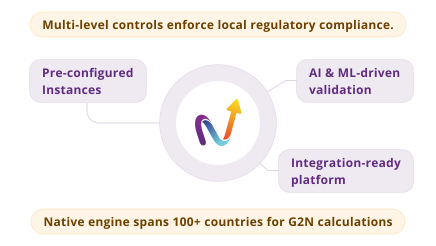
  • G2N Nova – Advanced Payroll Processing Solution: G2N Nova provides global gross-to-net payroll processing in over 100 countries, making it one of the world’s most advanced native payroll engines. Available as a SaaS solution or service delivery platform, it can operate independently or seamlessly integrate with major Human Capital Management (HCM) and Workforce Management systems.

Conclusion

In conclusion, navigating the Colombian employment landscape requires a nuanced understanding of the legal and regulatory framework. Mercans offers comprehensive Employer of Record (EOR) services, simplifying the complexities associated with workforce management, payroll, and compliance. By providing tailored solutions that adhere to the intricacies of Colombian labor laws, Mercans empowers businesses to focus on their core operations, ensuring a seamless and compliant employment experience in this dynamic South American market. With expertise spanning various aspects of human resources and a commitment to keeping abreast of legislative changes, Mercans stands as a strategic partner for businesses aiming to thrive in Colombia’s evolving business environment.

This document was prepared for informational purposes only. As local laws & regulations keeps on changing. Please consult your tax & legal advisors as well.
Contact Sales
Let's get this conversation started. Tell us a bit about your requirement, and we'll get in touch a soon as we can.

    Sample message

    1. We want to expand in $country

    2. We want you to employ 'X' number of employees on our behalf

    3. Contract duration – 3/6/9/12/18/24 months

    4. Number of legal entities (if any exist today)

    5. Employment type: EOR employee or contractor?

    6. Any benefits requirement or “standard statutory only”?

    FAQs

    What is an Employer of Record in Colombia?

    An Employer of Record in Colombia is a third-party service provider that legally employs workers on behalf of another company. They manage all employment-related responsibilities, including contracts, payroll, taxes, benefits, and compliance with Colombian labor laws, allowing businesses to hire employees without establishing a local entity.

    How can foreign companies hire employees in Colombia without establishing a local entity?

    Foreign companies can engage an EOR to hire employees in Colombia. The EOR assumes the legal employer role, handling all statutory obligations, while the client company manages the employee’s daily tasks. This approach enables businesses to operate in Colombia without the need for a local branch or subsidiary.

    What compliance and payroll services does an EOR in Colombia provide

    An EOR in Colombia ensures compliance with local labor laws by managing employment contracts, processing payroll, withholding and remitting taxes, making social security contributions, administering mandatory benefits, and completing statutory filings.

    What are the advantages of using EOR services in Colombia?

    Utilizing an EOR in Colombia offers several benefits: it simplifies market entry by eliminating the need for a local entity, ensures compliance with complex labor laws, reduces administrative burdens, mitigates legal risks, and accelerates the hiring process.

    How much does it cost to hire through an EOR in Colombia?

    The cost of hiring through an EOR in Colombia varies depending on the provider and the services included. Generally, fees can range from $500 to $2,000 per employee per month. It’s advisable to consult with the EOR provider for a detailed pricing structure.

    Is an EOR the right solution for expanding a business into Colombia?

    An EOR is an effective solution for businesses looking to expand into Colombia without the complexities of setting up a local entity. It provides a compliant and efficient way to hire employees, allowing companies to focus on their core operations while the EOR manages employment-related tasks.

    Ready to hire in Colombia?

    No local entity needed. Our experts handle payroll, compliance, and onboarding.

    Talk to an expert
    Proven expertise in global payroll.