ANSES Social Security Contributions

ANSES – Administración Nacional de la Seguridad Social – is Argentina’s national social security administration. It administers state pensions, family allowances, unemployment benefits and related social programmes. ANSES social security contributions are the monthly payroll charges that fund that system, levied on both employer and employee and calculated on remuneration.

The term is used loosely in practice. Strictly, ANSES administers the benefits; the contributions themselves are collected by the tax authority and flow into the Sistema Único de Seguridad Social (SUSS), the single social security system that ANSES draws on. Understanding that split is the first step to getting Argentine payroll right.

The vocabulary you need

Argentine payroll uses two distinct words that both translate as “contribution” in English, and conflating them is the most common source of confusion for foreign employers.

Aportes – the employee’s contributions, withheld from gross salary. The employer acts as withholding agent: it pays the full gross, deducts the aportes, and remits them.

Contribuciones patronales – the employer’s contributions, paid on top of gross salary. These never appear on the employee’s payslip but represent a substantial real cost.

Cargas sociales – the umbrella term covering both, plus the mandatory work-injury premium. This is the figure to use when discussing total employment cost.

Other terms that recur:

  • SIPA (Sistema Integrado Previsional Argentino) – the state pension system, fully public since the private AFJP scheme was wound up in 2008. There is no separate employer pension pot and no auto-enrolment equivalent; entitlement is built purely from SIPA contributions over a career.
  • Obra social – the sector- or union-linked health fund each employee is assigned to, financed by both employer and employee healthcare contributions. Employees above a threshold can redirect their contribution to a private plan (medicina prepaga).
  • INSSJP / PAMI – the institute providing healthcare to pensioners, funded by a dedicated slice of both sides’ contributions.
  • Asignaciones familiares – family allowances, funded through employer contributions and paid by ANSES directly to the employee, not through the employer’s payroll. The employer’s duty is to contribute and to register the employee’s family circumstances correctly.
  • ART (Aseguradora de Riesgos del Trabajo) – mandatory work-injury insurance, held with a licensed private insurer. The premium is commercial and varies by industry risk class, typically in the low single digits as a percentage of payroll. It is a real employment cost but sits outside the social security percentages.
  • SAC / aguinaldo (Sueldo Anual Complementario) – the statutory thirteenth salary, paid in two instalments by 30 June and 31 December, based on the highest monthly gross in each half-year. Social security contributions apply to it at the normal rates.

Who collects, who administers

  • ARCA (Agencia de Recaudación y Control Aduanero), the tax authority that replaced AFIP, collects contributions and receives the monthly payroll declaration.
  • ANSES administers the pension, family allowance and unemployment benefits funded by those contributions, and pays benefits directly to individuals.
  • The obra social receives the healthcare portion for the employee’s assigned fund.
  • The ART insurer is contracted privately by the employer.

So an employer’s monthly interaction is mostly with ARCA, even though the system is commonly called by the ANSES name.

Employee contributions: 17%

Total employee social security withholdings are 17% of gross remuneration, comprising 11% to the pension system, 3% to healthcare, and 3% to social services for pensioners.

The employee side is capped. A maximum monthly contribution base (base imponible máxima) applies, along with a minimum base. Both are index-adjusted monthly to keep pace with inflation – as of mid-2026 the maximum base sat above ARS 4.4 million per month, but the figure moves every month, so no payroll should hold it as a static value. In June and December the cap is increased by 50% to accommodate the SAC instalment.

Income tax (Impuesto a las Ganancias) is withheld separately and additionally, on a progressive scale.

Employer contributions: 24% to 26.4%, uncapped

Employer contributions are not a single national rate. They depend on the employer’s sector and size, under the framework established by Decree 814/2001 and subsequent amendments:

  • 26.4% for larger employers in services and commerce whose revenues exceed the defined thresholds.
  • 24% for other employers, including MSMEs (MiPyMEs) and non-services activity.

In each case, roughly six percentage points fund the obra social and the balance funds SIPA, PAMI, family allowances and the national employment fund. ART is on top.

Two features of the employer side deserve emphasis.

There is no ceiling. Unlike the employee’s 17%, employer contributions apply to the full gross salary with no upper limit. In countries with a contribution cap, a senior hire becomes proportionally cheaper as salary rises; in Argentina it does not. Budgeting models built on capped-contribution assumptions will understate the cost of senior hires.

A per-employee deduction from the base applies. A fixed non-taxable amount (detracción or mínimo no imponible) is subtracted from each employee’s contribution base before employer contributions are calculated, which lowers the effective rate – most noticeably at lower salary levels. Like the caps, the amount is periodically updated, so it has to be maintained rather than set once.

Filing and payment

Contributions are declared monthly on Form 931 (F.931), generated from the SICOSS payroll data set and filed with ARCA. Payment follows the monthly due date calendar, which is keyed to the employer’s tax identifier.

Registration is a separate obligation. New employees must be registered through the Mi Simplificación system before they start work, which creates the link between the employee’s CUIL (their unique labour identification number), the employer, the obra social and the ART policy. Contributions for an unregistered worker are not the problem – the unregistered employment relationship is, and it carries its own penalty regime and civil exposure.

Indexation: the recurring operational risk

Most payroll jurisdictions revise thresholds once a year. Argentina does not. Contribution caps, the non-taxable deduction, income tax brackets and minimum wage figures are all adjusted on a rolling basis, often monthly or quarterly, by resolution.

The practical consequence is that Argentine payroll cannot be configured and left alone. A parameter that was correct in March is very likely wrong by June, and the error is silent: the calculation runs, the file submits, and the amounts are simply understated or overstated. For multinational employers running Argentina alongside markets with annual update cycles, this mismatch in maintenance rhythm is the single most common cause of local non-compliance.

What’s changing

A Labour Assistance Fund (Fondo de Cese Laboral) is scheduled to take effect from November 2026 under the reform of the Employment Contract Law. It creates a funded mechanism for severance payments, financed by an additional monthly employer contribution – reported as 1% for large companies and 2.5% for micro, small and medium-sized enterprises. Employers should treat this as an incoming addition to employment cost and to the monthly filing, and confirm the final parameters as implementing regulations are issued.

Common errors

  • Treating employer contributions as capped, and under-budgeting senior headcount.
  • Holding the maximum contribution base as a static value rather than updating it monthly.
  • Missing the 50% cap uplift in the two SAC months.
  • Applying the wrong employer rate band by misclassifying the entity’s sector or size.
  • Failing to apply or update the per-employee non-taxable deduction.
  • Registering employees late through Mi Simplificación, or with an incorrect obra social or ART linkage.
  • Omitting contributions on the SAC, or calculating the SAC base on the wrong reference month.
  • Assuming family allowances flow through payroll – they are paid by ANSES directly, and the employer’s obligation is accurate registration of family data.
  • Forgetting ART when quoting total employment cost, since it sits outside the headline percentages.

How Mercans manages Argentine social security

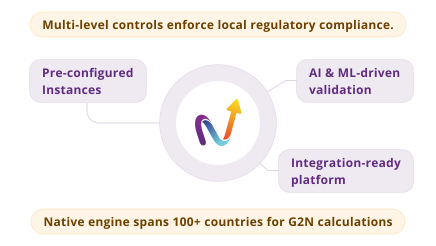
Mercans delivers managed payroll and Employer of Record services in Argentina as part of a single global platform, with social security treated as a maintained statutory service rather than a client-side configuration.

  • Parameters maintained continuously. Contribution caps, the non-taxable deduction, income tax scales and minimum wage values are updated as resolutions are issued, so calculations reflect the correct period rather than the last time someone checked.
  • Correct rate band applied. The employer contribution rate is determined from the entity’s sector and size classification and reviewed as the business changes, rather than defaulted.
  • Full gross-to-net in local terms. Aportes, contribuciones patronales, income tax withholding and SAC treatment are calculated together, including the cap uplift in June and December.
  • Form 931 preparation and filing. SICOSS data is assembled, validated against the payroll register, and filed with ARCA on the applicable due date.
  • Registration and lifecycle events. Mi Simplificación registrations, CUIL linkage, obra social assignment, ART policy alignment and terminations are handled within statutory timeframes.
  • Bilingual output. Payslips, contracts and employee self-service are available in Spanish and English, so local employees and head-office reviewers work from the same documents.
  • Global consistency. Argentina reports into the same calendar, data model and consolidated cost reporting as every other country in scope, which is where the monthly-indexation problem is usually caught before it becomes a filing error.

Frequently asked questions

What are ANSES social security contributions?

They are the monthly payroll charges that fund Argentina’s social security system – state pensions, healthcare, family allowances and unemployment benefits. Both employer and employee contribute. ANSES administers and pays the benefits, while the contributions themselves are collected by ARCA, the tax authority, and channelled through the single social security system. In everyday usage the whole arrangement is referred to by the ANSES name.

What is the difference between aportes and contribuciones?

Aportes are the employee’s contributions, withheld from gross pay by the employer acting as withholding agent, totalling 17%. Contribuciones patronales are the employer’s own contributions, paid on top of gross salary at 24% or 26.4% depending on sector and size. The employee never sees the second figure, but it is a real cost of employment. Cargas sociales is the umbrella term for both together, usually including the mandatory ART work-injury premium.

Is there a cap on Argentine social security contributions?

Only on the employee side. A maximum monthly contribution base applies to employee withholdings and is index-adjusted monthly, with a 50% uplift in June and December for the thirteenth-salary instalments. Employer contributions have no ceiling and apply to the full gross salary, which means senior hires do not become proportionally cheaper as pay rises – a point that catches out cost models imported from capped-contribution jurisdictions.

What is Form 931 and when is it due?

Form 931 is the monthly social security declaration filed with ARCA, generated from the employer’s SICOSS payroll data. It reports remuneration and both employee and employer contributions for the period. It is filed and paid monthly according to ARCA’s due date calendar, which is keyed to the employer’s tax identification number. It is the primary compliance artefact for Argentine payroll and should reconcile to the payroll register before submission.

Does the employer pay family allowances to employees?

No. Family allowances are funded through employer contributions but paid by ANSES directly to the employee. The employer’s responsibility is to make the correct contributions and to register the employee’s family circumstances accurately, since that registration determines entitlement. Paying allowances through payroll, or assuming ANSES will pay without correct registration, are both errors.

Why do Argentine payroll figures change so often?

Because contribution caps, the per-employee non-taxable deduction, income tax brackets and minimum wage levels are indexed and revised on a rolling basis rather than annually, reflecting the inflation environment. A parameter set correctly one quarter is frequently out of date the next. This is the defining operational feature of Argentine payroll compliance: the calculation is not especially complex, but it demands continuous maintenance, and errors are silent rather than obvious.