Employer of Record

Employer of Record (EOR) Equatorial Guinea

Hire compliantly, pay accurately, expand confidently.

Global Payroll Team
Written by Global Payroll Team
Published on October 7, 2026
Last updated October 7, 2026
Expert Reviewed

An Employer of Record (EOR) in Equatorial Guinea acts as the official employer for workers, often referred to as a Global Professional Employer Organization (Global PEO). This role encompasses a broad range of employment functions, ensuring full compliance with local labor laws and regulations, managing payroll, administering taxes, providing legally required benefits, and handling employment contracts.

Key Responsibilities of an Employer of Record (EOR) in Equatorial Guinea:
  • Ensuring employment terms are fully compliant with Equatorial Guinea’s labour legislation and Ministry of Labour, Social Security and Employment Promotion (MLSSPE) requirements.
  • Overseeing and processing local payroll in CFA Francs (XAF), the CEMAC-wide currency pegged to the Euro.
  • Managing registration and contributions to the Instituto Nacional de Seguridad Social (INSESO).
  • Navigating Equatorial Guinea’s strict local-hiring and local-content requirements, particularly in the hydrocarbons sector.
  • Issuing compliant payslips and disbursing salary payments in accordance with Equatoguinean standards.

With our Employer of Record (EOR) services, expanding your business into Equatorial Guinea becomes easier and more efficient. Our solution eliminates the need for setting up a local entity, providing a seamless path to establish a legal presence in Equatorial Guinea. We ensure full legal compliance, manage payroll, protect your intellectual property, and handle work permits, so you can focus on growing your business and building your workforce in Central Africa’s CEMAC economic bloc.

Things you need to know before hiring in Equatorial Guinea

Equatorial Guinea’s Labour Law Framework and Local Content Requirements

Equatorial Guinea’s employment relationships are governed by its labour legislation, most recently consolidated under the General Labour Law (Ley Núm. 4/2021), building on the framework established by the country’s long-standing 1990 Labour Code. As one of Sub-Saharan Africa’s historically significant oil producers, Equatorial Guinea also applies strict local-content and local-hiring requirements, particularly in the hydrocarbons sector, where foreign operators are commonly required to staff a high majority of positions with Equatoguinean nationals and meet minimum local equity thresholds. Employers should reconfirm the current statutory framework and any sector-specific local-content quotas before finalizing a hiring plan, since documentation in this market updates infrequently and Mercans verifies the latest requirements for each engagement.

Employment Contracts in Equatorial Guinea

Employment relationships in Equatorial Guinea are regulated by national labour legislation and enforced by the MLSSPE. An indefinite-term contract is the standard form of employment, while a fixed-term contract is used for defined-duration engagements.

Indefinite-Term Contracts

The standard, ongoing form of employment in Equatorial Guinea.

Fixed-Term Contracts

Used for defined-duration or project-based engagements. A written copy of the contract must generally be filed with the Ministry of Labour within 15 calendar days of its conclusion.

Probation Period

Commonly applied for up to 6 months depending on the role, consistent with regional CEMAC practice; Mercans confirms the applicable probation term for each role and contract type.

Mandatory Contract Terms

Employment contracts must be in writing and specify the parties, job role, remuneration, and contract duration, among other required particulars.

Working Hours

The standard working schedule in Equatorial Guinea is 8 hours per day and 48 hours per week for day workers (typically defined as 6am to 6pm); night workers are limited to 6 hours per day and 36 hours per week.

Local Content and Equatoguinean Hiring Preference

Equatorial Guinea applies some of the region’s strictest local-hiring requirements, particularly in the hydrocarbons sector: foreign operators are commonly required to staff a high majority — often cited in the 70–90% range — of their workforce with Equatoguinean nationals, often paired with mandatory training and localization plans for any foreign technical hires, alongside a minimum local equity stake commonly cited around 35% for foreign hydrocarbons companies. Mercans confirms the applicable local-content obligations for each engagement and sector.

Key Points on Overtime

Overtime Cap
Overtime is generally capped at 10 hours per day and 48 hours per week, with an annual cap commonly cited around 200 hours per year.
Overtime Premium
Overtime is commonly compensated at a minimum of 130% of the base wage for the first 4 overtime hours, rising to 160% thereafter, or alternatively compensated with paid time off by mutual agreement.
Night Work
Night workers are limited to 6 hours per day and 36 hours per week. Pregnant employees are prohibited from performing overtime work.

Termination and Severance Pay

Termination in Equatorial Guinea generally requires a valid ground, appropriate notice, and severance tied to the reason for termination and the employee’s length of service.

Notice of Termination

Economic, technological, or structural redundancies generally require 3 months’ advance notice. Resignation by the employee typically requires 15 to 30 days’ notice under the terms of the contract. Serious misconduct can permit summary dismissal without notice.

Severance Pay

Severance for redundancy-type terminations is commonly calculated at 45 days’ pay per year of service; Mercans confirms the applicable calculation for each engagement.

Protected Categories

Pregnant employees are prohibited from performing overtime work, and generally benefit from additional protection against dismissal consistent with regional labour norms.

Compensation for Unused Leave

Any accrued but unused annual leave must be paid out on termination.

Employees vs Independent Contractors

Equatorial Guinea does not have a widely publicized, codified multi-factor test for distinguishing employees from independent contractors. In practice, and consistent with general Hispanophone and Francophone civil-law principles applied across Central Africa, authorities and courts are expected to look at subordination indicators: control over working methods, schedule and tools, integration into the engaging company’s operations, and economic dependency on a single engaging party.

Misclassifying employees as independent contractors carries the same general enforcement risk seen across the region: potential retroactive social security contributions and penalties if a relationship is found to function as employment regardless of its contractual label.

Comparison Table: Employee vs Independent Contractor

Factor Employee Independent Contractor
Governing Framework National labour legislation General civil/commercial contract principles
Control & Subordination Works under the employer’s direction, schedule, and supervision Controls own working hours and methods
Registration Registered by the employer with INSESO Not registered as an employment relationship
Payment Structure Fixed monthly salary via payroll Paid per project, milestone, or invoice
Statutory Benefits Entitled to paid leave, severance, and INSESO coverage No statutory employment benefits
Misclassification Risk Not applicable Risk of reclassification and retroactive social security liability if subordination is shown

Understanding these differences is essential for ensuring compliance and correctly determining entitlements such as leave, severance, and social security contributions.

Social Security in Equatorial Guinea (INSESO)

The Instituto Nacional de Seguridad Social (INSESO) administers Equatorial Guinea’s social security system, covering old-age pensions, illness, disability, maternity, workplace risk, and survivor benefits, alongside a separate Work Protection Fund.

Contribution Employer Employee
INSESO (pension, health, maternity, work-injury, family benefits) ~21.5% ~4.5%
Work Protection Fund ~1% ~0.5%
Combined Total ~22.5% ~5%

Extraordinary bonuses, including the mandatory Independence Day and New Year’s payments described below, are generally subject to these contributions. No official wage ceiling for INSESO contributions could be independently confirmed — Mercans verifies the applicable base and rates for each engagement.

Payroll in Equatorial Guinea

Minimum Wage

Equatorial Guinea’s national minimum wage is commonly cited at XAF 129,035 per month, a figure that has been in place since 1 January 2019 with no more recent official adjustment confirmed. Mercans reconfirms the current rate for each engagement given the infrequency of updates in this market.

Payroll Cycle

Salaries in Equatorial Guinea are paid monthly in CFA Francs (XAF), pegged to the Euro at a fixed rate of 655.957 XAF = 1 EUR across the CEMAC zone. Employers are commonly required to pay a mandatory bonus equal to 15 days’ pay ahead of Independence Day (12 October) and a further 15 days’ pay ahead of New Year’s Eve (24 December).

Overtime Pay

Overtime pay is provided when an employee works beyond the standard 8-hour day or 48-hour week.

Overtime Premium

Overtime is commonly paid at a minimum 130% premium for the first 4 hours and 160% thereafter.

Annual Overtime Cap

Overtime is commonly capped around 200 hours per calendar year, subject to the daily and weekly limits described above.

Overtime rules can vary by sector, particularly within the hydrocarbons industry.

Mercans’ payroll capabilities

Payroll Cycle Management in Equatorial Guinea
Mercans delivers efficient, seamless payroll cycle management tailored to Equatoguinean requirements, including XAF-denominated payroll and mandatory bonus payments. We ensure that both employees and contractors are paid accurately and on time, providing a smooth and compliant payroll experience aligned with local standards.
Payroll Setup, Processing, and Administration
Mercans offers a complete range of payroll services from start to finish. Whether it’s setting up your payroll system, processing payments, or managing ongoing administration, we take care of every detail, ensuring accuracy, compliance, and efficiency so you can focus on running your business.
Statutory Filings and Payments
Navigating Equatorial Guinea’s regulatory framework can be complex, particularly given its strict local-content requirements and limited public documentation, but with Mercans, you’re in safe hands. We manage all statutory filings and payments, ensuring your business remains fully compliant with local tax laws and employment regulations.

Personal Income Tax in Equatorial Guinea

Equatorial Guinea applies a progressive personal income tax (Impuesto sobre la Renta de las Personas Físicas, IRPF) on annual income:

  • Up to XAF 1,400,000: 0%
  • XAF 1,400,000 – 5,000,000: 10%
  • XAF 5,000,000 – 10,000,000: 15%
  • XAF 10,000,000 – 15,000,000: 20%
  • Above XAF 15,000,000: 25% (top marginal rate)

Residents are taxed on worldwide income, while non-residents are taxed only on Equatoguinean-source income. A newer tax code has reportedly been adopted for recent years; Mercans confirms the applicable brackets and any subsequent revisions for each engagement.

Equatorial Guinea Employee Hiring Cost

When hiring an employee in Equatorial Guinea, employers must budget for gross salary plus mandatory employer INSESO and Work Protection Fund contributions.

Salary Details Amount (XAF)
Gross Monthly Salary 500,000
Employer INSESO & Work Protection Fund Contributions (~22.5%) ~112,500
Estimated Total Monthly Cost ~612,500*

*Illustrative estimate; Mercans confirms the exact contribution base, rates, and total employer cost for each engagement.

Employee Benefits in Equatorial Guinea

Equatoguinean employees are entitled to a combination of mandatory statutory benefits and, increasingly, supplementary benefits offered at the employer’s discretion.

  • Annual Leave: Commonly cited at around 1 month (approximately 30 days) per year of service, with an additional day per year of service after 10 years with the same employer.
  • Public Holidays: Equatorial Guinea observes national and religious holidays including New Year’s Day, Good Friday, Labour Day, President’s Day (5 June), Corpus Christi, Armed Forces/Freedom Day (3 August), Constitution Day (15 August), Independence Day (12 October), Immaculate Conception, and Christmas Day.
  • Sick Leave: The employer commonly pays full salary for the first 5 days of certified sick leave after 6 months of employment, with INSESO coverage applicable for extended absences subject to medical certification.
  • Maternity Leave: Commonly cited at around 14 weeks, split roughly 6 weeks before and 8 weeks after birth.
  • Paternity Leave: Commonly cited at around 2 weeks, to be used within the first month after birth.
  • INSESO Coverage: Employer- and employee-funded pension, health, maternity, and work-injury coverage, as described above.
  • Mandatory Holiday Bonuses: A 15-day pay bonus ahead of Independence Day and a further 15-day pay bonus ahead of New Year’s Eve, described above.
  • Work Protection Fund: A separate, jointly-funded contribution supplementing core INSESO coverage.
  • Local Training Programs: Many employers in regulated sectors provide structured training for Equatoguinean staff to meet local-content and localization commitments.
  • Workplace Wellness Programs: Companies are enhancing the workplace experience with wellness initiatives, including mental health support.
  • Flexible Work Options: Employers are increasingly offering flexible or hybrid working arrangements where operationally feasible.
  • Team-Building Activities: Employers are introducing more team-building and employee engagement activities.
  • Discount Programs: Some companies offer group discounts on shopping, travel, and leisure activities.

Essential Benefits for Employees in Equatorial Guinea
  • Annual Leave: Commonly cited at around 1 month (approximately 30 days) per year of service, with an additional day per year of service after 10 years with the same employer.
  • Public Holidays: Equatorial Guinea observes national and religious holidays including New Year’s Day, Good Friday, Labour Day, President’s Day (5 June), Corpus Christi, Armed Forces/Freedom Day (3 August), Constitution Day (15 August), Independence Day (12 October), Immaculate Conception, and Christmas Day.
  • Sick Leave: The employer commonly pays full salary for the first 5 days of certified sick leave after 6 months of employment, with INSESO coverage applicable for extended absences subject to medical certification.
  • Maternity Leave: Commonly cited at around 14 weeks, split roughly 6 weeks before and 8 weeks after birth.
  • Paternity Leave: Commonly cited at around 2 weeks, to be used within the first month after birth.

Additional Employee Benefits
  • INSESO Coverage: Employer- and employee-funded pension, health, maternity, and work-injury coverage, as described above.
  • Mandatory Holiday Bonuses: A 15-day pay bonus ahead of Independence Day and a further 15-day pay bonus ahead of New Year’s Eve, described above.
  • Work Protection Fund: A separate, jointly-funded contribution supplementing core INSESO coverage.
  • Local Training Programs: Many employers in regulated sectors provide structured training for Equatoguinean staff to meet local-content and localization commitments.

Perks & Wellness Initiatives
  • Workplace Wellness Programs: Companies are enhancing the workplace experience with wellness initiatives, including mental health support.
  • Flexible Work Options: Employers are increasingly offering flexible or hybrid working arrangements where operationally feasible.
  • Team-Building Activities: Employers are introducing more team-building and employee engagement activities.
  • Discount Programs: Some companies offer group discounts on shopping, travel, and leisure activities.

Work Permit in Equatorial Guinea

Foreign nationals working in Equatorial Guinea require both a work authorization and a residence permit, processed through two separate government bodies.

Work and Residence Authorization

The Ministry of Labour, Social Security and Employment Promotion (MLSSPE) issues the work/employment authorization, commonly cited at around 7 days for a decision once a complete application is submitted, while the Ministry of National Security handles the visa and residence card. Overall timelines are commonly cited in the range of 3 to 6 weeks, extending to 1 to 3 months depending on application completeness and sector-specific review.

Local Content and Hydrocarbons Sector Quotas

As described above, foreign operators — particularly in the hydrocarbons sector — are commonly required to staff a high majority of their workforce with Equatoguinean nationals and meet minimum local equity requirements, which directly shapes how many foreign work permits a company can realistically obtain and sustain.

Important Considerations for Employers

Employer Sponsorship

A registered entity in Equatorial Guinea is generally required to sponsor a foreign employee’s work and residence authorization — an EOR partner such as Mercans allows companies without a local entity to still hire and sponsor talent compliantly, while also navigating local-content obligations.

OHADA Business Law Context

Equatorial Guinea is a member of OHADA (Organisation pour l’Harmonisation en Afrique du Droit des Affaires), whose Uniform Acts govern company formation and commercial law regionally, though local entity setup remains a slow and costly process in practice.
Understanding these pathways can streamline the hiring process, allowing employers to bring skilled talent into their Equatorial Guinea-based operations effectively.

EOR Solutions in Equatorial Guinea

EOR Solutions for Prospective Employees in Equatorial Guinea
Mercans provides efficient Employer of Record (EOR) services for businesses that have already identified their ideal candidates in Equatorial Guinea. Our comprehensive services cover the entire employee lifecycle, ensuring full compliance with Equatoguinean labor laws, tax regulations, and employment standards, so you can focus on your business growth without the administrative burden.
EOR + Recruitment: Streamlined Talent Acquisition
For businesses seeking assistance with talent acquisition, our EOR and recruitment solutions offer a complete, end-to-end service, helping you find, hire, and retain top talent in Equatorial Guinea while ensuring all recruitment and compliance requirements are met.
Visa Sponsorship and Global Mobility Solutions
Navigating the complexities of expatriate employment becomes straightforward with our visa sponsorship and global mobility services. Mercans ensures a smooth relocation process for your international workforce, handling all aspects of Equatoguinean immigration and employment laws to guarantee compliance.
AOR Services for Contractor Payments
For businesses managing contractor payments in Equatorial Guinea, Mercans offers Agent of Record (AOR) services, handling the complexities of independent contractor payments to ensure accurate, timely, and fully compliant payments while managing misclassification risk.
Converting Freelancers to Employees in Equatorial Guinea
Mercans supports businesses transitioning freelancers and contractors to full-time employees in Equatorial Guinea, ensuring a smooth, legally compliant conversion process.
HCM Integration for Enhanced Workforce Management
Integrate Mercans’ EOR services with your Human Capital Management (HCM) system for a unified, real-time approach to data exchange, compliance tracking, and payroll management in Equatorial Guinea.

Best Employer of Record Equatorial Guinea

Mercans stands out as a leading Employer of Record (EOR) provider in Equatorial Guinea for several key reasons:

  • Full Compliance with Equatoguinean Labor Laws: Mercans ensures strict compliance with Equatorial Guinea’s labour legislation, INSESO requirements, and local-content obligations, keeping your business aligned with local labor law and protecting you from potential legal risk.
  • Independent Operations: As a fully independent entity, Mercans operates without external affiliations, delivering reliable, customized employment services tailored to your business requirements in Equatorial Guinea.
  • Supports All Employment Types: Whether you’re hiring employees, contractors, or expatriates, Mercans offers flexible solutions across a variety of workforce models.
  • Designed for Large Enterprises: Our scalable solutions meet the demands of enterprise-level organizations, including those operating in the hydrocarbons sector, integrating with your broader global business goals.
  • Multi-Currency Payroll Management: Mercans handles multi-currency payroll, simplifying salary management across multiple countries alongside Equatorial Guinea.
  • Global Network and Multi-Country Payroll Expertise: With a robust global presence, Mercans manages multi-country payroll seamlessly across Central Africa and beyond, handling local tax regulations and compliance requirements wherever your teams are based.
  • Certified Data Protection and Security Standards: Mercans adheres to stringent data protection protocols, including GDPR certification and SOC 1 & SOC 2 compliance.
  • ISO-Certified Service Quality and Security: Mercans holds ISO 20000 and ISO 27001 certifications, reflecting our commitment to excellence in IT service management and information security.
  • OWASP ASVS 3.0 Compliant: We adhere to OWASP ASVS 3.0 standards, protecting your business through secure software development and management practices.
  • Mercans HRBlizz: Our proprietary global payroll and talent management SaaS platform simplifies payroll while ensuring full compliance with local labor laws in Equatorial Guinea, backed by a team of in-country specialists.
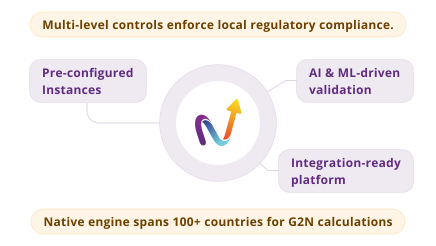
  • G2N Nova: Our advanced gross-to-net payroll engine, available in over 100 countries, integrates with major HCM and Workforce Management systems for a unified global payroll process.

Conclusion

Mercans provides comprehensive Employer of Record (EOR) services in Equatorial Guinea, ensuring accuracy, compliance, and efficiency in managing your workforce, including navigating the country’s local-content requirements. Our end-to-end solutions simplify payroll and employment processes, making us a trusted partner for businesses navigating the complexities of the Equatoguinean labor market. With Mercans by your side, your expansion into Equatorial Guinea will be smooth, compliant, and successful, allowing you to focus on growing your business with confidence.

This document was prepared for informational purposes only. As local laws & regulations keeps on changing. Please consult your tax & legal advisors as well.
Contact Sales
Let's get this conversation started. Tell us a bit about your requirement, and we'll get in touch a soon as we can.

    Sample message

    1. We want to expand in $country

    2. We want you to employ 'X' number of employees on our behalf

    3. Contract duration – 3/6/9/12/18/24 months

    4. Number of legal entities (if any exist today)

    5. Employment type: EOR employee or contractor?

    6. Any benefits requirement or “standard statutory only”?

    FAQs

    What is an Employer of Record (EOR) in Equatorial Guinea?

    An Employer of Record (EOR) in Equatorial Guinea is a third-party organization that legally employs workers on behalf of another company, handling payroll, INSESO social security contributions, tax withholding, and compliance with Equatorial Guinea’s labour legislation, without the client company needing to set up a local entity.

    Can a foreign company hire employees in Equatorial Guinea without a local entity?

    Yes. By partnering with an EOR such as Mercans, a foreign company can hire employees in Equatorial Guinea without registering a local branch or subsidiary. The EOR acts as the legal employer, managing contracts, payroll, INSESO registration, and statutory compliance on the company’s behalf.

    Do local-content and local-hiring rules apply to foreign companies in Equatorial Guinea?

    Yes, particularly in the hydrocarbons sector, where foreign operators are commonly required to staff a high majority of their workforce with Equatoguinean nationals and meet minimum local equity requirements. An EOR helps employers navigate these local-content obligations alongside standard employment compliance.

    What compliance, payroll, and HR services does an EOR manage in Equatorial Guinea?

    An EOR manages drafting and executing compliant employment contracts, monthly payroll processing in CFA Francs (XAF), INSESO registration and contributions, personal income tax withholding, issuing compliant payslips, and administering statutory leave and benefits in line with Equatoguinean labor law.

    How much does an EOR service cost in Equatorial Guinea?

    EOR pricing varies by provider and the scope of services required, and is typically charged as a flat monthly fee per employee or a percentage of payroll. Mercans provides tailored pricing based on your specific hiring needs in Equatorial Guinea.

    Is EOR suitable for expanding into Equatorial Guinea?

    Yes. EOR is well suited to companies testing the Equatoguinean market, placing a small number of technical or expatriate staff, or needing to move quickly without the time and cost of setting up a local entity, while staying compliant with Equatorial Guinea’s local-content and work permit requirements.

    Ready to hire in Equatorial Guinea?

    No local entity needed. Our experts handle payroll, compliance, and onboarding.

    Talk to an expert
    Proven expertise in global payroll.