Employer of Record

Employer of Record (EOR) in Costa Rica

Hire compliantly, pay accurately, expand confidently.

Global Payroll Team
Written by Global Payroll Team
Last updated April 24, 2026
Expert Reviewed

An Employer of Record, also known as a Global Professional Employer Organization (Global PEO), assumes the vital role of the legal employer for workers in Costa Rica. This comprehensive function involves overseeing various employment facets, ensuring strict compliance with local labor laws, and efficiently managing essential processes like payroll, taxes, statutory benefits, and the creation of employment agreements.

Key responsibilities of the Employer of Record (EOR) include:
  • Ensuring meticulous adherence to Costa Rica’s employment laws.
  • Managing the local payroll process with precision.
  • Handling the filing of employment-related taxes and essential paperwork.
  • Providing detailed payslips to the worker.
  • Timely distribution of the worker’s salary payments.

Our Employer of Record (EOR) services in Costa Rica ensure legal compliance, including Intellectual Property protection, allowing your business to focus on core activities. Facilitate seamless global mobility, work visas, and foster a diverse and efficient global workforce. Partner with Mercans, your dedicated Employer of Record in Costa Rica, for a compliant and efficient employment experience for your global workforce.

Things you need to know before hiring in Costa Rica

EOR Solutions in Costa Rica

EOR for Prospective Employees

Mercans offers seamless Employer of Record (EOR) solutions for businesses that have already identified their ideal candidates in Costa Rica. Our services encompass every aspect of the employee lifecycle, ensuring compliance with Costa Rican labor laws and regulations.

EOR + Recruitment

For those seeking assistance in talent acquisition, our EOR and recruitment services provide a holistic solution. We tap into our extensive network and expertise to help you find, onboard, and retain top talent, streamlining your expansion into the Costa Rican market.

Visa Sponsorship and Global Mobility

Navigating the intricacies of expatriate employment is simplified through our visa sponsorship and global mobility services. We facilitate the relocation of your international workforce, ensuring compliance with Costa Rica immigration and employment laws.

AOR for Contractor Payments

Businesses grappling with contractor payments can leverage our Assistance on Record (AOR) services. We handle the complexities of contractor payments, guaranteeing accuracy and compliance.

Converting Freelancers to Employees

Mercans supports the transition from independent contractors to permanent employees in Costa Rica. Our expertise ensures smooth conversions while adhering to legal requirements.

HCM Integration

Integrate Mercans’ EOR services seamlessly with your HCM system in Costa Rica for real-time data exchange, enhanced compliance, and cost-efficiency. Trust our expertise for a unified, compliant, and efficient approach, elevating your workforce management and payroll operations.

Employees vs Independent Contractor Compliance

FactorEmployeeIndependent Contractor
Governing lawGoverned by the Labor Code and mandatory labor protections. An employment contract exists where there is service, remuneration, and dependence/subordination.Usually governed by civil/commercial services contract rules. But if the facts show subordination, it can be reclassified as employment.
How the relationship is classifiedReality of the relationship controls. The Labor Code presumes an employment contract where one person provides services to another under dependence and for pay.Must be genuinely independent: no employer-style control, no labor subordination, own business risk, and services provided under a commercial/professional arrangement.
Contract / hiring formIn most cases should be in writing; the Code also recognizes some cases where contracts may be verbal. Lack of a written contract is generally attributed against the employer.Usually engaged through a professional services / service agreement. Contract wording helps, but actual working conditions matter more than labels
Payroll vs invoicingPaid through payroll. No invoice is issued. (Hacienda)Usually paid against electronic invoice/comprobante electrónico as part of an economic activity.
Income tax — employee (2026)Monthly salary tax: up to CRC 918,000 exempt; excess up to CRC 1,347,000 at 10%; up to CRC 2,364,000 at 15%; up to CRC 4,727,000 at 20%; excess over CRC 4,727,000 at 25%. (Hacienda)Not taxed under salary withholding rules. Contractor generally files own income tax based on business activity.
Income tax — contractor / self-employed (2026)Not applicable as business income. (Hacienda)Annual individual business-income bands: up to CRC 6,244,000 exempt; then 10% / 15% / 20% / 25% on the progressive bands published by Hacienda
VAT (IVA)Salary payments are not treated as invoiced VAT-able services.Services may be subject to 13% VAT, unless exempt or otherwise outside the tax. So “contractors always pay VAT” is too broad.
Minimum wageMust comply with the applicable minimum wage category set by MTSS / Consejo Nacional de Salarios. 2026 minimum wages were increased by 1.63% generally, with special adjustments for some categories.No labor-law minimum wage rule as such; compensation is set by contract.
VacationStatutory right: minimum 2 weeks of paid vacation for every 50 weeks of continuous work with the same employer. (MTSS)No statutory labor vacation entitlement unless contractually agreed.
Aguinaldo (13th salary)Mandatory. Must be paid within the first 20 days of December. (MTSS)Not a statutory labor benefit unless expressly agreed in the contract.
Termination rightsMay trigger preaviso and cesantía depending on the facts and termination basis. The Labor Code sets notice and severance rules for indefinite-term employment.No labor-law severance/preaviso regime as such; rights depend on the commercial contract.
Maternity / protected labor rightsEmployees have statutory maternity and other labor protections under labor law.No automatic labor-law maternity or statutory employee protections unless reclassified as employment.
Social security — employee side (2026)Worker contributions include SEM 5.50%, IVM 4.17%, and Banco Popular 1.00%. (CCSS)Independent worker contribution is not one fixed universal %; it depends on CCSS category/scale and reported income.
Social security / payroll — employer side (2026)Employer contributions include SEM 9.25%, IVM 5.42%, plus payroll-related items such as Banco Popular 0.25%, FCL ১ৱ50%, and ROP 2.00%. This means the screenshot line saying “26.83% to CCSS” is not precise if labeled as CCSS only. (CCSS)No employer payroll contribution as for an employee, but the contractor may have to contribute directly to CCSS as an independent worker.
Payment timingAccording to payroll cycle and labor arrangement.According to contract terms, commonly after invoice issuance/acceptance.
Tools / exclusivity / controlEmployer can direct work, schedule, internal rules, and supervision consistent with labor subordination.Should operate with more independence; too much control, exclusivity, or supervision increases reclassification risk.
Misclassification riskIf treated as contractor when the person is really an employee, the company may face back liabilities for wages, benefits, social security, and other labor exposure.Contractor status must be genuine. A services contract does not override the true legal nature of the relationship.

This table highlights the distinctions between employees and independent contractors in Costa Rica across various factors, encompassing employment laws, hiring practices, tax documents, remuneration, workers’ rights, benefits, payment methods, classification criteria, contracting models, engagement models, and tax obligations.

Employment Contracts in Costa Rica

Section 18 of the Labor Code in Costa Rica establishes the presumption of a contract, whether written or oral, between the employer and the worker. The mere initiation of the working relationship is enough to assume the existence of a contract, binding the two parties to adhere to the obligations and rights established by law.

Any agreements made by the parties in the labor relationship, whether written or not, become integral to it if they form part of the current conditions. This aligns with a fundamental principle of local labor law, known as the “Contrato Realidad” or Reality Contract, emphasizing the actual contents of the employment relationship, even if different from the written agreement, favoring the employee.

According to Costa Rican Labor Law, work contracts are essential under three circumstances:
  • When personal service is rendered exclusively by the hired individual.
  • When there is a salary or remuneration.
  • When the contracted worker is under the direction and supervision of an employer or their representative, referred to as legal subordination.

Legal subordination grants the employer general management power over the contracted individual concerning the agreed-upon work and business. The employer has the authority to give orders and instructions, and the worker is obligated to comply. Refusal to comply may lead to the employer exercising disciplinary power, with sanctions commensurate to the offense under Costa Rican Labor Law.

Contrary to common belief, a written contract is not a necessity under Costa Rican Labor Law. Oral contracts hold the same weight in terms of rights and obligations. In cases where contracts are not in writing, they are verified by testimonial evidence. Witness testimonies, especially those in the service of the same employer, play a crucial role in confirming the essential points of the contract.

The classification of work contracts in Costa Rica can be based on various criteria. Individual contracts apply when a single worker is hired, and the most significant classification pertains to the duration:

  • Fixed-term contracts specify a predetermined termination date.
  • Contracts of indefinite or indeterminate time have no specified end date.

Additionally, employers can enter into agreements for specific tasks or work, providing flexibility under Costa Rican Labor Law.

Working Hours

In Costa Rica, working days are divided into day shifts and night shifts, with the mixed shift combining elements of both:

  • Day Shift Between 5:00 a.m. and 7:00 p.m., allowing for 8 hours per day and a total of 48 hours per week. In healthy and non-hazardous conditions, an accumulated day shift may extend up to 10 hours per day without exceeding 48 hours per week.
  • Night Shift Spanning from 7:00 p.m. to 5:00 a.m., permitting 6 hours per day and a total of 36 hours per week.
  • Mixed Shift Involving both day and night hours, generally allowing 7 hours per day and a total of 42 hours per week. If the shift exceeds 3.5 hours after 7:00 p.m. or before 5:00 a.m., it is treated as a night shift.

Probation Period

The probationary period in Costa Rica is generally three months. During this period, an indefinite-term contract can usually be terminated without notice or payment in lieu of notice. This three-month probation also applies to domestic workers.

For employment periods exceeding three months but less than six months, a one-week notice period is required. If the employment duration is over six months but less than one year, a two-week notice period is mandated. In cases of employment lasting one year or more, a one-month notice is obligatory. The notice should be provided in writing, but in the case of a verbal contract, the employer can give verbal notice in the presence of two witnesses. Failure to give the required notice necessitates payment in lieu of notice, equivalent to the salary the employee would have earned during the notice period.

13th Month Salary

In Costa Rica, the mandatory 13th-month salary, commonly referred to as “aguinaldo,” serves as a Christmas bonus for employees. This bonus is calculated based on the ordinary and extraordinary salaries earned from 1 December of the previous year to 30 November of the relevant year, divided by twelve, and must be disbursed by employers no later than 20 December each year.

Payroll in Costa Rica

Minimum Wages

Minimum wages in Costa Rica are set by the National Salary Council and published in La Gaceta through the applicable minimum wage decree. As of 2026, the minimum wage list in force is based on Decree No. 45303-MTSS, effective from 1 January 2026.

The minimum wage varies by occupational category and payment unit. Illustrative 2026 figures include ₡12,436.41 per day for certain unskilled occupations, ₡13,991.86 per day for many semi-skilled and skilled occupations, ₡268,731.31 per month for domestic work, and ₡796,921.00 per month for licenciates where the monthly category applies.

In the majority of cases, employee wages are market-driven and often surpass the minimum wage standards. Employers compensating above the applicable minimum wage must still ensure that the wage structure remains compliant with the relevant occupational classification and current decree.

Payroll Cycle

In Costa Rica, salary may be paid by month, quincena, week, day, or hour, depending on the contractual arrangement and the nature of the role. As a general rule, the payment period cannot exceed a fortnight for manual workers or one month for intellectual workers and domestic employees.

Mercans’ payroll capabilities

Global Expertise
Mercans offers comprehensive payroll services globally, ensuring compliance with local regulations and standards.
Local Currency Payments
Payroll processing includes payments to employees and contractors in the local currency, facilitating seamless financial transactions.
Payroll Setup
Mercans provides expert assistance in setting up payroll systems tailored to local requirements, ensuring accuracy and efficiency.
Payroll Processing
The company excels in the efficient processing of payroll, handling various aspects such as salary calculations, deductions, and bonuses.
Payroll Administration
Mercans takes care of the administrative tasks associated with payroll, including record-keeping, documentation, and compliance monitoring.
Statutory Filings
Ensuring compliance with local laws, Mercans manages the timely filing of statutory documents, reducing the administrative burden on clients.
Payment Processing
The payroll capabilities extend to secure and timely payment processing, guaranteeing that employees receive their salaries accurately and on schedule.
Tax Compliance
Mercans navigates the complexities of local tax regulations, ensuring that payroll processes align with tax obligations.
Custom Solutions
Tailoring payroll solutions to meet the specific needs of clients, Mercans provides flexibility and scalability as businesses evolve.
Technology Integration
Leveraging advanced technologies, Mercans integrates modern tools for payroll management, enhancing accuracy and efficiency.
Advisory Services
Beyond basic payroll functions, Mercans offers advisory services to guide clients on optimizing payroll processes, minimizing risks, and ensuring best practices.
Legal Compliance
Mercans prioritizes legal compliance, staying abreast of changing regulations and adjusting payroll processes accordingly.
Global Workforce Support
Recognizing the diverse needs of a global workforce, Mercans supports clients in managing payroll for employees working across different countries and regions.

Explore Mercans’ full suite of payroll capabilities to streamline your global workforce management here: Mercans

Social Security and Income Tax in Costa Rica (page 22)

The labor legislation in Costa Rica encompasses social costs, referred to as “cargas sociales,” that support the country’s social security system. Both employers and employees contribute to these costs. The employee’s portion is withheld by the employer from salary and remitted to the Caja Costarricense del Seguro Social (CCSS), together with the employer’s contribution and other applicable parafiscal contributions.

The breakdown of social security costs for both employees and employers is detailed below:

Social CostEmployeeEmployerNotes
Medical & Maternity (SEM)5.50%9.25%Published by CCSS for 2026.
Old Age, Disability & Death (IVM)4.17%5.42%Increased for 2026–2028.
Banco Popular1.00%0.25%CCSS shows employer Banco Popular contribution at 0.25%; Banco Popular/SUPEN materials also reflect the worker 1.00% and employer 0.25% structure.
Family Welfare (FODESAF)0.00%5.00%Employer-side parafiscal contribution. CCSS materials identify FODESAF among the employer-collected charges.
INA (Training Institute)0.00%1.50%Employer-side contribution collected through the system.
IMAS0.00%0.50%Employer-side contribution collected through the system.
Complementary Pension (ROP / OPC)0.00%2.00%Built from the 3% employer LPT contribution: 1.5% direct plus 0.5% and 0.25% channels described in official pension/Banco Popular materials.
Labor Capitalization Fund (FCL)0.00%1.50%Half of the 3% employer contribution under the Ley de Protección al Trabajador.

Additionally, Labor Risk Insurance is compulsory under the Costa Rican Labor Code. Employers must pay this policy to the National Insurance Institute, a state-owned insurance provider, based on rates that vary according to the occupational risk profile of the employee’s role. Separately, from January 2026, the total contribution rate for the IVM pension regime increased from 11.16% to 11.66%.

Individuals are entitled to tax credits, outlined as follows:

Allowances

  • Child: CRC 1,710 per month
  • Spouse: CRC 2,590 per month

Note: These tax credits apply subject to the statutory eligibility conditions in force for salaried taxpayers.

Notably, income tax exemptions are granted for Christmas bonuses, Social Security contributions, severance, and termination payments to the extent provided by Costa Rican law.

Costa Rica Employee Hiring Cost

The total cost of employment in Costa Rica is not limited to gross salary. Employers should also budget for mandatory social security contributions, labor risk insurance, aguinaldo accrual, paid leave, and any other statutory or contractual benefits applicable to the role. The precise cost depends on salary level, occupational classification, insurance risk rate, and the employer’s overall compensation structure.

Payment of Tax

Employees who receive salaries and other similar or complementary remunerations or benefits must pay a monthly income tax that is withheld by the employer from the monthly payroll. Individuals generally do not need to file an annual tax return for employment income subject exclusively to payroll withholding. Self-employed individuals are subject to a different regime and may have advance payment and annual filing obligations.

Personal Income Tax

Income Level Tax Rate
  • Up to CRC6,244,000 annually: Exempt
  • Above CRC6,244,000 to CRC8,329,000 annually: 10%
  • Above CRC8,329,000 to CRC10,414,000 annually: 15%
  • Above CRC10,414,000 to CRC20,872,000 annually: 20%
  • Above CRC20,872,000 annually: 25%
Income Level Tax Rate
Up to CRC918,000 monthly: Exempt

  • Above CRC918,000 to CRC1,347,000 monthly: 10%
  • Above CRC1,347,000 to CRC2,364,000 monthly: 15%
  • Above CRC2,364,000 to CRC4,727,000 monthly: 20%

Above CRC4,727,000 monthly: 25%

Effective from January 1, 2026, the above tax brackets apply to salaried employees, pensioners, and retirees.

Employee Benefits in Costa Rica

Statutory Leaves

Annual Leave
  • Governed by the Costa Rica Labor Code.
  • Regulations cover working hours, vacations, and holidays.
  • Limits daily and weekly working hours.
  • Employees are entitled to a minimum of two weeks of paid annual leave for every fifty weeks of continuous work with the same employer.
Weekly Holidays and Public Holidays
  • Employees are entitled to weekly rest days and public holidays.
  • Some holidays are of mandatory payment and others are non-mandatory payment, depending on the statutory calendar and salary modality.
  • Employees who work on an applicable public holiday are generally entitled to double pay, with overtime on a holiday attracting the corresponding additional premium.
  • Exceptions may apply for specific activities authorized by law.
Domestic Employees
  • Domestic employees are covered by special rules under Costa Rican law.
  • Individual employment contracts should clearly outline working time, rest, and leave entitlements while preserving statutory rights.
Bereavement Leave
  • No general statutory bereavement leave is expressly established in the Costa Rican Labor Code for all private sector employees.
  • Such leave is typically governed by employer policy, collective bargaining agreements, or individual agreement.
Maternity Leave
  • Special regulations apply under the Costa Rica Labor Code and the CCSS health insurance framework.
  • One month before and three months after childbirth.
  • The maternity subsidy is generally financed 50% by the employer and 50% by the CCSS.
  • Termination during pregnancy or protected maternity periods can lead to legal consequences.
Parental Leave
  • Costa Rican law recognises specific maternity and paternity protections.
  • Paternity leave and related protections exist under current legislation.
  • There is no broad, general parental leave regime equivalent to maternity leave for all other caregiving situations.
Sick Leave
  • Employers pay at least 50 percent of salary for the first three days of sickness absence.
  • Under the CCSS framework, the cash sickness subsidy generally begins from the fourth day of incapacity.
  • Medical certification and CCSS rules determine eligibility and continuation.
Sabbatical Leave
  • Not explicitly regulated by Costa Rican labor law.
  • Any sabbatical arrangement is generally contractual or policy-based.
  • Employers should document any such leave clearly, including its effect on salary, benefits, and social security reporting.
Weekly Holidays
  • All employees are entitled to weekly and public holidays in addition to earned vacation time.
  • Public holidays are governed by the annual MTSS holiday calendar and the applicable salary modality.
  • Non-Christian employees may seek alternative arrangements for religious observance subject to employer agreement and operational requirements.
  • Exceptions exist for certain establishments and activities permitted by law.
  • Specific pay consequences apply where work is required on weekly holidays or public holidays.
Paid Annual Leave
  • Two weeks of annual paid leave for every 50 weeks of work.
  • Entitlement to proportional vacation pay may arise if employment ends before the full period is completed.
  • Vacation compensation in cash is restricted and only allowed in limited circumstances permitted by law.
  • Employee contracts must align with the Costa Rica Labor Code, preserving employee rights.
Paid Public Holidays
  • In 2026, mandatory-payment holidays include January 1, April 11, Holy Thursday, Holy Friday, May 1, July 25, August 15, September 15, and December 25.
  • In 2026, August 2, August 31, and December 1 are non-mandatory-payment holidays under the MTSS calendar.
  • Employees working on applicable statutory holidays are generally entitled to double pay.
Holidays and Vacations for Domestic Employees
  • Different rules apply to domestic employees under the special regime.
  • Individual employment contracts should determine working conditions while respecting statutory minimums.
  • Domestic workers remain entitled to statutory holidays, vacation rights, and social security registration where applicable.
Public Healthcare
  • Costa Rica’s public healthcare system is administered by the Caja Costarricense de Seguro Social (CCSS).
  • Access depends on insured status, registration, and payment of the corresponding contributions where required.
  • For employment purposes, registration with CCSS is a core compliance requirement for covered employees.
Private Healthcare
  • Private healthcare is available through private insurers and providers, including the National Insurance Institute (INS) products and private hospitals.
  • Employers sometimes offer private medical coverage as an additional benefit.
  • Private coverage does not replace mandatory social security obligations where those apply.
Hospitals and Payment
  • Costa Rica has an extensive public healthcare network operated by the CCSS, alongside private hospitals and clinics.
  • Payment arrangements vary depending on whether treatment is received through the public or private system.
  • Private providers may require direct payment, reimbursement processes, or private insurance coverage.
Working Hours in Costa Rica
  • Working hours are subject to statutory limits and should be stated in employer-employee contracts.
  • General pattern: eight hours a day for day work, not exceeding 48 hours a week.
  • Night and mixed shifts have lower ordinary limits under the Labor Code.
  • Breaks may be provided according to the work schedule and internal policies, subject to legal requirements.
Business Days
  • Business days vary by industry and employer operations.
  • Public sector and banking schedules may differ from private sector commercial schedules.
  • Retail, hospitality, and service businesses often operate on weekends and holidays subject to labor law rules.
  • Operating hours should be reviewed case by case for the relevant sector.

.

Overtime
  • Night shifts are limited to six hours per day and 36 hours per week, unless a special lawful regime applies.
  • Overtime is exceptional and should not become a regular substitute for ordinary working time.
  • Overtime is paid at 50% above the regular hourly wage.
  • Work performed on a holiday triggers the applicable holiday premium, and overtime on such days increases the cost further.

Termination, Severance Pay and Notice Period

Severance Pay

In Costa Rican law, Severance Pay, termed as “auxilio de cesantía,” is a benefit granted when the termination of employment results from causes not attributed to the employee. It is considered an “expected right” or “not consolidated right” of the worker, ensuring compensation in case of unforeseen job termination.

Employment Termination

The termination of employment in Costa Rica is regulated by the Labor Code, granting the right to both employers and employees to end the working relationship. Employers can terminate within the first three months or later for serious faults committed by the worker. These faults include acts against morality, attacks on the employer or colleagues, criminal acts, and unjustified absences.

Employees also possess the right to terminate the contract without responsibility if serious faults are committed by the employer, such as lack of payment, immoral acts, or endangering health and safety.

Notice Period and Severance Payment

Section 28 of the Labor Code allows either party to terminate the contract without cause, provided prior notice (preaviso) is given. If the notice is not given when required, the employee is entitled to compensation in lieu of notice equivalent to the salary corresponding to that notice period.

The notice period varies based on the duration of employment: one week for over three months but less than six months, two weeks for over six months but less than a year, and one month for employment exceeding a year.

If the termination occurs without justification after three months of service, the employer is obligated to pay severance. The severance amount increases with the duration of service, potentially reaching up to twenty-two days per year worked, with the calculation capped in accordance with the Labor Code.

Notice Period Calculation

The notice period calculation is contingent on the employee’s tenure. For employment over three months but less than six months, the notice period is one week. For employment over six months but less than a year, the notice period is two weeks. Finally, for employment exceeding a year, the notice period is one month. These provisions ensure a fair and structured approach to employment termination in Costa Rica.

Work Permit

Permanent Residence Permit

Issued in cases recognised by immigration law, including certain family-based categories and other qualifying grounds established by the Dirección General de Migración y Extranjería (DGME).

Provides indefinite residence rights, and holders generally have broader work rights than temporary residents, subject to the conditions of the approved category.

Temporary Residence Permit

Issued for specific purposes and categories recognised by Costa Rican immigration law, such as employment, family connection, investment, or other authorised grounds.

Temporary residence is granted for a defined validity period and is renewable subject to compliance. Work rights depend on the specific category approved by the DGME.

Differences

Permanent permits are indefinite, while temporary permits are granted for limited periods and renewed when eligibility continues.

Temporary permits do not automatically grant unrestricted work rights; the right to work depends on the specific residence category and the immigration approval obtained.

Permanent residence generally offers broader rights, including the ability to work under conditions similar to those applicable to other lawful residents.

For Provisional Visa at Consulate

Letter of application to the relevant authority, detailing personal information, reason for residency, and the immigration category sought.

Birth certificate, police clearance, valid passport, and copies, as applicable to the category.

Additional documents if applying based on a Costa Rican relative, employment sponsorship, investment, or another qualifying basis.

Proof of financial means and payment of the applicable government fees, where required.

For Residence Permit at Immigration Department

Completed application form.

Letter of application addressed to the immigration authority with the details required for the chosen category.

Civil status documents, police clearance, passport copies, proof of legal entry, photographs, and any category-specific supporting documents.

Additional documents related to the purpose of travel, stay, or employment, depending on the case.

Proof of financial means, social security compliance where applicable, and payment of the residence application fees.

Work Permits

Foreign nationals who will work in Costa Rica must hold an immigration status or authorisation that permits employment.

Work authorisation is category-specific and assessed by the DGME and, where relevant, supported by employer documentation.

Certain temporary residence categories may allow business ownership or investment without permitting day-to-day employee work unless the immigration category expressly authorises it.

Residence Permit

Permanent Residence Permit

  • Issued in cases recognised by immigration law, including certain family-based categories and other qualifying grounds established by the DGME.
  • Provides indefinite residence rights, with broader work rights than most temporary categories, subject to the approved status.

Temporary Residence Permit

  • Issued for specific legal categories, including employment, family connection, investment, and other approved purposes.
  • Granted for a defined period, renewable, and work rights depend on the immigration category approved.

Differences

  • Permanent permits are indefinite, while temporary permits have limited validity and require renewal.
  • Temporary permits may not automatically grant unrestricted work rights.
  • Permanent permits generally offer broader rights, including residence and employment rights subject to applicable law.

Application Requirements

For Provisional Visa at Consulate

  • Letter of application describing personal details and the immigration category requested.
  • Birth certificate, police clearance, valid passport, and copies, where applicable.
  • Additional documents if applying through a Costa Rican relative, employer, investment, or another qualifying route.
  • Proof of financial means and payment of applicable fees.

For Residence Permit at Immigration Department

  • Completed application form.
  • Letter of application to the immigration authority with the required details.
  • Proof of legal entry, civil documents, police clearance, and passport copies.
  • Supporting documents tied to the relevant immigration category.
  • Proof of financial means, social security compliance where applicable, and payment of the government filing fees.

Navigating the residency process in Costa Rica involves a detailed submission of documents, adherence to specific guidelines, and understanding the nuances of work permit availability based on the type of residency sought.

EOR Solutions in Costa Rica

EOR for Prospective Employees
Mercans offers seamless Employer of Record (EOR) solutions for businesses that have already identified their ideal candidates in Costa Rica. Our services encompass every aspect of the employee lifecycle, ensuring compliance with Costa Rican labor laws and regulations.
EOR + Recruitment
For those seeking assistance in talent acquisition, our EOR and recruitment services provide a holistic solution. We tap into our extensive network and expertise to help you find, onboard, and retain top talent, streamlining your expansion into the Costa Rican market.
Visa Sponsorship and Global Mobility
Navigating the intricacies of expatriate employment is simplified through our visa sponsorship and global mobility services. We facilitate the relocation of your international workforce, ensuring compliance with Costa Rica immigration and employment laws.
AOR for Contractor Payments
Businesses grappling with contractor payments can leverage our Assistance on Record (AOR) services. We handle the complexities of contractor payments, guaranteeing accuracy and compliance.
Converting Freelancers to Employees
Mercans supports the transition from independent contractors to permanent employees in Costa Rica. Our expertise ensures smooth conversions while adhering to legal requirements.
HCM Integration
Integrate Mercans’ EOR services seamlessly with your HCM system in Costa Rica for real-time data exchange, enhanced compliance, and cost-efficiency. Trust our expertise for a unified, compliant, and efficient approach, elevating your workforce management and payroll operations.

Employer of Record San José

Mercans, with a dedicated presence in San José, serves as your trusted Employer of Record (EOR) partner in Costa Rica. Our local entity ensures seamless and compliant workforce management for foreign companies, providing comprehensive EOR services. From payroll and benefits administration to legal compliance, Mercans simplifies international expansion for businesses in San José, allowing them to focus on their core objectives.

Best Employer of Record Costa Rica

Mercans Stands Out as the Leading Employer of Record in Costa Rica for the Following Reasons:

  • Regulatory Compliance: Mercans ensures full compliance with all regulations set by the Ministry of Labor and Social Security (Ministerio de Trabajo y Seguridad Social) and relevant Costa Rican authorities. It strictly adheres to Costa Rica’s employment laws and standards, guaranteeing full legal compliance.
  • Independent Operation: Operating as a distinct entity, Mercans offers reliable and customised employment services tailored to the unique needs of businesses in Costa Rica.
  • Diverse Employment Support: Mercans efficiently manages various forms of employment, including employees, freelancers, contractors, and expatriates, providing flexible solutions to meet a wide range of workforce needs.
  • Enterprise-Focused Solutions: Specifically designed to cater to large enterprises, Mercans delivers scalable and sophisticated services that accommodate complex organisational structures.
  • Multi-Currency Payroll Management: Mercans facilitates payroll processing in multiple currencies, ensuring seamless financial operations for businesses operating in Costa Rica and internationally.
  • Global Reach and Payroll Expertise: With a robust international presence, Mercans excels in managing multi-country payroll, enabling smooth operations across borders.
  • Data Protection and Compliance: Mercans adheres to rigorous data protection standards, including GDPR compliance and SOC 1 & SOC 2 certifications, ensuring the highest levels of data security.
  • ISO Certifications: Mercans holds ISO 20000 and ISO 27001 certifications, reflecting its commitment to excellence in IT service management and information security.
  • Security Standards Compliance: Mercans meets the OWASP ASVS 3.0 standards, ensuring strong security practices in application development and management.
  • HR Blizz Platform: The proprietary HR Blizz platform is a global payroll and talent management SaaS suite that streamlines payroll processes while ensuring compliance with Costa Rica’s regulations. With over 1,000 local experts, it provides in-depth knowledge of employment laws and business practices.
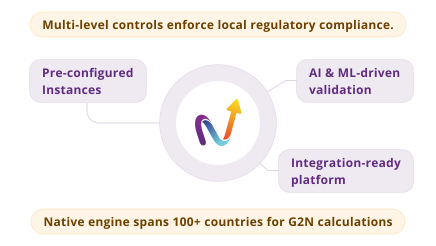
  • G2N Nova Payroll Engine: G2N Nova offers global gross-to-net payroll processing across more than 100 countries, making it one of the most advanced payroll engines available. It can be deployed as a SaaS solution or integrated seamlessly with major Human Capital Management and Workforce Management systems.

Conclusion

Choose Mercans as your trusted employer of record Costa Rica for comprehensive and compliant workforce solutions. Our expertise in payroll, statutory compliance, and EOR services ensures a seamless expansion experience, allowing you to navigate the complexities of the Costa Rican market with confidence. Contact us today to learn more.

This document was prepared for informational purposes only. As local laws & regulations keeps on changing. Please consult your tax & legal advisors as well.
Contact Sales
Let's get this conversation started. Tell us a bit about your requirement, and we'll get in touch a soon as we can.

    Sample message

    1. We want to expand in $country

    2. We want you to employ 'X' number of employees on our behalf

    3. Contract duration – 3/6/9/12/18/24 months

    4. Number of legal entities (if any exist today)

    5. Employment type: EOR employee or contractor?

    6. Any benefits requirement or “standard statutory only”?

    FAQs

    What is an Employer of Record in Costa Rica, and what responsibilities do they cover?

    An Employer of Record in Costa Rica acts as the legal employer. They manage contracts, payroll, taxes, benefits, and compliance.

    Is hiring through an EOR in Costa Rica legal, and what labor laws must be followed?

    Yes. The EOR complies with labor laws covering contracts, minimum wages, working hours, and social security.

    How does an EOR in Costa Rica handle payroll, taxes, and social security contributions?

    The EOR calculates salaries, issues payslips, withholds taxes, and pays contributions to CCSS for pensions and healthcare.

    What are the advantages of using an EOR in Costa Rica compared to establishing a local entity?

    It enables fast entry without incorporation. The EOR reduces compliance risks and simplifies HR administration.

    Do EOR providers in Costa Rica manage compliance with benefits and termination rules?

    Yes. They ensure compliance with paid leave, healthcare, severance, and notice periods.

    Ready to hire in Costa Rica?

    No local entity needed. Our experts handle payroll, compliance, and onboarding.

    Talk to an expert
    Proven expertise in global payroll.