Wage Protection System (WPS) Payroll

WPS payroll is the practice of running a payroll cycle so that every wage payment is made through a government-monitored electronic channel and reported to the labour authority in a prescribed file format. The term describes the operational discipline, not the regulation: the Wage Protection System is the government mechanism, and WPS payroll is what an employer has to do every month to satisfy it.

The distinction matters because most employers do not fail WPS by refusing to pay people. They fail it by paying correctly and reporting badly, or by paying on a schedule that used to be acceptable.

The idea behind it

Before wage protection systems, a labour ministry had no visibility of whether wages were actually paid. A complaint was the only trigger for investigation, which put the burden on the worker least able to carry it. Wage protection systems reversed that: salaries move through approved banks or exchange houses, the employer files a record of what was paid to whom, and the ministry compares that record against the registered employment contract.

The consequence for employers is that payroll became a reported activity. A pay run is no longer complete when the money leaves the account; it is complete when the file is accepted and reconciles.

The monthly cycle, step by step

The mechanics vary by country, but the sequence is consistent across the Gulf.

  • Register before you pay. The establishment registers with the labour authority and with an approved WPS agent – a bank or authorised exchange house. Each employee is registered separately, with their identity document, contract details and registered wage. An employee who is not in the system cannot be paid compliantly, which is why new hires must be entered before their first payroll cycle rather than alongside it.
  • Run payroll and calculate to the registered figures. Gross-to-net is calculated as normal, but the result has to be reconcilable to what the authority already holds. If someone received a pay rise and the registered wage was never updated, the run will be technically correct and still fail validation.
  • Generate the salary file. The Salary Information File (SIF) lists each employee, their identifier, their bank details and the amount paid for the period. The level of detail required differs – some jurisdictions accept a single consolidated salary figure, while others require the components broken out. The file is a compliance document, not an export.
  • Fund the account ahead of the transfer. This is where cash-flow planning meets compliance. The money has to have cleared to the agent before the deadline, not on it. Funding on the last day of the month and submitting the same day is, in many cases, already too late.
  • Transfer and submit. The agent moves the wages and transmits the file to the authority. In several countries this is now near real-time rather than batched, which means a shortfall or a mismatch is flagged within hours rather than at the next inspection.
  • Reconcile and retain. Confirm every employee appears, every amount matches, and no transfer bounced on a bad account number. A missing employee or a partial payment is generally treated as non-payment for that person, not as a rounding issue. Keep the evidence of each run.

What “compliant” actually requires

Four conditions have to hold simultaneously, and failing any one of them is a violation:

  • Full amount. The transferred figure must match the registered wage and the amount declared in the file. Paying basic salary through WPS and allowances in cash is a well-known workaround and a well-known violation.
  • On time. Against the statutory deadline, not the employer’s habitual pay date.
  • Through an approved channel. Cash, cheque and personal transfers do not count regardless of whether the employee received the money.
  • Correctly reported. Right identifier, right IBAN, right period, right amount, for every person on the payroll.

Where WPS payroll goes wrong

Across the region, the dominant failure mode is not withheld wages. It is data.

  • Mismatch against the registered contract. The wage in the file differs from the wage the ministry holds, usually because a salary change was processed in payroll and never pushed to the labour system.
  • Identifier and bank detail errors. A wrong ID number or a mistyped IBAN produces a failed transfer, which reads as non-payment for that employee.
  • New hires missing from the file. Registration lagging the first pay run is one of the most common and most avoidable violations.
  • Leavers still in the file, or final settlements paid outside the system.
  • Split payments. Part through WPS, part in cash or by transfer, typically for allowances or overtime.
  • Deadline drift. Running payroll on a long-standing internal date that no longer aligns with the statutory one.
  • Funding timing. The instruction was issued on time but the funds had not cleared, so the transfer landed late.
  • Unlawful or undocumented deductions, which show up as an unexplained gap between registered and paid wage.

Almost all of these are process and data-governance problems rather than intent, which is why they persist in organisations that pay their people reliably and on time.

How the rules differ across the GCC

The concept is shared; the platforms, deadlines and penalties are not. All six GCC states now require private-sector employers to pay salaries electronically through government-monitored channels, and enforcement across the region has shifted from periodic audits toward real-time automated flagging.

United Arab Emirates. WPS was introduced in 2009 under Ministerial Decree No. 788, jointly run by MoHRE and the Central Bank. The framework changed materially in 2026: Ministerial Resolution No. 340 of 2026, effective 1 June 2026, replaced the earlier regime and abolished the 15-day grace period, setting the 1st of each Gregorian month as a unified salary deadline with no business-day extension for weekends or public holidays. A minimum compliance threshold now applies at both company and individual level, and the enforcement ladder escalates within days rather than weeks – work permit suspension first, then financial penalties, then referral and travel restrictions for persistent non-payment. The work permit block is usually the most disruptive element, because it halts onboarding and visa renewals immediately.

Saudi Arabia. Wage payment is administered through the Mudad platform under the Ministry of Human Resources and Social Development, and it is mandatory for all private-sector employers regardless of size – including single-employee establishments. Salaries are paid in Saudi Riyals. Mudad does not sit in isolation: it feeds GOSI and the Qiwa contracting portal, so a wage discrepancy has consequences for social insurance records and Saudization measurement as well as wage compliance. Coverage has been extended to domestic workers.

Qatar. Administered by the Ministry of Labour, with wages paid in Qatari Riyals into a bank registered in Qatar within seven days of the due date. Non-compliance carries financial penalties and the risk of work permit suspension.

Bahrain, Kuwait and Oman. Bahrain’s system is administered by the Labour Market Regulatory Authority and has now reached full mandatory coverage. Kuwait operates through the labour ministry’s payroll reporting requirements, and Oman through its electronic payroll regime under the Ministry of Labour. File content requirements are lighter in some of these markets – a single consolidated salary figure is sufficient in certain jurisdictions where others demand a component breakdown.

For a multi-country employer, the practical implication is that “we are WPS compliant” is not a portable statement. Each country has its own registration route, file specification, deadline and penalty structure, and a shared payroll calendar has to accommodate the tightest of them.

What WPS does and does not protect against

Worth being precise, since the name overstates the scope. Wage protection systems verify that a declared amount reached a declared account on a declared date. They are strong on that and weak on everything adjacent.

They do not, on their own, detect miscalculated overtime, incorrect end-of-service gratuity, unpaid leave entitlements, or arrangements where wages are transferred correctly and then partially reclaimed in cash. Critics have long characterised them as wage information systems rather than wage protection systems for this reason. For employers, the useful reading is that WPS compliance is a floor rather than a ceiling: a clean WPS record does not establish that the underlying payroll calculation was right.

How Mercans runs WPS payroll

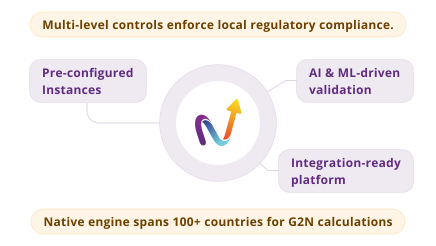
Mercans delivers managed payroll and Employer of Record services across the GCC on a single platform, with WPS treated as an integral part of the pay cycle rather than a downstream filing task.

  • Direct WPS agent integration. Salary files are transmitted through integrated connections to GCC banks and authorised exchange houses, removing manual file handling and re-keying between systems.
  • Country-native file generation. SIF and equivalent outputs are produced to each jurisdiction’s current specification – UAE MoHRE, Saudi Mudad, Qatar’s ministry format, and the Bahrain, Kuwait and Oman requirements – rather than a single generic template adapted per market.
  • Validation before submission. Employee identifiers, bank details, registered wage and paid amount are checked against contract and registration data ahead of transmission, so mismatches are caught before the authority sees them.
  • Deadline management per country. Payroll calendars are built to each market’s statutory deadline, including the UAE’s 1st-of-month rule, with funding timelines set so cleared funds precede the cut-off.
  • Linked statutory systems. In Saudi Arabia, wage data is kept consistent across Mudad, GOSI and Qiwa; in the UAE, WPS runs alongside gratuity provisioning and Emiratisation tracking, so a wage change updates every dependent record.
  • Lifecycle events handled in-cycle. Joiners are registered before their first pay run, leavers are removed, and final settlements are routed through the correct channel.
  • One calendar across markets. Employers operating in several GCC countries get a consolidated cycle and consistent reporting rather than separate providers, separate files and separate reconciliations per country.

Frequently asked questions

What is WPS payroll?

WPS payroll is a payroll process built to satisfy a Wage Protection System: wages are calculated as normal, then paid through a government-approved bank or exchange house and reported to the labour authority in a prescribed salary file. The authority compares the reported payment against the employee’s registered contract. A pay run is only complete once the file has been submitted and reconciles to the transfer.

What is a SIF file?

The Salary Information File is the standardised record submitted to the labour authority for each pay period. It identifies every employee, their bank details and the amount paid, and in most jurisdictions is generated by payroll software or by the WPS agent. Requirements differ by country – some accept a single consolidated salary figure while others require pay components to be itemised. It should be treated as a regulatory submission, since discrepancies in it are the most common source of violations.

Can allowances or overtime be paid in cash if basic salary goes through WPS?

No. Splitting payment so that part goes through the system and part is paid in cash or by direct transfer is a violation, even though the employee receives the full amount. The transferred figure must match the registered wage and the declared amount. This is one of the more frequently penalised practices because the shortfall is visible in the data without any inspection.

What happens if a salary is paid late?

Consequences depend on the jurisdiction, and in the UAE they now arrive quickly. Ministerial Resolution No. 340 of 2026 removed the previous 15-day grace period and set the 1st of the month as the deadline, with escalating enforcement beginning within days: suspension of new work permits, then financial penalties per affected employee, then referral and travel restrictions for persistent non-payment. The work permit block is often the most damaging in practice, because it stops hiring and visa renewals until the violation is cleared.

Does WPS apply to free zone companies and small employers?

Small employers are generally covered – several GCC markets have removed size-based exemptions entirely, and Saudi Arabia’s requirement applies even to establishments with a single employee. Free zones are the more nuanced case: some operate their own salary protection mechanism under their own authority rather than the federal system, and financial free zones with separate employment regimes differ again. The obligation to pay in full and on time exists in every case; the reporting route is what changes, so it should be confirmed per zone rather than assumed.

How is WPS different from social insurance contributions?

They are separate obligations with separate systems. WPS governs how wages are paid and reported – the channel, the timing and the file. Social insurance contributions such as GOSI in Saudi Arabia are a statutory payment calculated on a defined contributory wage and remitted to a social insurance authority. In some markets the two are linked in practice, since wage data reported for wage protection purposes also feeds the social insurance and labour registers, which means a discrepancy in one surfaces in the other.