Employer of Record

Employer of Record (EOR) Canada

Hire compliantly, pay accurately, expand confidently.

Global Payroll Team
Written by Global Payroll Team
Published on September 8, 2026
Last updated September 8, 2026
Expert Reviewed

An Employer of Record (EOR) in Canada acts as the official employer for workers, often referred to as a Global Professional Employer Organization (Global PEO). This role encompasses a broad range of employment functions, ensuring full compliance with local labor laws and regulations, managing payroll, administering taxes, providing legally required benefits, and handling employment contracts.

Key Responsibilities of an Employer of Record (EOR) in Canada:
  • Ensuring employment terms are fully compliant with the applicable federal or provincial employment standards legislation.
  • Overseeing and processing local payroll in Canadian Dollars (CAD), typically on a biweekly cycle.
  • Managing Canada Pension Plan (CPP) and Employment Insurance (EI) contributions, and provincial payroll taxes where applicable.
  • Drafting enforceable employment contracts that limit exposure to Canada’s uncapped common-law termination liability.
  • Issuing compliant pay statements and disbursing salary payments in accordance with Canadian standards.

With our Employer of Record (EOR) services, expanding your business into Canada becomes easier and more efficient. Our solution eliminates the need for setting up a local entity, providing a seamless path to establish a legal presence in Canada. We ensure full legal compliance across Canada’s federal and provincial employment frameworks, manage payroll, protect your intellectual property, and handle work permits, so you can focus on growing your business and building your workforce in one of North America’s largest talent markets.

Things you need to know before hiring in Canada

Canada’s 2026 Payroll and Termination Law Updates

Several Canadian payroll thresholds reset every 1 January: for 2026, the Canada Pension Plan’s Year’s Maximum Pensionable Earnings (YMPE) rises to CAD 74,600, the CPP2 second-tier ceiling (YAMPE) rises to CAD 85,000, and the Employment Insurance (EI) employee premium rate eases slightly to $1.63 per $100 while Maximum Insurable Earnings rise to CAD 68,900. Ontario’s general minimum wage increased to CAD 17.60/hour from 1 October 2025, and most provinces index their own minimum wage separately each year. Employers should also note a continuing 2024–2025 trend in Ontario case law (following Dufault v. Ignace) invalidating many standard termination clauses, which is widening employers’ exposure to uncapped common-law “reasonable notice” beyond the statutory minimums — a live compliance risk worth reviewing annually.

Employment Contracts in Canada

Canada has no true “at-will” employment. Most private-sector employees (roughly 90% of the workforce) are governed by provincial employment standards legislation — this page uses Ontario’s Employment Standards Act, 2000 (ESA) as the default reference province — while federally regulated industries (banking, telecommunications, broadcasting, interprovincial transportation) fall under the Canada Labour Code. Quebec operates under its own civil-law system with materially different rules, including French-language workplace requirements.

Indefinite-Term Contracts

The standard form of employment in Canada. Even without a fixed term, an employer must give statutory notice, pay in lieu, or just cause to terminate — there is no “at-will” dismissal concept.

Fixed-Term Contracts

Permitted but carry significant risk: if a fixed-term contract lacks a valid, ESA-compliant early-termination clause, courts can award the employee the full remaining value of the contract to its end date, with no duty to mitigate.

Probationary Period

Not formally named in the ESA, but employees with less than 3 months of continuous employment are not entitled to statutory notice or termination pay, even if a longer contractual “probation” period is used.

Mandatory Contract Terms

Employment contracts should specify job title and duties, wage, hours of work, vacation entitlement, and an enforceable termination clause, among other required particulars under the applicable provincial standard.

Working Hours

Ontario’s default standard is 8 hours per day and 44 hours per week. Overtime is calculated weekly rather than daily. Without a signed excess-hours agreement, the maximum is 48 hours per week; with a signed agreement (and Ministry approval above certain thresholds), up to 60 hours per week is permitted.

Common-Law “Reasonable Notice” — Canada’s Key Termination Risk

Beyond the statutory minimums set out below, Canadian courts can separately award terminated employees “reasonable notice” under common law, based on the Bardal factors: character of employment, length of service, age, and availability of similar employment. There is no fixed statutory cap on common-law notice, and awards routinely exceed statutory minimums, with reported ranges from roughly 2 to 26 months’ pay. This uncapped exposure — not the statutory formulas alone — is the primary reason companies use an EOR or carefully drafted termination clauses when hiring in Canada.

Key Points on Overtime

Overtime Threshold
In Ontario, overtime is triggered after 44 hours worked in a week (not on a daily basis), unless a different threshold applies under an approved averaging agreement.
Overtime Premium
Overtime is compensated at a minimum of 1.5 times the employee’s regular hourly rate for hours worked beyond the weekly threshold.
Rest Periods
Employees are generally entitled to 11 consecutive hours off work each day, at least 24 consecutive hours off each week (or 48 hours per two weeks), and a 30-minute unpaid eating period after 5 consecutive hours worked.

Termination and Severance Pay

Termination in Canada involves up to three separate layers of entitlement: statutory notice or pay in lieu, statutory severance pay in qualifying cases, and potentially common-law reasonable notice on top of both.

Notice of Termination

Ontario’s ESA sets statutory notice (or pay in lieu) at 1 week per completed year of service, capped at 8 weeks, available once an employee has 3 months of continuous employment. Employers may provide working notice or pay in lieu of notice.

Severance Pay

A separate ESA statutory severance payment applies where an employee has 5 or more years of service and the employer has an Ontario payroll of CAD 2.5 million or more (or terminates 50+ employees within six months): calculated at 1 week’s pay per year of service (pro-rated), up to a maximum of 26 weeks. These statutory amounts are a floor — common-law reasonable notice, described above, is assessed separately and can substantially exceed them.

Protected Categories

Termination that is discriminatory or made in reprisal for exercising statutory rights (such as taking a protected leave) is prohibited under human rights and employment standards legislation, independent of the standard notice and severance rules.

Compensation for Unused Leave

Any accrued but unused vacation pay must be paid out on termination.

Employees vs Independent Contractors

Canadian courts and the Canada Revenue Agency (CRA) apply a common-law, multi-factor test to distinguish employees from genuine independent contractors: control over the work, ownership of tools and equipment, chance of profit and risk of loss, and integration into the business. No single factor is decisive, and a contract’s label does not override the day-to-day working relationship.

Misclassifying employees as independent contractors is a recognized enforcement risk in Canada: a CRA reassessment can require the payer to remit both the employer’s and the employee’s share of CPP and EI in arrears, plus penalties and interest, potentially spanning multiple prior years.

Comparison Table: Employee vs Independent Contractor

Factor Employee Independent Contractor
Governing Law Provincial employment standards legislation (or Canada Labour Code) General commercial contract law
Control & Subordination Works under the employer’s direction, schedule, and supervision Controls own working hours and methods
Tools & Equipment Typically supplied by the employer Typically owned by the contractor
Payment Structure Fixed salary or wages via payroll, with CPP/EI withheld Paid per project, milestone, or invoice
Statutory Benefits Entitled to vacation, statutory notice/severance, and CPP/EI coverage No statutory employment benefits
Misclassification Risk Not applicable High risk if the relationship shows control and integration; CRA can reassess CPP/EI in arrears plus penalties

Understanding these differences is essential for ensuring compliance and correctly determining entitlements such as leave, notice, and statutory contributions.

Social Security and Payroll Contributions in Canada

Outside Quebec, employers and employees jointly fund the Canada Pension Plan (CPP) and Employment Insurance (EI). Quebec instead operates its own Quebec Pension Plan (QPP) and Quebec Parental Insurance Plan (QPIP), administered by Revenu Québec.

Contribution (2026) Employer Employee
CPP (up to YMPE CAD 74,600) 5.95% 5.95%
CPP2 (YMPE–YAMPE, up to CAD 85,000) 4% 4%
EI (up to CAD 68,900 insurable earnings) ~2.28% (1.4x employee rate) $1.63 per $100

CPP, CPP2, and EI thresholds are indexed and reset every 1 January — Mercans confirms the current-year rates and ceilings for each engagement, and administers QPP/QPIP separately for Quebec-based employees.

Payroll in Canada

Minimum Wage

Canada has no single national minimum wage for provincially regulated employees — each province and territory sets its own rate, indexed annually. Ontario’s general minimum wage is CAD 17.60/hour, effective 1 October 2025. By comparison, the federal minimum wage (for Canada Labour Code employers) is CAD 17.75, Alberta’s is CAD 15.00 (the lowest in Canada), and Nunavut’s is CAD 19.75 (the highest). Employers should confirm the applicable rate for each employee’s province of employment.

Payroll Cycle

Biweekly pay (26 pay periods a year) is the most common payroll cycle in Canada; semi-monthly and weekly cycles are also used. Payroll is run in Canadian Dollars (CAD). Employers must provide itemized pay statements showing gross pay, deductions, and net pay, file annual T4 slips and a T4 Summary, and retain payroll records for at least 6 years.

Overtime Pay

Overtime pay is provided when an employee (in Ontario) works beyond 44 hours in a week.

Overtime Premium

Overtime is paid at a minimum 1.5x the employee’s regular hourly rate.

Maximum Weekly Hours

The default maximum is 48 hours/week without a written agreement, extendable to 60 hours/week with a signed excess-hours agreement and, above certain thresholds, Ministry of Labour approval.

Working-hour and overtime rules vary by province — Mercans confirms the applicable standard for each employee’s province of employment.

Mercans’ payroll capabilities

Payroll Cycle Management in Canada
Mercans delivers efficient, seamless payroll cycle management tailored to Canadian requirements, including biweekly CAD-denominated payroll and the province-specific rules that apply to each employee. We ensure that both employees and contractors are paid accurately and on time, providing a smooth and compliant payroll experience aligned with Canadian standards.
Payroll Setup, Processing, and Administration
Mercans offers a complete range of payroll services from start to finish. Whether it’s setting up your payroll system, processing payments, or managing ongoing administration, we take care of every detail, ensuring accuracy, compliance, and efficiency so you can focus on running your business.
Statutory Filings and Payments
Navigating Canada’s federal and provincial regulatory framework can be complex, particularly across CPP/EI, T4 filings, and 13 distinct provincial and territorial employment standards regimes, but with Mercans, you’re in safe hands. We manage all statutory filings and payments, ensuring your business remains fully compliant with Canadian tax laws and employment regulations.

Personal Income Tax in Canada

Canada applies progressive federal income tax on top of which each province adds its own tax. Federal 2026 brackets are:

  • Up to CAD 58,523: 14%
  • CAD 58,524 – 117,045: 20.5%
  • CAD 117,046 – 181,440: 26%
  • CAD 181,441 – 258,482: 29%
  • Above CAD 258,482: 33%

Using Ontario as the reference province, provincial tax adds a further 5 brackets from 5.05% to 13.16%, plus an Ontario surtax at higher income levels. The combined federal and Ontario top marginal rate is approximately 53.53% for 2025/2026. Combined rates differ by province, since each sets its own brackets.

Canada Employee Hiring Cost

When hiring an employee in Canada, employers must budget for gross salary plus mandatory employer CPP and EI contributions, plus any applicable provincial payroll taxes (such as Ontario’s Employer Health Tax above a payroll threshold) or workers’ compensation premiums.

Salary Details Amount (CAD)
Gross Monthly Salary 6,000
Employer CPP & EI Contributions (~8.2%, up to annual ceilings) ~490
Estimated Total Monthly Cost ~6,490*

*Excludes any applicable provincial payroll tax (e.g., Ontario Employer Health Tax) and industry-rated workers’ compensation premiums, which vary by province and sector; Mercans confirms the full employer cost for each engagement.

Employee Benefits in Canada

Canadian employees are entitled to a combination of mandatory statutory benefits and, increasingly, supplementary benefits offered at the employer’s discretion.

  • Vacation: A minimum of 2 weeks per year under 5 years of service, rising to 3 weeks after 5 years (Ontario ESA), with vacation pay of at least 4% of gross wages (6% after 5 years). Entitlements vary by province.
  • Public Holidays: Ontario observes 9 statutory public holidays, including New Year’s Day, Family Day, Good Friday, Victoria Day, Canada Day, Labour Day, Thanksgiving Day, Christmas Day, and Boxing Day.
  • Sick Leave: Ontario provides 3 days per year of unpaid, job-protected sick leave; Ontario has no provincial paid sick leave mandate, though other provinces and federally regulated employers (10 paid days under the Canada Labour Code) differ.
  • Maternity & Parental Leave: EI-funded maternity benefits of up to 15 weeks at 55% of earnings for the birthing parent, plus parental benefits shareable between parents — either 40 additional weeks at 55% (standard option) or up to 69 weeks at 33% (extended option). Job-protected leave under provincial law generally runs at least as long as the EI benefit period.
  • Paternity/Parental Leave: No separate federal “paternity” leave outside Quebec — non-birthing parents draw on the shared parental leave pool. Quebec’s own QPIP provides a dedicated, non-transferable paternity leave alongside richer maternity and parental benefits.
  • CPP & EI Coverage: Jointly-funded pension (CPP/CPP2) and employment insurance coverage administered federally (QPP/QPIP in Quebec), as described above.
  • Extended Health & Dental: Widely offered by employers to supplement Canada’s public healthcare system, which does not cover prescription drugs, dental, or vision care by default.
  • Group RRSP / Retirement Savings: A common supplementary benefit, often with an employer matching contribution, on top of statutory CPP/QPP coverage.
  • Life & Disability Insurance: Frequently included in employer group benefits packages, particularly for professional and management roles.
  • Workplace Wellness Programs: Companies are enhancing the workplace experience with wellness initiatives, including mental health support.
  • Flexible Work Options: Employers are increasingly offering flexible or hybrid working arrangements where operationally feasible.
  • Team-Building Activities: Employers are introducing more team-building and employee engagement activities.
  • Discount Programs: Some companies offer group discounts on shopping, travel, and leisure activities.

Essential Benefits for Employees in Canada
  • Vacation: A minimum of 2 weeks per year under 5 years of service, rising to 3 weeks after 5 years (Ontario ESA), with vacation pay of at least 4% of gross wages (6% after 5 years). Entitlements vary by province.
  • Public Holidays: Ontario observes 9 statutory public holidays, including New Year’s Day, Family Day, Good Friday, Victoria Day, Canada Day, Labour Day, Thanksgiving Day, Christmas Day, and Boxing Day.
  • Sick Leave: Ontario provides 3 days per year of unpaid, job-protected sick leave; Ontario has no provincial paid sick leave mandate, though other provinces and federally regulated employers (10 paid days under the Canada Labour Code) differ.
  • Maternity & Parental Leave: EI-funded maternity benefits of up to 15 weeks at 55% of earnings for the birthing parent, plus parental benefits shareable between parents — either 40 additional weeks at 55% (standard option) or up to 69 weeks at 33% (extended option). Job-protected leave under provincial law generally runs at least as long as the EI benefit period.
  • Paternity/Parental Leave: No separate federal “paternity” leave outside Quebec — non-birthing parents draw on the shared parental leave pool. Quebec’s own QPIP provides a dedicated, non-transferable paternity leave alongside richer maternity and parental benefits.

Additional Employee Benefits
  • CPP & EI Coverage: Jointly-funded pension (CPP/CPP2) and employment insurance coverage administered federally (QPP/QPIP in Quebec), as described above.
  • Extended Health & Dental: Widely offered by employers to supplement Canada’s public healthcare system, which does not cover prescription drugs, dental, or vision care by default.
  • Group RRSP / Retirement Savings: A common supplementary benefit, often with an employer matching contribution, on top of statutory CPP/QPP coverage.
  • Life & Disability Insurance: Frequently included in employer group benefits packages, particularly for professional and management roles.

Perks & Wellness Initiatives
  • Workplace Wellness Programs: Companies are enhancing the workplace experience with wellness initiatives, including mental health support.
  • Flexible Work Options: Employers are increasingly offering flexible or hybrid working arrangements where operationally feasible.
  • Team-Building Activities: Employers are introducing more team-building and employee engagement activities.
  • Discount Programs: Some companies offer group discounts on shopping, travel, and leisure activities.

Work Permit in Canada

Most foreign nationals require authorization to work in Canada, obtained through one of several federal immigration routes.

Labour Market Impact Assessment (LMIA)

Most foreign hiring requires the employer to obtain a positive Labour Market Impact Assessment (LMIA) from Employment and Social Development Canada (ESDC), demonstrating that no Canadian worker is available for the role. Recent processing times run approximately 8–12 weeks for high-wage positions and 12–16 weeks for low-wage positions.

LMIA-Exempt Categories

Certain categories fall under the International Mobility Program and do not require an LMIA, including CUSMA/USMCA professional and intra-company-transfer categories for US and Mexican citizens, and general intra-company transferees who have worked for the foreign affiliate for at least 1 year within the prior 3 years.

Global Talent Stream

A dedicated fast-track for in-demand tech roles, with median processing times of around 2 weeks, in exchange for the employer committing to a Labour Market Benefits Plan rather than a standard LMIA.

Important Considerations for Employers

Employer Sponsorship

A Canadian entity is generally required to sponsor a foreign national’s LMIA or work permit application — an EOR partner such as Mercans allows companies without a local entity to still hire and sponsor talent compliantly.

Provincial Variation, Including Quebec

Work permit categories are federal, but day-to-day employment terms remain governed by the province of employment — Quebec in particular applies its own immigration selection process (the Quebec Selection Certificate, CSQ) and French-language workplace requirements alongside the federal work permit.
Understanding these pathways can streamline the hiring process, allowing employers to bring skilled talent into their Canada-based operations effectively.

EOR Solutions in Canada

EOR Solutions for Prospective Employees in Canada
Mercans provides efficient Employer of Record (EOR) services for businesses that have already identified their ideal candidates in Canada. Our comprehensive services cover the entire employee lifecycle, ensuring full compliance with Canadian federal and provincial labor laws, tax regulations, and employment standards, so you can focus on your business growth without the administrative burden.
EOR + Recruitment: Streamlined Talent Acquisition
For businesses seeking assistance with talent acquisition, our EOR and recruitment solutions offer a complete, end-to-end service, helping you find, hire, and retain top talent in Canada while ensuring all recruitment and compliance requirements are met.
Visa Sponsorship and Global Mobility Solutions
Navigating the complexities of expatriate employment becomes straightforward with our visa sponsorship and global mobility services. Mercans ensures a smooth relocation process for your international workforce, handling all aspects of Canadian immigration and employment laws to guarantee compliance.
AOR Services for Contractor Payments
For businesses managing contractor payments in Canada, Mercans offers Agent of Record (AOR) services, handling the complexities of independent contractor payments to ensure accurate, timely, and fully compliant payments while managing misclassification risk.
Converting Freelancers to Employees in Canada
Mercans supports businesses transitioning freelancers and contractors to full-time employees in Canada, ensuring a smooth, legally compliant conversion process.
HCM Integration for Enhanced Workforce Management
Integrate Mercans’ EOR services with your Human Capital Management (HCM) system for a unified, real-time approach to data exchange, compliance tracking, and payroll management in Canada.

Best Employer of Record Canada

Mercans stands out as a leading Employer of Record (EOR) provider in Canada for several key reasons:

  • Full Compliance Across Federal and Provincial Law: Mercans ensures strict compliance with the applicable federal or provincial employment standards, CPP/EI obligations, and Canada’s uncapped common-law termination exposure, keeping your business aligned with local labor law and protecting you from potential legal risk.
  • Independent Operations: As a fully independent entity, Mercans operates without external affiliations, delivering reliable, customized employment services tailored to your business requirements in Canada.
  • Supports All Employment Types: Whether you’re hiring employees, contractors, or expatriates, Mercans offers flexible solutions across a variety of workforce models.
  • Designed for Large Enterprises: Our scalable solutions meet the demands of enterprise-level organizations, integrating with your broader global business goals.
  • Multi-Currency Payroll Management: Mercans handles multi-currency payroll, simplifying salary management across multiple countries alongside Canada.
  • Global Network and Multi-Country Payroll Expertise: With a robust global presence, Mercans manages multi-country payroll seamlessly across North America and beyond, handling local tax regulations and compliance requirements wherever your teams are based.
  • Certified Data Protection and Security Standards: Mercans adheres to stringent data protection protocols, including GDPR certification and SOC 1 & SOC 2 compliance.
  • ISO-Certified Service Quality and Security: Mercans holds ISO 20000 and ISO 27001 certifications, reflecting our commitment to excellence in IT service management and information security.
  • OWASP ASVS 3.0 Compliant: We adhere to OWASP ASVS 3.0 standards, protecting your business through secure software development and management practices.
  • Mercans HRBlizz: Our proprietary global payroll and talent management SaaS platform simplifies payroll while ensuring full compliance with local labor laws in Canada, backed by a team of in-country specialists.
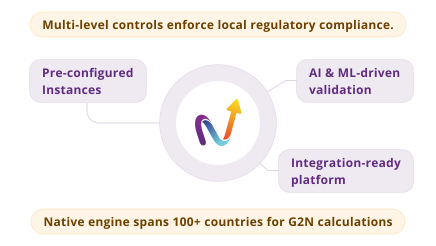
  • G2N Nova: Our advanced gross-to-net payroll engine, available in over 100 countries, integrates with major HCM and Workforce Management systems for a unified global payroll process.

Conclusion

Mercans provides comprehensive Employer of Record (EOR) services in Canada, ensuring accuracy, compliance, and efficiency in managing your workforce across Canada’s federal and provincial employment frameworks. Our end-to-end solutions simplify payroll, statutory contributions, and employment processes, making us a trusted partner for businesses navigating the complexities of the Canadian labor market. With Mercans by your side, your expansion into Canada will be smooth, compliant, and successful, allowing you to focus on growing your business with confidence.

This document was prepared for informational purposes only. As local laws & regulations keeps on changing. Please consult your tax & legal advisors as well.
Contact Sales
Let's get this conversation started. Tell us a bit about your requirement, and we'll get in touch a soon as we can.

    Sample message

    1. We want to expand in $country

    2. We want you to employ 'X' number of employees on our behalf

    3. Contract duration – 3/6/9/12/18/24 months

    4. Number of legal entities (if any exist today)

    5. Employment type: EOR employee or contractor?

    6. Any benefits requirement or “standard statutory only”?

    FAQs

    What is an Employer of Record (EOR) in Canada?

    An Employer of Record (EOR) in Canada is a third-party organization that legally employs workers on behalf of another company, handling payroll, CPP/EI contributions, tax withholding, and compliance with the applicable federal or provincial employment standards, without the client company needing to set up a local entity.

    Can a foreign company hire employees in Canada without a local entity?

    Yes. By partnering with an EOR such as Mercans, a foreign company can hire employees in Canada without registering a local branch or subsidiary. The EOR acts as the legal employer, managing contracts, payroll, CPP/EI registration, and statutory compliance on the company’s behalf.

    Does Canadian employment law differ by province?

    Yes. Roughly 90% of Canadian private-sector employees are governed by provincial employment standards legislation rather than federal law, and each of Canada’s 13 provinces and territories sets its own minimum wage, leave, and notice rules. Quebec is the most distinct, operating under its own civil-law system, French-language workplace requirements, and separate QPP/QPIP social programs. An EOR manages this province-by-province variation on your behalf.

    What compliance, payroll, and HR services does an EOR manage in Canada?

    An EOR manages drafting and executing compliant, enforceable employment contracts, biweekly payroll processing in CAD, CPP/EI registration and contributions, T4 filings, issuing compliant pay statements, and administering statutory leave and benefits in line with the applicable federal or provincial employment standards.

    How much does an EOR service cost in Canada?

    EOR pricing varies by provider and the scope of services required, and is typically charged as a flat monthly fee per employee or a percentage of payroll. Mercans provides tailored pricing based on your specific hiring needs in Canada.

    Is EOR suitable for expanding into Canada?

    Yes. EOR is well suited to companies testing the Canadian market, hiring across multiple provinces, or wanting to limit exposure to Canada’s uncapped common-law termination liability, without the time and cost of setting up a local entity.

    Ready to hire in Canada?

    No local entity needed. Our experts handle payroll, compliance, and onboarding.

    Talk to an expert
    Proven expertise in global payroll.