Employer of Record

Employer of Record (EOR) Algeria

Hire compliantly, pay accurately, expand confidently.

Global Payroll Team
Written by Global Payroll Team
Last updated July 23, 2026
Expert Reviewed

An Employer of Record (EOR) in Algeria acts as the official employer for workers, often referred to as a Global Professional Employer Organization (Global PEO). This role encompasses a broad range of employment functions, ensuring full compliance with local labor laws and regulations, managing payroll, administering taxes, providing legally required benefits, and handling employment contracts.

Key Responsibilities of an Employer of Record (EOR) in Algeria:
  • Ensuring employment terms are fully compliant with Algerian labor laws.
  • Overseeing and processing local payroll in Algerian Dinar (DZD).
  • Managing the filing of employment-related taxes and CNAS social security contributions.
  • Issuing compliant payslips (bulletin de paie) to employees.
  • Disbursing salary payments in accordance with Algerian standards.

With our Employer of Record (EOR) services, expanding your business into Algeria becomes easier and more efficient. Our solution eliminates the need for setting up a local entity, providing a seamless path to establish a legal presence in Algeria. We ensure full legal compliance, manage payroll, protect your intellectual property, and handle work permits, so you can focus on growing your business and building your workforce in North Africa.

Things you need to know before hiring in Algeria

Employment Contracts in Algeria

An employment contract is a formal agreement between an employer and an employee that outlines the terms and conditions of their employment. Algerian labor relations are governed primarily by Law No. 90-11 of 21 April 1990, as amended, most recently by Law No. 22-16 of 20 July 2022.

CDI, CDD and Probation Periods

The indefinite-term contract (CDI) is the default and standard form of employment in Algeria. A fixed-term contract (CDD) is treated as the exception and may only be used in specific, justified circumstances.

CDI: The Default Contract

The Contrat à Durée Indéterminée (CDI) is the standard, presumed form of employment in Algeria. Any employment relationship without a valid, documented reason for a fixed term is treated as a CDI.

CDD: Permitted Exceptions

A fixed-term contract (CDD) is only permitted to replace a temporarily absent employee, cover a temporary increase in workload, for seasonal work, or for a specific one-off task or project.

Written Contract Requirement

A CDD must be in writing and must state the specific reason justifying its fixed-term nature. Continued work beyond the agreed term, or the absence of a valid written contract, automatically reclassifies the relationship as a CDI.

Fixed-term contracts, including renewals, cannot exceed a total duration of 24 months.

Probation Periods

Probation periods vary by employee category:

  • Manual/production workers: up to 6 months.
  • Technicians and supervisory staff: up to 9 months.
  • Executives and senior managers: up to 12 months.

Working Hours

In Algeria, the standard legal working week is 40 hours, typically structured as 8 hours per day across 5 working days, with Friday commonly observed as the weekly rest day. Employees are entitled to a minimum weekly rest period of 24 consecutive hours.

13th Month Salary

There is no general legal requirement in Algeria for a mandatory 13th-month salary. However, many employment contracts and collective agreements provide for a seniority bonus (prime d’ancienneté), which increases pay progressively based on length of service.
It is important to note that any additional bonuses, such as end-of-year gratuities, are treated as discretionary unless otherwise fixed by contract or collective agreement.

Key Points on Working Hours & Overtime

Overtime Cap
Overtime is capped at 20% of the legal weekly working hours, broadly equivalent to around 8 additional hours per week.
Overtime Premiums
Overtime on ordinary working days is compensated at a premium above the normal hourly rate, with higher premiums applying to hours worked on the weekly rest day or on public holidays. Exact premium tiers should be confirmed against the applicable collective bargaining agreement, as these vary by sector.
Weekly Rest
Employees are entitled to a minimum weekly rest period of 24 consecutive hours, traditionally taken on Friday.

Overtime pay rules can vary depending on the applicable collective bargaining agreement or sector-specific rules.

Termination and Severance Pay

Termination of employment in Algeria must be based on a “real and serious cause,” such as gross misconduct, an economic/redundancy justification, or non-fault incapacity (for example, prolonged illness). Employers must follow a documented procedure, generally involving written notice to the employee, an investigation or hearing, and a written, reasoned decision.

Notice of Termination

Employees are generally entitled to a minimum notice period, with the exact duration depending on the applicable collective bargaining agreement and the employee’s length of service. A common structure seen in Algerian collective agreements provides for a base notice period of around one month, increasing by approximately 5 additional days for each year of service, up to a maximum additional 30 days.

Because notice periods can vary meaningfully by sector and by individual employment contract, Mercans reviews the applicable collective agreement for each engagement to confirm the precise entitlement before any termination is processed.

Severance Pay (Indemnité de Licenciement)

Employees dismissed after a minimum period of service are generally entitled to severance compensation, calculated with reference to their length of service and average monthly salary. The exact severance formula can depend on the applicable collective agreement and the grounds for dismissal, so Mercans confirms the precise entitlement on a case-by-case basis.

Redundancy (Economic Dismissal)

Redundancy dismissals for economic reasons require genuine justification, consultation with employee representatives, and prior notification to the labor inspectorate, and may also require a redeployment or social plan.

Work Certificate

On termination, employers are legally required to issue a work certificate (certificat de travail) confirming the employee’s dates of employment and job title.

Employees vs Independent Contractors

Algeria does not prohibit engaging independent contractors, but contractor relationships are governed by the Civil Code rather than the Labor Code, meaning genuine contractors are not entitled to Labor Code protections, mandatory benefits, or employer-side CNAS registration.

The key test applied by Algerian courts and authorities focuses on control and subordination: a genuine contractor sets their own working hours and methods, supplies their own tools and equipment, and is not subject to ongoing managerial direction in the way an employee is. Where a contractor relationship shows the hallmarks of subordination, Algerian authorities may reclassify the relationship as employment, exposing the engaging company to backdated CNAS contributions, IRG withholding, and penalties.

Comparison Table: Employee vs Independent Contractor

Factor Employee Independent Contractor
Control Subject to the employer’s direction and supervision Controls own working hours and methods
Integration Integrated into the business’s operations Operates as a separate, external business
Mode of Remuneration Fixed salary, paid regularly via payroll Paid per project or invoice
Tools & Equipment Provided by the employer Provided by the contractor
Social Security Registered with CNAS by the employer Self-registered, typically with CASNOS
Risk Bears little commercial risk Bears the commercial risk of the engagement

In essence, employees work as part of your business and are subject to your direction and control, while independent contractors operate independently, typically managing their own tools and bearing the risks associated with their work. Understanding these differences is essential for ensuring compliance and determining entitlements such as CNAS registration, leave, and tax obligations.

Social Security in Algeria

Algeria’s social security system is administered by the Caisse Nationale des Assurances Sociales (CNAS) for salaried employees. Combined employer and employee contributions total approximately 34.5% of gross salary, with no upper contribution ceiling, meaning contributions are calculated on the full gross salary regardless of how high it is.

Branch Employer Employee
Health, maternity, disability & death insurance 11.5% 1.5%
Work injury / occupational disease 1.25%
Retirement (CNR) 11% 6.75%
Early retirement 0.25% 0.25%
Unemployment insurance (CNAC) 1% 0.5%
Total ~25% ~9%

Self-employed individuals and genuine independent contractors contribute instead to CASNOS, at a combined rate of approximately 15% of declared income.

Payroll in Algeria

Minimum Wages

Algeria’s national guaranteed minimum wage (Salaire National Minimum Garanti, or SNMG) was raised by the Council of Ministers to 24,000 DZD per month, effective 1 January 2026 — a 20% increase from the previous 20,000 DZD level, which had been in place since 2020.

Payroll Cycle

Wages in Algeria must be paid in Algerian Dinar (DZD), typically by bank transfer, with salary payments generally settled shortly after the end of each month. Employers must provide employees with an itemized payslip (bulletin de paie) showing base salary, allowances, overtime, bonuses, and all statutory deductions.

Overtime Pay

Overtime pay is provided when an employee works beyond their standard hours. The premium depends on factors like the day worked, with higher premiums typically applying to work on the weekly rest day or public holidays compared with an ordinary working day.

Overtime Cap

Overtime is capped at 20% of the legal weekly working hours, broadly equivalent to around 8 additional hours per week.

Who Is Eligible for Overtime Pay?

Eligibility for overtime pay depends on the applicable collective bargaining agreement and employment contract terms, which set out the exact premium tiers and conditions under which overtime applies.

Overtime pay rules can vary depending on the sector or the specific collective agreement an employee is covered by.

Mercans’ payroll capabilities

Payroll Cycle Management in Algeria
Mercans delivers efficient, seamless payroll cycle management tailored to Algerian requirements. We ensure that both employees and contractors are paid accurately and on time, in Algerian Dinar, so you can trust us to streamline your payroll processes and provide a smooth, compliant payroll experience aligned with Algerian standards.
Payroll Setup, Processing, and Administration
Mercans offers a complete range of payroll services from start to finish. Whether it’s setting up your payroll system, processing payments, or managing ongoing administration, we take care of every detail, ensuring accuracy, compliance, and efficiency so you can focus on running your business.
Statutory Filings and Payments
Navigating Algeria’s regulatory framework can be complex, but with Mercans, you’re in safe hands. We manage all statutory filings and payments, including CNAS contributions and IRG withholding, ensuring your business remains fully compliant with Algerian tax laws and employment regulations.

Personal Income Tax in Algeria

Personal income tax in Algeria, known as the Impôt sur le Revenu Global (IRG), is administered by the Direction Générale des Impôts (DGI). Monthly salaries of 30,000 DZD or below are fully exempt from IRG, with a tapering abatement applying to salaries between 30,001 and 35,000 DZD per month.

Income Tax Rates in Algeria

Annual salary income above the exemption threshold is taxed according to progressive brackets:

Annual Income (DZD) Tax Rate
0 – 240,000 0%
240,001 – 480,000 23%
480,001 – 960,000 27%
960,001 – 1,920,000 30%
1,920,001 – 3,840,000 33%
Above 3,840,000 35%

Non-monthly income such as one-off bonuses, gratuities, and back-pay is generally subject to a flat 10% withholding at source rather than the progressive brackets above. Employers are required to maintain employee national identification records and file periodic statutory declarations with the DGI.

Algeria Employee Hiring Cost

When hiring an employee in Algeria, employers must budget not only for gross salary but also for mandatory CNAS employer contributions of approximately 25% of gross salary. For example, an employee with a gross annual salary of DZD 3,000,000 would require an additional employer CNAS contribution of approximately DZD 750,000, bringing the total estimated annual cost to approximately DZD 3,750,000.

Salary Details Amount (DZD)
Gross Annual Salary 3,000,000
Employer CNAS Contribution (~25%) 750,000
Total Estimated Annual Cost 3,750,000

Employee Benefits in Algeria

Algerian employees are entitled to a combination of mandatory statutory benefits and, increasingly, supplementary benefits offered at the employer’s discretion to improve retention and satisfaction. Below is a breakdown of the key benefits:

  • Annual Leave: Employees accrue 2.5 days of paid leave per month, equivalent to 30 calendar days per year (employees in certain southern provinces may be entitled to additional leave).
  • Public Holidays: Algeria observes around 10 official public holiday occasions each year, including New Year’s Day, Yennayer (Berber New Year), Eid al-Fitr, Labour Day, Eid al-Adha, Islamic New Year, Ashura, Independence Day, Mawlid Ennabaoui, and the Anniversary of the Revolution.
  • Maternity Leave: Under Law No. 25-08 of 19 July 2025, maternity leave was extended to 150 consecutive days, paid at 100% of salary, and may begin as early as 42 days before the expected due date. A further 50-day extension at full pay is available where the newborn has a disability, congenital condition, or serious illness.
  • Paternity Leave: Fathers are generally entitled to a short period of fully paid leave around the birth of a child.
  • Sick Leave: Employees are entitled to paid sick leave, with CNAS providing income replacement support after the initial period of employer-paid leave.
  • Supplementary Health Insurance: Particularly common in higher-paying sectors, providing subsidized or fully covered private health insurance.
  • Transport & Meal Allowances: Many employers provide allowances to cover commuting and daily meal costs.
  • Company Cars/Allowances: In some roles, particularly for higher-level positions, employers may provide company vehicles or a car allowance.
  • Professional Development: Some companies offer financial assistance for continuing education and professional training.
  • Workplace Wellness Programs: Companies are enhancing the workplace experience by offering wellness initiatives, such as mental health support and stress-relief activities.
  • Flexible Work Options: Employers are increasingly offering flexible working hours where operationally feasible.
  • Team-Building Activities: Employers are introducing more team-building and employee engagement activities.
  • Discount Programs: Some companies offer group discounts on shopping, travel, and leisure activities.

Essential Benefits for Employees in Algeria
  • Annual Leave: Employees accrue 2.5 days of paid leave per month, equivalent to 30 calendar days per year (employees in certain southern provinces may be entitled to additional leave).
  • Public Holidays: Algeria observes around 10 official public holiday occasions each year, including New Year’s Day, Yennayer (Berber New Year), Eid al-Fitr, Labour Day, Eid al-Adha, Islamic New Year, Ashura, Independence Day, Mawlid Ennabaoui, and the Anniversary of the Revolution.
  • Maternity Leave: Under Law No. 25-08 of 19 July 2025, maternity leave was extended to 150 consecutive days, paid at 100% of salary, and may begin as early as 42 days before the expected due date. A further 50-day extension at full pay is available where the newborn has a disability, congenital condition, or serious illness.
  • Paternity Leave: Fathers are generally entitled to a short period of fully paid leave around the birth of a child.
  • Sick Leave: Employees are entitled to paid sick leave, with CNAS providing income replacement support after the initial period of employer-paid leave.

Additional Employee Benefits
  • Supplementary Health Insurance: Particularly common in higher-paying sectors, providing subsidized or fully covered private health insurance.
  • Transport & Meal Allowances: Many employers provide allowances to cover commuting and daily meal costs.
  • Company Cars/Allowances: In some roles, particularly for higher-level positions, employers may provide company vehicles or a car allowance.
  • Professional Development: Some companies offer financial assistance for continuing education and professional training.

Perks & Wellness Initiatives
  • Workplace Wellness Programs: Companies are enhancing the workplace experience by offering wellness initiatives, such as mental health support and stress-relief activities.
  • Flexible Work Options: Employers are increasingly offering flexible working hours where operationally feasible.
  • Team-Building Activities: Employers are introducing more team-building and employee engagement activities.
  • Discount Programs: Some companies offer group discounts on shopping, travel, and leisure activities.

Work Permit in Algeria

Foreign nationals wishing to work in Algeria generally require both prior authorization for their employer and a work visa before entering the country.

Primary Steps for Foreign Worker Authorization

Agrément de Principe (Approval in Principle)

Obtained by the employer from the Wilaya (provincial) Directorate of Employment, including justification that no suitably qualified local candidate is available for the role.

Autorisation Préalable de Travail (APT)

A temporary work authorization issued by the Wilaya Directorate, required before the employee can apply for a work visa at an Algerian consulate abroad.

Employment Regimes by Duration

Foreign staffing arrangements in Algeria are generally categorized by duration: a General Regime for assignments longer than 3 months, a Temporary Regime for assignments of up to 3 months, and an Exceptional Regime for short calls of under 15 days (capped cumulatively at 3 months per year).

Permit Validity

Work permits are typically valid for up to 2 years and are renewable, generally aligned with the maximum 24-month duration of a fixed-term contract.

Important Considerations for Employers

Local Hiring Preference

Algerian authorities generally expect employers to demonstrate that no qualified local candidate is available before a foreign work permit is approved, reflecting a broader policy preference for local hiring.

Employer Sponsorship

A registered legal entity in Algeria is required to sponsor a foreign employee’s work authorization — an EOR partner such as Mercans allows companies without a local entity to still hire and sponsor talent compliantly.
Understanding these requirements can streamline the hiring process, allowing employers to bring skilled talent into their Algeria-based operations effectively.

EOR Solutions in Algeria

EOR Solutions for Prospective Employees in Algeria
Mercans provides efficient Employer of Record (EOR) services for businesses that have already identified their ideal candidates in Algeria. Our comprehensive services cover the entire employee lifecycle, ensuring full compliance with Algerian labor laws, tax regulations, and employment standards, so you can focus on your business growth without the administrative burden.
EOR + Recruitment: Streamlined Talent Acquisition
For businesses seeking assistance with talent acquisition, our EOR and recruitment solutions offer a complete, end-to-end service, helping you find, hire, and retain top talent in Algeria while ensuring all recruitment and compliance requirements are met.
Visa Sponsorship and Global Mobility Solutions
Navigating the complexities of expatriate employment becomes straightforward with our visa sponsorship and global mobility services. Mercans ensures a smooth relocation process for your international workforce, handling all aspects of Algerian immigration and employment laws to guarantee compliance.
AOR Services for Contractor Payments
For businesses managing contractor payments in Algeria, Mercans offers Agent of Record (AOR) services, handling the complexities of contractor remuneration to ensure accurate, timely, and fully compliant payments.
Converting Freelancers to Employees in Algeria
Mercans supports businesses transitioning freelancers to full-time employees in Algeria, ensuring a smooth, legally compliant conversion process.
HCM Integration for Enhanced Workforce Management
Integrate Mercans’ EOR services with your Human Capital Management (HCM) system for a unified, real-time approach to data exchange, compliance tracking, and payroll management in Algeria.

Best Employer of Record Algeria

Mercans stands out as a leading Employer of Record (EOR) provider in Algeria for several key reasons:

  • Full Compliance with Algerian Labor Laws: Mercans ensures strict compliance with Algerian employment regulations, keeping your business aligned with local labor law and protecting you from potential legal risk.
  • Independent Operations: As a fully independent entity, Mercans operates without external affiliations, delivering reliable, customized employment services tailored to your business requirements in Algeria.
  • Supports All Employment Types: Whether you’re hiring employees, contractors, or expatriates, Mercans offers flexible solutions across a variety of workforce models.
  • Designed for Large Enterprises: Our scalable solutions meet the demands of enterprise-level organizations, integrating with your broader global business goals.
  • Multi-Currency Payroll Management: Mercans handles multi-currency payroll, simplifying salary management across multiple countries alongside Algeria.
  • Global Network and Multi-Country Payroll Expertise: With a robust global presence, Mercans manages multi-country payroll seamlessly, handling local tax regulations and compliance requirements wherever your teams are based.
  • Certified Data Protection and Security Standards: Mercans adheres to stringent data protection protocols, including GDPR alignment and SOC 1 & SOC 2 compliance.
  • ISO-Certified Service Quality and Security: Mercans holds ISO 20000 and ISO 27001 certifications, reflecting our commitment to excellence in IT service management and information security.
  • OWASP ASVS 3.0 Compliant: We adhere to OWASP ASVS 3.0 standards, protecting your business through secure software development and management practices.
  • Mercans HRBlizz: Our proprietary global payroll and talent management SaaS platform simplifies payroll while ensuring full compliance with local labor laws in Algeria, backed by a team of in-country specialists.
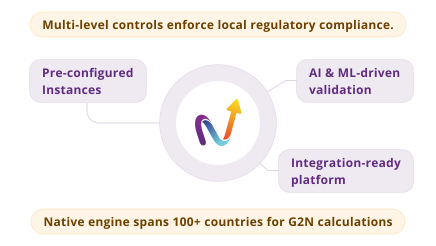
  • G2N Nova: Our advanced gross-to-net payroll engine, available in over 100 countries, integrates with major HCM and Workforce Management systems for a unified global payroll process.

Conclusion

Mercans provides comprehensive Employer of Record (EOR) services in Algeria, ensuring accuracy, compliance, and efficiency in managing your workforce. Our end-to-end solutions simplify payroll and employment processes, making us a trusted partner for businesses navigating the complexities of the Algerian labor market. With Mercans by your side, your expansion into Algeria will be smooth, compliant, and successful, allowing you to focus on growing your business with confidence.

This document was prepared for informational purposes only. As local laws & regulations keeps on changing. Please consult your tax & legal advisors as well.
Contact Sales
Let's get this conversation started. Tell us a bit about your requirement, and we'll get in touch a soon as we can.

    Sample message

    1. We want to expand in $country

    2. We want you to employ 'X' number of employees on our behalf

    3. Contract duration – 3/6/9/12/18/24 months

    4. Number of legal entities (if any exist today)

    5. Employment type: EOR employee or contractor?

    6. Any benefits requirement or “standard statutory only”?

    FAQs

    What is an Employer of Record (EOR) in Algeria?

    An Employer of Record (EOR) in Algeria is a third-party organization that legally employs workers on behalf of another company, handling payroll, CNAS social security contributions, IRG tax withholding, employment contracts, and compliance with Algerian labor law, so the client company does not need to set up its own local entity.

    Can a foreign company hire employees in Algeria without a local entity?

    Yes. By partnering with an EOR such as Mercans, a foreign company can hire employees in Algeria without registering a local branch or subsidiary. The EOR acts as the legal employer of record while the client company directs the employee’s day-to-day work.

    What compliance, payroll, and HR services does an EOR manage in Algeria?

    An EOR manages drafting and executing compliant employment contracts, monthly payroll processing in Algerian Dinar, CNAS social security registration and contributions, IRG income tax withholding and statutory filings, statutory leave and benefits administration, and lawful termination procedures.

    What are the benefits of using EOR services in Algeria?

    EOR services reduce the time and cost of market entry, eliminate the need for local entity setup, minimize compliance risk under Algeria’s labor and social security regulations, and give businesses a fast, compliant way to test the Algerian market or manage a small local team.

    How much does an EOR service cost in Algeria?

    EOR pricing varies by provider and the scope of services required, and is typically charged as a flat monthly fee per employee or a percentage of payroll. Contact Mercans for a tailored quote based on your specific hiring needs in Algeria.

    Is EOR suitable for expanding into Algeria?

    Yes. EOR is well suited to companies testing the Algerian market, hiring a small number of employees, or needing to move quickly without the time and cost of incorporating a local entity, while remaining fully compliant with Algerian employment and tax law.

    Ready to hire in Algeria?

    No local entity needed. Our experts handle payroll, compliance, and onboarding.

    Talk to an expert
    Proven expertise in global payroll.