Employer of Record

Employer of Record (EOR) Morocco

Hire compliantly, pay accurately, expand confidently.

Global Payroll Team
Written by Global Payroll Team
Last updated April 23, 2026
Expert Reviewed

An Employer of Record (EOR) in Morocco serves as the official legal employer for your workers. Often referred to as a Global Professional Employer Organization (Global PEO), this role encompasses a wide range of employment responsibilities. These include ensuring strict adherence to local labor laws and regulations, managing payroll, taxes, and mandatory benefits, and drafting comprehensive employment agreements.

Key responsibilities of the Employer of Record (EOR) include:
  • Ensuring compliance with Moroccan employment laws.
  • Managing local payroll processes.
  • Filing employment-related taxes and necessary paperwork.
  • Providing detailed payslips to workers.
  • Ensuring timely distribution of salary payments.

Simplify your global expansion with our Global PEO services – an effortless solution that eliminates the need for setting up an entity. Our EOR services in Morocco guarantee legal compliance, protect intellectual property (IP), and allow your business to concentrate on core activities. Enhance global mobility, secure work visas, and build a diverse and efficient international workforce. Partner with Mercans, your trusted Employer of Record in Morocco and the broader GCC, for a seamless and compliant employment experience for your global team.

Things you need to know before hiring in Morocco

Employment Contracts in Morocco

At Mercans, we ensure that employment contracts are meticulously crafted in compliance with Moroccan labor laws, governed by the Labour Code and the Code of Obligations and Contracts. These contracts formalize the agreement where an individual commits to providing personal services to an employer in exchange for remuneration.

Definitions and Legal Framework

  • Employee: An individual performing occupational activities under the direction of another party for remuneration.
  • Employer: Any organization or individual hiring the services of one or more individuals.

Contract Validity and Responsibilities

An employment contract in Morocco is valid only if both parties have the capacity to enter into it freely, and the contract’s object is lawful. Mercans ensures that each contract clearly outlines:

  • Compliance with Moroccan employment laws.
  • Management of local payroll processes.
  • Filing of employment-related taxes and necessary paperwork.
  • Provision of payslips and timely salary distribution.

Employers have the duty to ensure employees’ safety, health, and dignity, while employees must adhere to the employer’s authority and maintain good condition of work-related items. Employees are also responsible for their actions and any negligence during their employment.

Employee Information Requirements

When employment commences, Mercans provides employees with written information on:

  • Working time schedules.
  • Weekly rest arrangements.
  • Payment of wages.
  • Health and safety rules.
  • Applicable collective agreements.

Employees receive a labour card detailing the employer’s and employee’s information, job description, and wage, which is updated with any changes.

Contract Types

  • Indefinite-Term Contracts: May be oral or written; written contracts must be in two copies, signed by both parties.
  • Fixed-Term Contracts: Used for specific tasks such as replacing temporarily absent employees, handling temporary increases in activity, or seasonal work. These contracts are generally exceptional and may become indefinite if used outside the legal cases or extended improperly.
  • Temporary Agency Work Contracts: Involve assignments where employees work for a client company but are employed by a temporary work agency. These contracts must be in writing and state the assignment details, including the reason, duration, location, and wages.

Working Hours

In Morocco, the standard working hours for employees are governed by Article 184 of the Labour Code. The maximum standard workweek is set at 44 hours, with a legal daily limit of 10 hours. The workweek can be spread across five or six days.

Probation Period

In Morocco, probation periods depend on the type of employment contract. For indefinite-term contracts, the probation period is set at three months for executive positions, one and a half months for office employees, and 15 days for on-site laborers, with the possibility of renewal once. For fixed-term contracts, the probation period is one day per work week, up to a maximum of two weeks if the contract is less than six months, and one month if the contract exceeds six months.

13th Month Salary

In Morocco, there is no legal obligation to pay a 13th or 14th month salary or bonus. However, employers are required to provide seniority bonuses as follows:

  • 5% of the salary after two years of service
  • 10% after five years
  • 15% after 12 years
  • 20% after 20 years
  • 25% after 25 years

Termination, Severance Pay and Notice Period

In Morocco, Mercans ensures that termination procedures are managed in compliance with local labor regulations. When terminating an employment contract, employers are not legally obligated to provide a 13th or 14th month salary or bonus. However, they must adhere to specific guidelines regarding severance pay and notice periods:

  • Severance Pay: Dismissal indemnity is generally based on the employee’s average wage and length of service, using the statutory hourly formula under the Labour Code:
    • 96 hours of pay for each of the first five years of service.
    • 144 hours of pay for each year from the sixth to the tenth year.
    • 192 hours of pay for each year from the eleventh to the fifteenth year.
    • 240 hours of pay for each year after fifteen years of service.
  • Notice Period: The notice period required for termination varies depending on employee category and length of service under the Labour Code and applicable regulations. In practice, it commonly ranges from 8 days to 3 months.

Employees vs Independent Contractors

Here’s a straightforward comparison table outlining key factors between employees and independent contractors in Morocco:

FactorsEmployeeIndependent contractor / self-employed
Employment lawsPrimarily governed by the Moroccan Labour Code and related social-security and tax rulesGenerally governed mainly by the contract and the Code of Obligations and Contracts, not by the Labour Code as an employee relationship
Hiring practiceUsually hired under an employment relationship; contracts may be indefinite, fixed-term, or for a specific taskUsually engaged through a service agreement for specific services or deliverables
Tax documentsSalary income is typically handled through employer payroll withholdingSelf-employed persons generally manage their own tax filings and payment obligations through the tax system directly
Payer’s tax withholdingEmployer withholds and remits tax on salary income and similar incomeNot generally treated the same way as payroll salary withholding; treatment depends on the nature of the service and tax rules
RemunerationPaid wages/salary under the employment contractPaid fees according to the service contract
Workers’ rightsProtected by labour-law rules on matters such as contract type, probation, working time, leave, and dismissalNot ordinarily entitled to employee labour-law protections unless the relationship is recharacterised as employment
Benefits / social protectionCovered through employee social-security mechanisms where registeredMorocco has a CNSS framework for travailleurs non salariés as well, but it is a different regime from employee coverage
When paidPaid according to the employment arrangement and labour-law rulesPaid according to invoicing and contract terms

Social Security in Morocco

Employer

For employers in Morocco, contributing to social security through the CNSS (Caisse Nationale de Sécurité Sociale) is mandatory. Here are the current CNSS contribution rates, which apply to the gross salary, subject to the applicable ceilings and exclusions:

  • Family allocation: There is no employee contribution; the employer contributes 6.40%.
  • Short-term and long-term social benefits: Employees contribute 4.48%, while employers contribute 8.98%. Contributions are based on a ceiling of 6,000 MAD for the capped branches.
  • Professional training tax: There is no employee contribution; the employer contributes 1.60%.
  • Mandatory medical care (AMO): Employees contribute 2.26%, and employers contribute 4.11%.

These contributions ensure compliance with social security obligations and provide various benefits to employees under the CNSS regime in Morocco.

Employee

For employees in Morocco, the primary mandatory social security regime is managed by the Caisse Nationale de Sécurité Sociale (CNSS) fund. While other private social security organizations exist in Morocco, participation in CNSS is compulsory for employees. The CNSS contribution rates are determined based on the gross salary, excluding specific allowances and indemnities where applicable. Here are the current rates:

  • Family allocation: There is no employee contribution; the employer contributes 6.40%.
  • Short-term and long-term social benefits: Employees contribute 4.48%, and employers contribute 8.98%. Contributions are applied up to a monthly salary limit of 6,000 MAD for the capped branches.
  • Professional training: There is no employee contribution; the employer contributes 1.60%.
  • Mandatory medical care: Employees contribute 2.26%, and employers contribute 4.11%.

Additionally, if there is a social security treaty between Morocco and another country, foreign assignees may be exempt from Moroccan social security contributions and continue contributing to their home country’s social security regime, subject to the conditions outlined in the treaty.

Payroll in Morocco

Minimum Wages

New Minimum Wage Rates:

Effective January 1, 2026, the non-agricultural minimum wage (SMIG) is 17.92 MAD per hour. For the agricultural sector, the minimum daily wage (SMAG) is 97.44 MAD per day effective April 1, 2026.

Payroll Cycle

In Morocco, the typical payroll cycle is monthly, and employees usually receive their wages by the end of the relevant pay period in accordance with the employment contract or company practice.

Overtime Pay

In Morocco, overtime refers to any hour of work performed at the employer’s request beyond the normal working hours specified by the labor code. Companies may require overtime due to heavier workloads, staff shortages, or national emergencies requiring extended hours.

Compensating for Overtime

According to Article 196 of the Moroccan Labor Code, overtime must be compensated with additional pay on top of the regular salary. This compensation should be provided alongside the regular salary payment, unless specified otherwise in the employment contract or company regulations. All components of the salary must be considered in calculating overtime pay, excluding transportation costs, work-related expenses, and family allowances.

How Overtime Pay is Calculated

Non-Agricultural Activities:

Regular Workdays:

  • Between 6:00 a.m. and 9:00 p.m.: 25% increase on the basic hourly wage.
  • Between 9:00 p.m. and 6:00 a.m.: 50% increase on the basic hourly wage.
  • Sundays and Public Holidays:
  • Between 6:00 a.m. and 9:00 p.m.: 50% increase on the basic hourly wage.
  • Between 9:00 p.m. and 6:00 a.m.: 100% increase on the basic hourly wage.

Penalties for Non-Payment of Overtime

  • Employees can file a complaint with the labor inspectorate if they are not compensated for overtime worked. Proof of overtime hours must be provided. According to the labor code, employers failing to pay overtime may face fines.

Mercans’ Payroll Capabilities

In the dynamic employment landscape of Morocco, Mercans serves as your trusted Employer of Record (EOR) for comprehensive payroll solutions. We understand that payroll administration is crucial to your business operations, and our services are meticulously designed to meet your specific needs in Morocco.

  • Payroll Cycle in Morocco: As your dedicated Employer of Record in Morocco, Mercans manages the entire payroll cycle with precision and efficiency. From data collection to timely salary disbursals for both employees and contractors, we handle every step of the process, ensuring accuracy and compliance with local regulations.
  • Local Currency Payments: A key feature of our payroll expertise in Morocco is our ability to manage multi-currency payrolls. We guarantee that all payments are made in Moroccan dirham (MAD), aligning seamlessly with local labor laws and regulations. This simplifies payroll distribution and eliminates the complexities of currency conversion for your workforce.
  • Payroll Setup, Processing, and Administration: Our experienced team as your Employer of Record in Morocco takes care of comprehensive payroll setup, processing, and administration. Whether you need assistance in establishing payroll systems, managing routine cycles, or administering various payroll components, we provide reliable support tailored to your business needs.
  • Ensuring Statutory Compliance: Compliance is fundamental to our payroll services in Morocco. We handle all statutory filings and payments meticulously, ensuring your business adheres strictly to local tax laws and regulations. With our deep understanding of compliance requirements, we help maintain your organization’s credibility and compliance with authorities.

Personal Income Tax in Morocco

Individuals residing in Morocco are subject to personal income tax on their global income. Non-residents, however, are only taxed on income sourced within Morocco.

Personal Income Tax Rates in Morocco: The Moroccan individual income tax is applied according to a progressive scale based on annual taxable income:

  • 0 to 40,000 MAD: Exempted
  • 40,001 to 60,000 MAD: 10%
  • 60,001 to 80,000 MAD: 20%
  • 80,001 to 100,000 MAD: 30%
  • 100,001 to 180,000 MAD: 34%
  • More than 180,000 MAD: 37%

These rates determine the amount of tax owed by residents on their income earned worldwide.

Morocco Employee Hiring Cost

In Morocco, the cost of hiring an employee includes more than just their gross annual salary. Here’s a breakdown of the components involved to help you understand:

  • Gross Annual Salary: This refers to the total amount paid to the employee annually before any deductions or taxes. In this example, the gross annual salary is MAD 100,000.00.
  • Annual Employer Costs: These are additional expenses that the employer incurs beyond the gross salary. They typically cover contributions to social security, medical insurance, and other mandated or voluntary benefits. In Morocco, employer costs depend on the employee’s salary composition and the applicable contribution ceilings.
  • Total Annual Cost: This is the combined sum of the gross annual salary and the annual employer costs.

Understanding these components is essential for businesses to accurately budget and plan for the total expenditure associated with hiring and retaining employees in Morocco, considering both mandatory and discretionary costs related to employment.

Cost componentAmount (MAD)
Gross annual salary100,000.00
Annual employer costs (fixed statutory items only)€18,575.60
1) Family benefits6,400.00
2) Social benefits in the short term756.00
3) Social benefits in the long term5,709.60
4) Compulsory health insurance (AMO)4,110.00
5) Vocational training tax1,600.00
Total annual cost (excluding work accident insurance)118,576

Employee Benefits in Morocco

Mandatory Benefits

In Morocco, labor laws mandate a robust set of benefits aimed at providing financial security, time off, and social protection for employees. Employers must adhere to these regulations to ensure compliance with the law.

Paid Time Off

  • Employees accrue a minimum of 18 days of paid annual leave per year, with accrual based on service tenure.
  • Additional leave may be granted based on factors like age and extended service.
  • Paid time off is also provided for Morocco’s official public holidays.

Leave for Medical Reasons

  • Sick leave benefits through CNSS are generally available after meeting the required contribution conditions.
  • They typically start after the legal waiting period and are paid according to the applicable CNSS rules.
  • Female employees are entitled to 14 weeks of maternity leave, with maternity cash benefits generally paid through social security subject to eligibility conditions.

Social Security

  • Both employers and employees contribute to Morocco’s social security system, covering pensions, health insurance, family benefits, and other protections.
  • Contributions vary based on specific social security programs.

Probationary Periods and Overtime

  • Employment contracts may include a probationary period, typically lasting three months for executives, one and a half months for office employees, and 15 days for laborers on indefinite contracts, subject to the renewal rules permitted by law.
  • Overtime work requires employer instruction and is compensated at higher rates, especially for night shifts, weekends, and public holidays.
  • Termination procedures involve specific notice periods and dismissal indemnity calculations based on tenure.

Optional Benefits

In addition to mandatory benefits, Moroccan employers often offer optional benefits to attract and retain talent:

  • Financial Benefits
    • 13th-Month Bonus: Some companies provide an additional month’s salary as a bonus.
    • Seniority Bonuses: Additional bonuses may be granted based on an employee’s length of service.
    • Meal Vouchers and Transportation Allowances: Subsidies for meals and commuting costs may be offered.
  • Health and Wellness
    • Supplemental Health Insurance: Private health insurance plans may supplement basic public health coverage.
    • Fitness Allowances: Reimbursements for gym memberships or fitness programs to promote employee well-being.
  • Work-Life Balance
    • Flexible Work Arrangements: Options like flexible schedules or remote work may be available.
    • Childcare Allowances: Subsidies or on-site daycare facilities to support employees with children.
  • Professional Development
    • Training and Development: Opportunities for job training, conferences, or educational courses to enhance skills and career advancement.

Health Insurance Requirements

  • Assurance Maladie Obligatoire (AMO)
    • AMO, or compulsory health insurance, covers medical expenses for formal sector employees and their dependents.
    • For private sector employees, AMO is managed through CNSS and the contributions are mandatory and shared between employers and employees.
    • Coverage levels depend on the applicable reimbursement rules and medical network.

Retirement Plans

  • Caisse Marocaine de Retraite (CMR)
    • Public pension plans for civil servants, military personnel, and some public sector categories.
    • Benefits are based on salary and years of service, funded through employer and employee contributions.
  • Moroccan Inter-professional Retirement (CIMR)
    • Supplementary pension scheme commonly used in the private sector.
    • Provides additional retirement savings alongside the statutory schemes.
  • Personal Retirement Savings Plans (PER)
    • Individual retirement savings plans offered by banks and insurance companies, allowing tax-advantaged savings for retirement.

Work Permit in Morocco

Visa requirements for entry to Morocco depend on nationality. Certain nationals are exempt from entry visa requirements for short stays, while others must obtain a visa in advance.

Moroccan embassies or consulates provide details on necessary documents for visa applications.

Work Permits and Self-Employment

Foreigners can work in Morocco after obtaining the required authorizations:

  • Employment Contract: Foreigners can work for a Moroccan company or a foreign company’s Moroccan establishment once the employment contract has been approved by the competent Moroccan authorities.
  • Secondment: Foreigners seconded by a foreign parent company to its Moroccan subsidiary or branch must also comply with work authorization requirements.
  • Self-Employment: Expatriates can establish independent businesses in Morocco, subject to immigration, corporate, and investment formalities.

Residence Permits

Residence permits are typically issued for limited periods and are renewable. Applications are filed in person with the competent authorities. Required documents generally include a valid passport, proof of lawful stay, the approved work contract or work authorization, proof of address, and other supporting documents requested by the authorities.

Family and Personal Considerations

  • Family Members: Dependents wishing to reside in Morocco must obtain the appropriate residence documentation. Spouses or dependents seeking employment need separate work authorization.
  • Driver’s Permits: Foreigners can generally drive with their foreign driver’s license for a limited period, after which local conversion or a Moroccan driver’s license may be required depending on the rules that apply to their nationality and status.

EOR Solutions in Morocco

  • Employer of Record (EOR) Services: Mercans provides comprehensive Employer of Record solutions tailored for businesses expanding into Morocco. We manage the entire employee lifecycle, ensuring adherence to Morocco’s labor laws and regulations.
  • Recruitment Support: In addition to EOR services, Mercans offers recruitment solutions to facilitate talent acquisition in Morocco. Leveraging our extensive network and expertise, we assist in identifying, onboarding, and retaining top talent to support your business growth.
  • Visa and Immigration Services: Simplify global mobility with Mercans’ visa sponsorship and immigration services in Morocco. We navigate the complexities of expatriate employment, ensuring compliance with Moroccan immigration and employment regulations.
  • Contractor Management: Our Assistance on Record (AOR) services cater to businesses managing contractor payments in Morocco. We ensure accurate and compliant payment processing, relieving your administrative burden.
  • Employee Transition Services: Mercans facilitates the transition of freelancers to permanent employees in Morocco. We ensure smooth conversions while adhering to legal requirements, supporting your workforce integration strategy.
  • HCM Integration: Integrate Mercans’ EOR services seamlessly with your Human Capital Management (HCM) system in Morocco. Benefit from real-time data exchange, enhanced compliance, and operational efficiency for streamlined workforce management and payroll operations.

Best Employer of Record Morocco

Mercans Stands Out as the Leading Employer of Record in Morocco for the Following Reasons:

  • Regulatory Compliance: Mercans ensures full compliance with all regulations set by the Ministry of Economic Inclusion, Small Business, Employment, and Skills and relevant Moroccan authorities. It strictly adheres to Morocco’s employment laws and standards, guaranteeing full legal compliance.
  • Independent Operation: Operating as a distinct entity, Mercans offers reliable and customised employment services tailored to the unique needs of businesses in Morocco.
  • Diverse Employment Support: Mercans efficiently manages various forms of employment, including employees, freelancers, contractors, and expatriates, providing flexible solutions to meet a wide range of workforce needs.
  • Enterprise-Focused Solutions: Specifically designed to cater to large enterprises, Mercans delivers scalable and sophisticated services that accommodate complex organisational structures.
  • Multi-Currency Payroll Management: Mercans facilitates payroll processing in multiple currencies, ensuring seamless financial operations for businesses operating in Morocco and internationally.
  • Global Reach and Payroll Expertise: With a robust international presence, Mercans excels in managing multi-country payroll, enabling smooth operations across borders.
  • Data Protection and Compliance: Mercans adheres to rigorous data protection standards, including GDPR compliance and SOC 1 & SOC 2 certifications, ensuring the highest levels of data security.
  • ISO Certifications: Mercans holds ISO 20000 and ISO 27001 certifications, reflecting its commitment to excellence in IT service management and information security.
  • Security Standards Compliance: Mercans meets the OWASP ASVS 3.0 standards, ensuring strong security practices in application development and management.
  • HR Blizz Platform: The proprietary HR Blizz platform is a global payroll and talent management SaaS suite that streamlines payroll processes while ensuring compliance with Moroccan regulations. With over 1,000 local experts, it provides in-depth knowledge of employment laws and business practices.
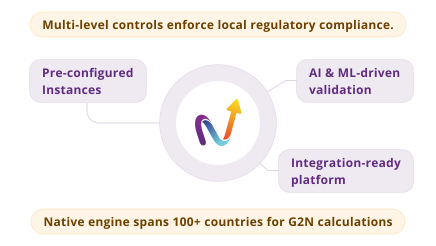
  • G2N Nova Payroll Engine: G2N Nova offers global gross-to-net payroll processing across more than 100 countries, making it one of the most advanced payroll engines available. It can be deployed as a SaaS solution or integrated seamlessly with major Human Capital Management and Workforce Management systems.

Conclusion

Mercans offers robust Employer of Record (EOR) services in Morocco, designed to streamline global expansion without the need for setting up a local entity. From managing payroll cycles and ensuring accurate compensation for overtime to providing comprehensive compliance with Morocco’s labor regulations, our services encompass every aspect of the employee lifecycle.

Our expertise extends to facilitating smooth transitions from freelancers to permanent employees, handling visa sponsorship and global mobility challenges, and managing contractor payments with precision. By integrating our EOR solutions with your Human Capital Management (HCM) system, we ensure real-time data exchange, enhanced compliance, and operational efficiency.

Partner with Mercans in Morocco for a compliant and efficient employment experience, enabling your business to focus on strategic growth and operational excellence in the Moroccan market.

This document was prepared for informational purposes only. As local laws & regulations keeps on changing. Please consult your tax & legal advisors as well.
Contact Sales
Let's get this conversation started. Tell us a bit about your requirement, and we'll get in touch a soon as we can.

    Sample message

    1. We want to expand in $country

    2. We want you to employ 'X' number of employees on our behalf

    3. Contract duration – 3/6/9/12/18/24 months

    4. Number of legal entities (if any exist today)

    5. Employment type: EOR employee or contractor?

    6. Any benefits requirement or “standard statutory only”?

    FAQs

    What is an Employer of Record (EOR) in Morocco?

    An Employer of Record (EOR) in Morocco is a third-party service provider that legally employs workers on behalf of another company. The EOR manages all employment-related responsibilities, including contracts, payroll, taxes, benefits, and compliance with Moroccan labor laws, enabling businesses to hire employees without establishing a local entity.

    How can foreign companies hire employees in Morocco without opening a local entity?

    Foreign companies can engage an EOR to hire employees in Morocco. The EOR assumes the legal employer role, handling all statutory obligations, while the client company manages the employee’s daily tasks. This approach allows businesses to operate in Morocco without the need for a local branch or subsidiary.

    What compliance, payroll, and HR services does an EOR in Morocco provide?

    An EOR in Morocco ensures compliance with local labor laws by managing employment contracts, processing payroll, withholding and remitting taxes, making social security contributions, administering mandatory benefits, and completing statutory filings. They also handle work permits and visa sponsorship for expatriate employees.

    What are the benefits of using EOR services in Morocco?

    Utilizing an EOR in Morocco offers several advantages: it simplifies market entry by eliminating the need for a local entity, ensures compliance with complex labor laws, reduces administrative burdens, mitigates legal risks, and accelerates the hiring process.

    How much does it cost to hire employees through an EOR in Morocco?

    The cost of hiring through an EOR in Morocco varies depending on the provider and the services included. Generally, fees can range from $500 to $2,000 per employee per month. It’s advisable to consult with the EOR provider for a detailed pricing structure.

    Is an EOR the right solution for expanding a business into Morocco?

    An EOR is an effective solution for businesses looking to expand into Morocco without the complexities of setting up a local entity. It provides a compliant and efficient way to hire employees, allowing companies to focus on their core operations while the EOR manages employment-related tasks.

    Ready to hire in Morocco?

    No local entity needed. Our experts handle payroll, compliance, and onboarding.

    Talk to an expert
    Proven expertise in global payroll.