Form P60

Form P60, officially known as the End of Year Certificate, is one of the most important payroll documents issued under the United Kingdom’s Pay As You Earn (PAYE) system. Produced by employers and governed by HM Revenue and Customs (HMRC), the P60 summarises an employee’s total earnings, Income Tax, National Insurance contributions, and statutory payments for a complete UK tax year, which runs from 6 April to 5 April of the following year.

The P60 acts as definitive proof of income for employees. It is essential for filing self-assessment tax returns, claiming tax refunds, applying for mortgages or loans, supporting tax credit claims, and verifying National Insurance records. For employers, issuing accurate P60s on time is not optional. It is a legal requirement under PAYE regulations, and non-compliance can result in HMRC penalties.

Multinational companies operating in the UK rely on Mercans, a global leader in payroll technology and Employer of Record (EOR) services with its global headquarters in London, to manage P60 generation, year-end reporting, and full HMRC compliance across the United Kingdom.

What Is Form P60?

A P60 is an HMRC-mandated annual certificate that records an employee’s pay and tax history for the tax year. Every employer must issue a P60 to each employee who was on the payroll on 5 April, the final day of the UK tax year.

Key purposes of Form P60:

  • Records total gross pay received from a single employer during the tax year.
  • Documents total Income Tax deducted under the PAYE system.
  • Captures National Insurance contributions (NICs) made by the employee.
  • Reports statutory payments such as Statutory Maternity Pay, Paternity Pay, Shared Parental Pay, Adoption Pay, and Bereavement Pay.
  • Lists Student Loan and Postgraduate Loan deductions.
  • Confirms the employee’s tax code used during the year.
  • Acts as official proof of income for financial, tax, and legal purposes.

The P60 is governed by HMRC’s PAYE regulations and forms the cornerstone of UK year-end payroll reporting alongside the Full Payment Submission (FPS) and Employer Payment Summary (EPS).

Who Must Issue and Receive a P60?

Under UK PAYE rules, every employer operating a payroll scheme has a legal duty to issue P60s to qualifying employees.

Employers must issue a P60 to:

  • All employees who were on the payroll on 5 April at the end of the tax year.
  • Employees in full-time, part-time, casual, or fixed-term roles, provided they are still employed on 5 April.
  • Pensioners receiving payments through PAYE (a simplified P60 design is permitted for pension payrolls).
  • Employees who have multiple jobs (each employer issues a separate P60).

P60 is NOT issued to:

  • Employees who left the company before 5 April. They receive a Form P45 instead.
  • Self-employed individuals, who report income through self-assessment.
  • Independent contractors operating outside PAYE.

If an employee has both employment and self-employment income, they will receive a P60 for the employed income only. They must report the rest through self-assessment.

For global companies hiring workers in Britain, Mercans’ UK Employer of Record and payroll services ensure that every employee receives a fully compliant, on-time P60 without the need to set up a local UK entity.

Key Sections of Form P60

The P60 contains several mandatory sections, each capturing specific year-end payroll information. Understanding these sections is critical for both employers preparing the form and employees reviewing it.

Employee Identification Section

  • Surname and Forenames: Employee’s full legal name as registered with HMRC.
  • National Insurance Number (NINO): The unique identifier used for tax and benefits.
  • Works/Payroll Number: Internal employer reference number (optional).
  • Tax Year: The tax year ending 5 April (for example, “Tax year to 5 April 2026”).

Pay and Income Tax Section

  • Pay in this employment: Total gross pay received from this employer in the tax year.
  • Pay in previous employment(s): Pay received from any earlier employer in the same tax year (taken from the previous P45).
  • Total pay for the year: Combined pay across all employments.
  • Income Tax in this employment: Tax deducted by the current employer.
  • Income Tax in previous employment(s): Tax deducted by any earlier employer.
  • Total Income Tax for the year: Combined Income Tax across all employments.
  • Final Tax Code: The tax code applied at year end (for example, 1257L is the standard code for a single job with full Personal Allowance).

National Insurance Contributions Section

This section records NICs across different earnings bands, broken down by NIC table letter:

  • Earnings at the Lower Earnings Limit (LEL).
  • Earnings above the LEL up to and including the Primary Threshold (PT).
  • Earnings above the PT up to and including the Upper Earnings Limit (UEL).
  • Earnings above the UEL.
  • Employee’s NIC contributions in this employment.

Statutory Payments Section

The P60 captures statutory payments included in the pay figure:

  • Statutory Maternity Pay (SMP).
  • Statutory Paternity Pay (SPP).
  • Statutory Adoption Pay (SAP).
  • Statutory Shared Parental Pay (ShPP).
  • Statutory Parental Bereavement Pay (SPBP).
  • Statutory Sick Pay (where applicable).

Loan Deductions Section

  • Student Loan deductions in this employment (whole pounds only).
  • Postgraduate Loan deductions in this employment (whole pounds only).

Employer Information Section

  • Employer’s full name and address (including postcode).
  • Employer PAYE reference number.

P60 Filing Deadlines for the 2025/2026 UK Tax Year

UK employers must adhere to strict statutory deadlines for issuing P60s. Missing these deadlines can lead to HMRC penalties and reputational risk.

  • 5 April 2026: End of the 2025/2026 UK tax year.
  • 31 May 2026: Final deadline for employers to issue P60s to all qualifying employees.
  • 19 April 2026: Deadline for the final Full Payment Submission (FPS) of the tax year.
  • 22 April 2026: Deadline for any final electronic PAYE payments to HMRC.

Employers can issue P60s on paper or electronically as an eP60, provided the electronic version meets HMRC’s design and accessibility requirements. eP60s must clearly include the text “This is a printed copy of an eP60” near the top of the form.

P60 vs P45: Understanding the Difference

P60 and P45 are both essential UK PAYE documents, but they serve very different purposes. Confusing the two is a common payroll error, particularly for international employers new to UK regulations.

Feature P60 (End of Year Certificate) P45 (Details of Employee Leaving Work)
When issued Annually at the end of the tax year When an employee leaves a job
Recipients Employees still working on 5 April Employees who have left employment
Purpose Annual summary of pay and tax Record of pay and tax up to leaving date
Issued by Current employer Departing employer
Used for Tax returns, mortgages, tax credit claims Starting a new job, claiming benefits
Deadline 31 May following the tax year At the time of leaving
Content Full year totals Year-to-date totals up to leaving date

For organisations managing employee transitions, Mercans’ UK payroll outsourcing solutions automate both P60 and P45 generation, ensuring accuracy and compliance with HMRC’s Real Time Information (RTI) framework.

2025/2026 and 2026/2027 UK Payroll Updates Affecting P60s

Several legislative and statutory updates impact P60 reporting for UK employers. Staying current with these changes is essential to avoid errors and penalties.

  • Tax year covered: 6 April 2025 to 5 April 2026 for the 2025/26 P60.
  • Personal Allowance: £12,570 for 2025/26 (frozen at this level).
  • Income reduction trigger: Personal Allowance reduces by £1 for every £2 earned above £100,000, becoming nil at £125,140.
  • Standard tax code: 1257L remains common for individuals with a single job, full Personal Allowance, and no taxable benefits.
  • Emergency tax codes: Codes followed by “W1,” “M1,” or “X” indicate emergency tax application, often when a P45 is not available.
  • National Insurance thresholds: Updated annually for 2025/26 and 2026/27 in line with HMRC announcements.
  • Statutory payment rates: SMP, SPP, SAP, ShPP, and SPBP rates revised for 2025/26.
  • Real Time Information (RTI) reporting: Continues as the foundation for year-end payroll, feeding directly into the P60.
  • Electronic P60 (eP60): Increasing adoption across UK businesses, replacing traditional paper P60s where employees consent.

For real-time updates on UK statutory payroll changes, Mercans publishes regular UK statutory alerts covering HMRC bulletins, Employment Rights Bill updates, and annual rate changes.

Why the P60 Matters for Employees

The P60 is far more than a payroll document. It is one of the most frequently requested forms in the UK financial system.

Common uses of a P60 by employees:

  • Filing a self-assessment tax return for additional income.
  • Claiming back overpaid Income Tax through HMRC.
  • Applying for a mortgage or remortgage (lenders require P60s as proof of income).
  • Supporting personal loan or credit applications.
  • Claiming tax credits, Universal Credit, or other means-tested benefits.
  • Verifying National Insurance contribution records for State Pension qualification.
  • Proving income for visa and immigration applications.
  • Reconciling tax codes and identifying overpayments or underpayments.

HMRC recommends that employees retain P60s for at least 22 months after the relevant tax year end. However, financial advisors typically recommend keeping P60s for at least six years to support pension calculations, retrospective tax queries, or any HMRC enquiry.

Penalties for Non-Compliance

Failure to issue accurate P60s on time exposes employers to several risks under UK law.

Common P60 compliance failures:

  • Missing the 31 May deadline for issuing P60s to employees.
  • Issuing P60s with incorrect names, NI numbers, or pay totals.
  • Failing to include statutory payments such as SMP or SPP.
  • Omitting Student Loan or Postgraduate Loan deductions.
  • Issuing P60s in non-compliant formats or substitute designs without HMRC approval.
  • Using outdated tax codes or thresholds.

HMRC may impose financial penalties, request remediation, or initiate compliance reviews for repeated breaches. Additionally, employees affected by P60 errors may report the employer directly to HMRC, triggering further scrutiny.

Lost or Incorrect P60s: What Employees Should Do

HMRC does not issue replacement P60s. If an employee misplaces their certificate, several alternatives exist.

Options for replacing or correcting a lost P60:

  • Contact the employer’s payroll or HR department for a duplicate or written statement.
  • Access the HMRC Personal Tax Account online for year-by-year pay and tax records.
  • Refer to the final payslip of the tax year, which contains year-to-date totals.
  • Request the employer to issue a corrected P60 if errors are found, with the amended data submitted to HMRC.

How Mercans Simplifies P60 and UK Payroll Compliance

Managing UK payroll involves more than running monthly payslips. It requires complete compliance with HMRC’s PAYE framework, RTI submissions, statutory pay rules, NIC calculations, and year-end reporting through P60s, P11Ds, P32s, and Final Payment Submissions. For international companies expanding into Britain, the regulatory complexity can be a serious barrier.

Mercans delivers a complete UK payroll and HR solution built for global employers:

  • Native UK payroll processing with full PAYE, NIC, and HMRC compliance.
  • Automated P60 generation, distribution, and eP60 delivery to employees.
  • Real Time Information (RTI) reporting including FPS, EPS, and year-end submissions.
  • Employer of Record (EOR) services for hiring UK employees without setting up a local entity.
  • HR Blizz™ SaaS platform unifying global payroll, HR, and reporting across 160 countries.
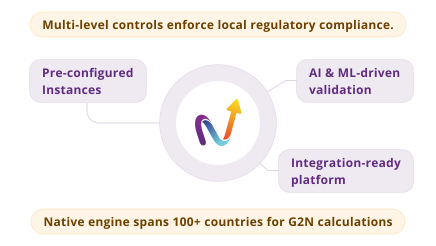
  • G2N Nova engine delivering accurate gross-to-net calculations with real-time compliance.
  • BACS Standard 18 compatibility for direct bank salary payments.
  • Automated P32 and P11D management for monthly HMRC obligations and benefits-in-kind reporting.
  • SOC 1, SOC 2, ISO 27001, and GDPR-certified data security.
  • 24/7 in-country UK payroll specialists providing local expertise and global consistency.

Founded in London in 2003, Mercans now serves 8,000+ clients across 160 countries, processing more than 25 million payslips annually for leading multinationals such as Tesla, Uber, Airbus, Bayer, Adidas, and Johnson & Johnson.

Explore Mercans’ UK Employer of Record and payroll services to see how your business can simplify P60 compliance, eliminate administrative burden, and grow seamlessly across the United Kingdom.

Frequently Asked Questions (FAQs)

Q1: When should I receive my P60?

Your employer must give you a P60 by 31 May following the end of the UK tax year. For the 2025/26 tax year, the deadline is 31 May 2026.

Q2: Do I get a P60 if I left my job during the tax year?

No. If you left your job before 5 April, you will receive a P45 instead. Only employees still employed on 5 April receive a P60.

Q3: What is the difference between P60, P45, and P11D?

P60 reports annual pay and tax. P45 records pay and tax up to your leaving date. P11D reports benefits in kind such as company cars, private medical insurance, or interest-free loans.

Q4: Can a P60 be issued electronically?

Yes. HMRC permits eP60 (electronic P60) issuance, provided it meets formatting and accessibility standards and includes the required wording.

Q5: What if there is an error on my P60?

Contact your employer’s payroll department immediately. They must issue a corrected P60 and submit the amended information to HMRC.

Q6: How long should I keep my P60?

HMRC recommends keeping P60s for at least 22 months after the tax year end. Most financial advisors recommend retaining them for at least six years for pension and tax purposes.

Q7: Can I get a P60 if I am self-employed?

No. P60s are only issued through the PAYE system. Self-employed individuals report income through self-assessment instead.

Q8: What happens if my employer fails to issue my P60?

You can report the employer to HMRC. Failing to issue a P60 by 31 May is a breach of PAYE regulations and may result in penalties.