Employees’ Provident Fund (EPF)

The Employees’ Provident Fund (EPF) is a government-backed retirement savings scheme designed to provide long-term financial security to salaried employees in India. Governed by the Employees’ Provident Funds and Miscellaneous Provisions Act, 1952, the scheme is administered by the Employees’ Provident Fund Organisation (EPFO), a statutory body operating under the Ministry of Labour and Employment, Government of India.

Often referred to as a PF account or provident fund scheme, EPF works as a mandatory contribution plan where both the employer and the employee deposit a fixed percentage of the employee’s basic salary every month. Over time, these contributions accumulate interest and build a substantial retirement corpus that employees can access at retirement, resignation, or during specific life events.

For multinational companies operating in India, EPF is one of the most critical statutory obligations to manage, which is why global payroll providers like Mercans play a vital role in ensuring full compliance with EPFO regulations.

How Does EPF Work?

The EPF scheme is mandatory for any organization employing 20 or more workers, although smaller establishments may register voluntarily. Both parties contribute monthly to the employee’s PF account, with the employer’s share split between the EPF and the Employees’ Pension Scheme (EPS).

Standard EPF Contribution Structure:

  • Employee contribution: 12% of basic salary plus dearness allowance (DA), credited entirely to the EPF account.
  • Employer contribution: 12% of basic salary plus DA, split as 3.67% to the EPF and 8.33% to the Employees’ Pension Scheme (EPS).
  • Additional employer charges include 0.5% towards the Employees’ Deposit Linked Insurance (EDLI) Scheme and administrative fees.

The accumulated balance earns interest at a rate declared annually by the central government, making EPF one of the most attractive risk-free, tax-efficient long-term savings instruments available to Indian employees.

Universal Account Number (UAN) and EPF Membership

Every EPF member is assigned a Universal Account Number (UAN), a 12-digit unique identifier that remains constant throughout the employee’s career. The UAN allows seamless transfer of PF balances across employers, online tracking of contributions, e-nominations, and digital withdrawal claims through the EPFO portal.

EPF Eligibility Criteria

EPF membership is mandatory for employees drawing a basic salary of up to ₹15,000 per month in establishments covered by the EPF Act. Employees earning above this threshold can also opt in voluntarily with employer consent. International workers employed in India are generally covered under EPF as well, unless exempted under a Social Security Agreement (SSA).

EPF Withdrawal Rules

EPF balance can be withdrawn fully upon retirement at the age of 58, or after a continuous period of unemployment of two months or more. Partial withdrawals are also permitted under specific circumstances such as:

  • Medical emergencies and treatment
  • Marriage of self, children, or siblings
  • Higher education
  • Purchase or construction of a house
  • Home loan repayment
  • COVID-19 or other declared emergencies

Withdrawals can be processed online through the EPFO member portal using the UAN, provided KYC details are updated and Aadhaar is linked.

EPF Tax Benefits

The EPF scheme qualifies for EEE (Exempt-Exempt-Exempt) tax treatment under Indian income tax law. Employee contributions are eligible for deduction under Section 80C of the Income Tax Act up to ₹1.5 lakh annually, the interest earned is tax-free (subject to thresholds introduced in recent budgets), and the final withdrawal after five years of continuous service is also exempt from tax.

Employer Compliance Obligations Under EPF

Employer compliance with EPF rules is non-negotiable. Key obligations include:

  • Registering the establishment with the EPFO and obtaining an establishment code.
  • Generating UANs for all eligible employees during onboarding.
  • Accurate calculation and deduction of EPF, EPS, and EDLI contributions every payroll cycle.
  • Filing the monthly Electronic Challan-cum-Return (ECR) with correct gross wages by the 15th of every following month.
  • Maintaining detailed records of employee data, contributions, and payment challans.
  • Facilitating EPF transfers, nominations, and withdrawals for employees.

From wage month August 2025, the EPFO mandated that employers report accurate gross wages in the ECR to ensure compliance and unlock eligibility for the Employment Linked Incentive (ELI) benefits, a development covered in detail by Mercans in its statutory alerts resource.

EPF vs. Voluntary Provident Fund (VPF)

While EPF contributions are mandatory and capped at 12%, employees who wish to boost their retirement savings can opt for the Voluntary Provident Fund (VPF), an extension of the EPF scheme. Under VPF, employees can voluntarily contribute up to 100% of their basic salary plus dearness allowance, with the same interest rate, tax benefits, and government backing as EPF. Employers, however, are not required to match the voluntary portion. You can learn more on the Mercans Voluntary Provident Fund glossary page.

Why EPF Compliance Matters for Global Employers

For multinational corporations expanding into India, EPF compliance is one of the most complex elements of local payroll. Errors in classification, late deposits, or inaccurate ECR filings can trigger penalties, interest charges, EPFO inspections, and reputational damage. Beyond the legal risk, accurate EPF management directly impacts employee trust, retention, and engagement.

This is why companies increasingly partner with experienced global payroll providers to handle their PF compliance, statutory filings, and employee benefit administration in India.

How Mercans Simplifies EPF and Payroll Compliance in India

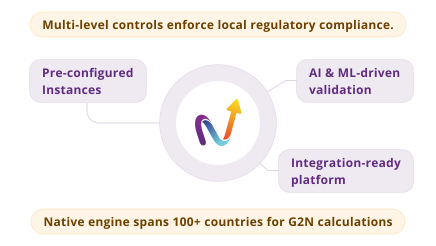
Mercans is a global leader in payroll technology and Employer of Record (EOR) services, supporting clients across more than 160 countries with proprietary SaaS solutions and in-country delivery teams. In India, Mercans ensures end-to-end compliance with Provident Fund (PF), Employees’ State Insurance (ESI), Tax Deducted at Source (TDS), Professional Tax, and Gratuity requirements by accurately calculating and remitting both employer and employee contributions within EPFO timelines.

By operating its own legal entity in India, Mercans eliminates third-party dependencies, reduces payroll errors, and provides real-time visibility into payroll operations. Whether you need fully managed payroll outsourcing, an Employer of Record solution for hiring in India, or AI-powered global payroll software that scales across geographies, Mercans delivers compliant, secure, and audit-ready payroll for organizations of every size.

To simplify EPF management, statutory reporting, and complete payroll compliance in India, partner with Mercans through its global payroll outsourcing solutions.

Frequently Asked Questions (FAQs)

1. Who is eligible for the Employees’ Provident Fund (EPF) in India?

EPF is mandatory for employees earning a basic salary of up to ₹15,000 per month in any organization with 20 or more employees. Employees drawing a higher salary can also join voluntarily with employer consent. International workers posted in India are generally covered as well, unless exempted under a Social Security Agreement (SSA) between India and their home country.

2. What is the current EPF contribution rate for employees and employers?

Both the employee and the employer contribute 12% of the employee’s basic salary plus dearness allowance. The employee’s full 12% is credited to the EPF account, while the employer’s 12% is split, with 3.67% going to EPF and 8.33% to the Employees’ Pension Scheme (EPS). Employers also pay 0.5% towards the EDLI Scheme and applicable administrative charges.

3. Can I withdraw my EPF balance before retirement?

Yes, partial withdrawals are allowed for specific purposes such as medical emergencies, marriage, higher education, home purchase, or home loan repayment. A full EPF withdrawal is permitted upon retirement at the age of 58, or after being unemployed for a continuous period of two months. All claims can be filed online via the EPFO portal using your UAN.

4. What happens to my EPF account when I change jobs?

Your EPF account is linked to your Universal Account Number (UAN), which stays the same throughout your career. When you switch employers, you simply share your UAN with the new employer, and your accumulated PF balance can be transferred to the new account online through the EPFO member portal without losing accrued interest or service continuity.

5. How does Mercans help businesses manage EPF compliance in India?

Mercans manages the complete EPF compliance lifecycle for businesses operating in India, including UAN generation, accurate monthly PF and EPS calculations, ECR filings, timely remittance to the EPFO, and statutory reporting. With its own legal entity in India and proprietary global payroll technology, Mercans helps employers avoid penalties, maintain audit-ready records, and deliver a seamless payroll experience to their workforce.