US Federal Payroll: W-4 & FICA

US federal payroll is the system through which employers in the United States calculate, withhold, deposit, and report federal payroll taxes on behalf of their employees. At the heart of this system are two pillars that every employer must understand:

  • Form W-4 (Employee’s Withholding Certificate): The IRS document employees complete so their employer can withhold the correct amount of federal income tax (FIT) from each paycheck.
  • FICA (Federal Insurance Contributions Act) taxes: The dual-component payroll tax funding Social Security and Medicare, split equally between employee and employer.

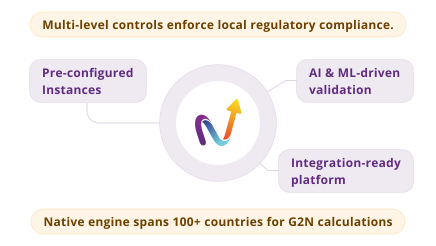
Together, the W-4 and FICA form the foundation of every US payroll cycle, alongside additional obligations such as FUTA (Federal Unemployment Tax), Federal Tax Deposits (FTDs), and quarterly Form 941 filings. For multinational employers hiring US workers, getting these basics right is non-negotiable, which is why global payroll providers like Mercans deliver fully automated US federal payroll compliance backed by proprietary technology and in-country experts.

What is Form W-4 (Employee’s Withholding Certificate)?

Form W-4, officially titled the Employee’s Withholding Certificate, is the IRS form every US employee completes at the start of employment, and whenever their personal or financial circumstances change. The information on the W-4 tells the employer how much federal income tax to withhold from each paycheck, ensuring the employee pays their tax liability incrementally throughout the year rather than as a lump sum on April 15.

The W-4 was significantly redesigned by the IRS in 2020 to align with the Tax Cuts and Jobs Act (TCJA). The current version eliminates the old “allowances” system and instead asks employees to provide direct dollar values, multiple-job adjustments, dependent claims, and other income information.

Key Sections of the Current Form W-4

  • Step 1: Personal information (name, address, Social Security Number, and filing status).
  • Step 2: Multiple jobs or spouse who works (used for households with more than one source of income).
  • Step 3: Claim dependents (Child Tax Credit and Credit for Other Dependents).
  • Step 4: Other adjustments (additional income, deductions, and extra withholding).
  • Step 5: Signature and date, which validates the form.

Employees should review their W-4 annually, after major life events such as marriage, divorce, the birth of a child, the purchase of a home, or a significant change in income. The IRS provides a Tax Withholding Estimator to help employees determine the right amount to withhold and avoid year-end surprises.

Employer Responsibilities for the W-4

Employers must collect a completed W-4 from every new hire, retain it in payroll records for at least four years, and update withholding amounts whenever a new W-4 is submitted. If an employee does not submit a W-4, the employer must default to withholding as if the employee is Single with no other adjustments, as outlined in IRS Publication 15-T (Federal Income Tax Withholding Methods).

What is FICA (Federal Insurance Contributions Act)?

FICA, the Federal Insurance Contributions Act, is the federal payroll tax that funds two of the most important US social insurance programs:

  • Social Security : Old-Age, Survivors, and Disability Insurance (OASDI)
  • Medicare: Hospital insurance for Americans aged 65 and older, as well as certain individuals with disabilities.

Unlike federal income tax, FICA is a flat-rate tax shared equally between the employee and the employer. Both parties pay the same percentages on the same wage base.

2026 FICA Tax Rates

For the 2026 tax year, the IRS and Social Security Administration confirmed the following rates:

  • Social Security (OASDI): 6.2% employee + 6.2% employer, up to the 2026 wage base of $184,500.
  • Medicare: 1.45% employee + 1.45% employer, with no wage base limit.
  • Additional Medicare Tax: 0.9% employee only, on wages above $200,000 in a calendar year for single filers.
  • Combined standard FICA rate: 15.3% total, split evenly at 7.65% each for employer and employee.
  • The Social Security portion stops once year-to-date earnings exceed the wage base.

Please note Mercans tracks every annual FICA change. The updated rates for 2026 are summarized in Mercans’ US Social Security wage base alert and the US Publication 15 (2026) employer guidance alert.

How Federal Income Tax Withholding Works

Federal income tax withholding under the W-4 is calculated using the methods set out in IRS Publication 15-T. There are two main approaches employers can use:

  • Percentage Method: A formula-based calculation suitable for automated payroll systems, applying graduated income tax rates to projected annual income.
  • Wage Bracket Method: A table-based method that simplifies withholding for smaller employers.

The withholding amount depends on the employee’s filing status (Single, Married Filing Jointly, or Head of Household), the dollar values claimed on the W-4, projected annual income, and supplemental wage rules for bonuses, commissions, and severance.

Supplemental wages are typically taxed at a flat 22% federal rate up to $1 million annually and 37% above that.

Read more on Mercans’ detailed Federal Income Tax (FIT) glossary page for a deeper view of FIT mechanics.

Other Core US Federal Payroll Taxes

Alongside the W-4 and FICA, US employers must also manage:

  • FUTA (Federal Unemployment Tax Act): 6% on the first $7,000 of each employee’s wages, with a credit of up to 5.4% available for state unemployment contributions, bringing the effective FUTA rate down to 0.6%, or a maximum of $42 per employee per year.
  • State income tax (SIT) and state unemployment tax (SUTA): Vary by state and locality.
  • Local and city taxes: Such as those in New York City, Philadelphia, and parts of Ohio.

Read more on Mercans’ Payroll Tax glossary entry for the complete US payroll tax structure.

Federal Tax Deposits (FTDs) and Form 941

After withholding federal income tax and FICA, the employer must deposit these amounts with the IRS through the Electronic Federal Tax Payment System (EFTPS) on a strict schedule:

  • Monthly Depositors: Deposit by the 15th of the following month.
  • Semiweekly Depositors: Deposit Wednesday, Thursday, and Friday paydays by the following Wednesday; Saturday through Tuesday paydays by the following Friday.
  • $100,000 Next-Day Rule: Any employer whose accumulated tax liability hits $100,000 on any day must deposit by the next business day.

Quarterly reporting is filed via Form 941 (Employer’s Quarterly Federal Tax Return), while annual filings include Form 940 (FUTA), Form W-2 (Wage and Tax Statement) for each employee, and Form W-3 (Transmittal of Wage and Tax Statements) to the Social Security Administration.

Explore Mercans’ related glossary entries for Federal Tax Deposit (FTD) and the Electronic Federal Tax Payment System (EFTPS) for full details.

Consequences of Non-Compliance With Federal Payroll Rules

The IRS treats payroll tax compliance as a top enforcement priority. Penalties include:

  • Failure-to-Deposit Penalties: Ranging from 2% to 15% of the unpaid amount, depending on how late the deposit is.
  • Failure-to-File Penalties: 5% of unpaid tax per month, up to 25%.
  • Failure-to-Pay Penalties: 0.5% per month, with interest charges accruing daily.
  • Trust Fund Recovery Penalty (TFRP): Personal liability up to 100% of unpaid withheld taxes for responsible officers, directors, or payroll staff.
  • Criminal Prosecution: For willful evasion or fraudulent payroll reporting.

The TFRP is one of the harshest enforcement tools available to the IRS because it pierces the corporate veil and creates personal financial exposure for individuals deemed responsible.

Why W-4 and FICA Compliance Matters for Global Employers

For multinational organizations expanding into the United States, the W-4 and FICA framework is just the beginning. Employers must also manage state and local withholding, multi-state nexus rules, expat tax under bilateral totalization agreements, non-resident alien withholding under Form 8233 and Form W-8BEN, equity compensation (RSUs, ESPPs, ISOs, NSOs), supplemental wage rules, fringe benefit taxation, and worker classification under the DOL and IRS independent contractor tests.

A single error in W-4 setup or FICA computation can trigger employee dissatisfaction, IRS notices, costly TFRP exposure, and reputational damage. This is why outsourcing US federal payroll to an experienced provider has become the standard for global businesses with US operations.

How Mercans Simplifies US Federal Payroll Compliance

Mercans is a global leader in payroll technology, delivering proprietary US payroll services backed by in-country tax experts, SOC 1, SOC 2, ISO 27001, and IRS-recognized compliance frameworks. Mercans’ US federal payroll services cover the entire compliance lifecycle, including:

  • W-4 collection, validation, and storage with secure digital onboarding
  • Accurate federal income tax withholding under IRS Publication 15-T
  • Full FICA (Social Security and Medicare) computation and employer matching
  • Additional Medicare Tax withholding for high earners
  • FUTA, SUTA, and SIT management across all 50 states and local jurisdictions
  • Federal Tax Deposit (FTD) scheduling and submission via EFTPS
  • Quarterly filing of Form 941 and annual filing of Forms 940, W-2, and W-3
  • Multi-state nexus management, expat tax coordination, and non-resident alien withholding
  • Integration with leading HCM platforms including Workday, SAP SuccessFactors, UKG, Oracle HCM, and Dayforce

For businesses hiring in the United States without a local entity, Mercans’ US Employer of Record (EOR) and PEO solution provides full federal, state, and local payroll compliance from day one, including W-4, FICA, FUTA, SUTA, and statutory benefits. For multinationals consolidating payroll globally, Mercans’ global payroll outsourcing solutions deliver unified US compliance alongside coverage in more than 160 countries.

Frequently Asked Questions (FAQs)

1. What is the purpose of IRS Form W-4?

Form W-4 (Employee’s Withholding Certificate) is the IRS form every US employee completes so their employer can withhold the correct amount of federal income tax from each paycheck. It captures the employee’s filing status, dependents, multiple-job adjustments, additional income, deductions, and any extra withholding the employee wishes to add. Employees should review and update their W-4 whenever they experience a major life change such as marriage, divorce, the birth of a child, or a significant change in income.

2. What are the current FICA tax rates for 2026?

For 2026, FICA taxes consist of two components.

  • Social Security (OASDI) is 6.2% paid by both the employee and the employer, applied to wages up to the 2026 Social Security wage base of $184,500.
  • Medicare is 1.45% paid by both parties with no wage cap.

An Additional Medicare Tax of 0.9% applies to employees on wages above $200,000 in a calendar year, withheld by the employer but not matched.

The combined standard FICA rate is 15.3% split equally between employer and employee.

3. What is the difference between federal income tax withholding and FICA?

Federal income tax withholding is based on the employee’s W-4 and applies graduated tax rates depending on filing status, dependents, and projected annual income. It funds general government operations and is only paid by the employee.

FICA, on the other hand, is a flat-rate payroll tax that funds Social Security and Medicare specifically, and it is shared equally between the employee and the employer. Both taxes are withheld from each paycheck but are calculated and reported separately.

4. How and when must employers deposit federal payroll taxes?

US employers deposit federal payroll taxes electronically through the Electronic Federal Tax Payment System (EFTPS). The deposit schedule, either monthly or semiweekly, is determined by the employer’s total payroll tax liability during the IRS lookback period.

A special $100,000 Next-Day Rule also applies, requiring employers whose tax liability reaches $100,000 on any day to deposit by the next business day. Late or inaccurate deposits trigger failure-to-deposit penalties ranging from 2% to 15% of the unpaid amount.

5. How does Mercans help businesses with US federal payroll compliance?

Mercans manages the entire US federal payroll lifecycle, from W-4 collection and validation to FICA computation, federal and state withholding, FUTA, SUTA, EFTPS deposits, and quarterly and annual IRS filings such as Forms 941, 940, W-2, and W-3. With its proprietary global payroll technology, in-country US tax experts, and full Employer of Record (EOR) capability, Mercans helps employers eliminate compliance risk, avoid IRS penalties, manage multi-state complexity, and deliver an accurate, on-time pay experience to every employee.