Global Payroll

Payroll in Austria

Accurate payroll, full compliance, zero hassle.

Global Payroll Team
Written by Global Payroll Team
Published on August 24, 2026
Last updated August 24, 2026
Expert Reviewed

Mercans is your premier partner for top-quality payroll services in Austria, offering both Managed and SaaS solutions. Our steadfast commitment to delivering exceptional payroll outsourcing in Austria is unmatched. Drawing from extensive experience in the payroll sector, Mercans ensures precise and compliant payroll services, establishing us as the preferred option for businesses of all sizes. Count on Mercans for prompt and accurate payroll transactions, complemented by the convenience of multi-currency payments tailored to the Austrian market. As your dedicated local payroll provider in Austria, we feature a team of in-country payroll specialists well-versed in local regulations, providing comprehensive assistance for a seamless payroll experience customized to your business requirements.

Payroll Services in Austria

At Mercans, our unwavering commitment to local compliance in Austria goes beyond a mere checklist. We proactively navigate the intricate regulatory landscape — including Austria’s collective-agreement-driven wage structure and strict pre-employment registration rules — ensuring your business aligns seamlessly with the country’s norms. Here’s an insight into how Mercans expertly manages key activities, safeguarding both compliance and operational efficiency:

Comprehensive Services Include

Payroll Settlement

  • Precise calculations encompassing wage tax (Lohnsteuer), social security, Abfertigung Neu, and other deductions.
  • Inclusion of overtime, collective agreement (Kollektivvertrag) entitlements, and applicable allowances.
  • Monthly preparation of filings for the Austrian Health Insurance fund (ÖGK) and tax office (Finanzamt).

Payment Processing

  • Generation and delivery of payslips (Lohnzettel).
  • Efficient management of the mandatory 13th and 14th month special payments (Urlaubsgeld and Weihnachtsgeld).
  • Streamlined SEPA payment processing in Euro.

Regulatory Compliance

  • Ensuring new hires are registered with the ÖGK before their first day of work, as Austrian law strictly requires.
  • Accurate monthly withholding and remittance of wage tax, social security, and municipal tax (Kommunalsteuer).
  • Preparation of the annual wage statement (L16 / Jahreslohnzettel) for each employee.

Social Security & Provident Fund Management

  • Monthly social security contribution filings with the ÖGK, which allocates funds across pension, unemployment, and accident insurance.
  • Ongoing Abfertigung Neu contributions to each employee’s Betriebliche Vorsorgekasse (BV-Kasse).
  • Expert management of collective agreement-driven pay structures across sectors.

Minimum Wages and Collective Agreements in Austria

Austria is one of only a handful of EU countries with no single statutory national minimum wage. Instead, minimum pay is set sector by sector through collective agreements (Kollektivverträge) negotiated between trade unions and employer associations, which cover more than 95% of Austrian employees. Since around 2020, Austria’s social partners have worked toward an informal floor of approximately EUR 1,500 gross per month across most collective agreements, though the exact minimum still varies meaningfully by sector. Mercans confirms the applicable collective agreement and minimum pay rate for each specific role and industry.

Working Hours

The standard legal working week in Austria is 40 hours, structured as 8 hours per day, with many collective agreements setting an effective norm of 38 to 38.5 hours. The statutory maximum, including overtime, is 12 hours per day and 60 hours per week, though average weekly hours may not exceed 48 over a 17-week reference period.

13th & 14th Month Salary (Urlaubsgeld & Weihnachtsgeld)

While not mandated directly by the base labor statute, special payments equivalent to a 13th and 14th month’s salary — holiday pay (Urlaubsgeld, typically paid around June) and Christmas bonus (Weihnachtsgeld, typically paid around November) — are effectively universal in practice, provided for by the collective agreements covering the vast majority of Austrian employees. These special payments benefit from preferential “Sechstel” (one-sixth) taxation, generally taxed at a flat rate rather than at the employee’s normal marginal rate, provided they remain within the applicable annual limit.

Key Points on Overtime

Standard Overtime Premium
True overtime — hours beyond the statutory 8-hour day or 40-hour week — carries a flat 50% surcharge above the normal hourly rate.
Part-Time “Mehrarbeit”
A separate 25% premium applies specifically to part-time employees for hours worked beyond their part-time contract but still within the full-time statutory or collective agreement norm; hours beyond the full-time norm still attract the full 50% overtime surcharge.
Tax-Free Overtime Allowance
A portion of overtime pay is tax-free each month, up to a capped monthly amount, subject to conditions on the number of hours and rate.

Payroll Cycle in Austria

Salaries in Austria are paid monthly, in Euro, generally via SEPA bank transfer. Employers must provide employees with a detailed payslip (Lohnzettel) each pay period.

Company Registration in Austria

When establishing a business presence in Austria to run local payroll, foreign companies typically choose from the following structures, registered through the Firmenbuch (commercial register):

GmbH (Limited Liability Company)

The standard vehicle for a full commercial presence. Minimum share capital is EUR 10,000 (reduced from EUR 35,000 effective 1 January 2024), with at least half payable in cash at formation. Requires at least one managing director (Geschäftsführer) and formation by notarial deed, with registration at the competent Firmenbuch court. End-to-end setup commonly takes a few weeks.

Branch Office (Zweigniederlassung)

Not a separate legal entity — liabilities attach to the foreign parent. Registered in the Firmenbuch via an authorized representative. Non-EU/EEA parent companies must appoint a permanent representative habitually resident in Austria; EU/EEA parent companies are exempt from this requirement. Can hire and run local payroll without a fully separate Austrian legal entity.

Representative Office

Not registered in the Firmenbuch and restricted to auxiliary activities such as market research and liaison work. It cannot invoice, generate revenue, or sign contracts, making it unsuitable for a company that intends to hire staff and run full local payroll.

Setting up and maintaining any of these structures — including the ongoing corporate compliance obligations that come with them — requires dedicated legal and administrative resources. Mercans’ Employer of Record and Global Payroll solutions allow companies to hire and pay employees in Austria without first establishing any of these entities.

Employer Registration for Payroll in Austria

Running compliant payroll in Austria requires several registrations:

  • Finanzamt (Tax Office): Register the business to obtain a tax number (Steuernummer), a prerequisite for legally withholding and remitting employee wage tax.
  • ÖGK (Austrian Health Insurance Fund) Employer Account: Register the company to obtain an employer account number with the ÖGK, which also administers pension, unemployment, and accident insurance contributions.
  • Employee Registration — Before Work Starts: Austria strictly requires each new employee to be registered with the ÖGK before their first day of work, submitted electronically via the ELDA system. Late or missing registration can trigger contribution surcharges and administrative penalties.
  • Local Bank Account: While EU SEPA rules require acceptance of any euro-area IBAN, opening a local Austrian account is often the practically smoother path for share capital deposits and day-to-day payroll transfers.

Payroll Taxes in Austria

Personal Income Tax in Austria

Austria applies a progressive income tax scale, with brackets indexed annually for inflation (“kalte Progression” adjustment) as part of a multi-year reform.

Annual Taxable Income Tax Rate
Up to EUR 13,539 0%
EUR 13,539 – 21,992 20%
EUR 21,992 – 36,458 30%
EUR 36,458 – 70,365 40%
EUR 70,365 – 104,859 48%
EUR 104,859 – 1,000,000 50%
Above EUR 1,000,000 55% (temporary top bracket)

Tax Reporting

Employers must remit withheld wage tax (Lohnsteuer) to the Finanzamt, social security contributions to the ÖGK, and municipal tax (Kommunalsteuer) — 3% of the monthly gross payroll — to the relevant municipality, all generally due by the 15th of the following month. By the end of February each year, employers must submit each employee’s annual wage statement (L16 / Jahreslohnzettel) electronically to the Finanzamt.

Social Security in Austria

Austrian social security contributions cover health, pension, unemployment, and accident insurance, calculated up to an annually indexed contribution ceiling.

Contribution Employee Employer
Health Insurance 3.87% 3.78%
Pension Insurance 10.25% 12.55%
Unemployment Insurance Graduated, up to 2.95%* 2.95%
Accident Insurance 1.10%
Abfertigung Neu (Provident Fund) 1.53%

*The employee unemployment insurance rate is reduced or waived entirely for lower earners, on a graduated scale. Contributions are calculated up to a monthly contribution ceiling, indexed annually, with a separate, lower annual cap applied to the 13th and 14th month special payments. Regional levies, such as a housing-fund contribution in some areas, may add further modest amounts to the total employer cost; Mercans confirms the exact all-in rate for each engagement.

Termination Payroll in Austria

Notice periods for employer-initiated termination were harmonized between white-collar and blue-collar employees in October 2021, and now generally scale with length of service: 6 weeks up to 2 years of service, 2 months after 2 years, 3 months after 5 years, 4 months after 15 years, and 5 months after 25 years, typically expiring at the end of a calendar quarter unless otherwise agreed. On termination, the final settlement includes outstanding wages, any pro-rata 13th or 14th month payments accrued, and payout of unused accrued vacation. Abfertigung Neu contributions are not paid out as a lump sum by the employer at termination — the employee draws down their own Betriebliche Vorsorgekasse (BV-Kasse) balance directly, generally once at least 3 years of contributions have accrued.

Austria Compliance Requirements

Obligation Frequency / Deadline
Employee Registration with ÖGK Before the employee’s first day of work
Wage Tax (Lohnsteuer) Remittance Monthly, by the 15th of the following month
Social Security Contributions Monthly, by the 15th of the following month
Municipal Tax (Kommunalsteuer) Monthly, by the 15th of the following month
Annual Wage Statement (L16 / Jahreslohnzettel) By the end of February following the tax year

Employee Benefits in Austria

Mercans, in adherence to Austrian labor law and applicable collective agreements, ensures that employees receive the right benefits by staying vigilant about statutory deductions and entitlements.

  • 13th & 14th Month Salary: Urlaubsgeld and Weihnachtsgeld special payments, effectively universal across collective agreements, described above.
  • Abfertigung Neu: An employer contribution of 1.53% of gross salary into each employee’s personal, portable provident fund account from day one of employment.
  • Annual Leave: Statutory paid annual leave, with entitlements increasing after extended years of service.
  • Sick Leave: Continued pay during illness, with duration and rate depending on length of service.
  • Collective Agreement Benefits: Many additional entitlements — including minimum pay, allowances, and working conditions — are set at the sector level through the applicable Kollektivvertrag.

Benefits of Payroll Outsourcing in Austria

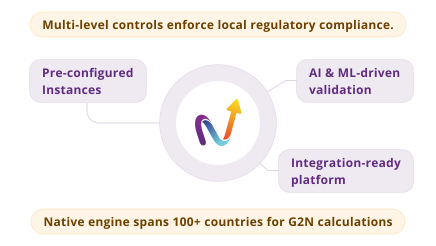
For our payroll services, we have strategically implemented a robust tool designed to seamlessly operate across diverse countries, ensuring regional uniformity and meeting the specific requirements of our clients. This tool reflects our commitment to delivering:
Stringent Data Security Measures
Incorporating industry-leading security measures to safeguard sensitive data, including compliance with GDPR, SOC, ISO, and OWASP standards. ISO 27001 and ISAE3402 certifications ensure adherence to stringent information security protocols, guaranteeing the highest level of data protection.
Consistent and Sustainable Performance
Ensuring reliable performance that meets the dynamic demands of payroll services, providing clients with consistent and sustainable solutions across Austria’s collective agreement landscape.
Flexibility and Scalability
Offering flexibility and scalability to accommodate evolving client needs and adapt to changing business environments, ensuring seamless integration and expansion.
Collaborative Cloud Platform
Utilizing a cloud-based platform that facilitates collaborative work, promoting efficiency and accessibility across teams, enhancing collaboration and productivity.
Key Features of Electronic Payroll Support

  • Full Traceability: Enabling a traceable process from generation to transmission and validation, ensuring transparency and accountability at every step.
  • Efficiency in Human Resources: Enhancing the efficiency of the human resources area by streamlining the payroll settlement process, resulting in significant time savings and improved resource allocation.
  • Certified Suppliers: Partnering with certified suppliers who uphold the highest standards of information security with ISO 27001 certification, ensuring secure data transmission processes and bolstering the integrity of our services.

Payroll Solutions in Austria

Uncover the potential of seamless payroll processing in Austria with Mercans’ Global Payroll Solutions. Our flexible models ensure local compliance, support multi-currency transactions, and offer connectivity to global Human Capital Management (HCM) and Enterprise Resource Planning (ERP) systems. Paying correctly has never been more straightforward.
Explore Our Flexible Models

  • SaaS (Software as a Service): Tailored for enterprise businesses managing multi-country payroll with intricate complexities arising from diverse data points, locations, currencies, and languages. Our SaaS model streamlines operations for optimal efficiency.
  • Managed Services: Designed for mid-sized and large enterprise businesses, our Managed Services model caters to those operating multi-country payroll. It provides on-demand HR expertise, ensuring security, reliability, and compliance across the board.
  • HRMS (Human Resource Management System): Perfect for mid to large businesses in expansion mode, our HRMS model offers a comprehensive range of functionalities, including payroll and benefits. Businesses can select the specific features they need, ensuring a tailored and efficient solution.

Streamline Payroll with Mercans’ Technology and Integrations

Mercans leads the way in providing top-tier payroll solutions in Austria, offering a diverse range of tailored options to meet our clients’ unique needs. Choose Mercans as your reliable ally, ensuring a smooth and effective payroll process in Austria’s dynamic business environment.

  • Cutting-Edge Technology: Explore the forefront of innovation with Mercans’ state-of-the-art technology, driving our global payroll solutions.
  • Seamless Integrations: Effortlessly integrate your Human Capital Management (HCM) systems with Mercans’ solutions, enhancing connectivity and efficiency.
  • Recognized Excellence: Partner with an esteemed organization known for its commitment to excellence in delivering outstanding payroll services.

Outsource to Payroll Company in Austria

In the dynamic business landscape of Austria, Mercans stands as a beacon of excellence, offering tailored solutions to meet the diverse needs of our clients. With a stable economy, sophisticated regulatory environment, and strategic position at the heart of Central Europe, Austria presents attractive opportunities for business expansion, alongside genuinely distinctive payroll requirements shaped by its collective-agreement system. Mercans is your trusted partner in navigating the complexities of the Austrian market. Our unwavering commitment to 100% local compliance, coupled with our extensive knowledge of Austrian labor laws, ensures that businesses establish a solid presence in Austria with ease. By choosing Mercans, companies can leverage our expertise to streamline operations, adhere to statutory requirements, and lay the groundwork for sustained growth in this dynamic environment. With Mercans by your side, embark on a journey of success and prosperity in Austria’s thriving business landscape.

This document was prepared for informational purposes only. As local laws & regulations keeps on changing. Please consult your tax & legal advisors as well.
Contact Sales
Let's get this conversation started. Tell us a bit about your requirement, and we'll get in touch a soon as we can.

    Sample message

    1. Headcount per legal entity (breakdown by country/entity)

    2. Systems to be interfaced with (e.g., HRIS, payroll, finance, time tracking, etc.)

    3. Any specific integration requirements or preferred platforms

    4. Requirement for additional modules (e.g., benefits administration, time & attendance, expense management)

    5. Level of customization or configuration needed for systems integration

    FAQs

    How do you ensure compliance with Austria's ÖGK pre-employment registration rule?

    Our global payroll platform automates country-specific rules, including Austria’s strict requirement that every new employee be registered with the ÖGK (Austrian Health Insurance Fund) before their first day of work, ensuring accurate and timely compliance.

    How do you manage Austria's collective agreement (Kollektivvertrag) wage structures?

    We leverage in-country expertise to identify and apply the correct sector-specific collective agreement for each role, since Austria has no single statutory minimum wage and pay is instead set through collective bargaining covering over 95% of employees.

    How do you handle Austria's 13th and 14th month special payments?

    We calculate and process Urlaubsgeld and Weihnachtsgeld special payments correctly, applying the preferential “Sechstel” tax treatment these payments are entitled to under Austrian tax law.

    What challenges arise when integrating Austrian payroll data with global systems, and how do you address them?

    Integration challenges are solved through a unified payroll platform that consolidates data, standardizes reporting, and connects HR, finance, and compliance teams across every country you operate in, including Austria.

    How do you manage the Abfertigung Neu provident fund contributions?

    We calculate and remit the mandatory 1.53% employer contribution to each employee’s Betriebliche Vorsorgekasse (BV-Kasse) every pay period, ensuring this portable severance-replacement benefit is administered accurately from day one of employment.

    Need payroll in Austria?

    Accurate, compliant payroll processing handled by local experts.

    Talk to an expert
    Proven expertise in global payroll.