Employer of Record

Employer of Record (EOR) South Africa

Hire compliantly, pay accurately, expand confidently.

Global Payroll Team
Written by Global Payroll Team
Last updated April 24, 2026
Expert Reviewed

An Employer of Record (EOR) South Africa assumes the critical role of the legal employer for workers, often referred to as a Global Professional Employer Organization (Global PEO). This essential function involves overseeing all aspects of employment to ensure strict compliance with local labor laws and regulations. From managing payroll and taxes to providing mandated benefits and creating employment contracts, the EOR plays a pivotal role in maintaining legal and operational integrity.

Key responsibilities of the Employer of Record (EOR) in South Africa encompass:
  • Ensuring full compliance with local employment laws and regulations.
  • Efficiently managing the local payroll process.
  • Handling the timely filing of employment-related taxes and necessary documentation.
  • Issuing accurate payslips to employees.
  • Facilitating prompt and secure salary payments to employees.

Our Global PEO services offer a streamlined solution for businesses looking to expand into South Africa without the complexities of setting up a local entity. Partnering with Mercans as your Employer of Record (EOR) in South Africa ensures not only legal compliance but also safeguards Intellectual Property (IP) interests, allowing your business to focus on core activities. Benefit from seamless global mobility management, effective visa facilitation, and the establishment of a diverse and productive global workforce. Trust Mercans, your dedicated Employer of Record in South Africa, for a compliant and efficient employment solution tailored to your global expansion needs.

Things you need to know before hiring in South Africa

Employment Contracts in South Africa

In South Africa, employment contract law is rigorously governed to ensure the protection of employees’ rights and define the obligations of employers. Whether one holds a permanent position, a fixed-term contract, or engages as a casual employee, all are recognized under South African labor law with specific rights outlined by the Basic Conditions of Employment Act.

Understanding what constitutes an employment contract in South Africa is crucial. It encompasses various types, including full-time indefinite contracts, fixed-term agreements, and casual employment arrangements. Each type specifies unique terms and conditions, ensuring clarity and compliance with legal standards.

Unlike independent contractors, employees in South Africa are typically engaged under employment contracts. Even in the absence of a written agreement, an implied contract may exist, safeguarding the fundamental rights and obligations of both parties. This framework helps ensure that workers, including domestic employees, are protected under applicable labour law.

Employment contract law, integral to South Africa’s broader labor law landscape, governs a spectrum of employment arrangements. This includes contracts for casual workers, executive roles, project-based employment, and collective agreements. It ensures employees’ rights are upheld, regulates changes to employment terms, and fosters fair practices across diverse employment scenarios.

In essence, South Africa’s employment contract law underpins the fundamental relationship between employers and employees, promoting equity, compliance, and clarity in all aspects of the employment relationship.

Working Hours

In South Africa, working hours and overtime are regulated by Chapter 2 of the Basic Conditions of Employment Act (BCEA), ensuring fair practices and protection for employees. Here’s a breakdown of the key regulations:

Hours of Work
For employees earning below the statutory earnings threshold, the maximum ordinary working time is 45 hours per week (Section 9 BCEA). This equates to 9 hours per day if the employee works a five-day week, or 8 hours per day if the employee works more than 5 days per week, excluding meal intervals.

The actual hours worked within the normal working time are subject to contractual agreement between the employer and employee. While the statutory limit is 45 hours per week, some employers may implement shorter workweeks, such as 40 hours per week. Meal intervals are generally unpaid and are the employee’s own time, typically lasting 1 hour unless mutually agreed to be reduced to 30 minutes.

Employees are required to have a meal interval after five hours of continuous work. Tea breaks are not counted as part of the statutory meal interval. Therefore, an employee working a 5-day week with a daily 1-hour lunch break may be present at the workplace for 50 hours per week.

For employees earning above the statutory threshold amount, the ordinary working hours must be negotiated between the employer and employee.

Overtime
Overtime work is voluntary and must be agreed upon by both the employer and employee. The maximum permissible overtime is 3 hours on any day or 10 hours in any week (Section 10 BCEA). Overtime must be compensated at 1.5 times the normal wage rate, except for Sunday work and public holidays, which are compensated according to the BCEA rules. Alternatively, time off can be granted in lieu of payment, but only if agreed upon with the employee.

Employees earning above the current earnings threshold are generally exempt from the overtime provisions outlined in Section 10 of the BCEA. This means they cannot demand overtime pay under those provisions, nor paid time off in lieu under those provisions. However, employers are also prohibited from compelling these employees to work overtime without agreement.

In cases where overtime is required for employees above the threshold, the terms of overtime work and compensation should be negotiated with the employee. If an employer fails to compensate for overtime worked under the agreed terms, the employee has the right to refuse the overtime hours.

These regulations ensure that working hours and overtime practices in South Africa are fair, transparent, and respectful of both employer and employee rights, contributing to a balanced and productive work environment.

Probation Period

  • Probation periods in South Africa are optional and apply only to newly hired employees, not those promoted internally.
  • If implemented, probation terms must be clearly outlined in the employment contract upfront.
  • The purpose of probation is to assess work performance and suitability for the role.
  • There is no mandated length for probation, but three months is commonly accepted as reasonable.
  • During probation, employees are entitled to fair procedures and protections under labour law.
  • Dismissals during or after probation must be substantively and procedurally fair, following legal requirements closely.

13th Month Salary

  • South African labor law does not mandate bonuses, making payment entirely at the employer’s discretion unless contractually agreed.
  • The 13th cheque, often termed a Christmas bonus, is typically viewed as a discretionary or contractual benefit rather than a statutory legal requirement.
  • Employers commonly include the 13th cheque in employees’ basic salaries or may not offer it at all, depending on company policy and financial performance.
  • If an employer traditionally pays a 13th cheque but wishes to change the practice, the issue should be handled carefully and, where applicable, through consultation and proper documentation.
  • Performance bonuses are based on individual or departmental achievements exceeding company standards.
  • Production bonuses are tied to meeting or exceeding production targets and maintaining quality standards.
  • Employers considering changes to bonus policies should negotiate with employees where necessary and document the process to ensure fairness and compliance with labor laws.

Termination, Severance Pay and Notice Period

Severance Pay
According to Chapter 5 of the Basic Conditions of Employment Act (BCEA), termination of employment requires specific notice periods based on the length of employment:

  • One week for employees employed for six months or less.
  • Two weeks for employees employed for more than six months but less than one year.
  • Four weeks for employees employed for one year or more, and for farmworkers or domestic workers employed for more than six months.
  • These notice periods are minimum requirements and cannot be shortened by agreement, except in cases permitted by collective agreements.
  • Notice of termination must be provided in writing, unless the employee is illiterate.
  • Employers are prohibited from giving notice during an employee’s statutory leave period and cannot require employees to use leave entitlements during their notice period, except where the law allows.
  • It is advisable to seek advice from a labour law practitioner to ensure compliance and understanding of a specific situation.
Notice Period
  • Termination of employment must be initiated with the following minimum notice periods:
    • One week if the employee has been employed for six months or less.
    • Two weeks if employed for more than six months but less than one year.
    • Four weeks if employed for one year or more, or for farmworkers or domestic workers employed for more than six months.
  • These notice periods are non-negotiable minimums and cannot be reduced by agreement, except where collective agreements allow the four-week period to be reduced to not less than two weeks.
  • The employer must give the same notice period to terminate an employee as required of the employee to terminate their contract.

Employees vs Independent Contractors

Distinguishing between an employee and an independent contractor is crucial under South African labour law, as it affects rights, obligations, and legal relationships. Understanding these differences helps ensure compliance with the law and proper working arrangements. Below is a comparison between the two classifications:

Aspect Employee Independent Contractor
Definition Works under an employment relationship and is generally subject to the employer’s direction and control Provides services under a contract for services and is genuinely independent in how the work is done
Rights and Benefits Covered by labour-law protections such as minimum standards under the BCEA and other employment legislation Generally not entitled to employee labour-law benefits or protections merely because services are rendered
Legal Relationship Regulated mainly by labour legislation such as the Labour Relations Act (LRA) and the Basic Conditions of Employment Act (BCEA) Governed mainly by contract law and the actual terms of the service agreement
Control Employer usually controls or directs how, when, and where the work is performed Greater autonomy over work methods, timing, and delivery, subject to the contract
Integration Usually integrated into the employer’s business Usually operates an independent business and may serve multiple clients
Risk and Investment Employer more often bears business risk and provides core work resources Usually bears own financial risk and often provides own tools/resources
Duration and Exclusivity May be long-term, ongoing, or exclusive, depending on the job Often project-based or service-based and may work for more than one client
Economic Dependence May be economically dependent on one employer Usually less economically dependent and more commercially independent
Tax and Compliance Employer generally handles payroll deductions and employment-related statutory compliance Contractor generally manages own tax affairs and business compliance
Reclassification Risk Lower if the relationship is correctly documented and operated as employment Higher if the relationship is labelled as contracting but functions like employment in practice

Key Factors to Determine Classification

  • Control: More control by the employer indicates employee status.
  • Integration: Integrated into business suggests employee; distinct business suggests independent contractor.
  • Risk and Investment: Employees bear fewer business risks.
  • Duration and Exclusivity: Longer-term and exclusive relationships indicate employee status.
  • Economic Dependence: Employees rely economically on their employer.

Legal Considerations and Compliance

  • Correctly classify working relationships to avoid legal and tax liabilities.
  • Misclassification can lead to disputes, claims for benefits, and non-compliance issues.
  • Seek professional advice and ensure clear, written contracts outlining the nature of the relationship and scope of work.

Types of Employment Contracts

  • Permanent Employment Contract
  • Temporary or Fixed-Term Employment Contract
  • Part-Time or Temporary Employment Contracts

Importance of Employment Contracts

  • Required by law through written particulars of employment and related BCEA obligations.
  • Regulates terms and conditions of employment.
  • Defines obligations and employment terms clearly.

Social Security in South Africa

Employee

In South Africa, there is no comprehensive employer-employee social security system similar to many other jurisdictions. However, both employers and employees are generally obligated to contribute to the Unemployment Insurance Fund (UIF).

Unemployment Insurance Contributions

Contribution Rates
  • Employees: 1% of their remuneration, subject to the applicable earnings ceiling.
  • Employers: 1% of the employee’s remuneration, subject to the applicable earnings ceiling.
Contribution Limit
  • The contributions are limited to a remuneration ceiling of ZAR 17,712 per month, or ZAR 212,544 per annum, per employee.

Employer

  • Skills Development Levy (SDL):The Skills Development Levy (SDL) is a compulsory levy aimed at funding education and training initiatives. It is paid by employers and cannot be deducted from employees’ remuneration. Employers with an annual payroll of ZAR 500,000 or less are generally exempt from this levy. The SDL rate is 1% of the total leviable payroll, and payments are made monthly along with employees’ tax.
  • Unemployment Insurance Fund (UIF) Contributions: Employers are required to make contributions to the Unemployment Insurance Fund (UIF) on behalf of their employees. The contribution rate is 1% of remuneration, up to a monthly cap based on the earnings ceiling of ZAR 17,712 per employee. Employees contribute an additional 1%, also subject to the same ceiling, which the employer withholds and submits.
  • Compensation for Occupational Injuries and Diseases Act (COIDA) Fund: Under the Compensation for Occupational Injuries and Diseases Act (COIDA), employers must make annual contributions to the Compensation Fund. These contributions are solely the responsibility of the employer and cannot be deducted from employees’ salaries. For the current published notice, the maximum earnings amount on which an assessment of an employer is calculated is ZAR 633,168 per employee per annum. This fund provides compensation to employees who suffer workplace injuries or diseases.

Payroll in South Africa

Running payroll in South Africa involves navigating a complex landscape of regulations, compliance requirements, and taxation laws. Employers must adhere to local labor laws, including statutory deductions, employee benefits, and reporting obligations to various government authorities. Ensuring payroll compliance is vital to avoid legal penalties and maintain operational efficiency.

This guide outlines the key requirements for processing payroll in South Africa, assisting businesses in staying compliant with the South African Revenue Service (SARS), the Department of Labour, and other regulatory bodies. Understanding these requirements is crucial for effectively managing payroll, ensuring timely payments to employees, and meeting statutory obligations.

Government Requirements

Registration Requirements
Employers in South Africa must complete several registrations with government bodies to manage payroll effectively.

  • Registration for Employees’ Tax (PAYE): Employers are required to register for Pay-As-You-Earn (PAYE) with the South African Revenue Service (SARS) within 21 business days of becoming liable to register as an employer. PAYE is deducted from employees’ remuneration and remitted to SARS on a monthly basis.
  • Registration for Skill Development Levy (SDL): Employers whose total annual remuneration exceeds ZAR 500,000 must register for the Skills Development Levy (SDL) with SARS.
  • Registration for Unemployment Insurance Fund (UIF): Employers must register for the Unemployment Insurance Fund (UIF) with SARS or the Department of Employment and Labour, depending on their status. Registration is mandatory for employers contributing to UIF.
  • Registration of an Employer with the Compensation Fund: Employers must register with the Compensation Fund after employing their first employee, in line with COIDA requirements.
Ongoing Compliance Requirements
Maintaining compliance involves regular reporting and contributions to various funds and authorities.

  • Return of Payroll Taxes (PAYE, UIF, and SDL): Employers must submit monthly returns using Form EMP201, detailing payroll taxes. This submission is due by the seventh day of the following month, along with payment of the taxes owed to SARS.
  • PAYE: The PAYE amount deducted from employee remuneration is calculated according to the tax tables issued by SARS and must be remitted monthly.
  • SDL Contributions: The SDL is calculated at a rate of 1% of the total leviable amount paid to employees. This contribution is solely the employer’s responsibility and must be reported and paid monthly.
  • UIF Contributions: Both employers and employees contribute 1% of remuneration to the UIF, subject to the earnings ceiling. Certain payments, such as those to independent contractors in appropriate circumstances, may be excluded.
  • Biannual Reconciliation: Employers must submit a biannual reconciliation (Form EMP501) according to SARS filing periods.
  • Tax Year-End Reconciliation: An annual reconciliation (also Form EMP501) is due according to SARS year-end payroll reconciliation deadlines.
  • Form UI19: Declaration: Employers are required to submit Form UI19 to the Department of Employment and Labour as required for UIF administration and employee claims.
  • Annual Return of Earnings: The annual return of earnings must be filed online each year, detailing employee earnings and determining COIDA contributions.
  • Remuneration for Annual Return of Earnings: Employers must report the total remuneration paid to employees for the relevant assessment period, including regular overtime, bonuses, and other included benefits, while excluding specified non-remuneration items where applicable.
  • Employment Equity Reports: Designated employers must submit Employment Equity Reports annually, in line with the Employment Equity Act reporting requirements.

Pension Requirements

Registration Requirements
  • Employers that provide retirement benefits must register the relevant fund under the Pension Funds Act, 1956, as applicable.
  • Retirement Funds: Pension, Provident, and Retirement Annuity Funds
  • Employers can establish various types of retirement funds, including defined contribution funds, defined benefit funds, and hybrid funds that combine elements of both.
Ongoing Compliance Requirements
Employers must comply with specific obligations regarding contributions and reporting.

  • Filing Obligations: Each month, employers must submit a retirement fund contributions schedule detailing member and employer contributions to the relevant fund, if a fund is in place.
  • Contribution Rates: Contribution rates are determined according to the rules of each retirement fund and must be adhered to by both employer and employee where applicable.
  • Payment Obligations: All contributions to the retirement fund must be paid within the required timeframes and deposited with the appropriate financial institution or administrator.

Employment Obligations

Annual Vacation Leave Days
Employees are entitled to a minimum of 21 consecutive days of paid annual leave per annual leave cycle, or by agreement one day for every 17 days worked or one hour for every 17 hours worked. Employers may provide additional leave at their discretion.
Sick Leave, Family Responsibility Leave, and Maternity Leave
  • Sick Leave: During a 36-month sick leave cycle, an employee is entitled to an amount of paid sick leave equal to the number of days the employee would normally work during a six-week period.
  • Family Responsibility Leave: Eligible employees receive three days of paid family responsibility leave per annual leave cycle.
  • Maternity Leave: Employees are entitled to at least four consecutive months of maternity leave, which is generally unpaid unless the employer provides paid leave or another arrangement applies.
Basic Conditions of Employment: Parental Leave
All eligible parents are entitled to 10 consecutive days of unpaid parental leave upon the birth or adoption placement of a child, subject to the BCEA requirements.

Payroll Requirements

  • Pay Slips (BCEA4): Employers must provide pay slips to employees that include necessary details such as the employer’s name, employee’s name, pay period, gross remuneration, deductions, and net amount paid. Pay slips can be issued electronically or in hard copy.
  • Certificate of Service (BCEA5): Upon termination of employment, employers must provide a Certificate of Service detailing the employee’s tenure, job title, and remuneration at termination. The reason for termination is included if requested by the employee.

Banking Requirements Related to Payroll

  • Payment Methods: Employers can pay employee salaries through cash, cheque, or electronic funds transfer (EFT), subject to legal and practical requirements. Bank transfer is the most common method.
  • Foreign Exchange Control: When payments involve foreign nationals or cross-border transactions, employers must ensure compliance with South Africa’s foreign exchange control regulations and obtain necessary approvals where required.
  • Minimum Wages: From 1 March 2026, the national minimum wage in South Africa is ZAR 30.23 per ordinary hour worked.
  • Hourly Rate: ZAR 30.23 per hour for most workers, including domestic and farm workers, while separate reduced rates apply only in limited exempted categories such as EPWP workers.
  • Maximum Working Hours: 45 hours per week, typically 9 hours per day for a 5-day week or 8 hours per day where more than 5 days are worked.

The monthly equivalent depends on the hours actually worked. Employers must comply, as failure to pay the minimum wage can result in penalties.

Payroll Cycle

In South Africa, companies have flexibility to choose their payroll cycles, often monthly, fortnightly, or weekly. There is no statutory requirement to provide a 13th-month salary, although employers may do so contractually or as a company policy.

Overtime Pay

  • In South Africa, overtime is voluntary and can only be worked by mutual agreement between the employer and employee. Employees may work a maximum of 3 hours per day or 10 hours per week in overtime. Compensation for overtime is generally set at 1.5 times the regular wage rate, while Sundays and public holidays are compensated according to the BCEA rules.
  • Employees earning above the statutory earnings threshold are exempt from the BCEA overtime provisions, meaning overtime for these employees must be regulated by agreement rather than by the BCEA overtime protections.
  • Overtime is defined as hours worked beyond the employee’s ordinary hours of work. Employees can decline overtime on short notice unless exceptional urgent circumstances apply.

Mercans’ payroll capabilities

  • Payroll Management Solutions Experience the efficiency of Mercans’ payroll management services. Our solutions ensure timely and accurate payments to both employees and contractors, all in the local currency. Trust Mercans to streamline your payroll processes, creating a seamless experience.
  • Payroll Setup, Processing, and Administration Mercans offers comprehensive payroll solutions that cover every aspect from setup to processing and administration. Our dedicated team ensures accuracy and compliance, allowing you to focus on your core business functions.
  • Statutory Filings and Payments Navigate South Africa’s regulatory landscape effortlessly with Mercans. We handle all statutory filings and payments, ensuring your business remains compliant with legal requirements. Count on Mercans for accurate and timely submissions,

Personal Income Tax in South Africa

In South Africa, Personal Income Tax is a crucial aspect of the country’s tax system, serving as a primary source of revenue for the government. Governed by the Income Tax Act, this tax applies to the income earned by individuals, including wages, salaries, bonuses, and other forms of remuneration. The tax structure is progressive, meaning that individuals with higher incomes pay a higher rate, ensuring a fair distribution of the tax burden. Understanding the intricacies of personal income tax, including tax rates, rebates, and thresholds, is essential for South African residents to effectively manage their finances and comply with legal obligations.

Personal Income Tax Overview (2027 Tax Year)

Tax Rates (1 March 2026 – 28 February 2027)
  • R1 – R245,100: 18%
  • R245,101 – R383,100: R44,118 + 26% on income above R245,100
  • R383,101 – R530,200: R79,998 + 31% on income above R383,100
  • R530,201 – R695,800: R125,599 + 36% on income above R530,200
  • R695,801 – R887,000: R185,215 + 39% on income above R695,800
  • R887,001 – R1,878,600: R259,783 + 41% on income above R887,000
  • R1,878,601 and above: R666,339 + 45% on income above R1,878,600
Tax Rebates (2027 Tax Year)
  • Primary: R17,820
  • Secondary (65+): R9,765
  • Tertiary (75+): R3,249
Tax Thresholds (2027 Tax Year)
  • Under 65: R99,000
  • 65 and older: R153,250
  • 75 and older: R171,300

South Africa Employee Hiring Cost

In South Africa, an employer’s total hiring cost depends on the employee’s gross salary plus employer-side statutory costs such as UIF, SDL where applicable, and Compensation Fund assessments. The precise amount will vary based on the employee’s remuneration and the employer’s sector and payroll profile.

Description Amount (ZAR)
Gross annual salary 240,000.00
UIF (employer contribution) 2,125.44
SDL (Skills Development Levy) 2,400.00 only if the employer is liable
Compensation Fund / COIDA (Workman’s Compensation) Variable by industry class; minimum assessment 1,621.00
Annual employer costs 3,746.44 + variable COIDA (or 6,146.44 + variable COIDA if SDL applies)
Total annual cost 243,746.44 + variable COIDA (or 246,146.44 + variable COIDA if SDL applies)

Employee Benefits in South Africa

In South Africa, employee benefits play a pivotal role in enhancing the overall compensation package and promoting workforce satisfaction. As businesses compete to attract and retain top talent, a comprehensive benefits program has become increasingly important. Employee benefits in South Africa typically include a range of offerings such as retirement savings plans, health care provisions, paid leave, and various insurance coverages. These benefits not only support the financial and physical well-being of employees but also contribute to a positive work culture and employee engagement. Understanding the landscape of employee benefits, including statutory requirements and optional offerings, is essential for both employers and employees to navigate the complexities of labor laws and to create a mutually beneficial workplace environment.

  • Unemployment Insurance Fund (UIF) Both employers and employees contribute 1% each to the UIF. The current earnings ceiling remains R17,712 per month, or R212,544 annually.
  • Holiday Pay Employees are entitled to annual leave in terms of the BCEA, generally 21 consecutive days per annual leave cycle.

Supplementary Employee Benefits in South Africa

  • Retirement Given that the government old-age grant is limited, employer-sponsored retirement funding is highly valued. Employers may enroll employees in a retirement fund according to company policy and the relevant fund rules.
  • Healthcare (Medical Aid & Insurance) Due to challenges in the public healthcare system, many South Africans opt for private healthcare coverage, which is highly regarded. Medical Aid provides broad access to private healthcare, while Medical Insurance usually offers lower levels of cover.
  • Life & Disability Insurance Group life insurance schemes usually provide lump-sum benefits for death or disability, often based on a multiple of the employee’s salary.
  • Health and Wellness Benefits Employee Assistance Programs (EAP) offer services like trauma counseling, financial advice, legal support, and mental health assistance.
  • Healthy Lifestyle and Rewards Some medical scheme providers offer wellness programs that reward members for improving their health, fitness, and finances. These benefits are often voluntary and funded by employees.

Work Permit in South Africa

Work visas and temporary residence visas are issued by the Department of Home Affairs. Applications are generally lodged through the prescribed Home Affairs or application centre process, and travel arrangements should be made only after visa approval.

Types of Work Visas

  • General Work Visa: Issued to foreign nationals where the required conditions for employment in South Africa are met.
  • Critical Skills Work Visa: Designed for individuals whose skills fall within occupations on South Africa’s Critical Skills List. Applicants must show that they meet the qualification and professional requirements for the listed skill.
  • Intra-Company Transfer Work Visa: For employees of multinational companies being transferred to a South African branch, subsidiary, or affiliate. Supporting transfer documentation is required.
  • Corporate Work Visa: This visa allows a corporate applicant to employ a specified number of foreign nationals where the statutory criteria are met.
  • Business Visa: This visa is for individuals looking to establish or invest in a business in South Africa, subject to the immigration rules and investment requirements.

EOR Solutions in South Africa

Employer of Record (EOR) Services
Mercans provides comprehensive EOR solutions for businesses looking to hire in South Africa. Our services manage the entire employee lifecycle, ensuring compliance with local labor laws and regulations.
EOR + Recruitment
For companies needing support in talent acquisition, we offer combined EOR and recruitment services. Leveraging our extensive network and expertise, we assist in finding, onboarding, and retaining top talent, facilitating a smooth entry into the South African market.
Visa Sponsorship and Global Mobility
Our visa sponsorship and global mobility services simplify the complexities of relocating international employees. We ensure compliance with South African immigration and employment laws, making the process efficient and hassle-free.
AOR for Contractor Payments
Businesses dealing with contractor payments can utilize our Assistance on Record (AOR) services. We manage the intricacies of contractor payments, ensuring accuracy and compliance with local regulations.
Converting Freelancers to Employees
Mercans helps facilitate the transition from independent contractors to permanent employees in South Africa, ensuring compliance with legal requirements throughout the process.
HCM Integration
Our EOR services can be seamlessly integrated with your Human Capital Management (HCM) system in South Africa. This integration supports real-time data exchange, enhances compliance, and improves cost efficiency, offering a unified and efficient approach to workforce management and payroll operations.

Best Employer of Record South Africa

Mercans is the best employer of record in South Africa because of the following reasons:

  • Compliant with The South African Department of Employment & Labour: Mercans adheres strictly to the regulations set by the South African Department of Employment & Labour, ensuring that all employment practices are legal and ethical. This commitment guarantees protection for both employers and employees, fostering a trustworthy working environment.
  • Own Entity: As an independent entity, Mercans operates its payroll and HR processes autonomously. This autonomy allows for customized services that align with specific client needs, providing flexibility and efficiency in managing employee records.
  • Supports All Employment Types – Manage All Employment Types – Employees, Freelancers, Contractors, Expats: Mercans is adept at managing a diverse range of employment types, including full-time employees, freelancers, contractors, and expatriates. This versatility makes it an ideal choice for businesses with varied workforce requirements.
  • Suitable for Enterprise Businesses: Designed to meet the needs of enterprise-level businesses, Mercans offers scalable solutions that can accommodate the complexities and demands of large organizations, ensuring seamless payroll management and compliance across multiple jurisdictions.
  • Supports Multiple Currencies: Mercans facilitates payroll processing in various currencies, simplifying international transactions and making it easier for businesses operating in multiple countries to manage their payroll effectively.
  • Global Presence and Multi-Country Payroll Capabilities: With a robust global presence, Mercans can manage payroll across multiple countries. This capability is essential for organizations looking to streamline their HR operations on an international scale.
  • GDPR Certified, SOC 1 & SOC 2 Compliant: Mercans prioritizes data privacy and security, evidenced by its compliance with GDPR regulations and SOC 1 & SOC 2 certifications. These certifications ensure that client and employee data are handled with the highest standards of security and privacy.
  • ISO 20000 & ISO 27001 Certified: By achieving ISO 20000 and ISO 27001 certifications, Mercans demonstrates its commitment to delivering high-quality IT service management and information security practices, providing clients with confidence in their operational reliability and data security.
  • OWASP ASVS 3.0 Compliant: Mercans adheres to the OWASP Application Security Verification Standard (ASVS) 3.0, ensuring that its applications meet stringent security requirements. This compliance minimizes risks associated with application vulnerabilities.
  • HRBlizz: Mercans HR Blizz is a proprietary global payroll and talent management SaaS suite that streamlines payroll processes while ensuring compliance with local regulations. With over 1,000 in-country specialists, it provides expert knowledge of labor laws and business protocols.
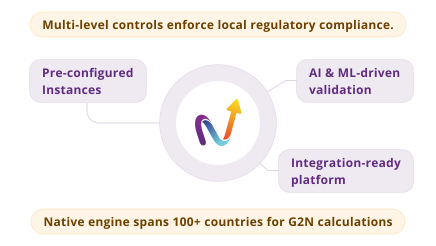
  • G2N Nova: G2N Nova provides global gross-to-net payroll processing in over 100 countries, making it the world’s most advanced native payroll engine. Available as a SaaS or service delivery platform, it can function as a stand-alone solution or integrate seamlessly with major HCM and Workforce Management systems

Conclusion

In today’s competitive landscape, navigating employment laws and managing workforce logistics can be challenging for businesses expanding into South Africa. Mercans’ Employer of Record (EOR) solutions offer a streamlined approach, ensuring compliance with local regulations while simplifying the hiring process. By leveraging our expertise in talent acquisition, visa sponsorship, contractor management, and HCM integration, companies can focus on their core operations without the administrative burden. Trust Mercans to be your partner in successfully managing your workforce in South Africa, enabling efficient growth and seamless employee engagement.

This document was prepared for informational purposes only. As local laws & regulations keeps on changing. Please consult your tax & legal advisors as well.
Contact Sales
Let's get this conversation started. Tell us a bit about your requirement, and we'll get in touch a soon as we can.

    Sample message

    1. We want to expand in $country

    2. We want you to employ 'X' number of employees on our behalf

    3. Contract duration – 3/6/9/12/18/24 months

    4. Number of legal entities (if any exist today)

    5. Employment type: EOR employee or contractor?

    6. Any benefits requirement or “standard statutory only”?

    FAQs

    What is an Employer of Record (EOR) in South Africa?

    An Employer of Record (EOR) in South Africa is a third-party service provider that legally employs workers on behalf of another company. The EOR manages all employment-related responsibilities, including contracts, payroll, taxes, benefits, and compliance with South African labor laws, enabling businesses to hire employees without establishing a local entity.

    How can foreign companies hire employees in South Africa without establishing a local entity?

    Foreign companies can engage an EOR to hire employees in South Africa. The EOR assumes the legal employer role, handling all statutory obligations, while the client company manages the employee’s daily tasks. This approach allows businesses to operate in South Africa without the need for a local branch or subsidiary.

    What compliance, payroll, and HR tasks does an EOR in South Africa handle?

    An EOR in South Africa ensures compliance with local labor laws by managing employment contracts, processing payroll, withholding and remitting taxes, making statutory contributions, administering mandatory benefits, and completing statutory filings. They also handle work permits and visa sponsorship for expatriate employees.

    What are the benefits of using EOR services in South Africa?

    Utilizing an EOR in South Africa offers several advantages: it simplifies market entry by eliminating the need for a local entity, ensures compliance with complex labor laws, reduces administrative burdens, mitigates legal risks, and accelerates the hiring process.

    How much does it cost to hire employees through an EOR in South Africa?

    The cost of hiring through an EOR in South Africa varies depending on the provider and the services included. Generally, fees can range from $500 to $2,000 per employee per month. It’s advisable to consult with the EOR provider for a detailed pricing structure.

    Is an EOR the right solution for expanding a business into South Africa?

    An EOR is an effective solution for businesses looking to expand into South Africa without the complexities of setting up a local entity. It provides a compliant and efficient way to hire employees, allowing companies to focus on their core operations while the EOR manages employment-related tasks.

    Ready to hire in South Africa?

    No local entity needed. Our experts handle payroll, compliance, and onboarding.

    Talk to an expert
    Proven expertise in global payroll.