Employer of Record

Employer of Record (EOR) Georgia

Hire compliantly, pay accurately, expand confidently.

Global Payroll Team
Written by Global Payroll Team
Last updated April 22, 2026
Expert Reviewed
An Employer of Record (EOR) serves as the legal employer for workers in Georgia, playing a vital role similar to a Global Professional Employer Organization (Global PEO). As your dedicated Employer of Record in Georgia, we take on key responsibilities to ensure your workforce operates seamlessly. This includes ensuring strict compliance with local labor laws and regulations, expertly managing payroll, handling taxes, providing mandated benefits, and drafting comprehensive employment agreements.

With Mercans as your Employer of Record in Georgia, you can trust us to:
  • Ensure full compliance with Georgia’s employment laws.
  • Manage the complexities of local payroll processing.
  • Expertly handle employment-related tax filings and necessary documentation.
  • Provide timely payslips to employees.
  • Ensure prompt salary disbursements to workers.

Our Global PEO services in Georgia offer a smooth, hassle-free solution for your global expansion needs, eliminating the need for setting up a local entity. As your trusted Employer of Record, we guarantee legal compliance, a strong local presence, and more. This allows your business to focus on its core operations while benefiting from our expertise in managing global mobility, work visas, and building a diverse and efficient workforce. Choose Mercans as your Employer of Record in Georgia for a compliant, streamlined employment experience for your global team.

Things you need to know before hiring in Georgia

Employment Contracts in Georgia

The legal nature of an employment contract in Georgia is that it is a bilateral agreement, meaning both the employer and employee have mutual obligations. It serves as a formalized arrangement where the employer hires the employee to perform specific duties in exchange for agreed compensation. The contract is legally binding and enforceable, ensuring both parties adhere to the agreed terms, including working hours, remuneration, and grounds for termination.

The employment contract can be concluded either orally or in writing, depending on the duration and type of work. Oral agreements are permitted if labour relations last no longer than 1 month, while written agreements are required if labour relations last longer than 1 month. If no explicit conditions are stated, the employment relationship is considered to have started when the employee begins performing their work.

Types of Employment Contracts

In Georgia, employment contracts can take two primary forms: individual and collective. An individual contract involves a direct employment relationship between a single employer and an employee, where the terms are specific to that individual worker. On the other hand, a collective contract is negotiated between one or more employers (or their unions) and one or more employees (or employee unions). This type of contract typically addresses the working conditions of a larger group of employees, often setting standards for an entire workforce.

Fixed-Term vs. Indefinite-Term Contracts

Employment contracts can be either fixed-term or indefinite-term. A fixed-term contract has a specific duration, and it ends once that period is complete. However, if the contract lasts longer than 30 months, or if fixed-term contracts are concluded consecutively two or more times and the total duration exceeds 30 months, it is deemed to be an indefinite-term contract. Except where the contract duration is 1 year or longer, a fixed-term contract may only be concluded if one of the legal grounds under the Labour Code is present.

An indefinite-term contract is more permanent and does not specify an end date. It continues until either party decides to terminate the agreement, in compliance with the provisions outlined in the Labour Code. For indefinite-term contracts, no expiration date is indicated, and termination cannot be solely based on the expiration of the contract term.

Key Terms and Conditions

A labor contract must include certain essential terms that define the working relationship. These include:

  • Information about the parties involved in the contract, i.e., the employer and employee.
  • Start date and duration of employment, specifying when the employee will begin work and how long the employment will last.
  • Working hours and rest periods, indicating the times the employee is expected to work, as well as when rest periods or breaks are given.
  • Workplace details, including the primary location where the employee will work and any secondary locations if applicable.
  • Job position and duties, which should specify the employee’s role, rank, or category, as well as a description of the work to be performed.
  • Compensation, including salary, allowances, and how and when the employee will be paid.
  • Overtime pay terms, detailing how overtime will be compensated if applicable.
  • Leave entitlements, which should specify the duration of paid and unpaid leave and the procedure for granting such leave.
  • Termination conditions, including the procedures by which either the employer or the employee can terminate the employment relationship.

In addition to these conditions, employers may set internal labor regulations, which further detail the rules for employees. However, these regulations cannot contradict the rights and protections laid out in the Labor Code.

Working Hours

In Georgia, the Labor Code defines specific rules for working hours:

  • Normal Working Hours: The standard workweek is 40 hours. For industries with continuous operations exceeding 8 hours, it can be 48 hours per week.
  • Rest Between Shifts: Employees must have at least 12 hours of uninterrupted rest between working days or shifts.
  • Breaks: If the workday exceeds 6 hours, employees are entitled to a break. The duration of the break is determined by agreement between the parties. If the workday is no longer than 6 hours, the break must be at least 60 minutes.

Overtime

Overtime work in Georgia is work performed by agreement between the parties for a period longer than standard working time. Overtime compensation must be determined by agreement between the employer and employee and should be higher than the regular hourly rate.

13th Month Salary

The 13th-month salary is not a mandatory requirement in Georgia; however, employers have the option to offer bonuses at their discretion.

Probation Period

In Georgia, a trial period may be included in an employment agreement, but it must be agreed upon by both parties and can only be applied once. The trial period cannot exceed six months and is intended to assess the employee’s suitability for the position. Such agreements must always be made in writing.

During the trial period, the employee is entitled to pay for the work performed. The amount and payment terms for this compensation are determined by mutual agreement between the employer and employee.

The employer has the flexibility to terminate the labor agreement during the trial period at any time, or alternatively, they can choose to formalize the employment by converting the trial agreement into a fixed-term or open-ended contract.

It’s important to note that the provisions of Article 48 of the Labour Code, which usually govern termination notice and severance, do not apply to the trial period unless specifically outlined in the agreement. If the trial period agreement is terminated, the employee will be paid for the time worked up until the termination.

Termination, Severance Pay, and Notice Period

Termination

When a labor agreement is terminated, the employer must follow the provisions outlined in the Labour Code. The termination can be initiated by either the employer or the employee, depending on the specific grounds stipulated in the law. If the employer terminates the agreement, the reasons must be consistent with the applicable legal grounds under the Labour Code. Employees also have the right to terminate the agreement, with certain procedures and notice requirements, particularly in cases allowed by law.

Severance Pay

Upon termination of the labor agreement, the employee is entitled to severance pay in cases where the Labour Code provides it. The amount depends on the notice period used by the employer.

  • If the employer provides a 30-day notice, the employee must receive at least one month’s remuneration in severance pay, paid within 30 calendar days of termination.
  • If the employer gives a shorter notice period of three calendar days for the relevant statutory grounds, severance pay must be at least two months’ remuneration and also paid within 30 calendar days.

Notice Period

The notice period is a critical component of terminating a labor agreement.

  • If the employer is terminating the agreement for the relevant grounds under the Labour Code, they must provide the employee with at least 30 calendar days’ written notice.
  • If the employer shortens the notice period to three calendar days for those statutory grounds, they must provide severance pay of at least two months’ remuneration.
  • Employees who wish to terminate their agreement on the statutory ground of resignation must give the employer 30 calendar days’ written notice.

During the notice period, employees can also request a written substantiation for the termination, which the employer must provide within seven calendar days. If the employer fails to comply, the employee can appeal the decision in court.

Social Security in Georgia

Georgia does not operate a broad employer-employee social security contribution system comparable to many other jurisdictions.

Pension Contributions

Since January 1, 2019, Georgia has operated a funded pension scheme. Participation rules depend on age, citizenship or residency status, and the employee’s circumstances. In practice, employers should check whether the employee falls within the mandatory participation rules or qualifies for an exception.

  • Employer Contributions: Where the employee is a participant in the funded pension scheme, the employer is generally required to contribute 2% of the employee’s gross salary to the employee’s individual pension account each time wages are paid.
  • Employee Contributions: Participating employees generally contribute 2% of their gross salary to their pension account.
  • Self-Employed Contributions: Self-employed individuals who participate contribute 4% of their annual income.
  • Government Contributions: The government contributes according to the applicable income thresholds under the pension scheme rules.

Payroll in Georgia

  • Minimum Wages: Georgia does not have a current market-relevant private-sector minimum wage used in normal payroll practice. Compensation is generally determined by employment agreement and market conditions. The historical formal minimum wage figure is outdated and not used as a practical benchmark for modern salary setting.
  • Payroll Cycle: Georgia commonly follows a monthly payroll cycle, where employees generally receive their pay at the end of each month or on the contractually agreed payday. Employers are responsible for processing salary payments and required deductions in accordance with Georgian law.

Mercans’ payroll capabilities

  • Payroll Cycle: Experience the streamlined efficiency of Mercans’ comprehensive payroll cycle management in Georgia. We ensure that payments to both employees and contractors are made accurately and on time, all in the local currency. Trust Mercans to simplify your payroll processes, providing a seamless and localized experience every step of the way.
  • Payroll Setup, Processing, and Administration: Mercans offers more than just standard payroll services. We provide end-to-end solutions, handling everything from payroll setup to precise processing and effective administration. With our focus on accuracy and compliance, your payroll is in expert hands, allowing you to focus on what truly matters—growing your business.
  • Statutory Filings and Payments: Navigating Georgia’s regulatory framework is made effortless with Mercans. Our dedicated team manages all statutory filings and payments, ensuring full compliance with local legal requirements. Rely on Mercans for timely and accurate submissions, giving you confidence that your business remains in good standing with all statutory obligations.

Personal Income Tax in Georgia

Income sourced outside Georgia is exempt from tax for resident individuals, while Georgian-source employment income is generally taxed at a flat rate of 20%.

Georgia Employee Hiring Cost

For example, if you hire an employee with a gross annual salary of GEL 100,000.00 and the employee participates in the funded pension scheme, the total cost to the employer is higher than just the salary. In addition to the gross salary, the employer is generally responsible for an additional 2% pension contribution, which in this example amounts to GEL 2,000.00.

Thus, the total annual cost for the employer would be GEL 102,000.00, combining the employee’s salary and the employer’s additional pension obligation.

Breakdown:

Salary DetailsGeorgia
Gross Annual SalaryGEL 100,000.00
Employer Pension Contribution (2%)GEL 2,000.00
Annual Employer CostsGEL 2,000.00
Total Annual Cost to EmployerGEL 102,000.00

In this example, the employer’s total annual expense for the employee is GEL 102,000.00, which includes both salary and the mandatory employer pension contribution where applicable.

Employee Benefits in Georgia

In Georgia, employee benefits are classified into mandatory and supplementary categories, each playing a vital role in protecting workers and enhancing the overall employment experience. Mandatory benefits are those required by Georgian law, including paid leave entitlements under the Labour Code and participation in the pension savings scheme where the employee falls within the funded pension rules. Depending on the nature of the work and the sector, additional health and safety obligations or insurance requirements may also apply.

Supplementary benefits, on the other hand, are optional and offered at the discretion of the employer. These can include private health insurance, performance-based bonuses, allowances, and additional retirement savings, all of which enhance employee satisfaction and help businesses attract and retain top talent. Understanding these benefit categories is essential for employers in Georgia to maintain legal compliance while also offering a competitive and supportive workplace.

Mandatory Benefits

  • Pension Savings Scheme: Georgia’s funded pension scheme remains a key mandatory benefit for participants who fall within the legal scope of the system. Employers generally contribute 2% of the employee’s gross salary, employees contribute 2%, and government contributions apply under the statutory rules and thresholds.
  • Paid Annual Leave: Under the Georgian Labour Code, employees are entitled to at least 24 working days of paid annual leave and at least 15 working days of unpaid leave annually. Additional paid leave may apply for arduous, harmful, or hazardous work under the law.
  • Health and Safety Protections: Employers must comply with occupational safety requirements under Georgian law. Depending on the work performed, additional insurance or protective arrangements may apply in higher-risk sectors.

Supplementary Benefits

  • Private Health Insurance: While not required by law in most cases, many businesses, particularly large or multinational companies, offer private health insurance as an additional benefit for their employees. This can provide broader access to healthcare services beyond public programs.
  • Performance Bonuses and Allowances: In addition to basic salary and mandatory benefits, many employers provide employees with bonuses, performance-based incentives, or allowances as a way to motivate and reward staff. These benefits could include holiday bonuses, annual performance bonuses, meal vouchers, transport subsidies, or gifts for special occasions, enhancing overall job satisfaction and loyalty to the employer.
  • Voluntary Pension Contributions: To supplement the government pension framework, some employers offer additional retirement contributions or employer-sponsored savings arrangements.

These supplementary benefits, though not required by law, provide employees with greater security and satisfaction, positioning businesses as attractive employers in the competitive Georgian job market.

Work Permit in Georgia

When expanding operations to Georgia or outsourcing certain business functions, assembling a capable team is essential to ensure a smooth transition. However, hiring international employees is only one step in the process. To operate legally in Georgia, foreign employees must now follow Georgia’s updated labour migration and immigration rules. Understanding the current work authorization, visa, and residence permit process is crucial for staying compliant and facilitating your company’s expansion.

Categories of Work Visas for Georgia

For foreign nationals intending to work in Georgia, the first step is to determine which type of entry and stay authorization they need. Georgia offers several visa categories, including diplomatic, special, ordinary, immigration, and transit visas. For employment purposes, the key route is usually an appropriate long-stay immigration basis together with the required labour authorization and, for longer stays, a work residence permit.

Conditions for obtaining a work visa

As of March 1, 2026, Georgia introduced a formal work permit and labour registration framework for foreign nationals working in the country. Depending on the case, the foreign national may need a work permit or registered right to work, an appropriate visa status, and then a work residence permit if staying longer term.

  • A completed and signed application and supporting documents under the applicable migration process
  • A valid passport or other travel document
  • A contract of employment or other proof of lawful work activity in Georgia
  • Proof of payment of the relevant state fee, where applicable

These documents are handled through the competent Georgian authorities under the current labour migration, visa, and residence permit rules.

Procedures for applying

The process depends on the nationality of the employee, the basis for entry, and the type of work to be performed. As a general rule, employers and foreign nationals should first assess whether the person needs labour authorization under the rules that entered into force on March 1, 2026. For longer stays, the foreign national must then apply for a work residence permit with the Public Service Development Agency.

A work residence permit is issued to a labour immigrant registered with the Ministry or to an alien carrying out entrepreneurial activities in Georgia in accordance with Georgian legislation. An alien must generally apply for a Georgian residence permit 40 calendar days before lawful stay in Georgia expires, subject to the statutory exceptions.

By understanding the current labour migration, visa, and residence permit process, your company can ensure that its expansion into Georgia proceeds smoothly and legally.

EOR Solutions in Georgia

  • EOR for Prospective Employees: Mercans provides comprehensive Employer of Record (EOR) services for businesses that have already selected their ideal candidates in Georgia. We manage all aspects of the employee lifecycle, ensuring full compliance with Georgian labor laws and regulations, allowing you to focus on your core business operations.
  • EOR + Recruitment: For companies looking for end-to-end talent acquisition solutions, our combined EOR and recruitment services offer a streamlined process. Leveraging our extensive network and expertise, we help you attract, hire, onboard, and retain top talent, ensuring a smooth entry into the Georgian market.
  • Visa Sponsorship and Global Mobility: Our visa sponsorship and global mobility services simplify the relocation of international employees to Georgia. We navigate the complexities of Georgian immigration and employment laws, ensuring your workforce is compliant and legally able to work in Georgia.
  • AOR for Contractor Payments: For businesses dealing with contractor payments, our Assistance on Record (AOR) services help manage the complexities of contractor relationships. We ensure timely and accurate payments while maintaining full compliance with Georgian regulations.
  • Converting Freelancers to Employees: Mercans facilitates the smooth transition of freelancers to permanent employees in Georgia, ensuring that the conversion complies with all local labor laws and regulations.
  • HCM Integration: Enhance your HR operations by integrating Mercans’ EOR services with your Human Capital Management (HCM) system in Georgia. Our integration ensures real-time data exchange, improved compliance, and cost-effective workforce management, optimizing payroll and HR processes across your organization.

Best Employer of Record Georgia

Mercans is a leading Employer of Record (EOR) provider in Georgia for the following reasons:

  • Compliance with Georgian Labor Laws: Mercans ensures full compliance with all employment regulations set by the competent Georgian labour and migration authorities. We manage your workforce while strictly adhering to local labor laws and statutory requirements.
  • Independent Entity: Mercans operates as a standalone entity in Georgia, offering reliable and customized employment solutions to meet your business needs, ensuring a tailored approach that works for your specific requirements.
  • Flexible Employment Solutions: Whether you are managing employees, contractors, freelancers, or expatriates, Mercans provides flexible solutions that accommodate various employment types. We ensure that all employment arrangements are compliant with Georgian laws.
  • Enterprise-Ready Services: Designed to meet the complex needs of large enterprises, Mercans offers scalable services that support intricate organizational structures, making us the ideal partner for expanding or managing global operations.
  • Multi-Currency Payroll Support: Mercans supports payroll management in multiple currencies, ensuring smooth financial operations for businesses with international teams and cross-border transactions in Georgia.
  • Global Presence and Multi-Country Expertise: With a global network and multi-country payroll capabilities, Mercans excels at managing payroll across several jurisdictions. We provide seamless international operations for businesses operating in Georgia and beyond.
  • Data Protection and Security: Mercans is committed to maintaining high standards of data security and privacy. We adhere to GDPR regulations and hold SOC 1 and SOC 2 compliance certifications, ensuring that all data handling and processing are secure and compliant with international standards.
  • ISO 20000 & ISO 27001 Certifications: We hold ISO 20000 and ISO 27001 certifications, demonstrating our dedication to high-quality IT service management and robust information security practices, ensuring the protection of your business and employees’ data.
  • OWASP ASVS 3.0 Compliance: Mercans follows best practices in security by meeting OWASP ASVS 3.0 standards for application security, ensuring the safety of all systems and platforms we use.
  • HRBlizz: Our proprietary HRBlizz SaaS suite simplifies global payroll and talent management. With over 1,000 in-country specialists, we provide expert local knowledge to ensure compliance with Georgia’s labor laws and business practices.
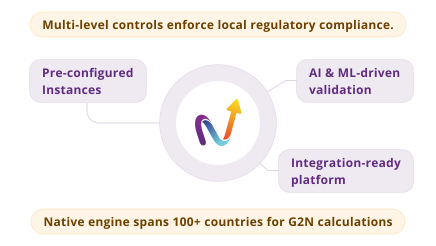
  • G2N Nova: Mercans utilizes G2N Nova, an advanced global gross-to-net payroll engine, supporting payroll processing in over 100 countries. Whether used as a standalone solution or integrated with HCM and workforce management systems, it guarantees efficient and compliant payroll management for your business in Georgia and worldwide.

Conclusion

In conclusion, Mercans offers comprehensive Employer of Record (EOR) solutions in Georgia, providing businesses with a seamless and compliant way to manage their workforce. From ensuring full adherence to local labor laws to offering flexible employment solutions and multi-currency payroll support, we handle every aspect of workforce management, allowing you to focus on growing your business. With our global expertise, advanced technology platforms, and commitment to data security, Mercans is the ideal partner to navigate the complexities of the Georgian market. Whether you’re expanding, hiring international talent, or managing cross-border operations, Mercans delivers efficient, scalable, and tailored EOR services to meet your unique business needs.

This document was prepared for informational purposes only. As local laws & regulations keeps on changing. Please consult your tax & legal advisors as well.
Contact Sales
Let's get this conversation started. Tell us a bit about your requirement, and we'll get in touch a soon as we can.

    FAQs

    What is an Employer of Record (EOR) in Georgia?

    An Employer of Record in Georgia is a service provider that legally employs workers on behalf of a foreign company. The EOR manages employment contracts, payroll, taxes, benefits, and ensures compliance with Georgian labor laws, allowing businesses to hire locally without establishing a Georgian entity.

    How can foreign companies hire employees in Georgia without establishing a local entity?

    Foreign companies can partner with an EOR, which acts as the legal employer while the client company oversees daily operations. This enables businesses to operate in Georgia without forming a branch or subsidiary.

    What compliance, payroll, and HR services does an EOR in Georgia manage?

    An EOR in Georgia handles employment contracts, payroll processing, tax withholdings, social security contributions, mandatory benefits, and government filings. They can also assist with work permits and visas for international hires.

    What are the benefits of using EOR services in Georgia?

    Using an EOR simplifies market entry, ensures compliance with local labor regulations, reduces administrative burden, mitigates legal risks, and accelerates hiring.

    How much does it cost to hire employees through an EOR in Georgia?

    Fees typically range from $500 to $2,000 per employee per month, depending on the services offered. Companies should consult the EOR provider for an accurate pricing structure.

    Is an EOR the best solution for expanding a business into Georgia?

    An EOR is ideal for businesses expanding into Georgia without establishing a local entity. It allows companies to focus on core operations while the EOR manages employment, payroll, and compliance responsibilities.

    Ready to hire in Georgia?

    No local entity needed. Our experts handle payroll, compliance, and onboarding.

    Talk to an expert
    Proven expertise in global payroll.