Employer of Record

Employer of Record (EOR) Armenia

Hire compliantly, pay accurately, expand confidently.

Global Payroll Team
Written by Global Payroll Team
Last updated August 10, 2026
Expert Reviewed
An Employer of Record (EOR) in Armenia acts as the official employer for workers, often referred to as a Global Professional Employer Organization (Global PEO). This role encompasses a broad range of employment functions, ensuring full compliance with local labor laws and regulations, managing payroll, administering taxes, providing legally required benefits, and handling employment contracts.

Key Responsibilities of an Employer of Record (EOR) in Armenia:
  • Ensuring employment terms are fully compliant with Armenian labor laws.
  • Overseeing and processing local payroll in Armenian Dram (AMD).
  • Managing the filing of employment-related income tax, pension, and social contributions with the State Revenue Committee.
  • Issuing compliant payslips to employees.
  • Disbursing salary payments in accordance with Armenian standards.

With our Employer of Record (EOR) services, expanding your business into Armenia becomes easier and more efficient. Our solution eliminates the need for setting up a local entity, providing a seamless path to establish a legal presence in Armenia. We ensure full legal compliance, manage payroll, protect your intellectual property, and handle work permits, so you can focus on growing your business and building your workforce in the Caucasus region.

Things you need to know before hiring in Armenia

Employment Contracts in Armenia

Armenian labor relations are governed by the Labour Code of the Republic of Armenia. An indefinite-term contract is the default and standard form of employment, while a fixed-term contract is treated as the exception.

Indefinite-Term Contracts

The standard, presumed form of employment in Armenia. Employers must register each new hire electronically with the State Revenue Committee.

Fixed-Term Contracts

Permitted for temporary or seasonal work, project-based work, covering an employee on leave, or employing a foreign national tied to a residence permit. Typically issued for up to 1 year and renewable, but total duration cannot exceed 3 years, after which the contract converts to indefinite-term.

Probation Period

The standard probation period is up to 3 months, extendable to 6 months for managerial or technical roles by written agreement. Either party may terminate the relationship during probation with 3 days’ written notice.

Digital Employment Contract System

Armenia introduced an electronic system for signing, amending, and terminating labour contracts through the State Revenue Committee’s platform, voluntary since July 2025. Following a National Assembly amendment in February 2026, mandatory use was postponed from January 2026 to 1 July 2027.

Working Hours

The standard legal working week in Armenia is 40 hours, structured as 8 hours per day. The absolute maximum, including overtime, is capped at 12 hours per day and 48 hours per week.

13th Month Salary

There is no legal requirement in Armenia for a 13th-month salary, and it is not a common market practice. Some employers may choose to pay a discretionary year-end bonus, but this is not mandatory or expected.

Key Points on Overtime & Night Work

Overtime Cap
Overtime is capped at 4 hours over two consecutive days, and 120 hours per calendar year. Employee consent is generally required except in emergencies.
Overtime Pay
Overtime is paid at 150% of the standard hourly rate.
Night Work
Work performed between 10pm and 6am is paid at a 130% premium above the standard hourly rate.

Termination and Severance Pay

The Labour Code sets out an exhaustive list of lawful grounds for dismissal, including liquidation, workforce reduction, non-compliance with position requirements, incapacity for work exceeding 6 consecutive months, misconduct, and mutual agreement.

Notice of Termination

Required notice periods vary by the ground for termination: 2 months for liquidation or workforce reduction; 14 to 60 days (scaled by length of service) for non-compliance or incapacity; 10 days before expiry for a fixed-term contract; 3 days for an invalid residence permit or the end of a seasonal contract; 3 days during probation; and 7 days for termination by mutual agreement. Employers may also pay in lieu of notice.

Severance Pay

Employees dismissed due to workforce or staff reduction are generally entitled to one month’s average salary as severance. Where an employee is dismissed for refusing to continue after a change to essential contract terms, severance ranges from 10 to 44 times the average daily wage, scaled by length of service.

Mass Dismissals

Terminating more than 10% of the workforce (minimum 10 employees) within a 2-month period requires 2 months’ advance notice to the state employment authority and employee representatives.

Forced Downtime Compensation Cap (2024 Reform)

Under Law HO-364-N, effective 24 November 2024, compensation owed to an employee for a wrongful-dismissal court case is now capped at a maximum of 9 months’ salary if the employee found alternative employment during the case, rather than the previously uncapped back-pay for the full duration of proceedings.

Employees vs Independent Contractors

Employees in Armenia are governed by the Labour Code, while independent contractors and self-employed individuals operate under Civil Code service or works-execution contracts. Authorities apply a substance-over-form test, examining the employer’s actual control over methods and schedule, the worker’s integration into the company, and exclusivity, rather than the label used in the contract.

Reclassifying a civil-law contractor relationship as employment can trigger retroactive application of labor-law guarantees, additional tax and social contribution liabilities, and administrative sanctions, so genuine contractor relationships should be structured and documented carefully.

Comparison Table: Employee vs Independent Contractor

Factor Employee Independent Contractor
Governing Law Labour Code of the Republic of Armenia Civil Code service / works-execution contract
Control & Subordination Works under the employer’s direction, schedule, and supervision Controls own working hours and methods
Exclusivity Typically works for one employer May serve multiple clients
Payment Structure Fixed monthly salary via payroll Paid per project, milestone, or invoice
Statutory Benefits Entitled to paid leave, sick pay, and pension contributions No statutory employment benefits
Misclassification Risk Not applicable High risk if the relationship shows subordination; reclassification carries retroactive liability

Understanding these differences is essential for ensuring compliance and correctly determining entitlements such as pension contributions, leave, and income tax withholding.

Social Security and Payroll Contributions in Armenia

Armenia’s structure is distinctive: there is no separate employer-paid social security tax. Pension, health insurance, and the military stamp duty are all funded through withholdings from the employee’s salary, with the employer acting as the withholding and remittance agent to the State Revenue Committee.

Contribution Who Pays Rate
Funded (Accumulative) Pension Employee 5% of gross salary up to AMD 500,000/month; above that, 10% minus AMD 25,000, capped at a monthly base of AMD 1,125,000
Health Insurance Contribution (introduced Dec 2025) Employee AMD 4,800/month up to AMD 500,000 salary; AMD 10,800/month above that (applies once salary exceeds AMD 200,000/month)
Military Stamp Duty (restructured Dec 2025) Employee AMD 1,000/month up to AMD 1,000,000 salary; AMD 15,000/month above that
Personal Income Tax Employee (withheld by employer) Flat 20%

The mandatory funded pension applies to Armenian and foreign citizens born after 1 January 1974. Employees hired before 1 July 2014, and public-sector employees, cannot opt out of the pension scheme.

Payroll in Armenia

Minimum Wages

Armenia’s national minimum wage is AMD 75,000 per month, in effect since 1 January 2023. The government has publicly discussed a further increase to AMD 85,000 per month, but this has not yet been enacted.

Payroll Cycle

Salaries in Armenia are typically paid monthly, in Armenian Dram (AMD), by bank transfer. Employers must provide employees with a payslip itemizing gross pay, pension and health insurance withholdings, military stamp duty, income tax withheld, and net pay.

Overtime Pay

Overtime pay is provided when an employee works beyond the standard 40-hour week, up to the legal cap of 120 hours per year.

Overtime Rate

Overtime is paid at 150% of the standard hourly rate.

Night Work Rate

Work performed between 10pm and 6am is paid at a 130% premium above the standard hourly rate.

Overtime rules can vary depending on the applicable employment contract or collective agreement.

Mercans’ payroll capabilities

Payroll Cycle Management in Armenia
Mercans delivers efficient, seamless payroll cycle management tailored to Armenian requirements. We ensure that both employees and contractors are paid accurately and on time, in Armenian Dram, providing a smooth and compliant payroll experience aligned with Armenian standards.
Payroll Setup, Processing, and Administration
Mercans offers a complete range of payroll services from start to finish. Whether it’s setting up your payroll system, processing payments, or managing ongoing administration, we take care of every detail, ensuring accuracy, compliance, and efficiency so you can focus on running your business.
Statutory Filings and Payments
Navigating Armenia’s regulatory framework can be complex, but with Mercans, you’re in safe hands. We manage all statutory filings and payments with the State Revenue Committee, ensuring your business remains fully compliant with Armenian tax laws and employment regulations.

Personal Income Tax in Armenia

Armenia applies a flat personal income tax rate of 20% on employment income, including salary, bonuses, commissions, and fees. This follows a gradual step-down from 23% that completed in 2023, and no further reduction has been reported since. Other categories of income are taxed differently — dividends at 5%, royalties at 10%, and rental income at 10%.

Armenia Employee Hiring Cost

Because Armenia places pension, health insurance, and the military stamp duty entirely on the employee side rather than as an employer-paid social tax, the direct statutory add-on cost for employers is comparatively lower than in many other jurisdictions. Employers should still budget for standard costs such as paid leave accrual alongside gross salary.

Salary Details Amount (AMD)
Gross Monthly Salary 500,000
Employer-Side Statutory Social Contributions None (pension, health insurance, and military stamp duty are withheld from the employee)
Estimated Employer Cost (excluding overheads) ~500,000

Employee Benefits in Armenia

Armenian employees are entitled to a combination of mandatory statutory benefits and, increasingly, supplementary benefits offered at the employer’s discretion.

  • Annual Leave: 20 working days per year for a 5-day work week, or 24 days for a 6-day work week, with up to 25 days for employees in high-stress or high-risk-health roles.
  • Public Holidays: Armenia observes national holidays including New Year’s Day, Christmas, Genocide Memorial Day (24 April), Labour Day, Victory Day, Independence Day (21 September), and others.
  • Sick Leave: Paid at 80% of average monthly salary — the employer covers the first 5 days, with state social insurance covering the remainder, up to a total of 120 days.
  • Maternity Leave: 140 calendar days (70 before and 70 after birth), extended to 155 days for complicated births and 180 days for multiple births, paid at 100% of average earnings.
  • Paternity Leave: 5 working days, paid at the average daily salary, to be taken within the first month after birth.
  • Extended Parental Leave: Unpaid childcare leave is available to either parent (or another relative) until the child turns 3 years old.
  • Supplementary Health Insurance: Some employers offer private health coverage in addition to the mandatory health insurance contribution.
  • Meal & Transport Allowances: Common non-mandatory benefits provided by many employers.
  • Professional Development: Some companies offer financial assistance for continuing education and training.
  • Workplace Wellness Programs: Companies are enhancing the workplace experience with wellness initiatives, including mental health support.
  • Flexible Work Options: Employers are increasingly offering flexible or hybrid working arrangements where operationally feasible.
  • Team-Building Activities: Employers are introducing more team-building and employee engagement activities.
  • Discount Programs: Some companies offer group discounts on shopping, travel, and leisure activities.

Essential Benefits for Employees in Armenia
  • Annual Leave: 20 working days per year for a 5-day work week, or 24 days for a 6-day work week, with up to 25 days for employees in high-stress or high-risk-health roles.
  • Public Holidays: Armenia observes national holidays including New Year’s Day, Christmas, Genocide Memorial Day (24 April), Labour Day, Victory Day, Independence Day (21 September), and others.
  • Sick Leave: Paid at 80% of average monthly salary — the employer covers the first 5 days, with state social insurance covering the remainder, up to a total of 120 days.
  • Maternity Leave: 140 calendar days (70 before and 70 after birth), extended to 155 days for complicated births and 180 days for multiple births, paid at 100% of average earnings.
  • Paternity Leave: 5 working days, paid at the average daily salary, to be taken within the first month after birth.

Additional Employee Benefits
  • Extended Parental Leave: Unpaid childcare leave is available to either parent (or another relative) until the child turns 3 years old.
  • Supplementary Health Insurance: Some employers offer private health coverage in addition to the mandatory health insurance contribution.
  • Meal & Transport Allowances: Common non-mandatory benefits provided by many employers.
  • Professional Development: Some companies offer financial assistance for continuing education and training.

Perks & Wellness Initiatives
  • Workplace Wellness Programs: Companies are enhancing the workplace experience with wellness initiatives, including mental health support.
  • Flexible Work Options: Employers are increasingly offering flexible or hybrid working arrangements where operationally feasible.
  • Team-Building Activities: Employers are introducing more team-building and employee engagement activities.
  • Discount Programs: Some companies offer group discounts on shopping, travel, and leisure activities.

Work Permit in Armenia

Work permit requirements for foreign nationals in Armenia depend heavily on nationality, with a significant simplification for citizens of Eurasian Economic Union (EAEU) member states.

EAEU Nationals

Citizens of Russia, Belarus, Kazakhstan, and Kyrgyzstan are exempt from Armenian work permit requirements and can work freely. Long-term stays generally only require registering the employment relationship online to obtain a Certificate of Lawful Residence — no labor-market test or employer sponsorship is required.

Non-EAEU Nationals

The process for other foreign nationals is managed by the Migration and Citizenship Service via the official workpermit.am platform, and generally involves:

  • The employer notifying Armenia’s Ministry of Labor and Social Affairs of the vacancy (a labor-market test).
  • The employer registering on workpermit.am and submitting company documents alongside the employee’s personal documents (passport, CV, qualifications, police clearance, medical certificate).
  • Review by the Migration Service, including a labor-market assessment and security check.
  • On approval, issuance of a combined work-and-residence document valid for up to 1 year.

Upcoming Reform

A new Law on Foreigners is scheduled to take effect on 1 November 2026, revising work-permit categories and narrowing some current exemptions, while explicitly preserving the treaty-protected EAEU exemption. Employers planning to bring in foreign talent around this date should confirm the latest requirements with Mercans.

Important Considerations for Employers

Employer Sponsorship

For non-EAEU nationals, a registered legal entity in Armenia is generally required to sponsor a foreign employee’s work authorization — an EOR partner such as Mercans allows companies without a local entity to still hire and sponsor talent compliantly.

Regional Mobility

Businesses hiring across the Eurasian Economic Union can take advantage of Armenia’s simplified pathway for EAEU nationals.
Understanding these pathways can streamline the hiring process, allowing employers to bring skilled talent into their Armenia-based operations effectively.

EOR Solutions in Armenia

EOR Solutions for Prospective Employees in Armenia
Mercans provides efficient Employer of Record (EOR) services for businesses that have already identified their ideal candidates in Armenia. Our comprehensive services cover the entire employee lifecycle, ensuring full compliance with Armenian labor laws, tax regulations, and employment standards, so you can focus on your business growth without the administrative burden.
EOR + Recruitment: Streamlined Talent Acquisition
For businesses seeking assistance with talent acquisition, our EOR and recruitment solutions offer a complete, end-to-end service, helping you find, hire, and retain top talent in Armenia while ensuring all recruitment and compliance requirements are met.
Visa Sponsorship and Global Mobility Solutions
Navigating the complexities of expatriate employment becomes straightforward with our visa sponsorship and global mobility services. Mercans ensures a smooth relocation process for your international workforce, handling all aspects of Armenian immigration and employment laws to guarantee compliance.
AOR Services for Contractor Payments
For businesses managing contractor payments in Armenia, Mercans offers Agent of Record (AOR) services, handling the complexities of independent contractor payments to ensure accurate, timely, and fully compliant payments while managing misclassification risk.
Converting Freelancers to Employees in Armenia
Mercans supports businesses transitioning freelancers and contractors to full-time employees in Armenia, ensuring a smooth, legally compliant conversion process.
HCM Integration for Enhanced Workforce Management
Integrate Mercans’ EOR services with your Human Capital Management (HCM) system for a unified, real-time approach to data exchange, compliance tracking, and payroll management in Armenia.

Best Employer of Record Armenia

Mercans stands out as a leading Employer of Record (EOR) provider in Armenia for several key reasons:

  • Full Compliance with Armenian Labor Laws: Mercans ensures strict compliance with Armenia’s employment regulations, including its evolving digital contract and payroll requirements, keeping your business aligned with local labor law and protecting you from potential legal risk.
  • Independent Operations: As a fully independent entity, Mercans operates without external affiliations, delivering reliable, customized employment services tailored to your business requirements in Armenia.
  • Supports All Employment Types: Whether you’re hiring employees, contractors, or expatriates, Mercans offers flexible solutions across a variety of workforce models.
  • Designed for Large Enterprises: Our scalable solutions meet the demands of enterprise-level organizations, integrating with your broader global business goals.
  • Multi-Currency Payroll Management: Mercans handles multi-currency payroll, simplifying salary management across multiple countries alongside Armenia.
  • Global Network and Multi-Country Payroll Expertise: With a robust global presence, Mercans manages multi-country payroll seamlessly across the Caucasus, Europe, and beyond, handling local tax regulations and compliance requirements wherever your teams are based.
  • Certified Data Protection and Security Standards: Mercans adheres to stringent data protection protocols, including GDPR alignment and SOC 1 & SOC 2 compliance.
  • ISO-Certified Service Quality and Security: Mercans holds ISO 20000 and ISO 27001 certifications, reflecting our commitment to excellence in IT service management and information security.
  • OWASP ASVS 3.0 Compliant: We adhere to OWASP ASVS 3.0 standards, protecting your business through secure software development and management practices.
  • Mercans HRBlizz: Our proprietary global payroll and talent management SaaS platform simplifies payroll while ensuring full compliance with local labor laws in Armenia, backed by a team of in-country specialists.
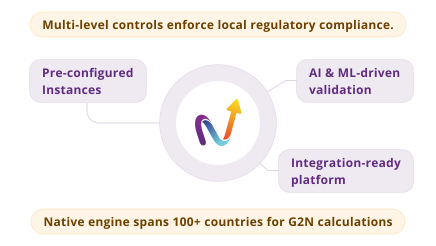
  • G2N Nova: Our advanced gross-to-net payroll engine, available in over 100 countries, integrates with major HCM and Workforce Management systems for a unified global payroll process.

Conclusion

Mercans provides comprehensive Employer of Record (EOR) services in Armenia, ensuring accuracy, compliance, and efficiency in managing your workforce. Our end-to-end solutions simplify payroll and employment processes, making us a trusted partner for businesses navigating the complexities of the Armenian labor market. With Mercans by your side, your expansion into Armenia will be smooth, compliant, and successful, allowing you to focus on growing your business with confidence.

This document was prepared for informational purposes only. As local laws & regulations keeps on changing. Please consult your tax & legal advisors as well.
Contact Sales
Let's get this conversation started. Tell us a bit about your requirement, and we'll get in touch a soon as we can.

    Sample message

    1. We want to expand in $country

    2. We want you to employ 'X' number of employees on our behalf

    3. Contract duration – 3/6/9/12/18/24 months

    4. Number of legal entities (if any exist today)

    5. Employment type: EOR employee or contractor?

    6. Any benefits requirement or “standard statutory only”?

    FAQs

    What is an Employer of Record (EOR) in Armenia?

    An Employer of Record (EOR) in Armenia is a third-party organization that legally employs workers on behalf of another company, handling payroll, pension and health insurance withholdings, income tax, employment contracts, and compliance with Armenian labor law, so the client company does not need to set up its own local entity.

    Can a foreign company hire employees in Armenia without a local entity?

    Yes. By partnering with an EOR such as Mercans, a foreign company can hire employees in Armenia without registering a local branch or subsidiary. The EOR acts as the legal employer of record while the client company directs the employee’s day-to-day work.

    Does Armenia have employer-paid social security contributions?

    No. Armenia’s system is distinctive in that pension, health insurance, and the military stamp duty are withheld entirely from the employee’s salary rather than paid separately by the employer, with the employer acting as the withholding and remittance agent.

    What compliance, payroll, and HR services does an EOR manage in Armenia?

    An EOR manages drafting and executing compliant employment contracts, monthly payroll processing in Armenian Dram, pension and health insurance withholdings, personal income tax filings with the State Revenue Committee, statutory leave and benefits administration, and lawful termination procedures.

    How much does an EOR service cost in Armenia?

    EOR pricing varies by provider and the scope of services required, and is typically charged as a flat monthly fee per employee or a percentage of payroll. Contact Mercans for a tailored quote based on your specific hiring needs in Armenia.

    Is EOR suitable for expanding into Armenia?

    Yes. EOR is well suited to companies testing the Armenian market, hiring a small number of employees, or needing to move quickly without the time and cost of incorporating a local entity, while remaining fully compliant with Armenian labor and tax law.

    Ready to hire in Armenia?

    No local entity needed. Our experts handle payroll, compliance, and onboarding.

    Talk to an expert
    Proven expertise in global payroll.