Employer of Record

Employer of Record (EOR) in Turkey

Hire compliantly, pay accurately, expand confidently.

Global Payroll Team
Written by Global Payroll Team
Last updated April 24, 2026
Expert Reviewed

An Employer of Record (EOR) in Turkey streamlines and expedites business expansion into the country. Opting for a Turkey EOR ensures efficient and compliant management of payroll, contracts, work permits, taxation, and more, all without the need for establishing a legal entity. Mercans offers expert support to handle these crucial aspects for your workforce in Turkey.

The Employer of Record (EOR) in Turkey takes on the following key responsibilities:
  • Ensuring that workers’ employment arrangements adhere to the laws and regulations of the country.
  • Managing the local payroll process efficiently.
  • Handling the necessary paperwork and filings related to employment taxes.
  • Providing workers with detailed payslips for transparency.
  • Ensuring the timely distribution of workers’ salary payments.

Enhance your global expansion with our Global PEO services in Turkey. Through our Employer of Record (EOR) in Turkey, we handle legal compliance, IP protection, and work visas, so you can focus on core operations and create a diverse, efficient global workforce without setting up a legal entity.
Things you need to know before hiring in Turkey

EOR Solutions in Turkey

EOR for Prospective Employees
Mercans offers top-tier Employer of Record (EOR) services in Turkey, simplifying the entire employment process upon candidate selection. Our comprehensive solutions encompass payroll management, benefits administration, tax compliance, and HR administration, guaranteeing a seamless and legally compliant transition. With a profound understanding of Turkish labor regulations, we expertly handle employment contracts, salary disbursements, and benefits, ensuring full legal compliance and operational efficiency.
EOR and Expert Recruitment Support in Turkey
Mercans provides unparalleled Employer of Record (EOR) services in Turkey, streamlining the recruitment and integration of top talent. Our experienced team oversees the entire process, from candidate selection to seamless assimilation. We take care of employment contracts, payroll management, benefits administration, tax compliance, and HR administration, guaranteeing a frictionless transition for your workforce.
Facilitating Expat Visa Sponsorship and Global Mobility
Mercans offers comprehensive Employer of Record (EOR) services, simplifying the visa sponsorship process for expatriates and facilitating global mobility. We navigate the complexities of visa procedures and ensure full compliance with local regulations. Our specialized services bridge the gap between international talent and opportunities, ensuring a smooth transition for expatriate employees.
Agent of Record (AOR) Services in Turkey
An “Agent of Record” plays a pivotal role in ensuring compliance, documentation, and legal requirements in contractor payments. Mercans’ EOR services in Turkey excel in this capacity, serving as the premier choice for seamless, compliant, and efficient contractor payment solutions in the region.
Converting Independent Contractors to Permanent Employees in Turkey
Mercans’ EOR services in Turkey serve as a catalyst for the seamless conversion of independent contractors into permanent employees, expertly navigating the complex regulatory landscape. Leveraging our blend of experience and technology-driven efficiency, we ensure a smooth transition, placing a strong emphasis on compliance and precision throughout the process.
HCM Integration in Turkey
Integrate Mercans’ EOR services seamlessly with your Human Capital Management (HCM) system in Turkey to facilitate real-time data exchange, enhance compliance, and optimize cost-efficiency. Trust our expertise to provide a unified, compliant, and efficient approach, elevating your workforce management and payroll operations to a higher level of effectiveness.

Employment in Turkey

Turkey’s employment landscape is undergoing transformation, influenced by evolving initiatives and regulations. As Turkey continues to advance economically, it is essential to have a comprehensive understanding of employment regulations and compliance. Explore Mercans’ Employer Of Record services for comprehensive support in navigating the dynamic employment landscape in Turkey.

Employees vs Independent Contractors Compliance in Turkey
In Turkey’s EOR landscape, it’s essential to accurately distinguish between employees and independent contractors, as this distinction carries significant implications. Employees under EOR benefit from labor protections, with their taxes and insurance expertly managed, while independent contractors operate independently without employment benefits. Precisely delineating these distinctions, in accordance with Turkish labor law, is crucial to mitigate legal risks. Rely on Mercans’ EOR services in Turkey for precise workforce classification and comprehensive support.
Hiring and Recruiting in Turkey
Mercans revolutionizes the recruitment landscape in Turkey with an innovative hiring solution, streamlining the entire process in the region. This tool simplifies talent sourcing, assessment, and onboarding, ensuring a compliant and efficient recruitment experience in Turkey’s dynamic job market, especially in high-demand sectors like business development, sales, IT, finance, and marketing.
Employee Onboarding in Turkey
Mercans’ EOR Platform streamlines the onboarding process for foreign employers, simplifying the integration of remote talent. Through our Employee Self-Serve Portal, new hires can complete paperwork digitally, expediting the onboarding process. This user-centric interface enables easy document uploads and efficient navigation.
Background Verification in Turkey
Comprehensive background checks are a critical component of the hiring process, ensuring candidate credibility and suitability. Mercans recognizes the importance of this step and offers an efficient solution for background verifications in Turkey through our Employer of Record (EOR) services. Collaborating with Mercans provides a strategic advantage in managing background checks effectively, thanks to our expertise in EOR services. We ensure compliance with Turkish regulations and employment laws, offering meticulous verifications that include validating government-issued documents and conducting criminal record checks. Our efficient, technology-driven approach minimizes the risk of fraudulent information and adds transparency to the process. Beyond verification, we provide comprehensive support throughout the hiring journey, from talent identification to onboarding and legal compliance. As a trustworthy partner, Mercans guarantees accuracy, compliance, and a secure hiring process, enabling businesses to confidently navigate background checks and ensure the right fit for their organizations.
Top Skills on demand in Turkey

In the dynamic Turkish job market, staying attuned to the skills that are currently in high demand is crucial for effective recruitment. According to insights from reputable sources like CIO and International Wealth, here are the top skills that are currently sought after in Turkey:

  • IT and Technology Specialists: IT professionals are in high demand in Turkey, with various specialized roles garnering attention. From software developers to network administrators, the IT sector offers promising career opportunities.
  • Engineering Professionals: Turkey’s growing infrastructure and development projects require skilled engineers. This includes civil engineers, mechanical engineers, and electrical engineers.
  • Finance and Investment Experts: The financial sector in Turkey seeks professionals with expertise in finance, investment, and wealth management. Positions like financial analysts and investment consultants are particularly sought after.
  • Healthcare Practitioners: The healthcare industry continues to grow in Turkey, leading to increased demand for healthcare practitioners, including doctors, nurses, and specialists in various medical fields.
  • Digital Marketing Specialists: With the expanding digital landscape, companies are looking for digital marketing professionals to enhance their online presence and drive business growth.
Top #5 Cities in Turkey with Remote Talent
Cities like Istanbul, Ankara, and Izmir boast thriving pools of remote talent, particularly in roles such as Digital Marketing Specialists, E-commerce Managers, Data Analysts, and Sales Executives, driving business growth through online strategies. The tech sector seeks IT Professionals skilled in cybersecurity and cloud computing for efficient operations. Mercans, through its Employer of Record (EOR) services, sources global talent for these positions, supporting businesses in these cities.

Turkey Employment Contracts

Navigating the intricacies of employment contracts in Turkey is essential for both employers and employees. These contracts, as detailed in Turkish labor law resources, hold significant importance in shaping the terms and conditions of employment relationships:

Fixed-Term Contracts

These are contracts with predetermined ends, as the name implies. It’s crucial to grasp the specific rules governing fixed-term contracts in Turkey, such as their maximum duration, renewal limitations, and situations in which they are applicable.

Part-Time Contracts

Part-time work arrangements are commonplace in Turkey, offering flexibility to employers and employees alike. Familiarity with the legal requisites of part-time contracts, encompassing working hours, compensation, and benefits, is of paramount importance.

Agency Workers

Agency workers represent a unique category of employment, often engaged through third-party staffing agencies. Understanding the legal framework regarding agency workers in Turkey is indispensable for complying with labor statutes.

Penal Clauses

Employment agreements in Turkey may incorporate penal clauses that specify repercussions for breaches of contract terms. These clauses serve as mechanisms for enforcing compliance and safeguarding the interests of both contractual parties.

In conclusion, a comprehensive grasp of employment contracts, fixed-term arrangements, part-time agreements, regulations pertaining to agency workers, and the inclusion of penal clauses is essential within the context of Turkish labor law. This knowledge empowers both employers and employees to navigate the Turkish employment landscape confidently, while adhering to legal requirements.

Payroll in Turkey

Payroll in Turkey operates under stringent regulations. Employers must follow specific payroll cycles, calculating gross salaries, making deductions, and disbursing net income on fixed paydays. Minimum wage rates, set officially, determine the baseline income for employees. Taxes such as income tax and stamp tax are deducted from salaries. Social security and unemployment insurance contributions are also calculated on the gross salary, subject to the official minimum and ceiling amounts. Yearly payroll parameters, including tax rates and exemption amounts, influence salary calculations. The Social Security Base and Ceiling Amounts determine contribution limits, ensuring compliance with Turkish labor laws and tax regulations.

Payroll Cycle

In Turkey, the payroll cycle follows a systematic process similar to that of other countries. It involves the calculation and disbursement of employee salaries and related deductions on specific payment dates, typically monthly. The payroll cycle encompasses various key components, including:

  • Salary Calculation: Employers compute the gross salary of employees, which includes their base salary, bonuses, and other forms of compensation.
  • Deductions: Deductions are made from the gross salary to cover various taxes, social security contributions, and other mandated withholdings.
  • Payment Processing: After calculating salaries and deductions, employers process payments to employees via bank transfers or other lawful payment methods on predetermined paydays.
  • Reporting: Employers are required to submit payroll-related reports and declarations to government authorities to ensure compliance with tax and social security regulations.

Minimum Wages

Turkey sets minimum wage levels by official determination. The currently published gross monthly minimum wage amount in force is TRY 26,005.50, with a net amount of TRY 22,104.67. This minimum wage amount is a critical factor in payroll calculations and in work permit salary criteria.

Payroll Parameters

The Turkish payroll system incorporates various parameters and taxes, which include:

Personal Income/Payroll Tax: This tax is levied on employment income earned in Turkey. It is deducted directly from employees’ salaries and is a crucial component of the country’s revenue collection.

Social Security Contributions: Both employees and employers are required to contribute to the Turkish Social Security system. These contributions fund social security programs, including health insurance, retirement benefits, and disability coverage. The key components of social security contributions include:

  • SSI Premiums, both employee and employer
  • SSI Unemployment Premiums, both employee and employer
  • Income Tax
  • Stamp Tax

The Turkish government publishes payroll parameters, which serve as the basis for payroll calculations. These parameters include:

  • Income Tax Rate and Limits
  • Social Security Minimum and Ceiling Amount
  • Exemption Amounts
  • Severance Limits, which may be revised in July and January
  • Social Security Base & Ceiling Amounts and Rates
  • In Turkey, all payments are calculated based on their gross amounts, and social security contributions are applicable to both employees and employers. The rates for social security contributions are applied to the total gross of salaries, wages, and bonuses, up to a maximum monthly amount determined by the government.

For example, the currently published monthly social security base amount in force is TRY 26,005.50, and the monthly SSI ceiling amount is TRY 195,041.40. These rates play a significant role in determining the contributions made to the Social Security Insurance system. Employers may also benefit from a 5-point discount on employer disability, old age, and survivor premiums if the statutory conditions are met and all obligations are fulfilled on time.

These Social Security amounts and rates are crucial for accurate payroll calculations and are reported monthly via e-declaration to government authorities. They play a pivotal role in ensuring compliance with Turkish labor and tax regulations.

Social Security in Turkey

Social security in Turkey is a crucial component of the country’s labor and social welfare system. It encompasses various aspects, including premium deductions, contributions, and unemployment insurance. Here’s an overview of how social security functions in Turkey:

Social Security Institution premium deductions play a fundamental role in the Turkish social security system. These deductions are a combination of both employee and employer contributions and are calculated based on the employee’s gross salary.

Employee Contribution: Employees in Turkey are generally required to contribute 14% of their gross salary to social security for the employee share of long-term insurance and general health insurance.
Employer Contribution: Employers in Turkey also make contributions to the social security system on behalf of their employees. The ordinary employer contribution is generally 20.5% of the employee’s gross salary, before any applicable incentive or discount.
Total Social Security Premium: When you combine the employee and employer contributions, the total social security premium amounts to 34.5% of the employee’s gross salary, before unemployment insurance is added.

In addition to social security premium deductions, Turkey has an unemployment insurance system in place to provide financial support to workers in case of job loss.
Employee Contribution: Employees contribute 1% of their gross salary towards unemployment insurance. This contribution acts as a safety net for individuals who find themselves unemployed.

Employer Contribution: Employers also play a role in supporting unemployment insurance. They contribute 2% of the employee’s gross salary, which helps sustain the unemployment insurance fund.

Premium Deductions
Social Security Institution premium deductions play a fundamental role in the Turkish social security system. These deductions are a combination of both employee and employer contributions and are calculated based on the employee’s gross salary.

  • Employee Contribution: Employees in Turkey are generally required to contribute 14% of their gross salary to social security.
  • Employer Contribution: Employers in Turkey also make contributions to the social security system on behalf of their employees. The employer’s contribution is generally 20.5% of the employee’s gross salary before any applicable discount.
  • Total Social Security Premium: When you combine the employee and employer contributions, the total social security premium amounts to 34.5% of the employee’s gross salary before unemployment insurance is added.
Unemployment Insurance
In addition to social security premium deductions, Turkey has an unemployment insurance system in place to provide financial support to workers in case of job loss.

  • Employee Contribution: Employees contribute 1% of their gross salary towards unemployment insurance. This contribution acts as a safety net for individuals who find themselves unemployed.
  • Employer Contribution: Employers also play a role in supporting unemployment insurance. They contribute 2% of the employee’s gross salary, which helps sustain the unemployment insurance fund.

Total Unemployment Premium

The total unemployment premium, which combines both employee and employer contributions, amounts to 3% of the employee’s gross salary. This fund serves as a vital resource for assisting individuals during periods of joblessness.

ComponentEmployeeEmployer
Long-term insurance (old age, disability, death)9%11%
Short-term insurance (work accident, occupational disease, sickness, maternity)0%2%*
General health insurance5%7.50%
Unemployment insurance1%2%
Total15%22.5%*

Gross salary is considered based on the currently published monthly minimum and maximum legal basic wages in Turkey. The social security minimum wage amount in force is TRY 26,005.50 gross and the monthly SSI ceiling amount is TRY 195,041.40 gross.

SSI Exemption

In Turkey, the Social Security Institution offers incentives and exemptions for specific categories of employees, providing relief from certain social security premium deductions in line with applicable legislation. These incentives aim to support vulnerable groups and stimulate employment. Here’s an overview of the SSI incentive system in Turkey:

New Graduates
Certain first-time employment or youth-focused incentives may apply if the statutory conditions are met.
Female Employees
Certain incentives may apply for female employees or for employment in prioritized regions or sectors, depending on the legal conditions in force.
Disabled Employees
Employers hiring disabled employees may benefit from social security premium support under the relevant legislation, subject to the applicable criteria.
Unemployed Graduates
Certain vocational training and employment support programs approved by İŞKUR may provide premium support for eligible participants.
Social Security Support for the Unemployed
Individuals who have exhausted their unemployment benefits and remain unemployed may receive social security premium support from the Turkish government where the legal conditions are met.
Other Categories
Additional categories of employees, such as agricultural workers and seasonal employees, may be eligible for social security premium incentives or special rules based on specific legislation.

It’s essential to note that the exact eligibility criteria and the duration of incentives may vary, and updates to these regulations can occur over time. Therefore, employers and employees should stay informed about the latest SSI incentive rules to ensure compliance with Turkish labor laws and to take advantage of available benefits.

These incentives aim to promote social inclusion, encourage employment, and provide targeted support to vulnerable groups within the Turkish workforce. Understanding and leveraging these incentives can benefit both employees and employers while fostering a more inclusive labor market.

Employer Costs in Turkey

Employing individuals in Turkey involves several employer costs, including social security contributions, unemployment insurance, stamp tax administration, income tax withholding obligations, and other mandatory benefits. The precise annual employer cost depends on the employee’s gross salary, the applicable SSI base and ceiling, any available incentive, and the timing of payroll parameters in force.

Personal Income Tax in Turkey

In Turkey, individuals are subject to Personal Income Tax based on their annual income. The PIT rates vary depending on the income bracket. Employers are responsible for withholding and remitting the appropriate amount of income tax from employees’ salaries to the tax authorities.

  • Up to TRY 158,000: 15%
  • TRY 158,001 to TRY 330,000: 20%
  • TRY 330,001 to TRY 1,200,000 for wage income: 27%
  • TRY 1,200,001 to TRY 4,300,000 for wage income: 35%
  • Over TRY 4,300,000 for wage income: 40%

Employment Laws in Turkey

  • Probation Period: Turkish labor laws allow employers to establish a probation period for newly hired employees. During this period, either party can terminate the employment contract with relatively short notice. The probation period may not exceed two months, although it can be extended up to four months through collective bargaining agreements.
  • Termination Policy: Terminating an employment contract in Turkey must comply with labor laws and regulations. The process typically involves providing written notice, observing notice periods, and fulfilling any legal requirements related to severance pay.

Employee Benefits in Turkey

Employment in Turkey often includes a range of benefits, including health insurance, annual leave, public holidays, and additional allowances. These benefits can vary depending on the industry, employer policies, and employment agreements.

Leave Policy in Turkey

Turkey’s labor laws stipulate various types of leave for employees, including annual leave, public holidays, maternity leave, paternity leave, and sick leave. Employers are required to comply with these regulations and provide employees with the appropriate leave entitlements.

Work Permit in Turkey

Employing foreign nationals in Turkey involves obtaining work permits and complying with immigration regulations. Employers should be aware of the application processes, salary criteria, and legal requirements related to work permits. Under the current work permit evaluation criteria, the foreigner’s remuneration must generally be at least the applicable multiple of the current gross minimum wage, depending on the role. For example, senior executives and pilots must generally receive at least five times the gross minimum wage, engineers and architects four times, other managers three times, jobs requiring expertise and mastery two times, and domestic workers and certain other jobs at least the minimum wage.

Best Employer of Record Turkey

Mercans Stands Out as the Leading Employer of Record in Turkey for the Following Reasons:

  • Regulatory Compliance: Mercans ensures full compliance with all regulations set by the Turkish Employment Agency (ISKUR) and relevant Turkish authorities. It strictly adheres to Turkey’s employment laws and standards, guaranteeing full legal compliance.
  • Independent Operation: Operating as a distinct entity, Mercans offers reliable and customised employment services tailored to the unique needs of businesses in Turkey.
  • Diverse Employment Support: Mercans efficiently manages various forms of employment, including employees, freelancers, contractors, and expatriates, providing flexible solutions to meet a wide range of workforce needs.
  • Enterprise-Focused Solutions: Specifically designed to cater to large enterprises, Mercans delivers scalable and sophisticated services that accommodate complex organisational structures.
  • Multi-Currency Payroll Management: Mercans facilitates payroll processing in multiple currencies, ensuring seamless financial operations for businesses operating in Turkey and internationally.
  • Global Reach and Payroll Expertise: With a robust international presence, Mercans excels in managing multi-country payroll, enabling smooth operations across borders.
  • Data Protection and Compliance: Mercans adheres to rigorous data protection standards, including GDPR compliance and SOC 1 & SOC 2 certifications, ensuring the highest levels of data security.
  • ISO Certifications: Mercans holds ISO 20000 and ISO 27001 certifications, reflecting its commitment to excellence in IT service management and information security.
  • Security Standards Compliance: Mercans meets the OWASP ASVS 3.0 standards, ensuring strong security practices in application development and management.
  • HR Blizz Platform: The proprietary HR Blizz platform is a global payroll and talent management SaaS suite that streamlines payroll processes while ensuring compliance with Turkey’s regulations. With over 1,000 local experts, it provides in-depth knowledge of employment laws and business practices.
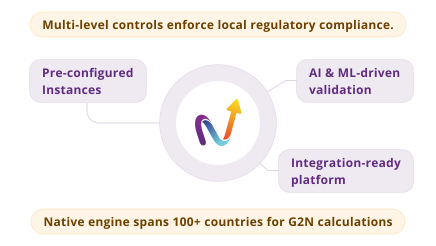
  • G2N Nova Payroll Engine: G2N Nova offers global gross-to-net payroll processing across more than 100 countries, making it one of the most advanced payroll engines available. It can be deployed as a SaaS solution or integrated seamlessly with major Human Capital Management and Workforce Management systems.

Conclusion

Navigating employment in Turkey requires a comprehensive understanding of employer costs, labor laws, employee benefits, leave policies, and work permits. Complying with these regulations is essential to establish a productive and legally compliant work environment. By prioritizing compliance and understanding the nuances of Turkish employment laws, employers can create a favorable and efficient workplace for their employees.

This document was prepared for informational purposes only. As local laws & regulations keeps on changing. Please consult your tax & legal advisors as well.
Contact Sales
Let's get this conversation started. Tell us a bit about your requirement, and we'll get in touch a soon as we can.

    FAQs

    What is an Employer of Record in Turkey, and how does it function?

    An Employer of Record in Turkey is the legal employer. They manage contracts, payroll, taxes, benefits, and compliance, while your company directs daily work.

    Is it legal to hire employees in Turkey through an EOR, and what regulations apply?

    Yes. The EOR complies with Turkish labor law, tax obligations, and social security requirements.

    How does an EOR in Turkey manage payroll, income tax, and social security contributions?

    The EOR calculates salaries, pays wages, withholds taxes, and handles employer and employee contributions.

    What are the benefits of using an EOR in Turkey compared to opening a local entity?

    It enables quick hiring without creating a company. The EOR reduces compliance risks and manages HR processes.

    Do EOR providers in Turkey ensure compliance with labor laws and severance?

    Yes. They prepare compliant contracts, manage benefits, and handle severance payments.

    Ready to hire in Turkey?

    No local entity needed. Our experts handle payroll, compliance, and onboarding.

    Talk to an expert
    Proven expertise in global payroll.