Form W-2

Form W-2, officially titled the Wage and Tax Statement, is one of the most important payroll tax documents in the United States. Issued annually by employers, it reports an employee’s total wages, tips, and other compensation, along with federal, state, and other taxes withheld throughout the calendar year. Every U.S. employer that pays wages subject to income, Social Security, or Medicare taxes is legally required to file Form W-2 with the Internal Revenue Service (IRS) and the Social Security Administration (SSA), while also providing copies to employees for their personal income tax filings.

For multinational companies operating in the United States, accurate and timely W-2 reporting is non-negotiable. Errors, delays, or misclassification can trigger costly penalties and audits. That is why global businesses partner with Mercans, a global leader in payroll technology and Employer of Record (EOR) services, to ensure full compliance with U.S. federal and state payroll regulations.

What Is Form W-2?

Form W-2 is the IRS-mandated annual statement that documents an employee’s earnings and tax withholdings for a calendar year. It serves multiple critical functions in the U.S. payroll and tax ecosystem.

Key purposes of Form W-2:

  • Reports total taxable wages, tips, and other compensation paid to an employee.
  • Documents federal income tax, Social Security tax, and Medicare tax withheld.
  • Captures state and local income tax withholdings where applicable.
  • Provides the foundation for the employee’s annual federal tax return (Form 1040).
  • Records contributions to retirement plans, HSAs, dependent care benefits, and other pre-tax items.
  • Enables the SSA to credit employees with proper Social Security and Medicare earnings history.

The form is governed by 26 U.S. Code § 6051 and is issued under OMB Number 1545-0029. Form W-2 must be furnished to employees by January 31 following the end of the tax year, or the next business day if it falls on a weekend. For tax year 2025, the deadline is February 2, 2026, since January 31, 2026 falls on a Saturday.

Who Must File Form W-2?

According to IRS guidelines, every employer engaged in a trade or business who pays remuneration for services performed by an employee must file Form W-2 if any of the following apply:

  • Income, Social Security, or Medicare tax was withheld from the employee’s wages.
  • Income tax would have been withheld had the employee not claimed exemption on Form W-4.
  • Total annual wages or noncash payments meet the IRS reporting threshold.

Important update: For wages paid after calendar year 2025, Public Law 119-21 raised the wage reporting threshold from $600 to $2,000 when no federal income, Social Security, or Medicare tax was withheld. This threshold will be adjusted annually for inflation starting in 2027.

Form W-2 must be filed for:

  • Full-time and part-time W-2 employees.
  • Statutory employees.
  • Household workers (depending on wage thresholds).
  • Employees of federal, state, and local government agencies.
  • Family members employed by the business.

Form W-2 is NOT required for:

  • Independent contractors, who receive Form 1099-NEC instead.
  • Self-employed individuals.
  • Workers classified under different employment relationships per IRS rules.

Misclassifying employees as independent contractors is one of the most common and most penalized payroll errors in the United States. Mercans’ US payroll and EOR services help employers correctly classify workers and avoid costly compliance failures.

Key Boxes and Sections of Form W-2

Form W-2 contains numerous lettered and numbered boxes, each capturing specific tax-relevant information. Understanding each box is essential for both employers preparing the form and employees reading it.

Employer and Employee Identification Boxes

  • Box a: Employee’s Social Security Number (SSN).
  • Box b: Employer Identification Number (EIN).
  • Box c: Employer’s name, address, and ZIP code.
  • Box d: Control number (optional, used for internal payroll tracking).
  • Box e: Employee’s full legal name.
  • Box f: Employee’s address and ZIP code.

Wage and Tax Withholding Boxes

  • Box 1, Wages, tips, other compensation: Total taxable federal wages, excluding pre-tax deductions like 401(k) contributions and Section 125 cafeteria plans.
  • Box 2, Federal income tax withheld: Total federal income tax withheld from the employee’s paychecks.
  • Box 3, Social Security wages: Wages subject to Social Security tax. The 2025 wage base limit is $176,100.
  • Box 4, Social Security tax withheld: 6.2% of Social Security wages.
  • Box 5, Medicare wages and tips: Wages subject to Medicare tax (no annual cap).
  • Box 6, Medicare tax withheld: 1.45% on all Medicare wages, plus 0.9% Additional Medicare Tax on wages exceeding $200,000.
  • Box 7, Social Security tips: Tips reported by the employee subject to Social Security tax.
  • Box 8, Allocated tips: Tips assigned to the employee, typically in food and beverage establishments.

Benefits and Special Compensation Boxes

  • Box 10, Dependent care benefits: Employer-sponsored dependent care assistance amounts.
  • Box 11, Nonqualified plans: Distributions from nonqualified deferred compensation plans.
  • Box 12, Codes: Reports special compensation items using letter codes such as D for 401(k), DD for employer health coverage, and AA for Roth contributions.
  • Box 13, Checkboxes: Indicates statutory employee status, retirement plan participation, or third-party sick pay.
  • Box 14a, Other: Miscellaneous reportable items such as union dues, after-tax HSA contributions, or qualified tips and overtime pay.
  • Box 14b, Treasury Tipped Occupation Code: New for 2026 filings under the One Big Beautiful Bill Act (OBBBA).

State and Local Tax Boxes

  • Box 15: State and employer’s state ID number.
  • Box 16: State wages, tips, etc.
  • Box 17: State income tax withheld.
  • Box 18: Local wages, tips, etc.
  • Box 19: Local income tax withheld.
  • Box 20: Locality name (city or county).

The Six Copies of Form W-2

Form W-2 is generated in multiple copies, each with a specific recipient and purpose:

  • Copy A: Submitted to the Social Security Administration (SSA).
  • Copy B: Filed with the employee’s federal tax return.
  • Copy C: Retained by the employee for personal records.
  • Copy 1: Filed with the state, city, or local tax department, if applicable.
  • Copy 2: Filed with the employee’s state, city, or local tax return.
  • Copy D: Retained by the employer for payroll records, typically four years minimum.

Form W-2 Filing Deadlines for 2025 Tax Year

Strict deadlines govern W-2 distribution and filing. Missing them triggers automatic IRS penalties.

  • February 2, 2026: Deadline to furnish Copies B, C, and 2 to employees.
  • February 2, 2026: Deadline to file Copy A with the SSA, paper or electronic.
  • Form W-3: Transmittal form required for paper filers, accompanies Copy A submissions.
  • Extension requests: Employers may file Form 8809 for SSA extension, or Form 15397 for employee statement extensions. Extensions are not automatically granted.

Electronic filing (e-filing) is mandatory for employers filing 10 or more information returns (a total threshold that combines W-2s with other 1099s and information returns), unless a hardship waiver is approved by the IRS.

W-2 vs 1099: Understanding the Difference

One of the most searched payroll questions globally is the difference between Form W-2 and Form 1099. Misclassification can cost employers thousands in back taxes, penalties, and legal fees.

Feature Form W-2 Form 1099-NEC
Recipient Employee Independent contractor
Tax withholding Employer withholds federal, state, FICA Contractor pays self-employment tax
Benefits Eligible for employer benefits Not eligible
Control Employer directs work Contractor controls how work is done
Filing threshold Any wages with tax withheld; $2,000+ from 2026 $600 or more in payments
Issued by Employer Payer or client

For multinational organizations managing both employees and contractors across U.S. states, Mercans’ US payroll outsourcing solutions provide complete classification support, payroll processing, and tax filing under one secure platform.

2025 and 2026 Form W-2 Updates: What Changed

Several significant updates affect Form W-2 reporting for tax years 2025 and 2026, driven primarily by the One Big Beautiful Bill Act (OBBBA) and Public Law 119-21:

  • Wage reporting threshold raised: From $600 to $2,000 for wages paid after 2025, when no tax was withheld.
  • Box 14 split: Box 14 is now divided into Box 14a (Other) and Box 14b (Treasury Tipped Occupation Code).
  • Tip deduction: Eligible tipped workers can deduct up to $25,000 in qualified tips annually. This phases out at $150,000 modified AGI for individuals, and $300,000 for joint filers.
  • Overtime deduction: Eligible employees can deduct up to $12,500 ($25,000 for joint filers) in qualified overtime pay.
  • Updated OMB number: All 2025 W-2 forms display new OMB Number 1545-0029.
  • Form W-2c revision: Released January 2026 with revision date Rev. 1-2026.
  • Social Security wage base: Increased to $176,100 for 2025, up from $168,600 in 2024.
  • 401(k) contribution limit: $23,500 for 2025, with new higher catch-up of $11,250 for ages 60 to 63 under SECURE 2.0.

Staying compliant with these annual updates is one of the biggest challenges for global employers. Mercans’ native payroll technology automatically incorporates regulatory updates across 160 countries, ensuring zero lag between legislative change and compliant payroll execution.

Penalties for Non-Compliance

The IRS imposes tiered penalties for late, incorrect, or unfiled W-2s. For the 2026 filing year, penalties have increased and now range:

  • $60 per form if filed within 30 days of the deadline.
  • $130 per form if filed more than 30 days late but by August 1.
  • $340 per form if filed after August 1, or not filed at all.
  • $680 per form for intentional disregard of filing requirements.
  • Maximum annual cap: Up to $4 million+ for large employers, with no cap for intentional disregard.

Additional penalties apply for:

  • Failure to furnish W-2 to employees on time.
  • Filing with incorrect SSNs or names.
  • Failing to e-file when required.
  • Misclassifying employees as independent contractors.

E-Filing Form W-2: Modern Compliance Standard

The SSA’s Business Services Online (BSO) is the official platform for electronic W-2 submissions. E-filing is faster, reduces errors, provides instant confirmation, and is mandatory for most employers.

Benefits of e-filing W-2:

  • Automated error detection before submission.
  • Instant SSA acknowledgment.
  • Faster processing of corrections.
  • Reduced risk of postal loss or delay.
  • Eligibility for extended deadlines in some scenarios.

Mercans’ US payroll engine integrates directly with SSA-approved channels and supports automated W-2 generation, distribution, and electronic filing for global employers operating across all 50 U.S. states.

Common W-2 Mistakes to Avoid

Even experienced payroll teams make recurring W-2 errors. The most frequent issues include:

  • Incorrect or mismatched Social Security Numbers.
  • Misspelled employee names that do not match SSA records.
  • Wrong EIN reported in Box b.
  • Failure to include taxable fringe benefits in Box 1.
  • Omission of Section 125 cafeteria plan amounts.
  • Reporting state wages incorrectly for multi-state employees.
  • Missing Box 12 codes for retirement contributions and HSA deposits.
  • Not issuing Form W-2c (Corrected Wage and Tax Statement) when errors are found.
  • Late distribution to employees.
  • Failing to e-file when crossing the 10-return threshold.

How Mercans Simplifies Form W-2 Compliance for Global Employers

Managing U.S. payroll is complex. It combines federal IRS rules, 50 different state regimes, local taxes, and ever-changing legislation like the OBBBA and SECURE 2.0. For global companies expanding into the United States, getting it right is mission-critical.

Mercans provides a complete suite of payroll and HR services tailored for U.S. compliance:

  • Native US payroll processing with full federal, state, and local tax compliance.
  • Employer of Record (EOR) services allowing global businesses to hire U.S. employees without setting up a local entity.
  • Automated W-2 generation, distribution, and e-filing with the SSA.
  • Multi-state payroll engine handling reciprocity, residency rules, and state-specific withholding.
  • HR Blizz™ SaaS platform for unified payroll, HR, and reporting across 160 countries.
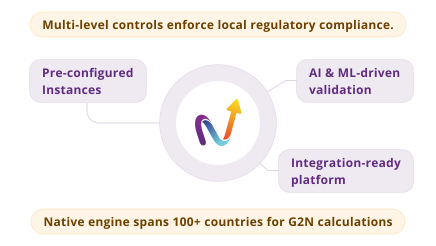
  • G2N Nova engine for accurate gross-to-net calculations with real-time compliance.
  • SOC 1, SOC 2, ISO 27001, and GDPR-certified data security.
  • 24/7 expert support from in-country payroll specialists.

With over 20 years of global payroll expertise, 8,000+ clients, and 160+ country coverage, Mercans is trusted by leading multinationals including Tesla, Uber, Ericsson, Bayer, Adidas, and Johnson & Johnson.

Explore Mercans’ US payroll and EOR services to see how your business can simplify Form W-2 compliance and scale operations across the United States with confidence.

Frequently Asked Questions (FAQs)

Q1: What is the difference between Form W-2 and Form W-4?

Form W-4 is the Employee’s Withholding Certificate completed at hire to determine how much tax is withheld. Form W-2 is the year-end statement reporting total wages and taxes actually withheld.

Q2: When should employees expect to receive their W-2?

Employees must receive their W-2 by January 31 of the year following the tax year. For tax year 2025, the deadline is February 2, 2026.

Q3: What if there is an error on my W-2?

The employer must issue a Form W-2c (Corrected Wage and Tax Statement) to correct any errors in name, SSN, or wage amounts.

Q4: Can W-2s be delivered electronically?

Yes, but only with the employee’s prior consent. Many employers use secure self-service portals to deliver electronic W-2s.

Q5: What if an employer fails to issue a W-2?

Employees should contact the IRS, which will issue Form 4852 as a substitute for filing. The employer faces significant penalties.

Q6: How long must employers keep W-2 records?

Employers must retain W-2 records for at least four years after the tax due date or payment date, whichever is later.