Form 16

Form 16, officially known as the TDS Certificate for salary, is one of the most important income tax documents for salaried employees in India. Issued by employers under Section 203 of the Income Tax Act, 1961, Form 16 serves as official proof that Tax Deducted at Source (TDS) has been deducted from an employee’s salary and deposited with the Income Tax Department (Central Board of Direct Taxes, CBDT). It contains a comprehensive breakdown of salary income, exemptions, deductions, and TDS for the financial year (1 April to 31 March).

For salaried individuals, Form 16 is essential for filing the Income Tax Return (ITR), applying for home loans, processing visa applications, and verifying tax compliance. For employers, issuing accurate and timely Form 16 is a legal mandate, with daily penalties for delays.

For multinational companies operating in India, the complexity of TDS compliance, statutory deductions like Provident Fund (PF), Employees’ State Insurance (ESI), Professional Tax, and quarterly Form 24Q filings makes payroll a high-risk function. That is why global businesses partner with Mercans, a global leader in payroll technology and Employer of Record (EOR) services, for fully compliant Indian payroll and TDS certificate management.

What Is Form 16?

Form 16 is the official TDS certificate issued by an employer to an employee, certifying that income tax has been deducted from the employee’s salary and deposited with the Government of India. It is issued annually under Section 203 of the Income Tax Act, 1961, and consolidates all salary, exemption, deduction, and tax data for the relevant financial year.

Key purposes of Form 16:

  • Acts as official proof of TDS deducted on salary income.
  • Provides a detailed breakdown of gross salary, allowances, and perquisites.
  • Lists exemptions claimed under Section 10 (HRA, LTA, gratuity, etc.).
  • Documents deductions under Chapter VI-A (Section 80C, 80D, 80CCD, etc.).
  • Calculates total taxable salary and tax liability.
  • Reflects the chosen tax regime (Old or New).
  • Serves as the primary document for filing the annual Income Tax Return (ITR).
  • Required for loan applications, visa filings, and financial verification.

Important update under the Income Tax Act, 2025: Effective from Tax Year 2026-27 (1 April 2026 onwards), Form 16 has been renumbered as Form 130. For Financial Year 2025-26, employers will continue to issue Form 16 in the existing format.

Who Issues and Receives Form 16?

Under Section 203 of the Income Tax Act, every employer who deducts TDS on salary payments must issue Form 16 to the concerned employee.

Employers must issue Form 16 to:

  • All salaried employees whose total income exceeds the basic exemption limit and on whom TDS has been deducted.
  • Employees who switched jobs during the year (each previous employer must issue a separate Form 16).
  • Employees in the Old Tax Regime exceeding ₹2,50,000 (below 60 years), ₹3,00,000 (senior citizens 60 to 80 years), or ₹5,00,000 (super senior citizens above 80 years).
  • Employees in the New Tax Regime exceeding ₹3,00,000 (FY 2024-25 limit).
  • All Indian residents and non-residents working in India whose salary attracts TDS.

Form 16 may not be issued if:

  • The employee’s total income is below the basic exemption limit.
  • No TDS was deducted from the salary because tax liability was nil.
  • The employee opted for the New Tax Regime where income up to ₹7,00,000 is tax-free under Section 87A rebate.

Even when no TDS is deducted, many employers issue Form 16 voluntarily as a goodwill practice and proof of employment income. For multinational companies hiring in India, Mercans’ India Employer of Record and payroll services ensure accurate TDS calculation, timely Form 24Q filing, and seamless Form 16 issuance to every eligible employee.

Structure of Form 16: Part A and Part B

Form 16 is divided into two distinct parts, each capturing different aspects of an employee’s tax record. Both parts together form the complete TDS Certificate.

Form 16 Part A: TDS Summary

Part A is generated and downloaded directly from the TRACES portal (TDS Reconciliation Analysis and Correction Enabling System) at tdscpc.gov.in. It is digitally authenticated and contains a unique 7-character certificate number for verification.

Information contained in Part A:

  • Name and address of the employer.
  • Name and address of the employee.
  • Permanent Account Number (PAN) of both employer and employee.
  • Tax Deduction and Collection Account Number (TAN) of the employer.
  • Assessment Year and period of employment with the employer.
  • Quarterly summary of TDS deducted and deposited.
  • Challan Identification Numbers (CIN) for each TDS deposit.
  • Book Identification Number (BIN) where applicable for government deductors.
  • Receipt numbers of quarterly TDS statements (Form 24Q).
  • TRACES logo and Government of India national emblem.
  • Digital signature of the deductor (employer).

Form 16 Part B: Detailed Salary and Tax Computation

Part B is prepared by the employer and provides a comprehensive computation of salary income, exemptions, deductions, and final tax liability. The Central Board of Direct Taxes (CBDT) has standardized Part B to ensure uniformity across all employers.

Information contained in Part B:

  • Detailed breakdown of gross salary including basic pay, dearness allowance, bonuses, and commissions.
  • Value of perquisites under Section 17(2) (company car, accommodation, club fees, etc.).
  • Profits in lieu of salary under Section 17(3).
  • Allowances exempt under Section 10 (House Rent Allowance, Leave Travel Allowance, Children Education Allowance, etc.).
  • Deductions under Section 16 (standard deduction, professional tax, entertainment allowance).
  • Income from house property reported by the employee.
  • Income from other sources declared for TDS deduction.
  • Deductions under Chapter VI-A (Section 80C, 80CCD, 80D, 80E, 80G, 80TTA, etc.).
  • Total taxable income.
  • Tax on total income with applicable surcharge and cess (4% Health and Education Cess).
  • Relief under Section 89 (for arrears of salary or family pension).
  • Net tax payable or refund due.
  • Indication of tax regime selected (Old or New).

Form 16 Filing and Issuance Deadlines

The Income Tax Department enforces strict deadlines for TDS deposit, quarterly statement filing, and Form 16 issuance.

Key deadlines for Indian employers:

  • 7th of every month: Deadline for depositing TDS deducted in the previous month (30 April for March deductions).
  • 31 May (post FY end): Due date for filing quarterly TDS Return (Form 24Q) for the last quarter (Q4) of the financial year.
  • 15 June (post FY end): Statutory deadline for issuing Form 16 to employees for the previous financial year.
  • 31 July: General ITR filing deadline for individual taxpayers (extended in some years).

For example, for Financial Year 2024-25 (Assessment Year 2025-26), employers must issue Form 16 to employees by 15 June 2025. Failure to issue Form 16 by this date triggers a penalty of ₹100 per day under Section 272A(2)(g) of the Income Tax Act, until the certificate is provided.

Form 16 vs Form 16A vs Form 16B vs Form 16C

India’s TDS certificate framework includes multiple forms, each applicable to different types of payments. Confusing them is a common compliance error, particularly for businesses managing both salaried employees and contractors.

Form Applicable Section Purpose Issued To Frequency
Form 16 Section 192 TDS on salary Salaried employees Annually by 15 June
Form 16A Sections 194, 194A, 194C, 194H, 194I, 194J TDS on non-salary payments (rent, professional fees, commission, contract, interest) Vendors, contractors, professionals Quarterly within 15 days of TDS return filing
Form 16B Section 194-IA TDS on sale of immovable property over ₹50 lakh Property seller Within 15 days of Form 26QB filing
Form 16C Section 194-IB TDS on rent paid by individuals over ₹50,000 per month Landlord Within 15 days of Form 26QC filing
Form 16D Section 194M TDS on payments to contractors and professionals by individuals Contractor or professional Within 15 days of Form 26QD filing

Beyond these certificates, Form 26AS (now largely replaced by the Annual Information Statement, AIS) consolidates all TDS, advance tax, and self-assessment tax credits across all sources, allowing the taxpayer to verify and reconcile data while filing the ITR.

For organizations managing multiple TDS categories, Mercans’ India payroll outsourcing solutions automate end-to-end TDS compliance covering all sections of the Income Tax Act.

How to Download Form 16 from the TRACES Portal

Employers (deductors) can generate Form 16 Part A and Part B from the TRACES portal. Here is the step-by-step process:

  • Step 1: Visit tdscpc.gov.in and log in using TAN, User ID, and Password.
  • Step 2: Navigate to the Downloads tab and select Form 16.
  • Step 3: Select the relevant Financial Year and certificate type (Form 16 Part A, Form 16 Part B, or both).
  • Step 4: Enter the employee’s PAN. Up to 10 PANs can be added in a single request, or use Bulk PAN Download for larger employee bases.
  • Step 5: Verify the displayed details and submit the request.
  • Step 6: Choose between DSC-based validation (Digital Signature Certificate) or Normal Validation (using TDS receipt number, tax deducted, and date).
  • Step 7: A unique reference number is generated. Once processed, Form 16 will be available for download under the Downloads section.
  • Step 8: The employer must authenticate the certificate using a digital signature (DSC) or manual signature before issuing it to the employee.

Why Form 16 Matters for Employees

Form 16 is far more than a tax document. It is one of the most important financial certificates for salaried Indians and serves multiple critical purposes throughout the year.

Common uses of Form 16:

  • Filing the annual Income Tax Return (ITR-1, ITR-2, or ITR-3 as applicable).
  • Reconciling salary and TDS data with Form 26AS and the Annual Information Statement (AIS).
  • Verifying that TDS deducted by the employer has been deposited with the government.
  • Acting as primary income proof for home loans, personal loans, car loans, and credit cards.
  • Supporting Visa and immigration applications.
  • Claiming tax refunds for overpaid TDS.
  • Verifying eligibility for employer-provided benefits and perquisites.
  • Providing historical income evidence for retirement planning and pension calculations.

The Income Tax Department recommends retaining Form 16 for at least eight years from the end of the relevant assessment year, especially in case of scrutiny, reassessment, or refund claims.

Penalties for Non-Compliance

Employers who fail to issue Form 16 on time, deposit TDS late, or file incorrect quarterly statements face significant penalties under the Income Tax Act, 1961.

Common penalties for Indian employers:

  • Failure to issue Form 16: ₹100 per day under Section 272A(2)(g), capped at the TDS amount.
  • Late deposit of TDS: Interest at 1.5% per month under Section 201(1A) from the date of deduction to the actual date of deposit.
  • Late filing of Form 24Q (quarterly TDS return): ₹200 per day under Section 234E, capped at the TDS amount.
  • Incorrect Form 24Q filing: ₹10,000 to ₹1,00,000 penalty under Section 271H.
  • Failure to deduct TDS: Disallowance of 30% of the salary expense under Section 40(a)(ia), plus interest and penalty.
  • Fraudulent or false Form 16: Prosecution under Section 277 with imprisonment from three months to seven years and a fine.

Repeat or willful non-compliance may result in CBDT scrutiny, audits, and reputational damage for the employer.

Common Form 16 Mistakes to Avoid

Even experienced Indian payroll teams encounter recurring Form 16 errors. The most frequent issues include:

  • Mismatch between Form 16 figures and Form 26AS or AIS.
  • Incorrect or missing PAN of the employee or TAN of the employer.
  • Wrong tax regime indicated in Part B.
  • Failure to include all four quarters of TDS in Part A.
  • Omission of HRA, LTA, or other Section 10 exemptions.
  • Incorrect treatment of perquisites (company car, accommodation, ESOPs).
  • Missing Section 89 relief for arrears or advance salary.
  • Late issuance past the 15 June deadline.
  • Issuing only Part A without Part B.
  • Failing to issue separate Form 16s when the employee changed jobs.
  • Not authenticating the certificate with a valid digital signature.

How Mercans Simplifies Form 16 and Indian Payroll Compliance

Managing payroll in India is one of the most complex compliance challenges in the Asia-Pacific region. It involves TDS under Section 192, Form 24Q quarterly filings, Provident Fund (PF), Employees’ State Insurance (ESI), Professional Tax (state-specific), Labour Welfare Fund, gratuity calculations, leave encashment rules, and multi-state reporting. For multinational companies expanding into India, navigating these requirements demands deep local expertise and reliable technology.

Mercans delivers a complete Indian payroll and HR solution built for global employers:

  • Native Indian payroll processing with full compliance under the Income Tax Act, 1961, and the upcoming Income Tax Act, 2025.
  • Automated Form 16 generation, Part A retrieval from TRACES, Part B preparation, and digital signing.
  • Quarterly Form 24Q filing with the Income Tax Department.
  • Employer of Record (EOR) services allowing global businesses to hire Indian employees without setting up a local entity.
  • Multi-state compliance covering Professional Tax, Labour Welfare Fund, and state-specific minimum wages.
  • PF, ESI, and gratuity calculations aligned with EPFO, ESIC, and Payment of Gratuity Act requirements.
  • HR Blizz™ SaaS platform unifying payroll, HR, and reporting across 160 countries.
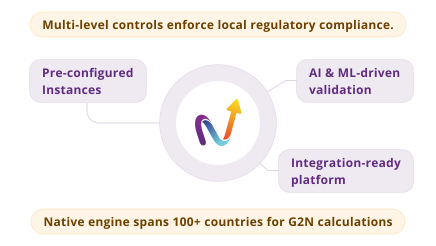
  • G2N Nova engine delivering accurate gross-to-net calculations with real-time compliance for India.
  • Old vs New Tax Regime calculations automatically adjusted per employee declaration.
  • Form 26AS and AIS reconciliation support for employees.
  • SOC 1, SOC 2, ISO 27001, and GDPR-certified data security.
  • 24/7 in-country Indian payroll specialists providing local expertise and global consistency.

With over 20 years of global payroll expertise, 8,000+ clients, and a strong India presence with its own legal entity, Mercans is trusted by leading multinationals expanding into the Indian market.

Explore Mercans’ India Employer of Record and payroll services to see how your business can simplify Form 16 compliance, automate TDS management, and scale operations across India with confidence.

Frequently Asked Questions (FAQs)

Q1: When should I receive my Form 16?

Your employer must issue Form 16 by 15 June of the assessment year following the relevant financial year. For FY 2024-25, the deadline is 15 June 2025.

Q2: What is the difference between Form 16 and Form 16A?

Form 16 is issued for TDS on salary under Section 192. Form 16A is issued for TDS on non-salary payments such as rent, professional fees, commission, and interest under various other sections.

Q3: Is Form 16 mandatory for filing ITR?

No, Form 16 is not mandatory for filing your ITR. You can file using Form 26AS, AIS, salary slips, and bank statements. However, Form 16 makes the process significantly easier and more accurate.

Q4: What if I changed jobs during the financial year?

You must collect a separate Form 16 from each employer for the period worked. Both will be needed to file an accurate ITR.

Q5: Can I download Form 16 myself?

No, only the employer (deductor) can download Form 16 from the TRACES portal. Employees receive the authenticated copy from their employer.

Q6: What if there is an error in my Form 16?

Notify your employer immediately. They must rectify the error, file a revised Form 24Q if needed, and issue a corrected Form 16.

Q7: What is Form 130 and when does it replace Form 16?

Under the Income Tax Act, 2025, Form 16 will be renumbered as Form 130 effective from Tax Year 2026-27 (1 April 2026 onwards). The current Form 16 will continue to apply for FY 2025-26 and earlier years.

Q8: How long should I keep my Form 16?

The Income Tax Department recommends retaining Form 16 for at least eight years from the end of the assessment year, especially for refund claims, scrutiny, or reassessment proceedings.