Global Payroll

Payroll in Germany

Accurate payroll, full compliance, zero hassle.

Global Payroll Team
Written by Global Payroll Team
Published on October 13, 2026
Last updated October 13, 2026
Expert Reviewed
Mercans is your premier partner for top-quality payroll services in Germany, offering both Managed and SaaS solutions. Our steadfast commitment to delivering exceptional payroll outsourcing in Germany is unmatched. Drawing from extensive experience in the payroll sector, Mercans ensures precise and compliant payroll services, establishing us as the preferred option for businesses of all sizes. Count on Mercans for prompt and accurate payroll transactions, complemented by the convenience of multi-currency payments tailored to the German market. As your dedicated local payroll provider in Germany, we feature a team of in-country payroll specialists well-versed in local regulations, providing comprehensive assistance for a seamless payroll experience customized to your business requirements.

Payroll Services in Germany

At Mercans, our unwavering commitment to local compliance in Germany goes beyond a mere checklist. We proactively navigate the intricate regulatory landscape — including Germany’s distinctive social insurance collection mechanism — ensuring your business aligns seamlessly with the country’s norms. Here’s an insight into how Mercans expertly manages key activities, safeguarding both compliance and operational efficiency:

Comprehensive Services Include

Payroll Settlement

  • Precise calculations encompassing wage tax (Lohnsteuer), the five branches of social insurance, and other deductions.
  • Inclusion of church tax where applicable, and collective agreement (Tarifvertrag) entitlements.
  • Monthly preparation of contribution statements (Beitragsnachweis) for each employee’s statutory health insurance fund.

Payment Processing

  • Generation and delivery of payslips.
  • Efficient management of social insurance prepayments, a distinctively German mechanic described below.
  • Streamlined SEPA payment processing in Euro.

Regulatory Compliance

  • Accurate monthly wage tax withholding and remittance to the Finanzamt.
  • Timely social insurance contribution payments and reporting to each employee’s Krankenkasse.
  • Preparation of the annual wage tax certificate (Lohnsteuerbescheinigung) for each employee.

Social Insurance Management

  • Coordinating collection across all five social insurance branches through each employee’s chosen health insurance fund.
  • Registration and de-registration of employees (DEÜV) and, where applicable, same-day Sofortmeldung filings.
  • Expert management of Finanzamt and Bundesagentur für Arbeit filings.

Minimum Wage in Germany

Germany’s national minimum wage (Mindestlohn) is EUR 13.90 per hour, effective 1 January 2026, with a further increase to EUR 14.60 per hour already legislated for 1 January 2027. The related mini-job monthly earnings ceiling, which is linked to the minimum wage, rose to EUR 603 per month for 2026.

Working Hours

The statutory maximum working day in Germany is 8 hours, extendable to 10 hours provided the average over a 6-month reference period does not exceed 8 hours per day — an effective ceiling of around 48 hours per week. In practice, many employees work fewer hours under a collective bargaining agreement (Tarifvertrag), commonly 35 to 40 hours per week.

Overtime & 13th Month Salary

Germany’s Working Hours Act sets no statutory overtime premium — whether overtime is paid extra, banked as time off, or already included in salary is determined entirely by the employment contract, works agreement, or applicable collective bargaining agreement, not by law. Similarly, there is no general legal requirement for a 13th-month salary, though many collective agreements and company policies provide one.

Probation & Termination Protection

Probation Period
The statutory maximum probation period is 6 months, during which either party may terminate the contract with 2 weeks’ notice, effective on any calendar day.
Termination Protection (Kündigungsschutzgesetz)
Statutory protection against unfair dismissal applies after 6 months of continuous employment at businesses with more than 10 employees, requiring dismissal to be justified on personal, conduct-related, or operational grounds.
Severance (Abfindung)
German law does not automatically mandate severance pay in most cases — it typically arises through a negotiated exit, a court settlement, or a social plan (Sozialplan) in restructurings, with a common rule-of-thumb benchmark of 0.5 gross monthly salary per year of service.

Payroll Cycle in Germany

Salaries in Germany are paid monthly, in Euro via SEPA credit transfer. A local German bank account is not strictly legally required, since payments can be made from any SEPA-zone account, though a local account is common practice for administrative simplicity.

Company Registration in Germany

When establishing a business presence in Germany to run local payroll, foreign companies typically choose from the following structures, registered through the commercial register (Handelsregister) via a notary:

GmbH (Limited Liability Company)

The standard vehicle for a full operating subsidiary with liability protection. Requires a minimum share capital of EUR 25,000, at least half of which (EUR 12,500) must be paid in at incorporation, with 1 shareholder and 1 managing director (Geschäftsführer) required.

UG (haftungsbeschränkt)

A lower-capital entry point, sometimes referred to as a “mini-GmbH,” with a minimum capital of just EUR 1 in cash. The company must retain 25% of annual profit as reserves until reaching EUR 25,000, at which point it can convert to a full GmbH.

Branch Office (Zweigniederlassung)

Not a separate legal entity — an extension of the foreign parent, using the parent’s own capital and legal representatives. Suited to a foreign company that wants a directly operating, commercially active German presence without incorporating a new legal entity.

Representative Office (Repräsentanz)

Not a recognized German commercial-law entity type, generally requiring only a local trade-office notification rather than commercial register entry. Restricted to liaison activity such as market research and customer contact — it cannot generate revenue, making it unsuitable for a company that intends to hire staff for revenue-generating work.

Setting up and maintaining any of these structures — including the ongoing corporate compliance obligations that come with them — requires dedicated legal and administrative resources. Mercans’ Employer of Record and Global Payroll solutions allow companies to hire and pay employees in Germany without first establishing any of these entities.

Employer Registration for Payroll in Germany

Running compliant payroll in Germany requires several registrations:

  • Finanzamt (Tax Office): Register to obtain a tax number (Steuernummer), required before withholding and remitting employee wage tax.
  • Krankenkasse — Single Collection Point: Uniquely, Germany’s statutory health insurance funds act as the sole collection agency for the combined social insurance contribution, covering health, long-term care, pension, and unemployment insurance in a single payment, which the fund then forwards to the other relevant carriers. Accident insurance is collected separately through the relevant Berufsgenossenschaft (trade association).
  • Betriebsnummer: An 8-digit employer number obtained from the Federal Employment Agency (Bundesagentur für Arbeit), required as soon as the first employee is hired.
  • Sofortmeldung (Immediate Reporting): A same-day electronic reporting requirement applying to specific higher-risk sectors — including construction, catering and hospitality, transport and logistics, and building cleaning — requiring the report to be filed electronically no later than the employee’s first day of work.

Payroll Taxes in Germany

Personal Income Tax in Germany

Germany applies a continuous progressive income tax scale (Einkommensteuer). Income up to the basic tax-free allowance (Grundfreibetrag) of EUR 12,348 for single filers (EUR 24,696 for joint filers) is untaxed for 2026, with rates then rising progressively to a top rate of 42% above EUR 69,879, and a further “wealth tax” rate of 45% above EUR 277,826.

Solidarity Surcharge & Church Tax

The solidarity surcharge (Solidaritätszuschlag) still technically exists but, following reform, only applies above an exemption threshold — EUR 20,350 of assessed income tax for single filers in 2026 (EUR 40,700 joint) — meaning the large majority of employees no longer pay it at all. Church tax (Kirchensteuer) is withheld only for registered members of a recognized religious community, calculated as 8% of wage tax in Bavaria and Baden-Württemberg, or 9% of wage tax in all other federal states.

Tax Reporting

Employers withhold wage tax (Lohnsteuer) via the electronic ELStAM system and remit it to the Finanzamt by the 10th of the following month for standard monthly filers, with quarterly or annual filing available for smaller employers below certain thresholds.

Social Security in Germany

German social insurance covers five branches, with contributions split between employer and employee (except accident insurance, which is employer-only), calculated up to annually indexed contribution ceilings.

Branch Total Rate Split
Health Insurance (Krankenversicherung) 14.6% + fund-specific supplement (Zusatzbeitrag) 50 / 50
Long-Term Care (Pflegeversicherung) 3.6% standard (4.2% for childless employees over 23) Roughly split, with the childless surcharge borne by the employee
Pension Insurance (Rentenversicherung) 18.6% 9.3% / 9.3%
Unemployment Insurance (Arbeitslosenversicherung) 2.6% 1.3% / 1.3%
Accident Insurance (Unfallversicherung) Industry-rated, employer-paid only 100% employer

Pension and unemployment insurance are calculated up to a 2026 ceiling of EUR 8,450 per month; health and long-term care insurance up to EUR 5,812.50 per month. Since 1 January 2025, the historical East/West Germany distinction in these ceilings has been fully eliminated, with uniform nationwide figures now in place.

The German “Prepayment” Mechanic

Uniquely, German social insurance contributions are due on the third-to-last banking day of the current month in which the work is performed — generally based on an estimate if final payroll figures aren’t yet available, with a corresponding contribution statement (Beitragsnachweis) submitted to the relevant health insurance fund by the fifth-to-last banking day, and any difference corrected the following month.

Termination Payroll in Germany

Notice periods for employer-initiated termination increase with an employee’s length of service under Section 622 of the German Civil Code (BGB), while an employee’s own resignation notice remains a flat 4 weeks regardless of tenure.

Years of Service Employer Notice Period
Probation (up to 6 months) 2 weeks, effective any day
Less than 2 years 4 weeks, to the 15th or end of a month
2 years 1 month, to month-end
5 years 2 months, to month-end
8 years 3 months, to month-end
10 years 4 months, to month-end
15 years 6 months, to month-end
20 years 7 months, to month-end

On termination, final settlement covers salary through the last working day and mandatory payout of any accrued, unused vacation that could no longer be taken. Employees are also statutorily entitled to a reference letter (Arbeitszeugnis) on request, regardless of who initiated the termination or why.

Germany Compliance Requirements

Obligation Frequency / Deadline
Wage Tax (Lohnsteuer) Remittance Monthly, by the 10th of the following month
Social Insurance Contribution Statement (Beitragsnachweis) By the 5th-to-last banking day of the current month
Social Insurance Contribution Payment By the 3rd-to-last banking day of the current month
Annual Accident Insurance Report (UV-Jahresmeldung) By 16 February of the following year
Annual Wage Tax Certificate (Lohnsteuerbescheinigung) By 28 February of the following year

Employee Benefits in Germany

Mercans, in adherence to German labour law and applicable collective agreements, ensures that employees receive the right benefits by staying vigilant about statutory deductions and entitlements.

  • Annual Leave: Statutory paid annual leave, with many collective agreements and company policies providing more than the legal minimum.
  • Sick Leave: Continued full pay for up to 6 weeks of incapacity, with statutory health insurance sick pay applying thereafter.
  • Collective Agreement Benefits: Many additional entitlements — including pay above the statutory minimum, working-time arrangements, and bonuses — are set at the sector or company level through the applicable Tarifvertrag.
  • Works Council Co-Determination: Where a works council (Betriebsrat) exists, it holds binding co-determination rights over matters such as working-time arrangements and overtime.

Benefits of Payroll Outsourcing in Germany

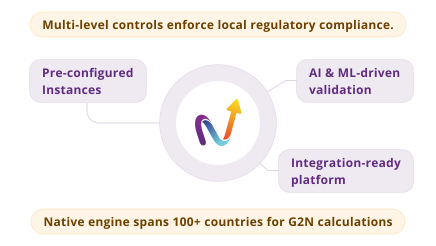
For our payroll services, we have strategically implemented a robust tool designed to seamlessly operate across diverse countries, ensuring regional uniformity and meeting the specific requirements of our clients. This tool reflects our commitment to delivering:
Stringent Data Security Measures
Incorporating industry-leading security measures to safeguard sensitive data, including compliance with GDPR, SOC, ISO, and OWASP standards. ISO 27001 and ISAE3402 certifications ensure adherence to stringent information security protocols, guaranteeing the highest level of data protection.
Consistent and Sustainable Performance
Ensuring reliable performance that meets the dynamic demands of payroll services, providing clients with consistent and sustainable solutions across Germany’s distinctive social insurance and collective bargaining landscape.
Flexibility and Scalability
Offering flexibility and scalability to accommodate evolving client needs and adapt to changing business environments, ensuring seamless integration and expansion.
Collaborative Cloud Platform
Utilizing a cloud-based platform that facilitates collaborative work, promoting efficiency and accessibility across teams, enhancing collaboration and productivity.
Key Features of Electronic Payroll Support

  • Full Traceability: Enabling a traceable process from generation to transmission and validation, ensuring transparency and accountability at every step.
  • Efficiency in Human Resources: Enhancing the efficiency of the human resources area by streamlining the payroll settlement process, resulting in significant time savings and improved resource allocation.
  • Certified Suppliers: Partnering with certified suppliers who uphold the highest standards of information security with ISO 27001 certification, ensuring secure data transmission processes and bolstering the integrity of our services.

Payroll Solutions in Germany

Uncover the potential of seamless payroll processing in Germany with Mercans’ Global Payroll Solutions. Our flexible models ensure local compliance, support multi-currency transactions, and offer connectivity to global Human Capital Management (HCM) and Enterprise Resource Planning (ERP) systems. Paying correctly has never been more straightforward.
Explore Our Flexible Models

  • SaaS (Software as a Service): Tailored for enterprise businesses managing multi-country payroll with intricate complexities arising from diverse data points, locations, currencies, and languages. Our SaaS model streamlines operations for optimal efficiency.
  • Managed Services: Designed for mid-sized and large enterprise businesses, our Managed Services model caters to those operating multi-country payroll. It provides on-demand HR expertise, ensuring security, reliability, and compliance across the board.
  • HRMS (Human Resource Management System): Perfect for mid to large businesses in expansion mode, our HRMS model offers a comprehensive range of functionalities, including payroll and benefits. Businesses can select the specific features they need, ensuring a tailored and efficient solution.

Streamline Payroll with Mercans’ Technology and Integrations

Mercans leads the way in providing top-tier payroll solutions in Germany, offering a diverse range of tailored options to meet our clients’ unique needs. Choose Mercans as your reliable ally, ensuring a smooth and effective payroll process in Germany’s dynamic business environment.

  • Cutting-Edge Technology: Explore the forefront of innovation with Mercans’ state-of-the-art technology, driving our global payroll solutions.
  • Seamless Integrations: Effortlessly integrate your Human Capital Management (HCM) systems with Mercans’ solutions, enhancing connectivity and efficiency.
  • Recognized Excellence: Partner with an esteemed organization known for its commitment to excellence in delivering outstanding payroll services.

Outsource to Payroll Company in Germany

In the dynamic business landscape of Germany, Mercans stands as a beacon of excellence, offering tailored solutions to meet the diverse needs of our clients. With Europe’s largest economy, a sophisticated regulatory environment, and a strategic position at the heart of the European Union, Germany presents attractive opportunities for business expansion, alongside genuinely intricate payroll requirements shaped by its social insurance and collective bargaining systems. Mercans is your trusted partner in navigating the complexities of the German market. Our unwavering commitment to 100% local compliance, coupled with our extensive knowledge of German labor laws, ensures that businesses establish a solid presence in Germany with ease. By choosing Mercans, companies can leverage our expertise to streamline operations, adhere to statutory requirements, and lay the groundwork for sustained growth in this dynamic environment. With Mercans by your side, embark on a journey of success and prosperity in Germany’s thriving business landscape.

This document was prepared for informational purposes only. As local laws & regulations keeps on changing. Please consult your tax & legal advisors as well.
Contact Sales
Let's get this conversation started. Tell us a bit about your requirement, and we'll get in touch a soon as we can.

    Sample message

    1. Headcount per legal entity (breakdown by country/entity)

    2. Systems to be interfaced with (e.g., HRIS, payroll, finance, time tracking, etc.)

    3. Any specific integration requirements or preferred platforms

    4. Requirement for additional modules (e.g., benefits administration, time & attendance, expense management)

    5. Level of customization or configuration needed for systems integration

    FAQs

    Why does German social insurance get paid before the month even ends?

    Germany’s social insurance system requires contributions to be paid by the third-to-last banking day of the current month, generally based on an estimate if final payroll figures aren’t yet available, with any difference corrected the following month. Our platform manages this distinctive prepayment mechanic automatically.

    How do you manage payments to different health insurance funds (Krankenkassen) for employees?

    Each employee’s chosen statutory health insurance fund acts as the single collection point for health, long-term care, pension, and unemployment insurance contributions combined. We calculate and remit the correct combined contribution to each employee’s fund every pay period.

    How do you determine the correct notice period for a German employee?

    Employer-initiated notice periods scale with an employee’s length of service under Section 622 of the German Civil Code, while employee resignation notice remains a flat 4 weeks regardless of tenure. We calculate the correct statutory or contractual notice period for each case.

    What challenges arise when integrating German payroll data with global systems, and how do you address them?

    Integration challenges are solved through a unified payroll platform that consolidates data, standardizes reporting, and connects HR, finance, and compliance teams across every country you operate in, including Germany.

    How do you manage currency requirements when running payroll in Germany?

    We process salaries in Euro via SEPA transfer, while giving multinational clients consolidated multi-currency visibility across their global payroll.

    Need payroll in Germany?

    Accurate, compliant payroll processing handled by local experts.

    Talk to an expert
    Proven expertise in global payroll.