Employer of Record

Employer of Record (EOR) Slovakia

Hire compliantly, pay accurately, expand confidently.

Global Payroll Team
Written by Global Payroll Team
Last updated April 24, 2026
Expert Reviewed

An Employer of Record (EOR) in Slovakia serves as the legal employer for a worker, often referred to as a Global Professional Employer Organization (Global PEO). Our role includes managing critical aspects of employment, ensuring full compliance with local labor laws and regulations. The EOR is responsible for handling functions such as payroll, taxes, mandatory benefits, and drafting employment contracts.

Key responsibilities of the Employer of Record (EOR) in Slovakia include:
  • Ensuring compliance with Slovakia’s labor laws for employee employment.
  • Overseeing the local payroll process.
  • Managing employment-related tax filings and documentation.
  • Providing employees with clear and accurate payslips.
  • Ensuring timely salary payments to workers.

Streamline your international expansion with Mercans’ Global PEO services, offering a seamless solution without the need to establish a local entity. As your trusted Employer of Record in Slovakia, we ensure legal compliance, Intellectual Property protection, and a smooth global mobility experience, including work visas. Partner with Mercans for an efficient, compliant employment experience, helping you build a diverse and effective workforce in Slovakia and beyond.

Things you need to know before hiring in Slovakia

Employment Contracts in Slovakia

In Slovakia, an employment relationship is established through a written contract between the employer and the employee. The employer is required to provide a copy of this contract to the employee. The contract must specify key elements, including:

  • The type of work the employee will perform and a brief description of the role.
  • The location of the workplace, whether it is a specific municipality, part of a municipality, or another designated place.
  • The agreed start date of employment.
  • The wage conditions, unless these are already outlined in a collective agreement.

If the working conditions are defined in a collective agreement, a reference to the agreement is sufficient in the employment contract.

Any changes to the agreed terms of the contract can only be made with mutual consent, and such amendments must be documented in writing.

The details of the employment relationship and contract are governed by the Slovak Labour Code.

Working Hours

In Slovakia, the standard working hours for employees are generally set at a maximum of 40 hours per week, with the average weekly working time, including overtime, not exceeding 48 hours. However, there are several exceptions to this rule based on factors such as the work schedule, the nature of the job, and the age of the employee.

For instance, employees working in a two-shift system are limited to a maximum of 38.75 hours per week, while those in a three-shift or continuous operation can work up to 37.5 hours per week. Additionally, workers exposed to specific hazardous working conditions may have shorter weekly working time. There are also age-related exceptions, where juvenile employees under the age of 16 can work no more than 30 hours per week, and those aged 16 or 17 can work up to 37.5 hours per week. These provisions are in place to ensure employee health and safety, particularly for those in hazardous roles or younger workers.

Probation Period

In Slovakia, the duration of the probationary period specified in the employment contract is typically capped at three months. However, for senior employees who are directly involved in the management of a statutory body, or for members of the statutory body themselves, this period can be extended to six months. It is important to note that the probationary period cannot be extended beyond the initial agreement, and it cannot be applied when renewing fixed-term employment contracts.

13th Month Salary

Monetary compensation given by the employer to an employee for work during the summer vacation period, commonly referred to as the 13th salary, and for the Christmas holidays, commonly referred to as the 14th salary, is treated as part of the employee’s wage. While these payments are not mandatory, employers may reward employees with additional compensation in June and December, in addition to their regular salary.

Termination, Severance Pay, and Notice Period

Termination

Termination of Employment by Mutual Agreement

When both the employer and the employee mutually agree to end the employment relationship, it will terminate on the agreed date. This agreement must be documented in writing. If requested by the employee, or if the termination is due to specific reasons, such as the relocation or closure of the employer’s business, redundancy, or the employee’s inability to continue working due to health issues or an occupational disease, the agreement should include the reasons for termination.

Termination of Employment by Dismissal

Both parties, employer and employee, may choose to terminate the employment relationship through dismissal. Such termination must be made in writing and delivered to the other party, otherwise it will be considered invalid. The employer can only terminate the contract for legally defined reasons, which must be clearly stated and cannot be changed afterward.

  • Immediate Termination: An employer may immediately terminate the employment contract if the employee has been legally convicted of an intentional crime or has seriously breached work discipline. Similarly, an employee may terminate the contract immediately if a medical report deems them unfit for work and the employer fails to assign suitable work within 15 days, or if the employer fails to pay wages or compensation within the same time frame. Immediate termination, whether by the employer or employee, must be documented in writing, specifying the reason, which must be clear and non-ambiguous, and delivered within the required timeframe.
  • Termination During the Probationary Period: During the probationary period, either the employer or the employee can terminate the employment relationship in writing, for any reason, or even without providing one. However, special protections apply to certain employees: a pregnant woman, a mother until the end of her ninth month after childbirth, a breastfeeding woman, and a man on paternity leave cannot be dismissed during this period unless it is for an exceptional reason unrelated to pregnancy, maternity, or parental leave. Such dismissals must also be documented in writing and justified, or they will be deemed invalid.

Severance Pay

Severance pay is calculated based on the duration of the employment relationship and the reason for termination. Below are the guidelines for severance pay when the employment is terminated by the employer.

Duration of employmentSeverance pay (medical inability or redundancy)Occupational accident / disease
Less than 2 yearsNo statutory severance on notice; 1 month’s average earnings if ended by agreement on these groundsDo not use a fixed “10× average earnings” row without separate legal confirmation
2 years to less than 5 years1 month’s average earningsSame caution
5 years to less than 10 years2 months’ average earningsSame caution
10 years to less than 20 years3 months’ average earningsSame caution
20 years or more4 months’ average earningsSame caution

Notice period (see the table)

In Slovakia, if the employer and employee do not agree on the length of the notice period, the duration is determined by law. The notice period varies depending on the length of the employment relationship, as outlined in the table below.

Duration of employment as of notice deliveryMinimum notice period (employer’s notice)Minimum notice period (employee’s notice)Reasons for termination: dismissal, employer’s cancellation, redundancy, or inability to continue working due to medical examinationReasons for other legal terminations
Less than 1 year1 month1 month1 month1 month
At least 1 year and less than 5 years2 months2 months2 months2 months
At least 5 years2 months2 months3 months2 months

Employees vs Independent Contractors Slovakia

Running a business requires flexibility in staffing to meet varying needs. Sometimes you need employees to work full-time, 40 hours a week, while other times, you may only need help for specific, short-term tasks. Deciding between hiring employees or independent contractors is an important choice that can impact your budget, workflow, and the way your company operates. Each option has its own benefits and drawbacks, so understanding the distinctions is key to making an informed decision. Whether it’s for a project-based task or ongoing work, let’s break down the differences to help you make the best choice for your business needs.

FactorIndependent ContractorEmployee
Duration of WorkUsually engaged for a specific service, project, mandate, or agreed activity periodMay be hired for fixed-term or indefinite employment
Payment StructurePaid according to the civil/commercial contract, often by task, project, or agreed feePaid wages or salary under the employment contract
Additional CostsUsually handles own taxes, insurance, and business costs, subject to the contractor’s legal/tax statusEmployer bears payroll-related employer costs and employment-law obligations
Work FlexibilityGenerally has more autonomy and may work for multiple clientsUsually works within the employer’s organization and under employer direction
Equipment and ToolsOften uses own tools and resources, unless the contract provides otherwiseEmployer often provides work tools and equipment needed for the job
SpecializationOften engaged for specific expertise, services, or outputsMay perform broader ongoing duties within the employer’s business
Legal and Tax ResponsibilitiesGoverned mainly by civil/commercial contract rules; tax and contribution treatment depends on the form of activityGoverned by Labour Code rules; employer withholds payroll tax and pays/remits mandatory contributions

Social Security in Slovakia

The amount of social insurance contributions, both minimum and maximum, is determined by the minimum and maximum assessment bases. For 2026, the Social Insurance Agency states the following:

  • The maximum assessment base for sickness insurance, pension insurance, unemployment insurance, guarantee insurance, and the reserve fund is EUR 16,764.
  • For compulsorily insured self-employed persons and voluntarily insured persons, the minimum assessment base for 2026 is EUR 914.40.

For self-employed individuals who are receiving an old-age pension or early old-age pension, or who have reached retirement age and are receiving a long-service pension, the contribution structure differs because they do not pay disability insurance.

Minimum and Maximum Social Insurance Contributions for 2026

Contribution TypePremium RateMinimum Assessment BaseMinimum ContributionMaximum Assessment BaseMaximum Contribution
Health Insurance16.00%762121.92No maximumNo maximum
Old Age Insurance18.00%762137.167,620€1,371.60
Disability Insurance6.00%€762.00€45.727,620€457.20
Solidarity Reserve Fund4.75%€762.00€36.207,620€361.95
Total Social Contributions44.75%762.00€340.99

The exact contribution amount depends on the worker category, wage base, and whether the person is an employee, self-employed person, or voluntarily insured person.

Payroll in Slovakia

Minimum Wages: According to the Labor Code, every employee is legally entitled to a wage that is at least equal to the minimum wage. The minimum wage is regulated by Act No. 663/2007 Coll. on the Minimum Wage, as amended. This law applies not only to employees in an employment relationship or similar working arrangements but also to individuals performing work for an employer based on agreements related to work performed outside the employment relationship.

Minimum Wage

As of 1 January 2026, the minimum monthly wage in Slovakia is EUR 915 for an employee paid a monthly wage, and the hourly minimum wage is EUR 5.259 for a standard 40-hour weekly schedule.

Payroll Cycle:

In Slovakia, employees are typically paid on a monthly basis, with wages disbursed by the end of the following month. The specific payment date is usually outlined in the employee’s contract.

Overtime Pay

According to the Labor Code, employees are entitled to a wage benefit of at least 25% of their average earnings for overtime work, or 35% if they perform hazardous work. However, employees lose the right to overtime pay if they agree with the employer to take compensatory time off for overtime. Additionally, employees whose overtime is already included in their agreed wage cannot claim further compensation or take compensatory time off. Wage conditions of this type can only be negotiated with certain senior, managerial, or specially qualified employees.

Mercans’ payroll capabilities

Payroll Cycle:
Discover the effectiveness of Mercans’ comprehensive payroll cycle management. Our services ensure accurate and timely payments to both employees and contractors, all in the local currency. With Mercans, your payroll process becomes streamlined, efficient, and fully localized for a hassle-free experience.
Payroll Setup, Processing, and Administration
Mercans offers more than just standard payroll services, providing complete, end-to-end solutions. From careful payroll setup to precise processing and smooth administration, we handle every detail with a focus on compliance and accuracy. Entrust your payroll to Mercans, and concentrate on what matters most, your core business.
Statutory Filings and Payments
Easily navigate Slovakia’s regulatory requirements with Mercans by your side. Our experienced team manages all statutory filings and payments, ensuring your business remains compliant with legal standards. Count on Mercans for timely and accurate submissions, so you can confidently fulfill your statutory obligations.

Payroll Compliance in Slovakia

Following are the essential compliance and reporting requirements for payroll operations in Slovakia.

Government Requirements

Registration Requirements

Social Security Registration

  • Employer Registration: Employers are required to register with the Slovak Social Insurance Agency (Sociálna poisťovňa) to comply with social security laws.
  • Employee Registration: Employers are responsible for registering employees with the Social Insurance Agency. This ensures that employees contribute to the national social security system, which covers pensions, sickness, and unemployment benefits.

Health Insurance Registration

  • Employer Registration: Employers must also register with a health insurance provider to manage employee health insurance contributions.
  • Employee Registration: Employees must select a health insurance provider, and the employer will handle the registration with the respective health insurance company.

Ongoing Compliance Requirements

Tax Compliance

  • Personal Income Tax (PIT):
    • For 2026, Slovakia applies progressive personal income tax rates to employment income, with 19%, 25%, 30%, and 35% brackets depending on the tax base.
    • Employers are responsible for calculating, withholding, and remitting the appropriate PIT from employee salaries.
    • Monthly PIT reports must be submitted to the Slovak Tax Authority, detailing the tax withheld and paid.

Social Insurance Compliance

  • Employee Contributions: Employees are generally required to contribute 9.4% of their gross salary to the social insurance system, which covers pensions, disability, sickness, and unemployment.
  • Employer Contributions: Employers generally contribute 25.2% of the employee’s gross salary to social insurance, plus accident insurance at 0.8% on an uncapped basis. The exact rate can vary in specific cases.
  • Reporting: Employers must submit monthly reports to the Social Insurance Agency, detailing the contributions made for each employee.

Health Insurance Compliance

  • Employee Contributions: Employees contribute 4% of their gross salary towards health insurance.
  • Employer Contributions: Employers contribute 11% of the employee’s gross salary to the health insurance system.
  • Reporting: Employers are required to submit monthly reports to the health insurance providers to confirm both employee and employer contributions.

Pension Requirements

Slovakia’s pension system is built around contributions to the social insurance system, which includes multiple pillars:

  • Employee Contributions: Employees contribute 4% of their gross salary towards old-age pension insurance in the state system, with additional pension-saving allocation rules applying for participants in the second pillar.
  • Employer Contributions: Employers contribute 14% of each employee’s salary toward old-age pension insurance.
  • Reporting: Pension contributions are part of the broader social insurance contributions, and employers must ensure that these are reported and paid to the Social Insurance Agency as part of the monthly filings.

Employment Obligations

  • Employment Contracts: All employees must have written contracts that clearly outline their job roles, remuneration, work hours, and terms of employment. This is required to ensure clarity and compliance with labor laws.
  • Minimum Wage: As of 2026, the minimum monthly wage in Slovakia is EUR 915 for employees working a full-time 40-hour workweek. The government reviews this wage annually.
  • Working Hours: The standard working hours in Slovakia are 40 hours per week, with provisions for part-time work and flexible working arrangements.
  • Annual Leave: Employees are entitled to a minimum of 20 working days of paid annual leave. Special conditions apply to employees who are at least 33 years old by the end of the calendar year, as they receive 25 days of annual leave.
  • Special Leave: In addition to annual leave, employees may be entitled to special leave for specific purposes such as maternity, paternity, educational leave, or leave for personal or public duties.
  • Additional Privileges for Parents: Employees who are raising children may be entitled to specific leave or working-time protections depending on the circumstances.

Payroll Requirements

  • Pay Frequency: Salaries are typically paid on a monthly basis, though employers and employees can agree on a different schedule if necessary.
  • Payslips: Employers must provide employees with a detailed payslip every pay period. This payslip should include gross pay, tax deductions, social insurance contributions, health insurance payments, and the final net salary, along with any overtime or holiday pay.
  • Record Keeping: Employers are required to maintain payroll records for each employee, including their personal information, working hours, salary details, and tax contributions. These records must be retained in line with Slovak labor, tax, and archiving rules.

Banking Requirements Related to Payroll

  • Payment Method: Employee salaries are typically paid by bank transfer so that payroll transactions are properly documented and traceable.
  • Employer Bank Accounts: Employers should maintain a practical banking setup that allows payroll payments and remittances to the Slovak tax, social insurance, and health insurance authorities.

Personal Income Tax in Slovakia

In Slovakia, the personal income tax rate is determined based on the tax base achieved during the year. The tax base is essentially the total amount of income from various sources, including employment, rental properties, and self-employment.

For 2026, the income tax rates for individuals are as follows:

Income Tax Rates for Employment and Other Income

  • 19% applies to the portion of the tax base that does not exceed EUR 43,983.32.
  • 25% applies to the portion of the tax base above EUR 43,983.32 and up to EUR 60,349.21.
  • 30% applies to the portion of the tax base above EUR 60,349.21 and up to EUR 75,010.32.
  • 35% applies to the portion of the tax base exceeding EUR 75,010.32.

Income Tax Rates for Business and Self-Employment

  • A 15% rate may still apply in qualifying cases where the taxable income of an individual from business and self-employment does not exceed the statutory threshold under the Income Tax Act.
  • If the taxable income exceeds that threshold, the standard progressive personal income tax rules apply.

Whether a self-employed individual or entrepreneur applies the reduced rate or the standard progressive rates depends on the total taxable income and the current statutory conditions for the relevant tax year.

Slovakia Employee Hiring Cost

When calculating the total cost of employing someone in Slovakia, it’s essential to consider both the gross salary and the additional employer costs, such as mandatory social and health insurance contributions. Here’s an example to demonstrate this:

DetailsAmount (EUR)
Gross Annual Salary100,000.00
Annual Employer Costs36,200.00
Total Annual Cost136,200.00

In this case, the gross salary is EUR 100,000, while the employer incurs additional mandatory contributions for social insurance and health insurance. The employer’s additional costs will vary depending on salary, caps, and specific statutory obligations, making it crucial to factor these in when calculating the full cost of employment in Slovakia.

Employee Benefits in Slovakia

In Slovakia, employees are entitled to both mandatory and supplementary benefits. These benefits are designed to protect employees’ financial wellbeing, provide for their health and security, and improve their work-life balance.

Mandatory Employee Benefits in Slovakia

Pension Contributions
The Slovak pension system is funded through mandatory contributions from both employees and employers. This system operates through multiple pillars. The first pillar involves contributions paid to the state-managed Social Insurance Agency (Sociálna poisťovňa). The second pillar gives employees the option to participate in old-age pension savings through licensed pension management companies. Additionally, there is a third pillar that is voluntary for most employers and employees, although it may be required for certain high-risk occupations.
Legislative Leave / Paid Time Off
Slovak law provides employees with a range of leave entitlements. These include paid short-term leaves for illness, funerals, doctor visits, or study purposes, some of which are partly or fully funded by the Social Insurance Agency. Long-term leave for maternity or parental care is also available, with a typical duration of up to three years, or longer if the child has special needs.
Paid annual leave is legally required, with 20 days of vacation per year for most employees. Employees who are at least 33 years old by the end of the calendar year are entitled to 25 days of paid vacation annually.
Unemployment Insurance
Employees in Slovakia are automatically covered by unemployment insurance, which is a mandatory part of the salary taxes paid by both the employee and employer. If an individual has paid contributions for the legally required period, they may become eligible for unemployment benefits should they become unemployed.
Meal Vouchers or Workplace Canteens
Employers in Slovakia must provide employees with meal support, either in the form of meals, meal vouchers, or a financial contribution for meals, with the employer contributing at least the statutory minimum share. Employees may choose between the available legal options depending on the employer’s setup.

Supplementary Employee Benefits & Perks

In addition to mandatory benefits, employers in Slovakia may offer supplementary perks that enhance employee satisfaction and work-life balance. Common supplementary benefits include:

  • Company Car: Often provided for business and private use.
  • Additional Vacation Days: Some employers offer extra leave beyond the statutory minimum.
  • Group Life or Accident Insurance: Many employers provide this for additional financial security.
  • Company Apartments: Some companies offer housing benefits, particularly in remote areas or for specific roles.
  • Cafeteria Services: Employees may have access to in-house dining options or meal discounts.

Work Permit in Slovakia

Slovakia, as a member of both the European Union and the Schengen Area, has different immigration routes depending on nationality, length of stay, and purpose of stay. For non-EU nationals intending to work in Slovakia for more than 90 days, the most common route is temporary residence for the purpose of employment, or in some cases an EU Blue Card or a national visa linked to employment.

Foreign nationals seeking to work in Slovakia generally need the appropriate residence authorization and, depending on the case, either a work permit or confirmation regarding the possibility of filling the vacancy.

Requirements for Obtaining a Slovak Work Visa

To apply for the relevant visa or residence authorization, foreign nationals are generally asked to submit documents such as:

  • A completed application form
  • A valid passport
  • Passport photographs where required
  • Proof of sufficient financial means where required
  • Proof of health insurance where required
  • An employment contract, job offer, or other employment document from an employer established in Slovakia

To apply for a work-related authorization, the following documents are typically relevant:

  • A valid passport
  • A signed application form in the required format
  • An employment contract or an official job offer from a Slovak employer
  • Documents verifying the applicant’s professional and educational qualifications, where relevant
  • Additional documents may be requested by the Labour Office, the Foreign Police, or the Slovak embassy or consulate depending on the applicant’s situation

Requirements and Application Process for Slovak Work Visas

Before many employment-related temporary residence applications are submitted, the employer must notify the vacancy to the relevant Office of Labour, Social Affairs and Family no later than 20 working days before filing the application, unless an exemption applies.

Foreign nationals can start the relevant visa or residence application process at the Slovak embassy or consulate abroad, while the residence stage is handled by the competent Foreign Police department in Slovakia.

In addition to the employment authorization, foreign nationals must also obtain the relevant residence permit if they intend to live and work in Slovakia for the longer term.

EOR Solutions in Slovakia

Employer of Record (EOR) Solutions for Slovakia
Mercans offers comprehensive Employer of Record (EOR) services for businesses looking to hire in Slovakia. We manage the entire employee lifecycle, ensuring full compliance with Slovak labor laws and regulations. Whether you’re hiring directly or expanding into Slovakia, our EOR services ensure a smooth and legally compliant process.
EOR & Recruitment Services in Slovakia
For companies in need of talent acquisition assistance, Mercans provides a combined EOR and recruitment service. We leverage our vast network and expertise to identify, onboard, and retain top talent in Slovakia, simplifying the hiring process and supporting your expansion efforts in the Slovak market.
Visa Sponsorship and Global Mobility for Slovakia
Mercans simplifies the complexities of relocating international employees to Slovakia with our visa sponsorship and global mobility services. We handle all aspects of the relocation process, ensuring your employees’ immigration and employment documentation is in full compliance with Slovak laws.
Assistance on Record (AOR) for Contractor Payments in Slovakia
Managing contractor payments can be challenging, but Mercans makes it easy through our Assistance on Record (AOR) services. We take care of all the intricacies of contractor payments, ensuring that all transactions are accurate and fully compliant with Slovak regulations.
Converting Freelancers to Employees in Slovakia
Mercans supports businesses transitioning independent contractors to full-time employees in Slovakia. Our team ensures a smooth conversion process while adhering to local labor laws and regulations, making the transition efficient and compliant.
HCM Integration for Slovakia
Mercans’ EOR services integrate seamlessly with your Human Capital Management (HCM) system in Slovakia. Our solution enables real-time data exchange, enhanced compliance, and cost efficiencies, offering a unified and streamlined approach to workforce management and payroll operations in Slovakia.

Best Employer of Record Slovakia

Why Mercans is the Top Employer of Record in Slovakia:

  • Compliant with the Ministry of Labour, Social Affairs and Family of the Slovak Republic:
    Mercans ensures full compliance with all employment regulations set by the Ministry of Labour, Social Affairs and Family of the Slovak Republic. We strictly adhere to local labor laws, ensuring your business meets all statutory requirements, including social security, pension contributions, and other mandatory benefits, protecting both employers and employees.
  • Independent Entity: Mercans operates as a standalone company, offering customized and reliable employment services, independent from other organizations.
  • Supports Diverse Employment Types: Whether you’re hiring employees, contractors, freelancers, or managing expats, Mercans provides flexible and effective solutions tailored to your specific workforce needs.
  • Tailored for Large Enterprises: Mercans is designed to support the needs of large businesses with complex organizational structures, offering scalable and sophisticated services that grow with your company.
  • Multi-Currency Payroll Management: With Mercans, managing payroll in multiple currencies is seamless, supporting global businesses and simplifying financial operations across different markets.
  • Global Reach and Multi-Country Payroll Expertise: Mercans offers comprehensive multi-country payroll solutions, backed by an extensive global network, ensuring smooth international operations and payroll management in numerous countries.
  • Data Protection and Security Standards: Mercans adheres to the highest security standards, including GDPR compliance and certifications in SOC 1 and SOC 2, safeguarding your company and employee data.
  • ISO Certified: Mercans holds ISO 20000 and ISO 27001 certifications, reflecting a commitment to excellence in IT service management and information security for optimal operational efficiency.
  • Security Standards Compliance: Mercans meets the OWASP ASVS 3.0 standards, ensuring that all application development and management practices are secure and robust.
  • HRBlizz Platform: Mercans’ proprietary HRBlizz platform streamlines global payroll and talent management processes, ensuring compliance with local labor laws and business protocols, supported by a team of over 1,000 in-country experts.
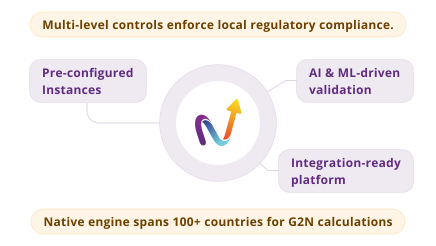
  • G2N Nova Global Payroll Engine: Mercans uses the advanced G2N Nova payroll system, providing gross-to-net payroll processing in over 100 countries. Available as a SaaS or service delivery platform, it integrates seamlessly with major Human Capital Management (HCM) systems.

Conclusion

To sum up, Mercans’ Employer of Record (EOR) services in Slovakia provide a streamlined, reliable, and fully compliant solution for managing your workforce. We take the complexities of local labor laws and regulations off your hands, allowing you to focus on business growth. From payroll processing to employee recruitment and global mobility, Mercans offers a comprehensive approach that adapts to your specific needs, whether you’re expanding, hiring talent, or converting contractors. By partnering with Mercans, you gain access to expert local knowledge and a seamless employment experience, ensuring that your operations in Slovakia run smoothly and compliantly every step of the way.

This document was prepared for informational purposes only. As local laws & regulations keeps on changing. Please consult your tax & legal advisors as well.
Contact Sales
Let's get this conversation started. Tell us a bit about your requirement, and we'll get in touch a soon as we can.

    FAQs

    What is an Employer of Record (EOR) in Slovakia?

    An Employer of Record in Slovakia is a service provider that legally hires employees on behalf of a foreign company. The EOR manages employment contracts, payroll, taxes, benefits, and ensures compliance with Slovak labor laws, allowing businesses to hire locally without establishing a Slovak entity.

    How can foreign companies hire employees in Slovakia without establishing a local entity?

    Foreign companies can engage an EOR, which serves as the legal employer while the client company oversees daily operations. This enables companies to operate in Slovakia without forming a branch or subsidiary.

    What compliance, payroll, and HR services does an EOR in Slovakia manage?

    An EOR in Slovakia handles employment contracts, payroll processing, tax withholdings, social security contributions, mandatory benefits, and government filings. They can also assist with work permits and visas for international employees.

    What are the benefits of using EOR services in Slovakia?

    Using an EOR simplifies market entry, ensures compliance with local labor regulations, reduces administrative burden, mitigates legal risks, and accelerates hiring.

    How much does it cost to hire employees through an EOR in Slovakia?

    Costs generally range from $500 to $2,000 per employee per month depending on the services included. It is recommended to consult the EOR provider for exact pricing.

    Is an EOR the best solution for expanding a business into Slovakia?

    An EOR is an effective solution for companies expanding into Slovakia without establishing a local entity. It allows businesses to focus on core operations while the EOR manages employment, payroll, and compliance responsibilities.

    Ready to hire in Slovakia?

    No local entity needed. Our experts handle payroll, compliance, and onboarding.

    Talk to an expert
    Proven expertise in global payroll.