Employer of Record

Employer of Record (EOR) Philippines

Hire compliantly, pay accurately, expand confidently.

Global Payroll Team
Written by Global Payroll Team
Last updated April 24, 2026
Expert Reviewed

An Employer of Record (EOR) is a legal entity that takes on the responsibilities of being the official employer for workers in the Philippines. This service, often referred to as a Global Professional Employer Organization (Global PEO), ensures compliance with Philippine labor laws while managing key employment functions. These include payroll processing, tax filings, government-mandated benefits, and creating employment contracts.

For businesses expanding to the Philippines, the EOR handles:
  • Ensuring full compliance with Philippine labor laws and regulations.
  • Managing local payroll and ensuring timely salary distribution.
  • Filing employment-related taxes and submitting required documentation.
  • Providing employees with payslips and accurate records.

With our Global PEO services, your business can operate in the Philippines without the need to establish a local entity. Our Employer of Record (EOR) solution ensures legal compliance, protects your intellectual property (IP), and streamlines workforce management. We facilitate work visas, global mobility, and support the development of a diverse and efficient workforce. Partner with Mercans to simplify your expansion into the Philippines and provide a seamless, compliant employment experience for your team.

Things you need to know before hiring in Philippines

Employment Contracts in Philippines

In the Philippines, employment contracts play a crucial role in establishing the terms and conditions of the relationship between employers and employees. These agreements not only ensure compliance with local labor laws but also provide clarity and transparency regarding each party’s responsibilities. For businesses operating in the country, understanding the various types of employment contracts is essential for creating fair and legally compliant arrangements.

Types of Employment Agreements:

  • Fixed-Term Employment Agreement: A fixed-term contract is designed for a specific duration, with an explicitly stated end date. This type of agreement is typically used for temporary roles, project-based work, or seasonal employment needs, subject to Philippine legal standards on fixed-term hiring.
  • Indefinite Employment Agreement: The most common type of employment contract in the Philippines, an indefinite agreement does not have a set end date. It remains active until the employee or employer decides to terminate the relationship in accordance with law, making it ideal for regular, full-time positions.
  • Part-Time Employment Agreement: This agreement outlines reduced working hours compared to a full-time schedule. Part-time employees are compensated according to the agreed pay arrangement and may still be entitled to mandatory labor standards depending on the nature of employment and applicable law.
  • Freelance or Consulting Agreement: Designed for independent contractors or freelancers, this type of contract specifies the scope of work, payment terms, and conditions for short-term or one-off projects. It emphasizes the contractor’s independent status and limited affiliation with the company.

Working Hours

Under Philippine labor laws, employees are generally required to work no more than eight (8) hours per day, excluding a one (1) hour meal break. However, there is no legal restriction against working fewer than eight hours if agreed upon by both the employer and the employee.

13th Month Salary

In the Philippines, the 13th-month pay is a government-mandated benefit aimed at supporting employees financially, particularly during the holiday season. It is calculated as one-twelfth (1/12) of the total basic salary an employee has earned over the calendar year.

How to Calculate 13th-Month Pay

The computation process is straightforward:
13th-Month Pay = Total Annual Basic Salary ÷ 12

Components Included in the Calculation

The calculation of the 13th-month pay is based on the “basic salary,” which refers to specific earnings tied directly to the employee’s services. Here’s what is generally included:

  • Basic Salary: The fixed amount paid to an employee for work performed. It excludes other forms of compensation, such as bonuses, overtime, or other discretionary payments, unless these are explicitly integrated into the basic pay.
  • Cost-of-Living Allowance (COLA): COLA is included in the computation only when it forms part of the employee’s basic pay structure as per agreements or policies.
  • Other Salary-Integrated Benefits: Certain benefits, such as allowances, may be included if company policies, collective bargaining agreements, or longstanding practices consider them part of the basic salary. These must be consistent and regularly provided to be factored into the computation.

Termination, Notice Period and Severance Pay

In the Philippines, terminating an employment contract involves a structured process with distinct legal requirements, depending on the circumstances surrounding the termination. These circumstances are generally categorized into three main types: dismissal by the employer for just causes, termination due to authorized causes, and voluntary resignation by the employee. Understanding these different scenarios and their legal implications is crucial for both employers and employees to ensure a fair and lawful process.

Dismissal by the Employer for Authorized Causes

Authorized causes for dismissal occur due to external factors, often unrelated to the employee’s actions. These include business-related reasons such as the introduction of labor-saving technologies, redundancy where positions are no longer required, retrenchment to prevent losses, closure or cessation of business, or disease under the Labor Code. In such cases, the termination is not a result of the employee’s misconduct, but rather operational or health-related needs of the employer.

Dismissal by the Employer for Just Causes

In the Philippines, employers have the legal right to terminate employees based on certain justifiable reasons. Just causes for dismissal include serious misconduct, fraud, immoral behavior, and physical assault. Other grounds for termination may include repeated violations of company policies, willful disobedience to lawful orders, or a breach of trust. Additionally, theft, dishonesty, substance abuse in the workplace, and committing crimes against the employer or their family are considered valid reasons for termination. Such actions directly breach the expected standards of conduct and ethical behavior in the workplace.

Procedures for Termination in the Philippines

The termination procedures in the Philippines differ based on whether the dismissal is due to just causes or authorized causes, and both employers and employees must adhere to the legal process. For just-cause dismissals, the employer must establish a legitimate reason, gather supporting evidence, and observe due process, including written notices and an opportunity for the employee to explain. In the case of authorized-cause dismissals, the employer must identify the grounds for termination, provide written notice to the employee at least 30 days in advance, and submit a copy to the Department of Labor and Employment (DOLE). Employees terminated for authorized causes are entitled to separation pay in accordance with the Labor Code.

Severance Pay

Severance pay, more commonly referred to as separation pay in the Philippines, is compensation provided to employees who are terminated due to authorized causes such as redundancy, retrenchment, installation of labor-saving devices, disease, or business closure in cases where the law requires payment. The amount of separation pay depends on the employee’s length of service and the reason for the termination.

Reason for termination Severance pay calculation
Installation of labor-saving devices At least 1 month pay or 1 month pay for every year of service, whichever is higher
Redundancy At least 1 month pay or 1 month pay for every year of service, whichever is higher
Retrenchment to prevent losses At least 1 month pay or 1/2 month pay for every year of service, whichever is higher
Closure or cessation of business not due to serious business losses At least 1 month pay or 1/2 month pay for every year of service, whichever is higher
Closure or cessation due to serious business losses or financial reverses No statutory separation pay
Disease / illness At least 1 month pay or 1/2 month pay for every year of service, whichever is higher

Who Is Not Entitled to Severance Pay?

Employees who voluntarily resign are generally not eligible for severance pay. However, exceptions may exist if separation pay is stipulated in the employment contract, collective bargaining agreement, or company policy.

Notice Period

In the Philippines, both employers and employees are required to follow specific notice period protocols when ending an employment contract.

  • Employer Notice Period: If an employer intends to terminate an employee due to authorized causes such as redundancy or business closure, they must provide the employee with a written notice at least 30 days before the intended termination date. This notice must outline the reason for termination, and a copy should be sent to the Department of Labor and Employment (DOLE) office.
  • Employee Notice Period: If an employee chooses to resign without just cause, they must give their employer at least 30 days’ notice in writing. This allows the employer to manage the transition and avoid work disruption. If the employee fails to provide the required notice, they may be held responsible for damages incurred by the employer due to the sudden departure.

However, if an employee resigns with just cause, they are not obligated to provide advance notice.

Employees vs Independent Contractors Compliance

In the Philippines, the legal and regulatory requirements for hiring independent contractors and employees differ significantly. Understanding these differences is crucial for businesses to ensure compliance with the law. Independent contractors are typically engaged for specific tasks or projects, with flexibility and less oversight from the hiring company. They are responsible for their own taxes, tools, and equipment, and are free to work with other clients. On the other hand, employees are considered members of an organization and enjoy various statutory benefits, including social security, health insurance, and paid leaves. Employers must comply with labor laws, such as minimum wage regulations, and ensure the provision of a safe working environment. Below is a comparison table highlighting the key distinctions between independent contractors and employees in the Philippines.

Aspect Independent Contractors Employees
Employment Agreement Usually engaged under a service / independent contractor agreement Employed under an employment agreement or employment arrangement
Business Registration May need BIR registration and, if operating a business, may also register with DTI or SEC as applicable No separate business registration as a business operator
Tax Responsibility Generally responsible for their own taxes; payers may still be required to withhold on professional or service payments Employer withholds compensation tax through payroll
Social Security Contributions Not “not applicable” — self-employed or individually paying contractors may still register and contribute in their own capacity Employer must register covered employees and remit required employer/employee contributions
Control Over Work More freedom over the means and methods of doing the work Employer generally controls the work schedule, methods, and supervision
Provision of Tools / Equipment Usually provides own tools and equipment, unless the contract says otherwise Employer usually provides work tools/equipment needed for the job
Non-Exclusivity May work for multiple clients unless contractually restricted May work exclusively or mainly for one employer, depending on the arrangement
Labor Laws Compliance Generally not covered as employees by the Labor Code’s employee benefits/protections, though OSH and other laws may still apply in context Covered by applicable labor standards such as minimum wage, hours, leave, and other protections
Termination Governed mainly by the service contract and civil law Termination must comply with labor law and due process requirements
Benefits No statutory employee benefits as such; any benefits depend on the contract Eligible employees may receive statutory benefits such as 13th month pay, service incentive leave, maternity/paternity-related benefits, and other mandatory benefits
Reclassification Risk High if the arrangement shows control, integration, and economic dependence similar to employment Lower if the worker is genuinely hired and treated as an employee

Understanding these distinctions helps employers navigate their legal obligations and classify their workers correctly, ensuring smooth operations and compliance with Philippine labor laws.

Social Security in Philippines

The Social Security System (SSS) provides crucial financial support in times of need, from sickness to retirement. Under the current schedule effective January 2025, understanding the updated contribution rates, how to calculate your share, and when to pay is essential for both employees and employers.

SSS Contribution Rate

The current SSS contribution rate is 15% of an employee’s monthly salary credit, split between the employer and employee:

  • Employer’s share: 10.0%
  • Employee’s share: 5.0%

This rate applies to the Monthly Salary Credit schedule currently in force, with the salary credit range updated effective January 2025.

How to Calculate SSS Contributions

  • Employees: Contributions are based on salary credit, with the employer deducting and remitting both shares according to the current SSS contribution table.
  • Self-employed/Voluntary Members: Contributions are based on the applicable contribution schedule and declared income, subject to current SSS rules.
  • Non-working Spouses: Contributions follow the applicable SSS rules for non-working spouses and are based on the covered spouse’s status and contribution framework.

When to Pay SSS Contributions

  • Employees: Payments are made by the employer on behalf of the employee according to the SSS remittance schedule.
  • Self-employed/Voluntary Members: Contributions are due according to the current SSS payment schedule for the applicable membership class.
  • Household Employers & OFWs: Payments follow the applicable remittance schedule under current SSS rules.

Paying on time ensures you avoid penalties and maintain access to SSS benefits. Keep track of your deadlines to stay compliant throughout the year.

Payroll in Philippines

Minimum Wage Adjustments

Minimum wage in the Philippines remains region-specific and is set by the Regional Tripartite Wages and Productivity Boards. As of the current official wage order matrix, the National Capital Region (NCR) daily minimum wage ranges from ₱658 to ₱695 depending on the sector or establishment classification. Other regions have their own current wage orders and rates.

Payroll Cycle Regulations

The payroll cycle in the Philippines refers to the regular period at which employees are paid. The Labor Code requires that wages be paid at least twice a month, at intervals not exceeding sixteen (16) days. The standard payroll cycle for many companies follows a semi-monthly schedule, often with paydays on the 15th and the last day of each month.

Overtime Compensation

Employees working overtime in the Philippines are generally entitled to at least 125% of their regular hourly rate for overtime work on ordinary working days. Different premium rules apply for rest days, special days, and regular holidays, and overtime on those days is computed using the applicable premium base under labor regulations.

Mercans’ Payroll Capabilities

  • Payroll Cycle Management in the Philippines: Mercans offers a seamless payroll cycle management solution that ensures timely and accurate payments to your employees and contractors in the local currency. With our services, your payroll process becomes efficient and fully localized, making it a stress-free experience for businesses in the Philippines.
  • Payroll Setup, Processing, and Administration: Mercans provides complete payroll services, from careful setup to precise processing and smooth administration. Our expert team handles every detail with a focus on accuracy and compliance, allowing you to focus on what matters most, your business operations, while we manage your payroll efficiently.
  • Statutory Filings and Payments: Stay compliant with all Philippine regulations with Mercans’ help. We take on the responsibility of managing your statutory filings and payments, ensuring that your business adheres to legal requirements. Our team ensures timely and accurate submissions, so you can have peace of mind knowing your compliance obligations are in capable hands.

Personal Income Tax in Philippines

Personal income tax in the Philippines is a progressive tax system that applies to individuals based on their income level and residency status. Resident citizens are taxed on their worldwide income, while non-residents are taxed only on income sourced within the country. The tax structure varies depending on whether the income is from compensation, business, or passive sources.

Tax Rates for Compensation Income

Taxable income (PHP) Tax on column 1 (PHP) Tax on excess (%)
0 – 250,000 0.00 0%
250,001 – 400,000 0 15%
400,001 – 800,000 22,500 20%
800,001 – 2,000,000 102,500 25%
2,000,001 – 8,000,000 402,500 30%
Over 8,000,000 2,202,500.00 35%

Philippines Employee Hiring Cost

When hiring in the Philippines, it’s important to consider not just the gross salary, but also additional costs that an employer must cover. These include mandatory benefits and contributions to social security, health insurance, housing savings, and other statutory benefits. For example, the employer cost for an employee earning PHP 100,000 annually should be recalculated using the current SSS, PhilHealth, Pag-IBIG, and Employees’ Compensation contribution schedules rather than older 2024 figures.

Description Amount (PHP)
Gross Annual Salary 100,000.00
Social Security System (SSS) – employer share 10,200
PhilHealth – employer share 3,000
Pag-IBIG Fund – employer share 2,000
EC (Employees’ Compensation) – employer share 120
Total Employer Cost 115,320.00

This table should reflect the gross salary and the additional costs for mandatory contributions that employers are required to pay in the Philippines, using the current contribution schedules.

Employee Benefits in Philippines

Employers in the Philippines provide various benefits designed to enhance the well-being, financial stability, and growth of their employees. These benefits support work-life balance and contribute to professional development. While benefits packages may differ based on the company or industry, there are several standard offerings that employers must provide.

Mandatory Employee Benefits

In the Philippines, certain employee benefits are mandated by law. These include:

  • Social Security System (SSS): This program provides protection for workers through benefits such as retirement, disability, sickness, maternity, unemployment, and death benefits. Contributions are shared by both employees and employers under the current SSS schedule.
  • PhilHealth: A government-run health insurance program that offers medical coverage. Under the current published premium advisory, the premium rate remains 5.0% of monthly basic salary, subject to the applicable salary floor and ceiling, and is generally shared equally by employer and employee.
  • Pag-IBIG Fund: A mandatory savings scheme that supports workers in securing housing and provides short-term loans. Both parties contribute to this fund in accordance with current HDMF rules.
  • Employees’ Compensation Program (ECP): This program covers employees who suffer work-related injuries or illnesses, offering compensation for medical expenses and lost wages. The contribution is employer-paid.
  • 13th Month Pay: Employees receive an additional salary, equivalent to one-twelfth of their basic annual salary, typically paid out not later than 24 December.
  • Service Incentive Leave: Employees with one year of service are entitled to five days of paid leave each year, subject to legal coverage rules and exemptions.
  • Holiday Pay: Employees who work on official holidays are entitled to additional pay as per the law.
  • Maternity Leave: Female employees are granted 105 days of paid maternity leave, with an option for an additional 30 days of unpaid leave, subject to the governing maternity law.
  • Paternity Leave: Male employees are entitled to seven days of paid leave following the birth of their child, subject to the legal conditions.
  • Retirement Pay: Employees who reach the optional or compulsory retirement age under the law and meet the service requirement are entitled to retirement pay based on the legal formula, unless a superior retirement plan applies.

Additional Employee Benefits

In addition to the mandatory benefits, many employers offer supplementary benefits that further support employee well-being:

  • Group Life and Accident Insurance: Many employers provide life and accident insurance for employees, often in amounts based on salary multiples or fixed sums.
  • Disability Benefits: Employees who suffer total and permanent disabilities may receive a lump-sum payment under employer-sponsored plans.
  • Critical Illness Coverage: Some companies offer insurance that covers a range of critical illnesses, either as a rider on a life insurance policy or as a standalone benefit.
  • Medical Coverage: A large number of companies offer full or partial HMO coverage for medical expenses.
  • Dental and Optical Benefits: While not as common as medical coverage, some companies include dental and optical benefits as part of their health insurance packages.
  • Business Travel Insurance: Employers often purchase group travel insurance to cover employees traveling for business.

Work Permit in Philippines

To obtain work authorization in the Philippines, foreign nationals generally need to first secure an Alien Employment Permit (AEP) from the Department of Labor and Employment (DOLE), unless exempt or excluded under the applicable rules. The AEP is commonly a prerequisite to the 9(g) Pre-arranged Employment Visa for foreign nationals who will work for a Philippine entity.

Once the AEP is approved, foreign workers can proceed with the 9(g) work visa process before the Bureau of Immigration. The process generally includes a Bureau of Immigration application, hearing, visa implementation, and ACR I-Card processing.

The work permit process in the Philippines ensures that foreign workers are employed within legal boundaries and that companies hiring non-nationals follow proper regulations. While there are other visa options for specific purposes, the 9(g) Work Visa remains the most common choice for expatriates seeking long-term employment in the country.

EOR Solutions in Philippines

  • EOR for Prospective Employees in the Philippines: Mercans provides tailored Employer of Record (EOR) solutions to businesses aiming to hire top talent in the Philippines. We handle every aspect of the employee lifecycle while ensuring full compliance with local labor laws, offering peace of mind and efficiency for your operations.
  • EOR and Recruitment Solutions: For organizations seeking to streamline talent acquisition, we combine EOR and recruitment services into one seamless offering. By leveraging our extensive network and deep industry knowledge, we assist in attracting, hiring, and retaining the best candidates, simplifying your entry into the Philippine market.
  • Visa Sponsorship and Global Mobility: Our visa sponsorship and global mobility services simplify the relocation process for international employees. We ensure your workforce remains compliant with the Philippines’ immigration and employment regulations, making cross-border employment smoother and more efficient.
  • AOR for Contractor Payments: Navigating contractor payments can be complex. Our Assistance on Record (AOR) service manages all aspects of contractor payments, ensuring they are accurate and fully compliant with Philippine law, reducing administrative burdens for your business.
  • Transitioning Freelancers to Full-time Employees: Mercans supports businesses in converting freelancers into permanent employees in the Philippines. With our expertise, we manage the legal and operational aspects of this transition, ensuring a smooth and compliant process.
  • HCM System Integration: Streamline your workforce management by integrating Mercans’ EOR services with your existing Human Capital Management (HCM) system in the Philippines. This integration ensures real-time data flow, improved compliance, and optimized payroll operations for greater efficiency and cost-effectiveness.

Best Employer of Record Philippines

Mercans stands out as a leading Employer of Record (EOR) in the Philippines for several important reasons:

  • Full Compliance with Local Laws: Mercans ensures full adherence to Philippine labor laws and regulations, including those set by the Department of Labor and Employment (DOLE) and other relevant government bodies. This ensures that your business operates smoothly without worrying about legal compliance.
  • Independent and Tailored Services: As a standalone entity, Mercans offers custom-designed employment services that cater specifically to the needs of businesses in the Philippines, providing flexibility and dependability.
  • Wide-Ranging Employment Solutions: Mercans supports various employment types, including full-time employees, freelancers, contractors, and expatriates, offering flexible solutions to meet diverse workforce needs.
  • Enterprise-Grade Solutions: Mercans offers scalable, sophisticated solutions ideal for large enterprises, accommodating complex business structures and ensuring seamless operations in the Philippines.
  • Multi-Currency Payroll Services: Mercans manages payroll in various currencies, helping multinational companies streamline their financial processes in the Philippines.
  • Global Reach with Multi-Country Payroll Expertise: With its extensive global network, Mercans excels in managing multi-country payroll, facilitating smooth operations for businesses expanding into the Philippines.
  • Commitment to Data Protection: Mercans complies with the Philippine Data Privacy Act of 2012, ensuring that employee data is handled with the highest standards of security and privacy.
  • ISO Certifications: Mercans holds ISO 20000 and ISO 27001 certifications, demonstrating its commitment to superior IT service management and robust information security practices.
  • Strict Security Compliance: Mercans adheres to the highest security standards in application development and management, ensuring your business data is secure.
  • HRBlizz Platform: Mercans’ proprietary HRBlizz platform streamlines payroll and talent management, with expert knowledge of Philippine labor laws and business protocols, helping businesses manage their workforce efficiently while staying compliant.
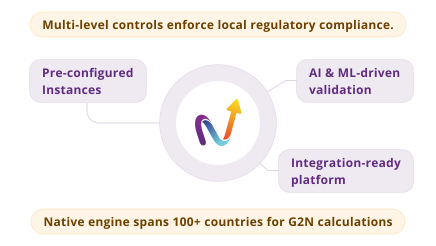
  • G2N Nova: The G2N Nova platform supports gross-to-net payroll processing across 100+ countries, providing an advanced payroll engine that integrates seamlessly with your existing Human Capital Management (HCM) systems, ensuring smooth payroll operations for businesses in the Philippines.

Conclusion

In summary, Mercans delivers top-tier Employer of Record (EOR) services in the Philippines, providing unmatched accuracy, compliance, and efficiency in payroll handling. Our broad range of solutions simplifies your operational workflows, positioning us as a reliable partner for businesses tackling the challenges of the Philippine labor market. With Mercans, you can confidently manage your global workforce, ensuring a smooth and prosperous expansion into the Philippines.

This document was prepared for informational purposes only. As local laws & regulations keeps on changing. Please consult your tax & legal advisors as well.
Contact Sales
Let's get this conversation started. Tell us a bit about your requirement, and we'll get in touch a soon as we can.

    Sample message

    1. We want to expand in $country

    2. We want you to employ 'X' number of employees on our behalf

    3. Contract duration – 3/6/9/12/18/24 months

    4. Number of legal entities (if any exist today)

    5. Employment type: EOR employee or contractor?

    6. Any benefits requirement or “standard statutory only”?

    FAQs

    What is an Employer of Record (EOR) in the Philippines?

    An Employer of Record in the Philippines is a service provider that legally employs staff on behalf of a foreign company. The EOR handles employment contracts, payroll, taxes, benefits, and ensures compliance with Philippine labor laws, allowing businesses to hire locally without establishing a Philippine entity.

    How can foreign companies hire employees in the Philippines without establishing a local entity?

    Foreign companies can partner with an EOR, which acts as the legal employer while the client company supervises daily operations. This approach enables companies to hire in the Philippines without creating a branch or subsidiary.

    What compliance, payroll, and HR services does an EOR in the Philippines manage?

    An EOR in the Philippines manages employment contracts, payroll processing, tax withholdings, social security contributions, mandatory benefits, and government filings. They can also assist with work permits and visas for international employees.

    What are the benefits of using EOR services in the Philippines?

    Using an EOR simplifies entry into the Philippine market, ensures adherence to labor laws, reduces administrative workload, mitigates legal risks, and accelerates hiring.

    How much does it cost to hire employees through an EOR in the Philippines?

    Fees typically range from $500 to $2,000 per employee per month, depending on the services offered. Companies should consult the EOR provider for accurate pricing.

    Is an EOR the best solution for expanding a business into the Philippines?

    An EOR is an effective solution for companies expanding into the Philippines without establishing a local entity. It allows businesses to focus on core operations while the EOR manages all employment-related responsibilities.

    Ready to hire in Philippines?

    No local entity needed. Our experts handle payroll, compliance, and onboarding.

    Talk to an expert
    Proven expertise in global payroll.