Employer of Record

Employer of Record (EOR) in France

Hire compliantly, pay accurately, expand confidently.

Global Payroll Team
Written by Global Payroll Team
Last updated April 22, 2026
Expert Reviewed
An Employer of Record (EOR) is the legal employer of a worker in France, often referred to as a Global Professional Employer Organization (Global PEO). Mercans’ role as an EOR encompasses comprehensive management of employment matters, ensuring full compliance with French labor laws and regulations. We handle key responsibilities, including payroll, taxes, statutory benefits, and employment contract creation.

As an Employer of Record in France, Mercans manages the following:
  • Ensuring compliance with French labor laws throughout the employment lifecycle.
  • Overseeing local payroll processes.
  • Filing employment-related taxes and required documentation.
  • Providing workers with detailed payslips.
  • Ensuring timely salary payments.

Simplify your global expansion with Mercans’ Global PEO services, offering a seamless solution without the need to establish a local entity. Choose Mercans as your trusted Employer of Record in France, ensuring legal compliance, protection of intellectual property, and a smooth global mobility experience. We manage work visas and support the creation of a diverse, effective global workforce, allowing your business to focus on its core objectives. Partner with Mercans for a compliant, efficient employment solution for your international workforce.

Things you need to know before hiring in France

Employment Contracts in France

In France, employment contracts govern the relationship between employer and employee, regardless of the type or duration of the contract. While permanent contracts (“Contrat à Durée Indéterminée” or CDI) are not always required to be in writing, the employer must still provide the employee with the essential information on the employment relationship, and the contract must comply with the applicable collective agreement of the company.

However, for fixed-term contracts (“Contrat à Durée Déterminée” or CDD), written documentation is mandatory, and certain information must be clearly outlined.

When a permanent contract is in written form, it typically includes the following key details:

  • The identity and address of both parties.
  • The employee’s job title and professional qualifications.
  • The place of work.
  • Working hours and conditions.
  • Salary details, including bonuses.
  • Paid leave entitlements.
  • Notice periods for contract termination.

Additionally, the contract may include various clauses to address specific aspects of the employment relationship, such as:

  • Probationary period.
  • Terms for contract fulfillment.
  • Remuneration structure.
  • Conditions for contract termination.

Employers must also take into account the collective agreement applicable to their sector or company. These agreements can introduce additional terms, obligations, or restrictions, such as requirements for permanent contracts to be in writing, the length of the probationary period, rules for a non-competition clause, and the structure of a mobility clause.

What is a Collective Agreement?

A collective agreement is a legally binding agreement between employer organizations and employee representatives within a specific sector. It governs essential employment conditions, including the specifics of contract clauses, health and safety standards, leave entitlements, remuneration, and rules for dismissal. Employers are required to adhere to the terms of the collective agreement applicable to their sector.

Working Hours in France

The legal working time in France remains 35 hours per week for full-time employees. In practice, many employees work more than 35 hours, with overtime, RTT arrangements, annualized hours, or fixed working day arrangements applying where legally permitted and contractually or collectively agreed.

Probationary Period

The length of the probationary period in France varies depending on the employee’s role and level within the company. According to the French Labor Code, the maximum initial probationary periods for a CDI are generally as follows:

  • Two months for blue-collar and office workers who work under direct supervision.
  • Three months for supervisors and technicians who possess specialized skills and operate with a level of autonomy.
  • Four months for executives who have full managerial responsibility and perform their duties independently.

These periods may be renewed only if an extended branch agreement allows renewal and the contract or offer letter expressly provides for it.

13th Month Salary

In France, there is no general statutory requirement to pay a “13th-month” salary. However, many employers grant it under a collective bargaining agreement, company practice, unilateral undertaking, or the employment contract.

Termination, Severance Pay, and Notice Periods

Notice Periods

The notice period for employment termination in France depends on the basis for termination, the employee’s status, length of service, and the applicable collective bargaining agreement:

  • Employees with 6 months to less than 2 years of service: at least one month’s notice in the case of dismissal, unless a more favorable rule applies.
  • Employees with 2 years or more of service: at least two months’ notice in the case of dismissal, unless a more favorable rule applies.
  • Executive-level employees: notice periods are often determined by the applicable collective agreement and are commonly three months.

Severance Pay

Statutory severance pay is based on the employee’s length of service and reference salary. The legal calculation is generally as follows:

  • For the first 10 years of service: one-quarter of a month’s salary for each year.
  • After 10 years of service: one-third of a month’s salary for each additional year.

The reference salary used for calculating severance pay is based on the employee’s gross earnings over the previous 3 or 12 months, whichever results in the more favorable figure.

Overtime Pay in France

In France, any hours worked beyond the 35-hour workweek are classified as overtime, subject to specific working-time arrangements. According to the standard legal framework, overtime is compensated with an additional surcharge:

  • 25% for the first 8 hours of overtime per week.
  • 50% for any further hours beyond that.

Certain collective bargaining agreements may specify different overtime pay rates, provided the minimum legal framework is respected.

It is common for employment contracts to specify a workweek exceeding 35 hours. In such cases, the additional hours must be clearly stated in both the employment contract and reflected on the employee’s payslip.

Furthermore, there is an annual overtime quota, commonly 220 hours per year in the absence of a collective agreement setting another figure. Once this limit is reached, employees may become entitled to additional compensatory rest in accordance with the applicable rules.

Employees vs Independent Contractors

In France, the distinction between employees and independent contractors is crucial for both legal compliance and tax purposes. French labor law provides protections and benefits for employees that do not apply to independent contractors. However, determining the status of a worker can sometimes be complex. The primary differentiating factor is the relationship of subordination. Employees perform their duties under the authority and control of an employer, while independent contractors operate autonomously, setting their own working conditions. This framework defines various legal, tax, and social distinctions between the two categories.

Below is a detailed comparison between employees and independent contractors:

AspectEmployeeIndependent Contractor
Legal DefinitionAn employee is not defined by a single standalone article, but by the existence of an employment contract and, above all, a relationship of legal subordination with the employer.A contractor is generally presumed to be non-salaried when properly registered for an independent activity. That presumption can be overturned if the actual relationship is one of employment.
SubordinationWorks under the employer’s authority: the employer can give instructions, supervise performance, and sanction misconduct.Works without a legal relationship of subordination. The client can define the expected result, but should not manage the person like an employee.
Working HoursUsually subject to company working-time rules and labor-law protections on working time, rest, and overtime.Normally organizes their own schedule. If the client imposes hours, place, and detailed control like for staff, there is misclassification risk.
Duties and RemunerationPerforms work in return for salary/wages, usually paid regularly through payroll.Usually paid fees under a commercial or civil contract, often per project, assignment, deliverable, or invoice.
Place of Work & EquipmentMay work on company premises or remotely, but the employer often determines the work organization and may provide tools/equipment.Typically uses their own organization, methods, and often their own tools, even if the contract may require coordination with the client.
Exclusivity & ClientsOften works mainly for one employer, subject to the employment contract.Can generally work for multiple clients, unless a lawful contractual restriction applies.
Social Security & Tax RegistrationEmployer registers the employee, pays employer social contributions, withholds employee payroll amounts, and handles payroll declarations.Must register their activity and handle their own social contributions and tax obligations under the applicable self-employed regime.
Income TaxSalary is taxed as employment income, with withholding handled through payroll.Taxed under the relevant business/professional tax regime; social contributions depend on the status and regime chosen.
Benefit EntitlementsProtected by labor law and social protection rules, including paid leave, sick leave rights, maternity/paternity-related rights, unemployment insurance coverage, and retirement contributions through the employee system.Does not receive employee benefits from the client as such. Social coverage exists through the self-employed system, but it is not the same as employee status.
Protection from TerminationTermination is regulated by labor law and usually requires a lawful process; employees may have rights to notice, documents, challenge before the labor court, and in some cases severance.Relationship ends under the service contract and general commercial/civil rules, not employee dismissal law, unless the arrangement is reclassified as employment.

Social Security in France

The French social security system offers comprehensive coverage through various schemes, providing benefits such as healthcare, maternity, disability, work-related accident compensation, unemployment benefits, and pensions. The system also includes mandatory complementary retirement and mandatory employer-sponsored supplementary health coverage for employees.

Social security contributions in France are shared between the employer and employee, but the effective rates vary significantly depending on salary level, employee status, location, reduced contribution schemes, and the applicable ceilings. For this reason, using fixed headline percentages can be misleading, and employer costs should be calculated case by case through current payroll rules.

Employers are also responsible for contributions to mandatory collective supplementary medical coverage schemes. In principle, the employer must finance at least 50% of the cost of the mandatory collective health plan.

For employees working in France, the employer is generally responsible for withholding and paying the employee and employer social security contributions through the DSN process. Under EU coordination rules and bilateral social security agreements, some posted workers may remain covered by their home social security scheme if the required certificate of coverage is obtained.

Payroll in France

This registration is linked to the employer’s French activity and payroll obligations. Employers must complete the necessary registrations and declarations before hiring their first employee, including the pre-hire declaration process.

Minimum Wages

Starting January 1, 2026, the minimum wage in France is set at €12.02 per hour, equating to €1,823.03 per month for a full-time employee working 35 hours a week. This figure represents the gross wage before deductions.

Payroll Cycle

In France, the payroll process generally operates on a monthly basis, with employees receiving their salaries monthly. In practice, employers often pay on the last working day of the month or on a fixed monthly payday.

Personal Income Tax in France

In France, personal income tax is calculated using a progressive tax scale, which consists of several brackets, each assigned a different tax rate. This structure ensures that individuals are taxed based on their ability to pay.

How to Calculate Your Income Tax

To determine your income tax liability, follow these steps:

  • Determine Your Family Quotient: Divide your net taxable income by the number of shares in your family quotient.
  • Apply the Progressive Tax Scale: Use the result from the first step to find the applicable tax bracket for your income.
  • Calculate Total Tax Due: Multiply the tax amount from the brackets by the number of shares in your family quotient to arrive at your total tax due.

2026 Tax Scale for 2025 Income

For income earned in 2025, which is declared in 2026, the tax scale is as follows:

  • Up to €11,600: 0%
  • From €11,601 to €29,579: 11%
  • From €29,580 to €84,577: 30%
  • From €84,578 to €181,917: 41%
  • Over €181,917: 45%

Example Calculations

Example 1: A Single Person Earning €35,555

For a single individual with a net taxable income of €32,000, the calculation would be:

  • Divide by 1 (one share): €32,000
  • Apply the tax brackets:
    • Income up to €11,600: 0% = €0
    • Income from €11,601 to €29,579: 11% = (€29,579 – €11,600) x 11% = €1,977.69
    • Income from €29,580 to €32,000: 30% = (€32,000 – €29,579) x 30% = €726.30

The total tax before multiplying by the family quotient is €0 + €1,977.69 + €726.30 = €2,703.99. Since the family quotient has only one share, the final tax remains €2,703.99.

Example 2: A Married Couple with Two Children Earning €55,950

This couple has three shares (two for the couple and one for the children). The calculation is as follows:

  • Divide the income by 3: €55,950 / 3 = €18,650
  • Apply the tax brackets:
    • Income up to €11,600: 0% = €0
    • Income from €11,601 to €18,650: 11% = (€18,650 – €11,600) x 11% = €775.50

The couple’s total tax before any discounts is €775.50 x 3 = €2,326.50. If the household qualifies for the low-income tax discount, the discount amount is determined under the current rules.

To assist with calculations, individuals can use the simulator available on the impots.gouv.fr website.

Adjustments to Net Tax Payable

The net tax payable can be adjusted based on various factors, including:

  • Capping of the Family Quotient: Limits the tax benefits from the family quotient for higher incomes.
  • Discount for Low Incomes: Reduces tax for households with modest incomes, with specific income thresholds established.
  • Tax Reductions and Credits: Deductions from gross tax, subject to the applicable caps.
  • Contribution on High Incomes: An additional contribution applies to high-income households, based on their reference tax income.

For the 2026 taxation of 2025 income, the discount formula uses a fixed amount of €897 for an individual assessment and €1,483 for a joint assessment, subject to the legal calculation rules.

France Employee Hiring Cost

When considering the cost of employing an individual in France, several factors contribute to the total expense beyond just the gross salary. Employer cost in France is heavily influenced by salary level, contribution ceilings, reduced-rate mechanisms, the employee’s status, supplementary benefits, transport obligations, and collective agreement requirements. For this reason, the total employer cost should be calculated case by case using current payroll rules rather than relying on a single flat percentage.

FranceAmount
Gross annual salaryEUR 105,000.00
Annual employer social contributionsVariable by profile and company settings
1) Health / maternity / invalidity / deathVariable
2) Work accidents / occupational illnesses (AT/MP)Variable
3) Old-age insurance – cappedVariable
4) Old-age insurance – uncappedEUR 2,215.50 (2.11% × 105,000)
5) Family benefitsVariable
6) Unemployment insuranceVariable
7) Supplementary retirement (Agirc-Arrco)Variable
8) FNAL housing contributionVariable
9) Solidarity-autonomy contribution / other statutory employer leviesVariable
10) Training / apprenticeship / dialogue social / related employer leviesVariable
11) Occupational health serviceVariable, not a standard national flat rate
12) Complementary health insurance (employer share)Variable, depends on policy
Internal admin costs (optional to include, not statutory payroll contributions)
13) Software / payroll platform costOptional
14) Electronic safe / document storage costOptional
Total annual employer costDo not fix as one amount without assumptions
Total annual costGross salary + actual employer costs

Employee Benefits in France

In France, employee benefits encompass both mandatory and supplementary offerings designed to support workers’ welfare throughout their careers and into retirement. Below is an overview of the key mandatory employee benefits.

Mandatory Employee Benefits

Old-Age Pension
France’s pension system includes a basic mandatory retirement pension and a mandatory complementary retirement pension. The minimum statutory retirement age is now gradually increasing to 64 depending on the worker’s year of birth, while the age for automatic entitlement to a full-rate pension remains 67. The qualifying period for a full pension varies based on date of birth.
Solidarity Allowance for the Elderly
Paid to eligible low-income pensioners who meet the applicable residence, age, and resource conditions.
Long-Term Disability Pension
Available to eligible individuals under retirement age who demonstrate a significant loss of earning capacity and meet the relevant insurance conditions.
Short-Term Disability Pension
Employees may qualify for daily sickness benefits under the statutory health insurance system if the contribution or activity conditions are satisfied. Collective agreements may provide for additional employer-funded salary maintenance.
Spouse’s Pension
Surviving spouses or ex-spouses may be eligible for survivor pension rights under the applicable basic and complementary pension rules, subject to legal conditions.
Death Grant
A death benefit may be payable to eligible beneficiaries if the deceased met the applicable insured status conditions at the time of death.
Worker’s Compensation
Covers occupational accidents and diseases, with benefits depending on the assessed incapacity and the relevant statutory framework.
Medical Insurance
Mandatory healthcare coverage is provided through France’s social security system, and employees are generally also covered by mandatory collective supplementary health insurance arranged by the employer.

Supplementary Employee Benefits

In addition to the mandatory benefits, French employees may also receive supplementary benefits:

  • Retirement and Death in Service Benefits: In addition to the basic pension, employees are covered by mandatory complementary pension arrangements. Additional death and disability coverage may also arise from collective agreements or employer-sponsored plans.
  • Short-Term and Long-Term Disability: Minimum statutory benefits may be supplemented by collective bargaining agreements or employer insurance arrangements.
  • Medical Insurance: Employees are generally covered by a compulsory collective health plan, with the employer usually financing at least 50% of the premium.
  • Worker’s Compensation: Occupational accident and occupational disease protection is part of the French social security system.
  • Retirement: The French retirement framework combines mandatory basic and complementary pension systems.
  • Career Termination Indemnities: Employees who satisfy the statutory eligibility conditions are entitled to termination indemnities, which may be increased by collective agreements.

Work Permit in France

Recruiting foreign employees in France involves navigating specific regulatory requirements, particularly regarding work authorization. Any foreign national who is not exempt and does not already hold a visa or residence permit authorizing work in France must obtain a work authorization. The employer is generally responsible for applying for this authorization before the employee starts work.

For workers living abroad, the employer must generally submit the work authorization request online before the employee enters France. If authorization is granted, the employee can then apply for the appropriate long-stay visa or residence permit process depending on the case.

Before submitting the application, employers may need to demonstrate compliance with the labor market test rules where they apply. In shortage occupations or exempt cases, labor market testing may not be required. The exact process depends on the worker’s nationality, current place of residence, job category, salary level, and the type of residence document sought.

If labor market conditions must be reviewed for the role, the employer may need to advertise the vacancy and show that no suitable candidate already authorized to work in France could be recruited before proceeding with the work authorization application.

EOR Solutions in France

Mercans stands out as a top Employer of Record in France for several compelling reasons:

  • Regulatory Compliance: Mercans strictly adheres to all regulatory standards set forth by the French Ministry of Labour. This ensures complete compliance with labor laws and social security requirements.
  • Independent Entity: Operating as a standalone organization, Mercans offers reliable and customized employment services tailored to meet specific client needs.
  • Versatile Employment Solutions: Mercans efficiently manages a range of employment types, including full-time employees, freelancers, contractors, and expatriates. This flexibility allows us to cater to diverse business requirements.
  • Enterprise-Ready Services: Designed with large enterprises in mind, Mercans provides scalable and sophisticated services that align with complex organizational structures, enabling seamless integration within existing systems.
  • Multi-Currency Payroll Management: Mercans facilitates payroll processing in multiple currencies, streamlining financial operations for global and multinational companies.
  • Global Network and Payroll Expertise: With an extensive international presence, Mercans excels in managing multi-country payroll, ensuring smooth and efficient operations across borders.
  • Data Protection and Compliance: Mercans is committed to upholding stringent data protection standards. We are GDPR certified and compliant with SOC 1 and SOC 2 regulations, ensuring the highest level of security for our clients’ data.
  • ISO Certifications: Our commitment to quality is demonstrated by our ISO 20000 and ISO 27001 certifications, showcasing excellence in IT service management and information security.
  • OWASP ASVS 3.0 Compliance: Mercans meets OWASP ASVS 3.0 standards, ensuring robust security practices in application development and management.
  • HRBlizz: Our proprietary HRBlizz platform is a global payroll and talent management SaaS solution designed to streamline payroll processes while ensuring compliance with local regulations. With a team of over 1,000 in-country specialists, we provide expert guidance on labor laws and business protocols.
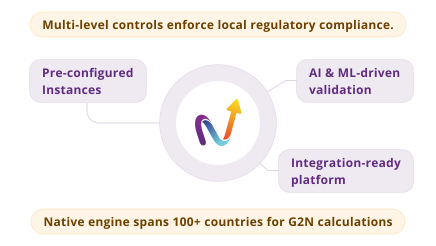
  • G2N Nova: G2N Nova is our advanced global gross-to-net payroll processing engine, operational in over 100 countries. Available as either a SaaS or service delivery platform, it can function independently or integrate seamlessly with major Human Capital Management (HCM) and Workforce Management systems.

Best Employer of Record France

Mercans stands out as a top Employer of Record in France for several compelling reasons:

  • Regulatory Compliance: Mercans strictly adheres to all regulatory standards set forth by the French Ministry of Labour and relevant French labor and social authorities. This ensures complete compliance with labor laws and social security requirements.
  • Independent Entity: Operating as a standalone organization, Mercans offers reliable and customized employment services tailored to meet specific client needs.
  • Versatile Employment Solutions: Mercans efficiently manages a range of employment types, including full-time employees, freelancers, contractors, and expatriates. This flexibility allows us to cater to diverse business requirements.
  • Enterprise-Ready Services: Designed with large enterprises in mind, Mercans provides scalable and sophisticated services that align with complex organizational structures, enabling seamless integration within existing systems.
  • Multi-Currency Payroll Management: Mercans facilitates payroll processing in multiple currencies, streamlining financial operations for global and multinational companies.
  • Global Network and Payroll Expertise: With an extensive international presence, Mercans excels in managing multi-country payroll, ensuring smooth and efficient operations across borders.
  • Data Protection and Compliance: Mercans is committed to upholding stringent data protection standards. We are GDPR certified and compliant with SOC 1 and SOC 2 regulations, ensuring the highest level of security for our clients’ data.
  • ISO Certifications: Our commitment to quality is demonstrated by our ISO 20000 and ISO 27001 certifications, showcasing excellence in IT service management and information security.
  • OWASP ASVS 3.0 Compliance: Mercans meets OWASP ASVS 3.0 standards, ensuring robust security practices in application development and management.
  • HRBlizz: Our proprietary HRBlizz platform is a global payroll and talent management SaaS solution designed to streamline payroll processes while ensuring compliance with local regulations. With a team of over 1,000 in-country specialists, we provide expert guidance on labor laws and business protocols.
  • G2N Nova: G2N Nova is our advanced global gross-to-net payroll processing engine, operational in over 100 countries. Available as either a SaaS or service delivery platform, it can function independently or integrate seamlessly with major Human Capital Management (HCM) and Workforce Management systems.

Conclusion

In conclusion, Mercans provides unparalleled Employer of Record (EOR) solutions in France, guaranteeing accuracy, compliance, and efficiency in payroll management. Our extensive services simplify operations, making us a trusted partner for businesses navigating the complexities of the French employment landscape. Rely on Mercans to streamline your global workforce management, ensuring that your expansion into France is a smooth and successful experience.

This document was prepared for informational purposes only. As local laws & regulations keeps on changing. Please consult your tax & legal advisors as well.
Contact Sales
Let's get this conversation started. Tell us a bit about your requirement, and we'll get in touch a soon as we can.

    FAQs

    What is an Employer of Record (EOR) in France?

    An Employer of Record (EOR) in France is a third-party provider that legally employs workers on behalf of another company. The EOR handles contracts, payroll, taxes, benefits, and compliance with French labor laws, allowing businesses to hire without a local entity.

    How can foreign companies hire employees in France without establishing a local entity?

    Foreign companies can hire through an EOR, which acts as the legal employer while the client company manages daily tasks. This avoids the need for a local branch or subsidiary.

    What compliance, payroll, and HR services does an EOR in France manage?

    An EOR manages employment contracts, payroll, tax withholding, statutory contributions, benefits, filings, and can assist with work permits and visas for expatriates.

    What are the benefits of using EOR services in France?

    Using an EOR simplifies market entry, ensures legal compliance, reduces administrative work, mitigates risks, and speeds up hiring.

    How much does it cost to hire employees through an EOR in France?

    Fees typically range from $500 to $2,000 per employee per month, depending on services. It’s best to consult the provider for details.

    Is an EOR the best solution for expanding a business into France?

    An EOR is ideal for businesses expanding into France without setting up a local entity, letting companies focus on core operations while the EOR handles employment tasks.

    Ready to hire in France?

    No local entity needed. Our experts handle payroll, compliance, and onboarding.

    Talk to an expert
    Proven expertise in global payroll.