Employer of Record

Employer of Record (EOR) India

Hire compliantly, pay accurately, expand confidently.

Global Payroll Team
Written by Global Payroll Team
Last updated April 24, 2026
Expert Reviewed

An Employer of Record (EOR) in India serves as the official employer for a worker. This entity manages crucial employment functions, ensuring adherence to local labor laws and regulations. Responsibilities include overseeing payroll, handling tax filings, providing legally mandated benefits, and drafting employment contracts.

The Employer of Record (EOR) is tasked with:
  • Ensuring compliance with Indian labor laws.
  • Managing the payroll system locally.
  • Filing employment-related taxes and handling necessary documentation.
  • Issuing payslips to employees.
  • Processing salary payments.

Enhance your global expansion with our Global PEO services, which offer a streamlined approach without the need for establishing a local entity. Our Employer of Record in India guarantees legal compliance and protects your intellectual property, allowing your business to concentrate on core activities. Facilitate smooth global mobility and work visas while building a diverse, efficient workforce.

Things you need to know before hiring in India

Employment Contracts in India

Employment contracts in India are essential legal documents that outline the terms and conditions governing the relationship between employers and employees. These contracts play a critical role in clarifying the rights, responsibilities, and expectations of both parties, providing a framework for a successful working relationship.

A well-drafted employment contract helps employees understand their roles and the company’s expectations, while also protecting the interests of the employer. Key elements typically covered include job responsibilities, salary, benefits, notice periods, and adherence to company policies. Given the diversity of employment situations, it’s crucial for individuals to review their contracts thoroughly before signing to ensure clarity and mutual understanding.

Types of Employment Contracts

In India, various types of employment contracts are used to cater to different employment arrangements:

Full-time Contract
Commonly offered to permanent employees, this contract outlines comprehensive terms of employment, including benefits and responsibilities.
Part-time Contract
Designed for employees working fewer hours than full-time, these contracts may differ in benefits and statutory coverage depending on the applicable law and establishment.
Freelance Contract
Used for project-based work, these contracts detail project specifics and ensure timely payment for services rendered.
Fixed-term Contract
Applicable for employees hired for a specific period or project, this contract clarifies the duration and conditions of employment.
Consultancy Agreement
This is established when companies engage consultants who provide services without being direct employees, outlining the terms of the consultancy arrangement.
Zero-Hour Contracts
Zero-hour contracts are not a standard statutory employment category under Indian labor law. Any highly flexible engagement model should be reviewed carefully for local labor, tax, and classification compliance.

13th Month Salary

In India, there is no general legal requirement for a 13th-month salary. However, eligible employees may be entitled to statutory bonus under the Payment of Bonus framework, and employers may also choose to pay ex gratia or discretionary bonuses based on policy or contract.

Working Hours and Overtime

Working Hours
In India, working hours are regulated under various labor laws, including state Shops and Establishments laws, the Factories Act where still applicable, and the labour codes framework where brought into force.
Key Provisions
  • Maximum Working Hours: In general, employees cannot work more than 9 hours a day or 48 hours a week without overtime compensation, subject to the applicable law for the establishment.
  • Overtime: Employees working beyond prescribed limits are generally entitled to overtime pay at not less than twice the normal wage rate where the applicable law so provides.
  • Breaks and Amenities: The law also mandates intervals for rest and the provision of basic amenities such as clean drinking water, sanitation facilities, and safety measures in relevant workplaces.
  • Special Provisions: For women working night shifts, employers must comply with applicable state-specific safety, transport, and welfare conditions.

Probation Period

The probation period, which commonly lasts between 3 months and 6 months, is a trial phase for new employees, allowing organizations to assess fit with the role and company culture.

Key Points

  • Evaluation: Organizations can gauge skills and cultural alignment.
  • Training: New hires receive orientation and training for better integration.
  • Cost Savings: Helps avoid the high costs of bad hires.

Termination, Severance Pay and Notice Period

Grounds for Termination

In India, employment termination can occur through various means, including:

  • Expiry of a fixed-term contract or mutual separation.
  • Employee resignation.
  • Retirement.
  • Layoffs or organizational restructuring.
  • Termination for cause, which may include:
    • Breach of contract or policies.
    • Criminal offenses.
    • Poor performance or misconduct.
    • Abandonment of employment.

Individual Dismissals

Individual dismissals may trigger retrenchment obligations under Indian labor law depending on the employee category, the establishment, and the applicable statute. In relevant cases, notice and retrenchment compensation may be required. Dismissals for proven misconduct may follow a different process and generally require a fair domestic inquiry or disciplinary process.

Is Severance Pay Required?

Yes, severance-related obligations may arise, with specifics varying based on circumstances:

  • Voluntary Resignation: Employees may receive accrued wages, payment for earned leave, and gratuity where eligible.
  • Employer-Initiated Termination: Employees may be entitled to accrued wages, leave encashment, retrenchment compensation where applicable, and gratuity where eligible.

Also note, gratuity is generally calculated in accordance with the Payment of Gratuity framework at 15 days’ wages for every completed year of service. The current maximum statutory gratuity ceiling is INR 20 lakh.

Employees vs Independent Contractors

In India, distinguishing between an employee and an independent contractor is crucial for determining legal rights and obligations. The courts apply various tests, primarily the control and integration tests, to assess the nature of the relationship. This classification affects taxation, benefits, and regulatory compliance.

Comparison Table: Employee vs. Independent Contractor

FactorEmployeeIndependent Contractor
Control TestEmployer generally controls what work is done and also has significant control over how, when, and where it is done.Contractor is generally engaged for a result or service and retains more control over how the work is performed.
Integration TestUsually integrated into the employer’s business structure, reporting lines, and internal processes.Usually operates independently of the client’s organization, even if coordination with the client is required.
PaymentPaid as salary/wages through payroll, often with statutory and contractual components.Paid as professional fees / contract fees under the contract; there is no employee-style salary structure unless the arrangement is really employment in substance.
Tax TreatmentEmployer generally withholds tax from salary under payroll rules and handles statutory payroll compliances.Contractor generally handles their own tax filings; TDS may still apply on fees depending on the arrangement, but this is not the same as employee payroll withholding.
Benefit EntitlementMay be covered by employee benefit laws such as EPF, ESI where applicable, bonus, gratuity, leave, and other statutory protections depending on eligibility and establishment coverage.Not entitled to employee statutory benefits as such merely because they provide services; rights depend on the contract and applicable commercial/tax law.
Contractual RelationshipGoverned by an employment contract / letter of appointment and labour-law rules.Governed by a service contract / consultancy / independent contractor agreement.
Use of EquipmentEmployer often provides work tools, systems access, and workplace infrastructure.Contractor typically uses their own equipment and business resources unless the contract provides otherwise.
Local Limitations / Compliance RiskSubject to labour-law rules on wages, working conditions, social security, termination, and other employee protections.Cannot be treated like a contractor in name only. If the actual facts show employment-style control and integration, there is misclassification risk and labour-law exposure.
DeputationIn a deputation / secondment context, the person usually remains an employee, though operational control may be shared or shifted depending on the arrangement.“Deputation” is generally not the right comparison point for an independent contractor. If a person is under employer-style control during deployment, that often points away from genuine independent contractor status.

Social Security in India

India’s social security system encompasses various schemes designed to provide financial protection and benefits to employees. However, it primarily serves a limited segment of the population, as many schemes are applicable only to specific industries or establishments.

Key Components of Social Security

Employee Provident Fund (EPF)
  • Employer Contribution: 12% of basic wages plus dearness allowance, subject to the statutory framework. A portion of the employer contribution is diverted to the Employees’ Pension Scheme where applicable.
  • Employee Contribution: 12% of basic wages plus dearness allowance. Contributions are mandatory for employees drawing wages up to INR 15,000 per month, with voluntary continuation or higher-wage arrangements possible in certain cases.
  • Tax Benefit: Eligible contributions may qualify for deductions under the Income Tax Act, subject to the applicable regime and limits.
Health Insurance and Medical Benefits
  • Governed by the Employees’ State Insurance (ESI) Act.
  • Coverage for medical care and cash benefits for sickness, maternity, and disability for employees earning up to INR 21,000 per month, or INR 25,000 per month for persons with disability.
Disability Benefit
  • Employers may be liable to compensate employees for work-related injuries or occupational diseases under the applicable law.
  • Compensation is calculated based on the employee’s wage and the applicable legal formula.
Maternity Benefit
  • Women in covered establishments are entitled to 26 weeks of paid maternity leave for up to two surviving children, and 12 weeks in certain other cases such as a third child.
  • Includes provisions for crèche facilities for establishments with 50 or more employees, subject to the applicable law.
Gratuity
  • Payment of 15 days’ wages for each completed year of service, generally applicable after five years of continuous service.
  • For fixed-term employees under the current labour code FAQ guidance, gratuity applies if the employee renders service under the contract for one year.
Social Security Agreements (SSAs)
  • India has entered into SSAs with several countries to facilitate portability or exemption of social security benefits for international workers.

Compliance and Registration

  • Companies are required to register for EPF and ESI based on employee count, wage thresholds, and the applicability of the relevant laws.
  • Registration timelines depend on the authority and the facts of the establishment.

Payroll in India

Payroll Essentials for India

Government Requirements

Registration Requirements
  • Permanent Account Number (PAN): Under the Income-tax Act, obtaining a PAN is mandatory for companies, serving as a unique identification number for corporate tax purposes. It is issued during the incorporation process and must be referenced in tax filings and communications.
  • Tax Deduction Account Number (TAN): Companies must register for a TAN to facilitate tax withholding from salaries and vendor payments. This unique number is essential for filing withholding tax returns.
Ongoing Compliance
  • Tax Compliance: Employers are responsible for withholding applicable taxes from employee salaries based on the prescribed slab rates and depositing these into the Government Treasury. The tax year in India runs from April 1 to March 31.
  • Quarterly Withholding Returns (Form 24Q): Companies are required to file electronic quarterly tax returns by the prescribed due dates.

Social Security and Pension Requirements

Registration Requirements
  • Provident Fund Registration: Under the Employees’ Provident Funds and Miscellaneous Provisions Act, 1952, establishments with 20 or more employees generally must register for provident fund coverage, subject to the law and notified classes of establishments.
Ongoing Compliance
  • Provident and Pension Fund Contributions: Employers must contribute 12% of basic wages plus dearness allowance to EPF, with the applicable portion allocated to EPS where relevant. Payments are generally deposited by the 15th of the following month.

Employment Obligations

  • Employee State Insurance Registration (ESI): This mandatory health insurance registration generally applies to covered establishments with 10 or more employees, subject to state implementation and wage eligibility.
  • Profession Tax (PT) Registration: State-specific registration is required where profession tax is applicable. Companies must deduct profession tax from employees and remit payments according to state law.
  • Shops and Establishment Act: Companies may need to register under the relevant state Shops and Establishments law depending on their location and business activity. Labour Welfare Fund obligations may also arise in certain states.

Payroll Requirements

Companies must establish a structured compensation plan for employees, ensuring that salaries are paid monthly after statutory deductions such as income tax and social security contributions. Employees receive a pay slip detailing their earnings and deductions, and annual tax statements are provided for transparency.

Banking Requirements Related to Payroll

Payments to employees are made in Indian Rupees, with expatriate payments subject to the Foreign Exchange Management Act, 1999. Payments are typically processed through corporate banks via electronic transfer methods, adhering to the regulations set forth by the Reserve Bank of India.

Minimum Wages

India does not have a single uniform national minimum wage applicable across all employments and all states. Minimum wages are generally fixed by the appropriate government based on geography, occupation, skill level, and sector. At the central level, the national floor wage remains INR 176 per day, but actual enforceable minimum wages may be significantly higher depending on the applicable state or scheduled employment.

Payroll Cycle

In India, the payroll cycle typically operates on a monthly basis. Under the current compliance framework summarized by the Ministry of Labour & Employment, where wages are paid monthly they must generally be paid before the expiry of the seventh day of the succeeding month.

Overtime Pay

In India, overtime pay is governed by several labor laws, including the Code on Wages framework and sector-specific legislation where still applicable. These laws establish minimum working conditions, including stipulations for working hours, rest intervals, and necessary employee amenities.

Maximum Working Hours

Generally, employees are limited to working a maximum of 9 hours a day or 48 hours a week. If an employee exceeds these limits, they are entitled to overtime compensation, subject to the applicable law.

Overtime Compensation

Employees working beyond normal working hours where minimum wages are fixed under the Code on Wages must generally be paid overtime at not less than twice the normal wage rate.

Employer Obligations

Employers are mandated to provide a healthy and safe workplace environment, particularly in manufacturing and high-risk sectors. This includes maintaining cleanliness, providing adequate safety measures, and ensuring access to basic facilities like clean drinking water and sanitation.

Grievance Redressal

Employers should establish grievance redressal mechanisms under the applicable labor framework for addressing employee complaints, including those related to overtime disputes.

Mercans’ payroll capabilities

Payroll Cycle in India

Experience a seamless payroll cycle with Mercans, ensuring timely payments to employees and contractors in the local currency. Our efficient processes are tailored to your business needs, providing a localized payroll experience.

Payroll Setup, Processing, and Administration

Mercans offers comprehensive payroll services, including setup, precise processing, and ongoing administration. Our expert team ensures compliance with all regulations, allowing you to focus on your core business functions.

Statutory Filings and Payments

Navigate India’s regulatory landscape effortlessly with Mercans. We handle all statutory filings and payments, ensuring timely and accurate submissions, so you can operate your business with confidence.

Pay Employees and Contractors in the Local Currency

Mercans guarantees that all payroll disbursements are made in the local currency, facilitating smooth transactions for both employees and contractors. Enjoy the convenience and reliability of localized payroll management tailored to your needs.

Personal Income Tax in India

Taxation for individuals in India is primarily determined by their residential status, assessed annually based on physical presence and other statutory tests. The residential statuses include:

  • Resident and Ordinarily Resident (ROR): Taxed on worldwide income.
  • Resident but Not Ordinarily Resident (RNOR): Taxed on income sourced in India and certain foreign income linked to a business controlled in or profession set up in India.
  • Non-Resident (NR): Taxed only on income accrued, arising, or received in India as provided by law.

Personal Income Tax Rates

The default new tax regime for assessment year 2026-27 is as follows:

  • Up to ₹400,000: 0%
  • ₹400,001 to ₹800,000: 5%
  • ₹800,001 to ₹1,200,000: 10%
  • ₹1,200,001 to ₹1,600,000: 15%
  • ₹1,600,001 to ₹2,000,000: 20%
  • ₹2,000,001 to ₹2,400,000: 25%
  • Above ₹2,400,000: 30%

Under the default new regime, the basic exemption threshold is ₹400,000. A resident individual may also be eligible for rebate under section 87A so that no tax is payable under the new regime up to total income of ₹1,200,000, subject to the law.

Old Tax Regime

Under the old tax regime, the standard slab rates remain:

  • Up to ₹250,000: 0%
  • ₹250,001 to ₹500,000: 5%
  • ₹500,001 to ₹1,000,000: 20%
  • Above ₹1,000,000: 30%

Under the old regime, specific deductions and exemptions may be available.

Residents aged 60 and above may benefit from a higher basic exemption limit under the old regime.

  • Surcharge and Cess: A surcharge applies when total income exceeds the prescribed thresholds. Additionally, a health and education cess of 4% on income tax and surcharge is applicable.
  • Tax Rebate: Residents under the new regime may receive rebate up to the amount prescribed by law if total income does not exceed the statutory threshold.
  • COVID-19 Reliefs: Any specific COVID-19 reliefs should be checked under the current law before reliance.
  • Alternative Minimum Tax (AMT): AMT applies in specified cases, subject to the applicable statutory rules and exceptions.
  • Local Taxes: Profession tax may be imposed by some states and is generally deductible where permitted by law.

Employee Benefits in India

In India, employers are required to provide several statutory benefits to employees, which include:

  • Employees’ Provident Fund (EPF): Mandated under the Employees’ Provident Funds and Miscellaneous Provisions Act, 1952, it comprises contributions from both the employer and employee to a retirement savings scheme.
  • Employees’ Pension Scheme (EPS): Also part of the EPF framework, EPS provides pension benefits subject to the statutory rules.
  • Employees’ Deposit Linked Insurance (EDLI): This scheme provides life insurance benefits to the nominees of employees who pass away while in service.
  • Employee State Insurance (ESI): For eligible employees within the wage threshold, ESI covers medical expenses, disability compensation, and dependent benefits, funded by employer and employee contributions.
  • Statutory Leaves: Governed by state-specific Shops and Establishments laws, the Factories framework where applicable, and other laws, these may include earned leave, sick leave, casual leave, and national or festival holidays depending on the jurisdiction.
  • Gratuity: A payment due after five years of continuous service in general, subject to the Payment of Gratuity framework. Fixed-term employees may qualify earlier under the current labour code FAQ position if they complete one year under the contract.
  • Maternity Leave: Mandated paid leave of 26 weeks for eligible women in covered establishments, with additional crèche obligations for larger employers.

Supplementary Benefits

Beyond mandatory provisions, many employers offer supplementary benefits such as:

  • Group Medical Insurance: Coverage typically includes hospitalization, maternity, and preventive care for employees and their families.
  • Group Personal Accident Insurance: Provides coverage for accidental death and disability, typically offered as a multiple of salary.
  • Retirement Benefits: Includes contributions to statutory schemes and options like the National Pension System (NPS) or employer-sponsored retirement savings.
  • Short-Term Disability Insurance: Covers income loss due to medical contingencies, where offered by the employer or insurer.

Employee Perks

Employers often provide additional perks to enhance job satisfaction, particularly in competitive sectors:

  • Transportation: Subsidized transport or company cars for senior employees.
  • Meal Subsidies: Cafeterias or meal vouchers.
  • Educational Reimbursement: Support for further education related to work.
  • Flexible Work Arrangements: Options for remote work and flexible hours.
  • Wellness Programs: Including mental health support, gym memberships, and health check-ups.

Employers also recognize performance through awards and may offer unique benefits like relocation assistance, daycare facilities, and special leave for significant life events.

Employee Hiring Cost

IndiaAmount
Gross annual salaryINR 20,000,000.00
Annual employer costs (EPFO statutory items only)INR 23,400.00
1) EDLI (0.5% of EPF wages, capped at INR 15,000/month)INR 900.00
2) Employer EPF + EPS contribution (12% of EPF wages, capped at INR 15,000/month)INR 21,600.00
3) EPF administrative charges (0.5% of EPF wages)INR 900.00
Total annual costINR 20,023,400.00

Based on the provided figures:

  • Base Salary: ₹100,000.00
  • Mandatory Employer Costs: The exact employer cost depends on which statutes apply, including EPF, ESI eligibility, gratuity provisioning, bonus eligibility, profession tax, and state-specific levies.

Total Monthly Cost: The total monthly cost must therefore be calculated case by case based on the employee’s wage structure, location, and statutory coverage.

This gives you a clearer view of the financial commitment involved in hiring an employee in India. In practice, the most common recurring employer costs include EPF, EDLI-related charges where applicable, gratuity provisioning, and state-specific obligations.

Work Permit in India

The Employment Visa is designed for skilled foreign nationals looking to work in India. This visa is suitable for roles requiring specialized skills, such as technical support, project execution, and consultancy.

Documents Required for Employment Visa Processing
  • Letter of Invitation: From the host Indian company.
  • Covering Letter: From the foreign company or applicant, where required.
  • Employment Contract: Detailing job role and salary.
  • Certificate of Incorporation: From the Indian host company.
  • Educational and Professional Certificates: Relevant qualifications of the applicant.
  • Valid Passport: With the required validity and blank pages.
Documents Required by the Applicant
  • Completed Visa Application Form.
  • Valid Passport.
  • Passport-Sized Photographs: Recent photos.
  • Proof of Address: As required by the relevant mission or application centre.
  • Resume/Curriculum Vitae: Detailing work experience and qualifications.
Documents Required by the Applicant’s Employer
  • Permission Letter: Requesting approval for the applicant’s visa where applicable.
  • Sponsorship Letter: Assuming responsibility for the applicant’s activities in India where required.
  • Tax Liability Letter: Where required by the mission or immigration process.
  • Justification Letter: Explaining the role and need for the foreign national where applicable.
  • Appointment Letter: Outlining the job role and salary.
  • Comprehensive Employment Contract.
  • Company’s PAN Card: Tax identification.
  • Company’s Incorporation Certificate.
Duration of Employment Visa / Registration Requirements / Extension
  • Duration: Employment visas may be issued for the permitted period under current visa policy, depending on the contract and case facts.
  • Salary Threshold: As per the Ministry of Home Affairs work visa FAQ, an Employment Visa is generally intended for highly skilled or qualified professionals and ordinarily requires salary in excess of US$25,000 per annum, subject to specified exceptions.
  • Registration: If the visa requires registration, the foreign national must register with the FRRO or FRO within 14 days of arrival.
  • Extensions: Employment visa extensions are subject to immigration approval, proper compliance, and the applicable visa policy in force at the time of extension.

EOR Solutions in India

Mercans delivers comprehensive Employer of Record (EOR) solutions customized for businesses operating in India. Whether you’ve found your ideal candidates or require support in talent acquisition, our services encompass every phase of the employee lifecycle, ensuring full compliance with India’s labor laws and regulations.

EOR Services and Recruitment
For companies looking to streamline their talent acquisition, our EOR and recruitment services provide an integrated solution. Utilizing our vast network and expertise, we assist in identifying, onboarding, and retaining top talent, facilitating your entry into the Indian market.
Visa Sponsorship and Global Mobility
Navigate the complexities of expatriate employment effortlessly with our visa sponsorship and global mobility services. We handle the relocation of your international workforce, ensuring compliance with India’s immigration and employment regulations.
Assistance on Record (AOR) for Contractor Payments
Our Assistance on Record (AOR) services simplify contractor payments, ensuring accuracy and adherence to local regulations.
Transitioning Freelancers to Employees
Mercans enables a seamless transition of independent contractors to full-time employees in India, ensuring legal compliance throughout the process.
HCM Integration
Integrate Mercans’ EOR services with your Human Capital Management (HCM) system for real-time data exchange, improved compliance, and operational efficiency. Trust our expertise for unified workforce management and payroll operations.

Best Employer of Record India

Mercans is the best employer of record in India because of the following reasons:

  • Compliant with Ministry of Labour & Employment, Government of India: Mercans ensures full compliance with Indian labor laws, minimizing legal risks for businesses and safeguarding employee rights.
  • Own Entity: Mercans operates through its own legal entity in India, providing direct control over employment processes, reducing intermediaries, and enhancing service reliability.
  • Supports all Employment Types: Mercans expertly manages all types of employment, including full-time employees, freelancers, contractors, and expatriates, catering to diverse workforce needs.
  • Suitable for Enterprise Businesses: Designed to handle the complexities of large enterprises, Mercans scales efficiently while offering tailored solutions for growing businesses.
  • Supports Multiple Currencies: Mercans facilitates payroll in multiple currencies, making international operations and cross-border transactions seamless.
  • Global Presence and Multi-Country Payroll Capabilities: With operations across multiple countries, Mercans offers businesses the ability to manage payroll and HR functions on a global scale.
  • GDPR Certified, SOC 1 & SOC 2 Compliant: Mercans meets stringent international data protection and security standards, ensuring privacy and safeguarding sensitive employee information.
  • ISO 20000 & ISO 27001 Certified: These certifications underscore Mercans’ commitment to delivering high-quality IT service management and robust information security practices.
  • OWASP ASVS 3.0 Compliant: Mercans follows advanced application security protocols to ensure the protection of digital assets and mitigate cybersecurity risks.
  • HRBlizz: Mercans HR Blizz is a proprietary global payroll and talent management SaaS suite that streamlines payroll processes while ensuring compliance with local regulations. With over 1,000 in-country specialists, it provides expert knowledge of labor laws and business protocols.
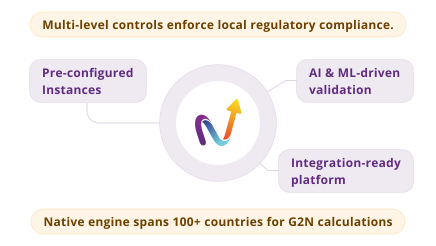
  • G2N Nova: G2N Nova provides global gross-to-net payroll processing in over 100 countries, making it the world’s most advanced native payroll engine. Available as a SaaS or service delivery platform, it can function as a stand-alone solution or integrate seamlessly with major HCM and Workforce Management systems.

Conclusion

Discover Mercans’ all-encompassing Employer of Record (EOR) solutions in India, crafted to facilitate global expansion. From ensuring payroll precision and compliance to supporting seamless workforce integration, Mercans provides unmatched assistance and expertise for businesses entering the Indian market, ensuring a successful and smooth transition.

This document was prepared for informational purposes only. As local laws & regulations keeps on changing. Please consult your tax & legal advisors as well.
Contact Sales
Let's get this conversation started. Tell us a bit about your requirement, and we'll get in touch a soon as we can.

    Sample message

    1. We want to expand in $country

    2. We want you to employ 'X' number of employees on our behalf

    3. Contract duration – 3/6/9/12/18/24 months

    4. Number of legal entities (if any exist today)

    5. Employment type: EOR employee or contractor?

    6. Any benefits requirement or “standard statutory only”?

    FAQs

    What is an Employer of Record (EOR) in India?

    An Employer of Record (EOR) in India is a third-party service provider that legally employs workers on behalf of another company. The EOR manages all employment-related responsibilities, including contracts, payroll, taxes, benefits, and compliance with Indian labor laws, enabling businesses to hire employees without establishing a local entity.

    How can foreign companies hire employees in India without setting up a local entity?

    Foreign companies can engage an EOR to hire employees in India. The EOR assumes the legal employer role, handling all statutory obligations, while the client company manages the employee’s daily tasks. This approach allows businesses to operate in India without the need for a local branch or subsidiary.

    What compliance, payroll, and HR responsibilities does an EOR in India handle?

    An EOR in India ensures compliance with local labor laws by managing employment contracts, processing payroll, withholding and remitting taxes, making statutory contributions, administering mandatory benefits, and completing statutory filings. They also handle work permits and visa sponsorship for expatriate employees.

    What are the benefits of using EOR services in India?

    Utilizing an EOR in India offers several advantages: it simplifies market entry by eliminating the need for a local entity, ensures compliance with complex labor laws, reduces administrative burdens, mitigates legal risks, and accelerates the hiring process.

    How much does it cost to hire employees through an EOR in India?

    The cost of hiring through an EOR in India varies depending on the provider and the services included. Generally, fees can range from $500 to $2,000 per employee per month. It’s advisable to consult with the EOR provider for a detailed pricing structure.

    Is an EOR the best option for expanding a business into India?

    An EOR is an effective solution for businesses looking to expand into India without the complexities of setting up a local entity. It provides a compliant and efficient way to hire employees, allowing companies to focus on their core operations while the EOR manages employment-related tasks.

    Ready to hire in India?

    No local entity needed. Our experts handle payroll, compliance, and onboarding.

    Talk to an expert
    Proven expertise in global payroll.