Employer of Record

Employer of Record (EOR) Estonia

Hire compliantly, pay accurately, expand confidently.

Global Payroll Team
Written by Global Payroll Team
Last updated April 24, 2026
Expert Reviewed

An Employer of Record (EOR) functions as the legal employer of workers in Estonia. This role, also known as a Global Professional Employer Organization (Global PEO), encompasses a wide array of employment responsibilities, ensuring full compliance with local labor laws and regulations. The EOR is tasked with managing critical functions such as payroll, taxes, legally mandated benefits, and the preparation of employment contracts.

The Employer of Record (EOR) in Estonia is responsible for:
  • Ensuring compliance with Estonian labor laws for employee engagements.
  • Overseeing local payroll processes.
  • Managing the filing of employment-related taxes and necessary documentation.
  • Providing employees with detailed payslips.
  • Ensuring timely payment of employee salaries.

Streamline your global expansion with our Global PEO services, offering a seamless solution that eliminates the need for establishing a local entity. Choose Mercans as your trusted Employer of Record in Estonia, where we ensure legal presence, compliance, and protection of intellectual property, allowing your business to concentrate on its core operations. We facilitate a smooth global mobility experience, including work visas, while helping you cultivate a diverse and effective international workforce. Partner with Mercans, your Employer of Record in Estonia, for a compliant and efficient employment experience for your global team.

Things you need to know before hiring in Estonia

Employment Contracts in Estonia

When an entrepreneur opens a company in Estonia, they must navigate the personnel selection process with a strong commitment to legal compliance in hiring workers. An employment contract in Estonia is a formal agreement between an employee and an employer that outlines the terms of employment.

This contract specifies that the employee will perform particular work under the employer’s supervision and management. In return, the employer agrees to compensate the employee and provide the working conditions stipulated in the contract, which are often governed by collective agreements, laws, or administrative regulations.

Key Elements of an Employment Contract

In Estonia, an employment contract should be documented clearly, and each party should retain its copy. Contracts can be either fixed-term or indefinite, depending on the nature of the work required.

To ensure validity, every Estonian employment contract must include the following essential information:

  • Identities of the Parties: Names, registration numbers, and residences of both the employer and employee.
  • Contract Dates: The date of entry into the contract and the employee’s starting date.
  • Duration: The validity period, specifically if it is a fixed-term contract.
  • Job Description: Details of the position, qualifications required, and professional title.

Additional information must also be included in the contract, such as:

  • The workplace location.
  • Wage conditions.
  • Working hours.
  • Length of annual leave
  • Criteria for offering extra holidays.
  • Terms for contract termination.

If applicable, the contract must reference any relevant collective agreements.

Termination of Employment Contracts

There are several valid reasons for terminating an employment contract in Estonia:

  • Mutual Agreement: Both parties can agree to terminate the contract at any time.
  • Expiry of Term: This applies to fixed-term contracts when the agreed period concludes.

Both the employer and employee can initiate termination; however, after the probationary period an employee ordinarily terminating an indefinite contract must generally provide at least 30 calendar days’ notice. The employer, on the other hand, is required to state a valid legal reason for termination and follow the applicable statutory notice rules. In specific insolvency situations, separate rules may apply.

In specific situations, third parties, such as parents or guardians, may request the termination of a contract involving a minor if the work poses risks to the child’s safety, moral development, or education.

Working Hours

The standard full-time schedule in Estonia is generally 8 hours per day and 40 hours in a seven-day period. Work schedules may vary by employer and role, and employees are entitled to statutory breaks and rest time.

Probationary Period

Estonia allows for a probationary period of up to four months, during which the employer can evaluate the employee’s suitability for the role. During this period, the employee retains all legal rights. If the employment contract is to be terminated during the probation, the party initiating the termination must notify the other party 15 calendar days in advance.

13th Month Salary

Employers in Estonia are not required to pay a 13th-month salary to their employees. However, it is common practice for companies to offer annual bonuses as part of their compensation packages.

Termination, Severance Pay and Notice Period

Notice Period
In Estonia, the notice period an employer must generally provide before ordinary termination varies based on the employee’s length of service with the employer:

  • Less than 1 year: 15 calendar days’ notice
  • 1 to 5 years: 30 calendar days’ notice
  • 5 to 10 years: 60 calendar days’ notice
  • 10 years or more: 90 calendar days’ notice

After the probationary period, an employee ordinarily terminating an indefinite contract must generally provide 30 calendar days’ notice. The notice period commences the day after the employee is informed of the termination. If the employer fails to give the required notice, they must compensate the employee for the equivalent period.

Communication of Termination
Termination of employment must be communicated in a format that can be reproduced in writing, clearly stating the reasons where the law requires them and the effective termination date.
Dispute Resolution
If disagreements arise regarding termination, Estonian law offers mechanisms for resolution, including the Labour Dispute Committee and the courts.
Severance Pay
In a lay-off redundancy situation involving an indefinite-term employment contract, the employer generally pays compensation equal to one month’s average wages. Depending on the employee’s length of service, additional redundancy benefit may also be payable by the Estonian Unemployment Insurance Fund.

Employees vs Independent Contractors

In Estonia, the distinction between independent contractors and employees is crucial, impacting legal rights, obligations, and benefits. Understanding these differences is vital for both workers and employers to ensure compliance with Estonian labor laws. While independent contractors enjoy flexibility and autonomy in their work arrangements, employees benefit from statutory protections and entitlements under the Employment Contracts Act. This guide outlines the key aspects of independent contractors and employees in Estonia, focusing on contract regulations, classification criteria, and the legal implications of misclassification.

Employees vs. Independent Contractors in Estonia

FeatureEmployeesIndependent Contractors
Contract TypeGoverned by the Employment Contracts Act.Usually governed by the Law of Obligations Act (for example, a services contract or authorisation agreement).
Contract DurationUsually indefinite. A fixed-term employment contract is allowed only where justified by the temporary nature of the work, and generally for up to 5 years.Duration is generally whatever the parties agree in the service contract; no equivalent 5-year employee rule.
SubordinationWork is performed under the employer’s management and control.Generally works independently, deciding how the work is carried out, subject to the contract.
Regular RemunerationPaid wages/salary by the employer, usually on a regular payroll cycle.Paid fees according to the contract, often per project, milestone, deliverable, or invoice.
Work FlexibilityMore limited flexibility; employer can set working rules, schedule, and workplace. Standard full-time work is generally 8 hours per day / 40 hours per week.Usually more freedom to choose the manner, time, and place of work, unless the contract says otherwise.
Statutory ProtectionsProtected by labour law rules on minimum wage, working time, rest time, leave, termination, and occupational health and safety.Not covered by the Employment Contracts Act in the same way; protections depend mainly on the service contract and general civil law.
Holiday PayEntitled to at least 28 calendar days of paid annual holiday each year.No statutory paid annual holiday entitlement from the client.
Social Security ContributionsEmployer pays 33% social tax and 0.8% employer unemployment insurance; employee generally contributes 1.6% unemployment insurance through payroll.No standard employer-style payroll contributions by the client. The contractor handles taxes and social contributions according to their legal form (for example, sole proprietor or company).
Unemployment InsuranceCovered through the employee/employer unemployment insurance system.Generally not covered as an employee under a standard contractor relationship.
Maternity / Paternity / Parental LeaveEmployees have statutory leave rights, including 100 calendar days of maternity leave, 30 calendar days of paternity leave, and 70 calendar days of adoptive parent leave.No statutory leave entitlement from the client under employment law, though access to state benefits may depend on the person’s insurance/contribution status.
Sick PayFirst 3 days unpaid; employer pays 70% of average wages for days 4–8; from day 9, the Health Insurance Fund pays according to the statutory rules.The client does not pay the contractor sickness benefit for days 4–8 under a services/authorisation contract. If insured, the Health Insurance Fund may pay from day 9.
Pension ContributionsPension/health financing is built into payroll taxes; employer-paid social tax supports the state social system. If the employee has joined the funded pension system, employee pension contributions may also be withheld.No employer pension contribution by the client in the employee sense; the contractor is responsible for arranging contributions through their own tax/social setup.
Penalties for MisclassificationIf the relationship is really employment, the worker can claim employee status and the related rights.Calling someone a “contractor” does not control the outcome if, in practice, the relationship looks like employment. The company may face reclassification risk, back taxes/contributions, and claims for employee entitlements.

Social Security in Estonia

Employers operating in Estonia, including non-residents with a permanent establishment (PE) or employees in the country, are generally required to pay social tax at 33% on taxable employment-related payments made to individuals. This tax consists of 20% allocated for pension insurance and 13% for health insurance. There is no general upper cap on employer social tax, but minimum social tax rules may apply in relevant cases. The tax is assessed on a monthly basis.

Individuals registered as sole proprietors are also subject to social tax on their net business income under the applicable rules, including advance payment rules and annual settlement requirements.

Payroll in Estonia

Government Requirements

Registration Requirements

Establishing a Company

  • Companies must be established in accordance with the Estonian Commercial Code.
  • All businesses must register with the Estonian Commercial Register.
  • Foreign companies can establish branches in Estonia; however, branches are not considered separate legal entities, and the foreign parent company is liable for the branch’s obligations.

Registration of Employment

  • All employers, whether natural or legal persons, must register employment in the Estonian employment register administered by the Estonian Tax and Customs Board.
  • This requirement includes registering employees, individual contractors, managers, board members, trainees, and volunteers who receive remuneration, where registration is required by law.
  • Registration must be completed before an employee starts working.

Registration as Taxpayer

  • Taxpayers registered in the Commercial Register (e.g., subsidiaries, branches) are automatically entered into the taxpayer register by the Estonian Tax and Customs Board.
  • Foreign companies may register under specific conditions, such as being a foreign employer or having a permanent establishment in Estonia.
Ongoing Compliance Requirements

Monthly Payroll Tax Return (TSD)

  • Employers must submit the combined corporate income and payroll tax return, known as Form TSD, by the 10th of the month following any taxable distributions or payments.
  • Social tax and other payroll contributions are generally calculated from gross employment income and declared through Form TSD.
Monthly Payroll Tax Return (TSD)

Monthly Payroll Tax Return (TSD)

  • Employers must submit the combined corporate income and payroll tax return, known as Form TSD, by the 10th of the month following any taxable distributions or payments.
  • Social tax and other payroll contributions are generally calculated from gross employment income and declared through Form TSD.

Payroll Taxes

Social Tax
  • The social tax rate is set at 33% of an employee’s gross earnings.
  • In 2026, the monthly rate on which the minimum social tax liability is based is €886, so the minimum social tax liability for the employer is €292.38 per month where the minimum obligation applies.
Unemployment Insurance Premiums
  • Unemployment insurance contributions are shared between the employer (0.8% of gross salary) and the employee (1.6% of gross salary), subject to the statutory exceptions.
  • These contributions do not apply in every case, and special rules apply for people who have reached pensionable age or have certain pension statuses.
Funded Pension Payment
  • For persons who have joined the second pillar, employee funded pension contributions are currently 2%, 4%, or 6% of gross salary, depending on the chosen rate.
  • The Estonian pension system continues to operate through three pillars, with first-pillar state pensions and second- and third-pillar funded arrangements.
Income Tax
  • Personal income earned by employees is subject to a 22% income tax.
  • In 2026, the standard basic exemption is €700 per month or €8,400 per year, and it no longer decreases as income increases.

Pension Requirements

Registration Requirements

  • To apply for a state pension, individuals must submit an application along with the required documents to the relevant authority.

Ongoing Compliance Requirements

  • The Estonian pension system comprises three pillars:
    • First Pillar: State pensions funded through social tax contributions.
    • Second Pillar: Funded pension arrangements for persons who have joined the system, with employee contribution rates of 2%, 4%, or 6% depending on the chosen option.
    • Third Pillar: Voluntary supplementary funded pensions.

Employment Obligations

Labor Relations

  • Employment and labor relations are governed by the Employment Contracts Act and related legal frameworks.
  • Employers are responsible for withholding all applicable payroll taxes and contributions.

Holiday

  • Employees are entitled to 28 calendar days of paid annual leave as a minimum, unless the law provides a longer entitlement in specific cases.

Rest Hours

  • Employees must have at least 11 consecutive hours of rest within a 24-hour period.
  • Weekly rest must generally be at least 48 consecutive hours, or 36 consecutive hours in the case of summarised working time.

Termination of Employment

  • Employment contracts can be terminated for economic reasons or employee-related issues, following the Employment Contracts Act and other applicable rules.

Minimum Wage

  • As of 1 April 2026, the minimum wage in Estonia is €946 per month for full-time work, and the minimum hourly wage is €5.67.

Payroll Requirements

Pay Slips

  • Employers must provide employees with information regarding wages paid and employment conditions.
  • Pay slips are typically issued monthly.

Banking Requirements Related to Payroll

  • Employers are required to pay wages at least once a month on the agreed payday, usually by transfer to the bank account specified by the employee unless otherwise agreed.

Minimum Wages

  • The current minimum wage in Estonia is €946.00 per month for full-time work, effective from 1 April 2026.

Payroll Cycle

  • The payroll cycle is generally monthly.

Overtime Pay

  • If an employer compensates overtime work in monetary terms, this must be mutually agreed upon with the employee and is generally paid at 1.5 times the wages for overtime hours.

Overtime Compensation Calculation:

Hourly / Piece-Rate Basis:

Monthly Basis:

Mercans’ payroll capabilities

Payroll Cycle

Mercans offers a well-organized payroll cycle designed to ensure timely and accurate payments to employees and contractors. The payroll cycle generally follows a monthly schedule, in accordance with Estonian labor laws. Employers have the flexibility to pay their employees either at the end of the month or on a designated date, ensuring compliance with local regulations.

Pay Employees and Contractors in the Local Currency

Mercans enables payroll processing in Euros (EUR), ensuring that all payments are made in the local currency. This capability helps businesses avoid complications related to currency conversion and guarantees that employees receive their salaries without deductions for exchange rates. Furthermore, Mercans provides solutions for paying contractors, ensuring that all financial transactions adhere to Estonian fiscal policies.

Payroll Setup, Payroll Processing, and Payroll Administration

Mercans delivers comprehensive payroll setup and processing services tailored to the Estonian market. This includes:

  • Payroll Setup: Establishing the essential infrastructure to comply with local labor laws, including configuring employee categories, salary structures, and benefit entitlements.
  • Payroll Processing: Accurately calculating employee wages, deductions, and benefits, ensuring timely disbursement of salaries. This process also accommodates overtime, bonuses, and any other variable pay components in line with Estonian labor regulations.
  • Payroll Administration: Ongoing management of payroll operations, including updates to employee records, addressing employee inquiries, and ensuring compliance with evolving labor laws and regulations.

Statutory Filings and Payments

Mercans guarantees that all statutory filings and payments are executed in compliance with Estonian labor laws. This includes:

  • Social Security Contributions: Calculation and remittance of employee and employer contributions to social security, encompassing health insurance, pension funds, and unemployment insurance.
  • Tax Filings: Management of income tax withholdings and ensuring adherence to Estonian tax authorities. This includes providing accurate documentation for all required filings.
  • Labor Compliance: Adhering to all labor laws, including severance payments, vacation entitlements, and other statutory benefits. Mercans offers support to ensure that all employer obligations are met, minimizing the risk of penalties or legal issues.

Personal Income Tax in Estonia

Estonia employs a straightforward and efficient personal income tax system, characterized by a flat tax rate and a clear set of regulations regarding taxable income. Here’s a detailed look at how personal income tax operates in the country:

Tax Residency

  • Residents: Individuals who are considered residents of Estonia are subject to taxation on their worldwide income, regardless of the origin of that income.
  • Non-residents: Conversely, non-residents are only taxed on income sourced within Estonia, such as earnings from local employment or business activities.

Taxable Income

Taxable income encompasses a wide array of earnings, including:

  • Active Income: This includes employment income and profits from business activities.
  • Passive Income: Various forms of passive income are also taxable, such as:
    • Capital gains
    • Rental income
    • Royalties
    • Interest income
    • Dividends
    • Certain insurance payouts
    • Pensions
    • Scholarships, grants, prizes, and lottery winnings

This list is not exhaustive; essentially, any income derived by a resident individual that does not fall under a specific tax exemption is subject to taxation.

Taxation Basis

  • Withholding Tax: Most items of personal income are taxed on a gross basis, primarily through withholding at the source. This means that taxes are deducted before the individual receives their income.
  • Business Income and Capital Gains: These types of income are taxed on a net basis, which means that allowable deductions are considered before tax liability is determined.

Special Considerations

  • Expatriates: Estonia does not have special taxation rules tailored for expatriates, meaning they are subject to the same tax rules as residents and non-residents based on their residency status.

Personal Income Tax Rates

  • Flat Tax Rate: Estonia currently applies a 22% income tax rate on employment income and many other forms of taxable personal income.
  • Basic Exemption: In 2026, the standard basic exemption is €700 per month or €8,400 per year. For persons at pensionable age, a higher exemption applies under the current rules.
  • Dividends and Other Income: The taxation of dividends and other investment-related income depends on the applicable rules and the nature of the payment.

Estonia Employee Hiring Cost

Employing individuals in Estonia involves several employer costs, including social tax contributions, unemployment insurance premiums, and other mandatory obligations. Let’s break down the employer costs for an employee with a Gross Annual Salary of €40,000:

Social Tax Contributions

Employers in Estonia are required to contribute to social security programs through social tax. The total annual employer cost for social tax contributions would amount to €13,200, which is 33% of the gross annual salary.

Total Annual Cost

When also taking into account the employer’s unemployment insurance premium of 0.8%, the estimated total annual statutory employer cost for a Gross Annual Salary of €40,000 is approximately €53,520. Additional benefits or allowances may increase the total cost further.

For more detailed calculations and information about employer costs, you can refer to Estonian labor laws and payroll tax regulations.

Employee Benefits in Estonia

In Estonia, employee benefits are structured into mandatory and supplementary categories. Mandatory employee benefits ensure a basic standard of living and security for workers, while supplementary benefits enhance the overall employment package.

Pension System: The Estonian pension system aims to provide financial security in retirement through a three-pillar structure:

  • State Pension The state pension provides regular income for those who have reached retirement age and meet the qualifying conditions. In 2026, the retirement age in Estonia is 65. State pensions are financed through the social security system.
  • Funded Pension For persons who have joined the second pillar, employee contributions are made at rates of 2%, 4%, or 6% depending on the selected option.
  • Supplementary Funded Pension This optional third pillar allows individuals to make voluntary contributions to pension products and benefit from the applicable tax treatment.

Legislated Leaves:

  • Annual Leave: Employees are entitled to a minimum of 28 calendar days of paid annual leave, with some categories of employees enjoying extended leave.
  • Maternity Leave: Women are entitled to 100 calendar days of maternity leave.
  • Paternity Leave: Fathers are entitled to 30 calendar days of paternity leave.
  • Sick Leave: Employees may receive sickness-related benefits under the applicable Estonian rules, depending on the reason for absence and the applicable insurance framework.

Unemployment Insurance: Unemployment insurance is mandatory, with employees contributing 1.6% of their gross salary and employers contributing 0.8%, subject to statutory exceptions.

Dental Care: Public healthcare and reimbursement rules in Estonia may cover certain dental costs, and additional benefits may be available for children and specific groups.

  • Healthcare: Estonia’s public health insurance system provides coverage for insured employees whose employers pay the required social tax. Private health insurance options are also available.
  • Voluntary Benefits: Employees may also receive additional employer-sponsored benefits depending on company policy and market practice.
  • Gym Memberships: Employers may offer gym memberships or subsidies to promote employee health and wellness.
  • Workplace Canteens: Although not widespread, some larger companies provide subsidized meals or on-site cafeterias, particularly in competitive industries.

Estonian employers may offer additional perks, especially in more competitive sectors:

  • Additional Vacation Days: Beyond the mandatory 28 days, some companies provide extra vacation as a perk.
  • Company Cars: Typically offered to salespeople and executives, these are often taxed as benefits.
  • Health Insurance: Supplemental health insurance is becoming increasingly popular, with a significant rise in contracts in recent years.
  • Telecommuting Options: Flexibility in work arrangements, such as remote work, is common in many industries.
  • Personal Accident Insurance: This coverage for death or disability is gaining traction among employers.

Mandatory Employee Benefits in Estonia
Pension System: The Estonian pension system aims to provide financial security in retirement through a three-pillar structure:

  • State Pension The state pension provides regular income for those who have reached retirement age and meet the qualifying conditions. In 2026, the retirement age in Estonia is 65. State pensions are financed through the social security system.
  • Funded Pension For persons who have joined the second pillar, employee contributions are made at rates of 2%, 4%, or 6% depending on the selected option.
  • Supplementary Funded Pension This optional third pillar allows individuals to make voluntary contributions to pension products and benefit from the applicable tax treatment.

Legislated Leaves:

  • Annual Leave: Employees are entitled to a minimum of 28 calendar days of paid annual leave, with some categories of employees enjoying extended leave.
  • Maternity Leave: Women are entitled to 100 calendar days of maternity leave.
  • Paternity Leave: Fathers are entitled to 30 calendar days of paternity leave.
  • Sick Leave: Employees may receive sickness-related benefits under the applicable Estonian rules, depending on the reason for absence and the applicable insurance framework.

Unemployment Insurance: Unemployment insurance is mandatory, with employees contributing 1.6% of their gross salary and employers contributing 0.8%, subject to statutory exceptions.

Dental Care: Public healthcare and reimbursement rules in Estonia may cover certain dental costs, and additional benefits may be available for children and specific groups.

Supplementary Benefits
  • Healthcare: Estonia’s public health insurance system provides coverage for insured employees whose employers pay the required social tax. Private health insurance options are also available.
  • Voluntary Benefits: Employees may also receive additional employer-sponsored benefits depending on company policy and market practice.
  • Gym Memberships: Employers may offer gym memberships or subsidies to promote employee health and wellness.
  • Workplace Canteens: Although not widespread, some larger companies provide subsidized meals or on-site cafeterias, particularly in competitive industries.

Employee Perks
Estonian employers may offer additional perks, especially in more competitive sectors:

  • Additional Vacation Days: Beyond the mandatory 28 days, some companies provide extra vacation as a perk.
  • Company Cars: Typically offered to salespeople and executives, these are often taxed as benefits.
  • Health Insurance: Supplemental health insurance is becoming increasingly popular in some sectors.
  • Telecommuting Options: Flexibility in work arrangements, such as remote work, is common in many industries.
  • Personal Accident Insurance: This coverage for death or disability is gaining traction among employers.

Work Permit in Estonia

Long-Stay Visa Types in Estonia

Estonia offers several immigration routes for individuals looking to reside and work in the country for more than 90 days. The primary routes include:

  • D-Visa: A long-stay D-visa can be used in relevant cases for staying in Estonia for a longer period, including certain work-related situations.
  • Temporary Residence Permit: For longer-term employment in Estonia, a temporary residence permit for work may be required. It is initially issued for up to five years.
  • Long-Term Residence Permit: After meeting the statutory residence requirements, individuals may apply for long-term residence where eligible.

Eligibility Requirements for a Work Visa in Estonia

To qualify for a work-related immigration route, applicants must generally meet the following requirements:

  • The employer must complete the required employment-related steps with the relevant Estonian authorities.
  • The employer must have the legal capacity to operate and hire in Estonia.
  • The employee must possess a valid work contract or another valid basis for work.
  • The employee must meet the qualifications required for the specific position.
  • The employee must satisfy the applicable immigration, health insurance, and security requirements.

The exact criteria and required documents depend on whether the person is applying for a D-visa, registration of short-term employment, or a residence permit for work.

Obtaining an Estonia Work Permit

To secure work authorization in Estonia, candidates typically submit their applications through the relevant Estonian foreign representation or, where permitted, directly to the Police and Border Guard Board. Typically, employers facilitate the process and cover associated costs for their employees.

Required Documents for a Work Visa Application

  • Completed application form
  • Valid passport or other accepted identity document
  • Passport-sized photograph
  • Document confirming payment of the state fee
  • Copy of the employment contract or employer documentation, where required
  • Additional documents depending on the specific immigration route

Process for Employee Work Visa Sponsorship in Estonia

In many cases, employers support work authorization procedures for their employees in Estonia. This may involve managing the application process and covering associated fees.

To initiate a work authorization process for employees, your company must legally operate and be able to hire in Estonia. This can be achieved if your business has a physical presence in Estonia, such as a subsidiary or local entity, or by utilizing an Employer of Record (EOR) service. Partnering with an EOR like Mercans enables companies to hire internationally in Estonia without needing a foreign subsidiary.

Once your company is authorized to employ individuals in Estonia, you can begin the immigration process. Depending on the case, employers may also need to interact with the Estonian Unemployment Insurance Fund and the Police and Border Guard Board before the residence permit process is completed.

EOR Solutions in Estonia

EOR for Prospective Employees
Mercans provides efficient Employer of Record (EOR) solutions for businesses that have already identified their ideal candidates in Estonia. Our services cover all aspects of the employee lifecycle, ensuring compliance with Estonian labor laws and regulations.
EOR + Recruitment
For organizations seeking assistance with talent acquisition, our combined EOR and recruitment services offer a comprehensive solution. Leveraging our extensive network and industry expertise, we help you find, onboard, and retain top talent, simplifying your entry into the Estonian market.
Visa Sponsorship and Global Mobility
Navigating the complexities of expatriate employment is made easier with our visa sponsorship and global mobility services. We facilitate the relocation of your international workforce while ensuring adherence to Estonian immigration and employment laws.
AOR for Contractor Payments
Businesses facing challenges with contractor payments can benefit from our Assistance on Record (AOR) services. We manage the intricacies of contractor payments, ensuring accuracy and compliance.
Converting Freelancers to Employees
Mercans assists companies in transitioning independent contractors to permanent employees in Estonia. Our expertise guarantees a seamless conversion process while remaining compliant with legal requirements.
HCM Integration
Integrate Mercans’ EOR services with your Human Capital Management (HCM) system in Estonia for real-time data exchange, enhanced compliance, and improved cost-efficiency. Rely on our expertise for a unified, compliant, and effective approach that elevates your workforce management and payroll operations.

Best Employer of Record Estonia

Mercans is the best employer of record in Estonia because of the following reasons:

  • Compliance with Estonian Regulations: Mercans is committed to ensuring full compliance with all regulatory requirements established by Estonian labor authorities, including the Republic of Estonia Labour Inspectorate. We prioritize adherence to local laws to protect both employers and employees.
  • Independent Entity: As an independent entity, Mercans offers reliable and customized employment services tailored to meet the specific needs of businesses operating in Estonia.
  • Diverse Employment Support: We efficiently manage a wide range of employment types, including full-time employees, freelancers, contractors, and expatriates. Our flexible solutions cater to various workforce needs.
  • Enterprise-Ready Solutions: Mercans is designed to meet the demands of large enterprises, offering scalable and sophisticated services that accommodate complex organizational structures and operational requirements.
  • Multi-Currency Payroll Management: With the capability to handle payroll in multiple currencies, Mercans facilitates seamless financial operations for global and multinational companies operating in Estonia.
  • Global Network and Multi-Country Payroll Expertise: Leveraging our extensive global network, Mercans excels in managing multi-country payroll, ensuring smooth international operations for businesses across different regions.
  • Data Protection and Security Compliance: Mercans adheres to rigorous data protection and security standards, including GDPR compliance, and is certified for SOC 1 and SOC 2, ensuring your data is secure and well-managed.
  • ISO Certified Quality Standards: We hold ISO 20000 and ISO 27001 certifications, demonstrating our commitment to high-quality IT service management and robust information security practices.
  • Robust Security Standards: Mercans complies with OWASP ASVS 3.0 standards, ensuring strong security practices in application development and management.
  • HRBlizz: Our proprietary HRBlizz platform is a global payroll and talent management SaaS solution that streamlines payroll processes while ensuring compliance with local regulations. With a network of over 1,000 in-country specialists, we provide expert knowledge of Estonian labor laws and business protocols.
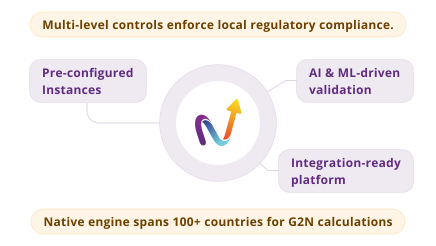
  • G2N Nova: G2N Nova is our advanced global gross-to-net payroll processing engine, operational in over 100 countries. Available as a SaaS or service delivery platform, it can function as a standalone solution or integrate seamlessly with major Human Capital Management (HCM) and Workforce Management systems.

Conclusion

Discover the simplicity of global expansion with Mercans’ all-inclusive Employer of Record (EOR) solutions in Estonia. From payroll management and regulatory compliance to effortless workforce integration, Mercans guarantees a seamless experience for businesses entering the Estonian market, backed by exceptional support and industry expertise.

This document was prepared for informational purposes only. As local laws & regulations keeps on changing. Please consult your tax & legal advisors as well.
Contact Sales
Let's get this conversation started. Tell us a bit about your requirement, and we'll get in touch a soon as we can.

    FAQs

    What is an Employer of Record (EOR) in Estonia?

    An Employer of Record (EOR) in Estonia is a third-party provider that legally employs workers on behalf of another company. The EOR handles contracts, payroll, taxes, benefits, and compliance with Estonian labor laws, allowing businesses to hire without a local entity.

    How can foreign companies hire employees in Estonia without establishing a local entity?

    Foreign companies can hire through an EOR, which acts as the legal employer while the client company manages daily tasks. This avoids the need for a local branch or subsidiary.

    What compliance, payroll, and HR services does an EOR in Estonia manage?

    An EOR manages employment contracts, payroll, tax withholding, statutory contributions, benefits, filings, and can assist with work permits and visas for expatriates.

    What are the benefits of using EOR services in Estonia?

    Using an EOR simplifies market entry, ensures legal compliance, reduces administrative work, mitigates risks, and speeds up hiring.

    How much does it cost to hire employees through an EOR in Estonia?

    Fees typically range from $500 to $2,000 per employee per month, depending on services. It’s best to consult the provider for details.

    Is an EOR the best solution for expanding a business into Estonia?

    An EOR is ideal for businesses expanding into Estonia without setting up a local entity, letting companies focus on core operations while the EOR handles employment tasks.

    Ready to hire in Estonia?

    No local entity needed. Our experts handle payroll, compliance, and onboarding.

    Talk to an expert
    Proven expertise in global payroll.