Employer of Record

Employer of Record (EOR) in Bangladesh

Hire compliantly, pay accurately, expand confidently.

Global Payroll Team
Written by Global Payroll Team
Last updated April 21, 2026
Expert Reviewed
An Employer of Record (EOR) in Bangladesh serves as the legal employer for workers, managing essential employment-related tasks and ensuring full compliance with local labor laws. Often referred to as a Global Professional Employer Organization (Global PEO), this service streamlines global hiring by overseeing critical aspects like payroll, taxes, statutory benefits, and employment agreements.

The Employer of Record (EOR) in Bangladesh handles:
  • Ensuring that all employment practices comply with local labor laws.
  • Managing payroll processes and ensuring timely salary distribution.
  • Handling the filing of employment-related taxes and necessary documentation.
  • Providing workers with payslips and managing local compliance requirements.

With Mercans’ Global PEO services, your business can expand into Bangladesh without the need for entity setup. Our Employer of Record (EOR) service ensures a legal presence, full compliance with regulations, and protection of your intellectual property. We simplify global mobility, work visas, and employee management, allowing your business to build a diverse and efficient global workforce. Partner with Mercans, your trusted EOR in South Asia, to manage your global employment needs effortlessly and efficiently.

Things you need to know before hiring in Bangladesh

Employment Contracts in Bangladesh

An Employment Agreement in Bangladesh is a legal document that defines the terms of employment between an employer and an employee. Employers should issue clear written employment documentation, including an appointment letter and key service terms, in line with the Bangladesh Labour Act and applicable rules. A well-drafted agreement includes key details such as:

  • Names and contact details of both the employer and employee.
  • Employment start date, office location, and job title with a description of duties.
  • Salary, including payment terms and any applicable taxes or deductions.
  • Expenses that the employer will reimburse, such as travel costs.
  • Expected working hours, ensuring compliance with legal limits on work hours.
  • Time off, covering vacation, holidays, and sick leave policies.
  • Probationary period for initial evaluation and flexibility in termination.
  • Provident fund or retirement benefit details where applicable, performance reviews, and term of employment, whether temporary or ongoing.
  • Clauses regarding deductions from pay, confidentiality, and non-compete restrictions where enforceable.
  • Grievance procedures and guidelines for termination, including misconduct and severance pay.

The agreement should also include clauses like severability, governing jurisdiction, and a clear statement that it is the final agreement between both parties. This ensures transparency and legal compliance while outlining both parties’ rights and responsibilities.

Working Hours

Under the Bangladesh Labour Act, the standard working hours are set on both a daily and weekly basis. Employees are to work 8 hours per day, with appropriate breaks as outlined in the law. Weekly working hours should not exceed 48 hours, but can extend to a maximum of 10 hours per day and up to 60 hours in a week, provided that the annual average does not exceed 56 hours per week. Female workers are not permitted to work at night, as defined by law, without their consent. Additionally, workers are prohibited from engaging in double employment.

Probation Period

As per the Labour Act, the probation period varies based on job type. For clerical workers, the probationary period is six months, while for other workers, it is three months.

13th Month Salary

There is no legal requirement in Bangladesh to provide a 13th-month salary. However, some employers choose to offer festival bonuses or similar discretionary payments.

Termination, Severance Pay and Notice Period

In Bangladesh, employment termination is governed by the Labour Act, which outlines the rights and responsibilities of both employers and employees during the termination process.

Termination by Employers

Employers can terminate employees by providing a written notice, with specific notice periods based on the employee’s status. For permanent workers, employers must provide 120 days’ notice for monthly-rated employees and 60 days for others. For temporary workers, the notice period is 30 days for monthly-rated employees and 14 days for others. Alternatively, employers may pay wages in lieu of notice.

Termination by Employees

Employees can also resign by providing written notice. Permanent employees must give 60 days’ notice, while temporary workers must provide 30 days’ notice, or 14 days if non-monthly-rated. Employees may choose to pay the employer the wages for the notice period instead of serving it.

Severance Pay

If an employee resigns after five years of service, they are entitled to compensation of 14 days’ wages per year of service. For ten or more years of service, the compensation increases to 30 days’ wages per year.

Overtime Pay

Overtime compensation in Bangladesh is generally payable at twice the worker’s ordinary rate of basic wages, dearness allowance, and ad hoc or interim wages, if any, for hours worked beyond the standard legal limits.

Employees vs Independent Contractors

In Bangladesh’s evolving labor landscape, the distinction between employees and independent contractors has become increasingly significant. As the gig economy gains traction, understanding the differences between these two classifications is essential for both employers and workers alike. Employees benefit from job security and a suite of legal protections, while independent contractors relish the freedom and autonomy that comes with project-based work. However, with these differences come varying responsibilities and risks. This nuanced relationship raises important questions about rights, obligations, and the future of work in Bangladesh, making it crucial to explore the implications of each classification.

CriteriaEmployeesIndependent Contractors
Working TenureTypically engaged for an indefinite or fixed term; work under employer’s direction and controlEngaged for specific projects or services; operate independently and control their work
Extent of Financial RiskEmployer handles taxes, social security (if applicable), and business risksContractor bears financial risks, including taxes, expenses, and insurance
Level of Job SecurityHigher job security; regular salary and statutory benefits (leave, bonuses, etc.)Lower job security; income depends on projects with no guaranteed continuity
Legal Rights and ProtectionsProtected under the Bangladesh Labour Act 2006 (wages, working conditions, dispute resolution)Limited statutory protection; governed mainly by contract law
Control and SupervisionEmployer controls how, when, and where work is performedContractor controls how work is completed
Benefits and EntitlementsEligible for benefits (leave, festival bonus, gratuity where applicable)No statutory employee benefits; paid per contract
Tax TreatmentIncome tax typically managed via payroll withholding (if applicable)Responsible for own tax filings and compliance
Tools & EquipmentProvided by employerProvided by contractor
ExclusivityUsually works for one employerCan work for multiple clients
TerminationSubject to notice periods and labour law protectionsGoverned by contract terms

Social Security in Bangladesh

Bangladesh does not operate a broad social security system in the same way as many other jurisdictions. However, certain statutory worker welfare and retirement-related mechanisms can apply depending on the employer’s size, sector, and internal policies. In particular, eligible companies may be required to contribute 5% of net profits to the Workers’ Participation Fund and Workers’ Welfare Fund under the Labour Act. In addition, all taxpayers must submit tax returns where required under current tax law.

Payroll Compliance for Employers

Employers in Bangladesh must adhere to specific payroll compliance requirements, including withholding tax from salaries where applicable and meeting reporting obligations under National Board of Revenue rules. Here are the key aspects:

Tax Deductions from Salaries under TDS Rules
  • Frequency: Monthly
  • Deadline: Employers should follow the current National Board of Revenue deadline for monthly salary tax deduction reporting and payment.
  • Details: Employers must report the tax deducted from employees’ salaries and remit it in line with current TDS requirements.
Payment of Salaries under TDS Rules
  • Frequency: Annually or as otherwise required by current tax rules
  • Deadline: Employers should follow the latest National Board of Revenue filing requirements for annual salary-related disclosures.
  • Details: Employers may need to detail salaries paid to employees throughout the year as part of annual tax reporting.
Filing of Return by Employees under TDS Rules
  • Frequency: Annually
  • Deadline: This should be aligned with the current individual income tax return deadline and related employer reporting obligations.
  • Details: Employers may be required to compile and submit information regarding employees’ tax filings, which can include:
    • e-TIN
    • Date of filing the return
    • Serial number or proof of submission issued by the authority upon filing the individual tax return

Summary Table of Mandatory Reporting

ActivityFrequencyDeadlinePenaltyReference
Details of tax deducted from salaries (TDS)MonthlyWithin 15 days after end of each monthLate payment may incur interest and penalties under tax lawSRO-206-AI / Income Tax Act 2023 (Sections 177 & 266)
Details of salaries paid to employees (Employer return/report)Annual15 September each yearHigher of: 10% of last assessed income or Tk 5,000; continuing default Tk 1,000/monthIncome Tax Act 2023
Employees’ personal income tax return filingAnnual15 April each year*Penalties apply for late filing as per tax rulesIncome Tax Act 2023

Perquisites

At the time of filing the annual return, employers may need to disclose perquisites and other employee benefits in the form prescribed by current tax rules. Perquisites are generally payments made to employees by the employer in forms other than salary, excluding:

  • Advance salary
  • Leave encashment
  • Overtime pay
  • Contributions to recognized provident funds
  • Contributions to approved pension, gratuity, and superannuation funds

Employers should verify the current annual thresholds and disallowance treatment under the latest Income Tax Act, rules, and paripatra before filing.

Payroll Compliance for Employees

Individuals who fall under certain categories are required to file an income tax return at the end of the tax year:

  • Individuals who must obtain a 12-digit e-TIN under applicable law.
  • Individuals whose earnings exceed the maximum tax-free income limit for the year.
  • Individuals assessed for tax during any of the preceding years, subject to current rules.
  • Shareholder directors, partners in firms, and many government employees.
  • Individuals who own a motor vehicle or hold certain memberships or licenses where return filing is required by law.
  • Business owners with a trade license.
  • Members of recognized professional bodies, such as doctors and lawyers, where filing requirements apply.
  • Registered income tax practitioners, chamber of commerce members, or candidates for certain public offices where required.
  • Individuals participating in government tenders or holding executive positions in businesses, where filing is required under current rules.

Exemptions from filing tax returns include:

  • Non-resident individuals with no Bangladesh-source filing obligation under current tax law.
  • Classes of individuals exempted by the tax board.

Penalties for Non-Compliance

Failure to file an income tax return can result in penalties and interest under the Income Tax Act, including a minimum penalty and further consequences if the default continues.
Individuals required to file must pay the difference between total tax payable and any deductions made at source by the due date to avoid additional charges under the law.

Universal Self-Assessment

Under this system, individuals can submit their tax returns electronically or manually by the specified deadline, along with the payment of any owed taxes. The tax authority will issue an acknowledgment, which may serve as the basis for assessment subject to audit or review under the applicable law.

Deadline for Filing Tax Returns

The final date for individual tax return filing should be checked each year against the latest National Board of Revenue announcement, as extensions and revised dates may be issued.

Minimum Wages

Bangladesh does not operate a single universal national minimum wage for all sectors. Minimum wages are generally set sector by sector through wage board determinations. In the readymade garment sector, the minimum monthly wage remains BDT 12,500.

Payroll Cycle

The payroll cycle in Bangladesh can be structured on a daily, weekly, bi-weekly, or monthly basis, depending on the employer and the specific sector. According to Bangladesh labour law, employees must generally receive their wages within seven working days following the end of the wage period.

Personal Income Tax in Bangladesh

In Bangladesh, personal income tax is structured around fixed income slabs that determine tax liabilities for individuals based on their total income. The tax rates currently reflected in the National Board of Revenue’s 2025-2026 Income Tax Paripatra for individual taxpayers are as follows:

Income Tax Rates

For Male Taxpayers
  • First Tk. 375,000: Nil
  • Next Tk. 300,000: 10%
  • Next Tk. 400,000: 15%
  • Next Tk. 500,000: 20%
  • Next Tk. 2,000,000: 25%
  • Balancing Amount: 30%
For Female Taxpayers and Senior Citizens (above 65)
  • First Tk. 425,000: Nil
  • Next Tk. 300,000: 10%
  • Next Tk. 400,000: 15%
  • Next Tk. 500,000: 20%
  • Next Tk. 2,000,000: 25%
  • Balancing Amount: 30%
For Taxpayers of the Third Gender or Individuals with Disabilities
  • First Tk. 500,000: Nil
  • Next Tk. 300,000: 10%
  • Next Tk. 400,000: 15%
  • Next Tk. 500,000: 20%
  • Next Tk. 2,000,000: 25%
  • Balancing Amount: 30%
For Gazetted Freedom Fighters
  • First Tk. 525,000: Nil
  • Next Tk. 300,000: 10%
  • Next Tk. 400,000: 15%
  • Next Tk. 500,000: 20%
  • Next Tk. 2,000,000: 25%
  • Balancing Amount: 30%

Note: Parents or legal guardians of disabled individuals are eligible for an additional exemption of Tk. 50,000 beyond the standard tax-free limit. However, if both parents are taxpayers, only one can claim this increased exemption.

The tax rate for non-resident foreigners is generally 30% on Bangladesh-source income, subject to treaty relief and specific statutory rules.

Bangladesh Employee Hiring Cost

Cost of Employing in Bangladesh

Cost CategoryAmount (BDT)
Gross Annual Salary10,000
Festival Bonus (13th Month – 1 bonus)*833
Total Annual Cost (Minimum)10,833

In Bangladesh, the total annual employer cost depends on the employee’s gross salary, any overtime, festival bonuses if contractually offered, provident fund contributions where applicable, gratuity arrangements, and whether the employer falls within the Workers’ Profit Participation Fund regime. Since there is no broad employer social security contribution system for all employees, hiring cost calculations should be reviewed on a case-by-case basis rather than using a fixed national markup.

Employee Benefits in Bangladesh

Mandatory Benefits

In Bangladesh, the Labour Act ensures that employees receive certain mandatory benefits, which are essential for their security and well-being. These benefits create a legal and ethical framework for employers to follow. Here are some of the key mandatory benefits:

Paid Leave Entitlements

Employees in Bangladesh are entitled to various types of paid leave:

  • Annual Leave: The amount of paid leave depends on the industry:
    • For most sectors like factories and shops, employees earn 1 day of leave for every 18 days worked.
    • In tea plantations, it’s 1 day for every 22 days worked.
    • In newspaper establishments, employees receive 1 day for every 11 days worked.
  • Festival Holidays: Employees enjoy 11 paid festival holidays per year under the Labour Act.
  • Casual Leave: Each employee gets 10 days of paid casual leave each calendar year.
  • Sick Leave: Employees are entitled to 14 days of paid sick leave annually, which cannot be carried over to the next year. A medical certificate is necessary to claim this leave.

Maternity Leave

Female employees in Bangladesh receive maternity leave benefits:

  • Maternity Leave Duration: Women are entitled to 16 weeks of maternity leave with full pay, subject to the conditions set out in the Labour Act.

Overtime Compensation

If employees work beyond their regular hours, they must receive overtime pay in accordance with the Labour Act, generally at double the ordinary rate.

Optional Benefits

While the mandatory benefits are crucial, many employers in Bangladesh also provide additional perks to attract and retain talent. These optional benefits can enhance the overall work experience:

Health and Wellness Benefits

  • Health Insurance: Though not legally required, many employers offer health insurance to cover medical expenses, making it a popular benefit.
  • Dental and Vision Insurance: Some companies include these in their health plans for comprehensive care.
  • Employee Assistance Programs (EAPs): These programs provide confidential counseling for personal or work-related issues, promoting overall well-being.

Financial Security Benefits

  • Provident Funds: These are savings plans sponsored by employers, allowing employees to save for retirement. Both the employer and employee may contribute to this fund where a recognized scheme exists.
  • Gratuity Payments: Some organizations provide a lump sum payment upon an employee’s retirement or termination after a certain period.

Work-Life Balance Benefits

  • Flexible Work Arrangements: Options like flexible hours and remote work can help employees manage their time better.
  • Childcare Assistance: This can include childcare subsidies or on-site facilities for working parents.

Other Optional Benefits

  • Transportation Allowances: Employers may offer allowances to help cover commuting costs.
  • Meal Vouchers or Subsidized Meals: Providing meals or vouchers can make daily work life easier for employees.
  • Employee Discounts: Many companies negotiate discounts for their employees on various products and services.
  • Training and Development Opportunities: Investing in employee development through training programs can foster a culture of growth and learning.

Health Insurance Requirements

Although health insurance is not mandatory in Bangladesh, it is increasingly common for employers to offer it as part of their employee benefits package. Some industries might have specific guidelines, so it is wise for companies to consult relevant industry bodies.

  • Employer-Sponsored Plans: Many larger organizations include health insurance in their compensation packages, which is attractive for potential hires.
  • Individual Coverage: Employees can also choose to purchase their own health insurance plans if they prefer.

Future Considerations

The government has introduced a Universal Pension Scheme framework, which is voluntary and may become increasingly relevant for private-sector retirement planning.

Retirement Plans

Traditionally, retirement support in Bangladesh relied heavily on family structures, but changes are on the horizon with new programs emerging:

Universal Pension Scheme (UPS)

Introduced in 2023, this voluntary scheme aims to provide a monthly pension for participants upon retirement.

  • Eligibility: Open to Bangladeshi citizens subject to the applicable UPS scheme rules.
  • Key Features: Participants contribute to their individual accounts under the selected scheme.
  • Benefits: A monthly pension may become available after retirement age, subject to scheme conditions and contribution history.

Provident Funds

These employer-sponsored retirement plans allow both employers and employees to contribute a portion of salary toward retirement savings, promoting financial security.

Work Permit in Bangladesh

When seeking to work in Bangladesh, foreign nationals generally need both a valid visa category and a work permit or approval from the relevant authority. Here’s an overview of the general requirements and specific details necessary for obtaining these documents.

General Requirements for All Categories

To apply for a work permit or employment visa, you’ll generally need to complete the following steps:

  • Online Application: Begin by filling out the visa application form available at www.visa.gov.bd.
  • Photographs: Prepare recent passport-sized photographs as required by the visa rules.
  • Original Passport: Ensure your passport is valid for at least six months from the date of application.
  • Visa Fee Payment Receipt: Applicants from countries that are not fee-exempt must provide proof of payment.
  • Supporting Documents: Include any previous passport, employer documents, and other relevant records as required.

Preparation for Online Submission

When filling out the online application, it’s helpful to have the following information ready:

  • Your original passport, valid for at least six months.
  • A digital photograph that meets the visa portal requirements.
  • A complete address in Bangladesh.
  • Your phone number and email address for contact purposes.

Requirements for Employment (E) Visa

The Employment (E) visa is specifically for foreign experts, consultants, and employees working in Bangladesh in eligible sectors.

Eligibility

To be eligible for an E visa, applicants should generally fall into one of the following categories:

  • Experts or consultants working in specialized fields.
  • Employees of government agencies or organizations.
  • Workers in semi-government or autonomous organizations.
  • Employees in private sector entities that have obtained the necessary approvals for expatriate employment.

Purpose of Arrival

The main purpose of the visa is to fulfill professional responsibilities or job-related tasks.

Essential Documents for Issuance

When applying for an E visa, you may need to provide:

  • An appointment letter from the employer in Bangladesh.
  • A recommendation or approval from the Bangladesh Investment Development Authority (BIDA), Bangladesh Export Processing Zones Authority (BEPZA), or other relevant authority, together with any required ministry approval.

Essential Documents for Extension

If you need to extend your employment visa, you will generally need to submit:

  • A recommendation from your appointing authority.
  • A valid work permit or approval.
  • Security clearance documents where required.

EOR Solutions in Bangladesh

EOR for Prospective Employees
Mercans provides streamlined Employer of Record (EOR) solutions for businesses that have already pinpointed their ideal candidates in Bangladesh. Our services cover every stage of the employee lifecycle, ensuring full compliance with Bangladeshi labor laws and regulations.
EOR + Recruitment
If you’re looking for support in talent acquisition, our combined EOR and recruitment services offer a comprehensive solution. We leverage our extensive network and industry expertise to help you identify, onboard, and retain exceptional talent, making your expansion into the Bangladeshi market more efficient.
Visa Sponsorship and Global Mobility
Navigating the complexities of expatriate employment is made easier with our visa sponsorship and global mobility services. We facilitate the relocation of your international workforce while ensuring compliance with Bangladeshi immigration and employment laws.
AOR for Contractor Payments
Businesses facing challenges with contractor payments can take advantage of our Assistance on Record (AOR) services. We manage the intricacies of contractor payments, ensuring accuracy and compliance throughout the process.
Converting Freelancers to Employees
Mercans aids in transitioning independent contractors to full-time employees in Bangladesh. Our expertise ensures a seamless conversion process while adhering to all legal requirements.
HCM Integration
Integrate Mercans’ EOR services smoothly with your Human Capital Management (HCM) system in Bangladesh for real-time data exchange, improved compliance, and enhanced cost-efficiency. Rely on our expertise for a unified, compliant, and efficient approach, elevating your workforce management and payroll operations.

Best Employer of Record Bangladesh

In today’s global economy, businesses looking to expand into new markets require reliable partners to navigate the complexities of employment regulations and workforce management. Mercans emerges as a leading Employer of Record (EOR) in Bangladesh, offering a comprehensive suite of services designed to simplify the employment process for local and international companies alike. Our commitment to compliance, innovative technology, and tailored solutions makes us the ideal choice for businesses seeking to establish a strong foothold in Bangladesh.

  • Compliance with Local Regulations: Mercans prioritizes compliance with all relevant regulations set by the Ministry of Labour and Employment and other competent authorities in Bangladesh. This ensures that all employment practices adhere to the latest labor laws and standards.
  • Independent Operations: As an independent entity, Mercans offers reliable and customized employment services tailored to meet the unique needs of businesses operating in Bangladesh.
  • Diverse Employment Solutions: Mercans efficiently manages a range of employment types, including full-time employees, freelancers, contractors, and expatriates. This flexibility allows us to cater to various workforce requirements.
  • Enterprise-Level Services: Mercans is designed to support the needs of large enterprises, providing scalable and sophisticated solutions that accommodate complex organizational structures and diverse business operations.
  • Multi-Currency Payroll Management: With the capability to manage payroll in multiple currencies, Mercans simplifies financial operations for both local and multinational companies, enhancing cross-border transactions.
  • Global Reach with Multi-Country Payroll Expertise: Mercans has a strong global presence, which enables us to effectively handle payroll across different countries, ensuring seamless international business operations for our clients.
  • Stringent Data Protection Standards: Mercans is committed to upholding high data protection standards, adhering to regulations similar to GDPR, and ensuring the security and confidentiality of sensitive employee information.
  • Quality Certifications: With certifications in international standards, Mercans demonstrates a commitment to high-quality IT service management and information security, ensuring that our systems and processes are robust and reliable.
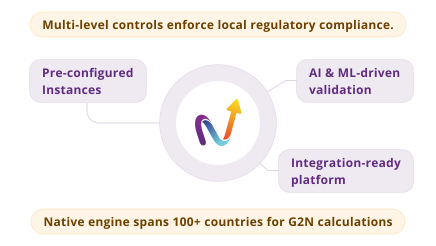
  • HRBlizz Platform: Our proprietary HRBlizz platform streamlines payroll and talent management processes, ensuring compliance with local labor laws. With a team of over 1,000 in-country specialists, we provide expert knowledge of Bangladeshi labor regulations and business protocols.
  • G2N Payroll: Mercans utilizes cutting-edge payroll technology to facilitate gross-to-net payroll processing, offering advanced payroll solutions. This system can operate independently or integrate seamlessly with major Human Capital Management (HCM) and workforce management systems.

Conclusion

In conclusion, Mercans provides exceptional Employer of Record (EOR) solutions in Bangladesh, ensuring accuracy, compliance, and efficiency in payroll management. Our all-encompassing services optimize operations, making us a dependable partner for businesses navigating the intricacies of the Bangladeshi employment landscape. Rely on Mercans to simplify your global workforce management, facilitating a smooth and successful expansion into Bangladesh.

This document was prepared for informational purposes only. As local laws & regulations keeps on changing. Please consult your tax & legal advisors as well.
Contact Sales
Let's get this conversation started. Tell us a bit about your requirement, and we'll get in touch a soon as we can.

    FAQs

    What is an Employer of Record (EOR) in Bangladesh?

    An Employer of Record (EOR) in Bangladesh is a third-party service provider that legally employs workers on behalf of another company. The EOR manages all employment-related responsibilities, including contracts, payroll, taxes, benefits, and compliance with Bangladeshi labor laws, enabling businesses to hire employees without establishing a local entity.

    How can foreign companies hire employees in Bangladesh without establishing a local entity?

    Foreign companies can engage an EOR to hire employees in Bangladesh. The EOR assumes the legal employer role, handling all statutory obligations, while the client company manages the employee’s daily tasks. This approach allows businesses to operate in Bangladesh without the need for a local branch or subsidiary.

    What compliance, payroll, and HR services does an EOR in Bangladesh handle?

    An EOR in Bangladesh ensures compliance with local labor laws by managing employment contracts, processing payroll, withholding and remitting taxes, making statutory contributions, administering mandatory benefits, and completing statutory filings. They also handle work permits and visa sponsorship for expatriate employees.

    What are the benefits of using EOR services in Bangladesh?

    Utilizing an EOR in Bangladesh offers several advantages: it simplifies market entry by eliminating the need for a local entity, ensures compliance with complex labor laws, reduces administrative burdens, mitigates legal risks, and accelerates the hiring process.

    How much does it cost to hire employees through an EOR in Bangladesh?

    The cost of hiring through an EOR in Bangladesh varies depending on the provider and the services included. Generally, fees can range from $500 to $2,000 per employee per month. It’s advisable to consult with the EOR provider for a detailed pricing structure.

    Is an EOR the best solution for expanding a business into Bangladesh?

    An EOR is an effective solution for businesses looking to expand into Bangladesh without the complexities of setting up a local entity. It provides a compliant and efficient way to hire employees, allowing companies to focus on their core operations while the EOR manages employment-related tasks.

    Ready to hire in Bangladesh?

    No local entity needed. Our experts handle payroll, compliance, and onboarding.

    Talk to an expert
    Proven expertise in global payroll.