Employer of Record

Employer of Record (EOR) Sweden

Hire compliantly, pay accurately, expand confidently.

Global Payroll Team
Written by Global Payroll Team
Last updated April 24, 2026
Expert Reviewed

Mercans serves as the trusted Employer of Record (EOR) in Sweden, acting as the official employer for workers in the country. As a leading Global Professional Employer Organization (Global PEO), our comprehensive services encompass vital aspects of employment. This includes meticulous compliance with local labor laws, proficient management of payroll, handling taxes, provision of mandatory benefits, and crafting detailed employment agreements.

Our Employer of Record (EOR) services in Sweden ensures:
  • Adherence to Employment Laws: As the designated Employer of Record in Sweden, Mercans guarantees strict compliance with the country’s employment laws.
  • Efficient Payroll Management: Our dedicated team oversees the local payroll process, ensuring accuracy and timeliness.
  • Tax Compliance: We take care of the filing of employment-related taxes and all necessary documentation, maintaining impeccable compliance standards.
  • Detailed Payslip Provision: Mercans provides workers with comprehensive payslips, ensuring transparency and clarity in financial transactions.
  • Timely Salary Payments: As your Employer of Record in Sweden, we ensure the prompt distribution of workers’ salary payments.

Choose Mercans as your Employer of Record in Sweden to streamline your global expansion. Our Global PEO services offer a hassle-free solution without the need for entity setup. We guarantee legal compliance, a physical presence, and Intellectual Property protection, allowing your business to focus on its core functions. Experience a smooth global mobility and work visa process while cultivating a diverse and efficient global workforce.

Things you need to know before hiring in Sweden

EOR Solutions in Sweden

EOR for Prospective Employees
Mercans offers seamless Employer of Record (EOR) solutions for businesses that have already identified their ideal candidates in Sweden. Our services encompass every aspect of the employee lifecycle, ensuring compliance with Sweden labor laws and regulations.
EOR + Recruitment
For those seeking assistance in talent acquisition, our EOR and recruitment services provide a holistic solution. We tap into our extensive network and expertise to help you find, onboard, and retain top talent, streamlining your expansion into the Sweden market.
Visa Sponsorship and Global Mobility
Navigating the intricacies of expatriate employment is simplified through our visa sponsorship and global mobility services. We facilitate the relocation of your international workforce, ensuring compliance with Sweden immigration and employment laws.
AOR for Contractor Payments
Businesses grappling with contractor payments can leverage our Assistance on Record (AOR) services. We handle the complexities of contractor payments, guaranteeing accuracy and compliance.
Converting Freelancers to Employees
Mercans supports the transition from independent contractors to permanent employees in Sweden. Our expertise ensures smooth conversions while adhering to legal requirements.
HCM Integration
Integrate Mercans’ EOR services seamlessly with your HCM system in Sweden for real-time data exchange, enhanced compliance, and cost-efficiency. Trust our expertise for a unified, compliant, and efficient approach, elevating your workforce management and payroll operations.

Employment Contracts in Sweden

A Swedish employer must provide written information about the essential terms and conditions of employment shortly after the employee starts work. In practice, some information must be provided no later than the seventh calendar day after the start date, while the remaining information must be provided no later than one month after the employee begins work.

What should be included in an employment contract in Sweden? The employment contract serves as a personal agreement between you and your employer, with some aspects potentially influenced by a collective agreement. While not mandatory to be in writing, certain details must be provided in writing, including:

Personal details, workplace information, and the employment start date
Job duties and title
Recruitment details and notice periods
Compensation, fringe benefits, and payment frequency
Duration of paid holiday, normal working hours, and collective agreements, if applicable
Conditions for potential assignments abroad lasting more than one month

Key concepts related to employment contracts in Sweden

Permanent Employment (Tillsvidareanställning)
The most common form of employment, characterized by an unspecified duration. All appointments are considered permanent unless stated otherwise.
Fixed-Term Employment (Tidsbegränsad Anställning)
Various types exist, such as special fixed-term employment, seasonal employment, temporary positions, or appointments after the age thresholds relevant under current employment protection rules.
Probationary Employment (Provanställning)
Common for permanent appointments, allowing a maximum six-month period for employers to assess the employee’s fit within the company and performance.
Fringe Benefits (Förmåner)
Common benefits in Sweden may include subsidies for fitness and health-related activities, occupational pension, and other perks governed by policy or collective agreement.

Working Hours

In Sweden, the standard work week typically spans 40 hours. Working hours are mainly governed by the Working Hours Act and, in many workplaces, by collective bargaining agreements.

Probation Period

In Sweden, it is customary for permanent appointments to begin with a probationary period, lasting a maximum of six months. This period allows employers to assess an employee’s fit within the company and their ability to fulfill job responsibilities.

Employees vs Independent Contractor Compliance

In Sweden, the classification of an individual as an employee or an independent contractor hinges on an overall assessment of the actual working relationship, influencing tax treatment and benefit entitlements. This comprehensive assessment considers aspects like work autonomy, equipment provision, directive adherence, economic dependence, and how integrated the person is in the hiring company’s operations.

Factor Employee Independent Contractor
Nature of Work Performs work as part of the employer’s organisation Carries out assignments as an independent business
Equipment Provision Employer often provides work equipment and resources Usually responsible for own tools and business resources
Directives and Instructions Works under the employer’s direction and control Has greater freedom over how the assignment is performed
Work Schedule Obligation Schedule is often set by the employer or workplace rules More flexibility over working time, subject to the contract
Remuneration Structure Salary or wages paid through payroll Fee paid under contract, often per assignment, hour, or project
Expense Compensation Employer may reimburse work-related expenses under employment rules/policy Normally bears own business expenses unless the contract says otherwise
Nature of Relationship Employment relationship under labour-law rules Business-to-business or contractor relationship
Exclusivity Not automatic, but employees often work mainly for one employer May usually work for multiple clients unless contractually restricted
Social and Economic Position Covered by employee-related protections and payroll contributions Responsible for own taxes and social security contributions as a business operator
Tax and Social Contributions Employer withholds tax and pays employer contributions Contractor usually applies for F-tax or FA-tax and pays own tax and self-employed contributions
Benefits and Protections May have sick-pay rights, leave rights, pension accrual, and employment protections Must usually arrange own insurance/pension setup and does not receive employee protections as such
Business Registration / Tax Status No business registration needed just to be an employee Often registered as a sole trader/company and commonly approved for F-tax or FA-tax

These distinctions have implications for tax treatment, with obligations for preliminary taxes and social security contributions. Employees enjoy benefit entitlements, while contractors are generally responsible for arranging their own insurance and benefit coverage. Employee termination is subject to extensive protective legislation, whereas independent contractors usually rely on contract law rather than employment protection rules.

It’s crucial to note that the distinction is not solely based on contractual titles but rather on the degree of independence from the hiring company. Deviations from these norms may incur legal consequences, emphasizing the importance of adherence to established norms and regulations in Sweden.

Payroll in Sweden

A foreign employer can hire employees in Sweden without a permanent establishment. Yet, if the work is performed in Sweden, the employer is usually required to register as an employer, withhold preliminary tax, and cover Swedish employer contributions for local hires unless social security coordination rules place the employee in another country’s system. If an employee acts as a dependent representative, the foreign employer may be considered to have a permanent establishment, requiring additional registration in Sweden. Minimum salary is not legally mandated by statute in Sweden, but collective bargaining agreements often include wage provisions.

Additionally, employees must receive a payslip on each pay date, and payroll records and accounting records must be maintained in accordance with Swedish bookkeeping and tax rules.

Minimum Wages

Sweden does not have a statutory national minimum wage. Instead, wages are generally set through collective bargaining agreements or established market practice in the relevant industry or occupation.

Payroll Cycle

In Sweden, payroll processing is typically carried out monthly, with a common practice of disbursing employee payments for the entire month on the 25th. Salary is normally paid in Swedish Krona (SEK), although in some cases other payment arrangements may be agreed, subject to legal and practical requirements.

Mercans’ Payroll Capabilities in Sweden

Payroll management in Sweden demands meticulous attention and comprehensive solutions. Mercans’ employer of record services simplify the process, ensuring precision, compliance, and operational efficiency.

Payroll Cycle in Sweden
In Sweden, payroll operates on a monthly basis, involving stages like setup, salary calculations, and reporting. Mercans’ Employer Of Record services handle these tasks with precision.
Local Currency Payments
Paying in the local currency enhances convenience and reduces currency exchange complexities. Mercans facilitates this with multi-country payment solutions.
Payroll Setup, Processing, Administration
From configuring software to processing salaries and managing leave balances, Mercans’ EOR services efficiently handle every aspect of payroll in Sweden.
Statutory Filings and Payments
Compliance with local regulations is paramount. Mercans offers seamless support for statutory filings, ensuring compliance with Swedish laws.

Mercans: Your Trusted Payroll Partner in Sweden: Mercans’ expertise in Employer Of Record services extends to multi-country payroll management, providing accurate and streamlined payroll operations across various locations.

Social Security and Income Tax in Sweden

In Sweden, employers are obligated to pay employer contributions on compensation for employees covered by the Swedish social security system. Here is an overview of the key financial aspects employers should be aware of:

Overview of Financial Obligations in Sweden

Financial Aspect Details
Social Security Contributions Swedish employers or foreign employers with a Permanent Establishment (PE) in Sweden must pay contributions at 31.42% of total taxable remuneration (cash and in kind). Different rates apply based on the employer’s status, and foreign employers without a PE can reach agreements with employees for payment.
Pension Fee Employees pay a 7% pension fee on gross earned income up to SEK 599,250, with a maximum fee of SEK 41,948. This fee is typically fully tax creditable on the employee’s tax return.
Consumption Taxes (VAT) The general VAT rate is 25% on most goods and services, with reduced rates of 12% for specific items like food, restaurant meals, and non-alcoholic drinks, and 6% for passenger transport. Some financial and insurance services are VAT-exempt.
Net Wealth/Worth Taxes The wealth tax was abolished in Sweden as of January 1, 2007.
Inheritance, Estate, and Gift Taxes There are no inheritance, estate, or gift taxes in Sweden.
Property Fee The property fee, paid annually by the registered owner, is a maximum of SEK 9,287 or 0.75% of the taxable value for houses and block of flats. This fee is not applicable to real estate situated abroad.
Special Wage Tax on Pension Premiums Employers, including non-Swedish entities with a PE in Sweden, pay a 24.26% special wage tax on pension costs related to tax-qualified company pension plans.

Employers and employees alike in Sweden actively participate in the country’s tax and social security framework. Notably, employers generally bear the majority of the contribution burden, with the standard employer contribution rate remaining 31.42% of salary and taxable benefits for most employees in 2026. Employees do not normally pay a general employee social security contribution on salary in the same way as the employer, although employees pay public pension contributions through the tax system and municipal and, where applicable, state income tax. The Swedish social security system encompasses essential benefits such as parental leave, sick pay, healthcare, accident insurance, and pensions, showcasing the country’s commitment to social well-being.

Importance of PAYE

In Sweden, the PAYE system is a tax withholding mechanism under which employers deduct preliminary income tax from employees’ wages before disbursing salaries. Employers bear the responsibility of precise calculation and deduction, furnishing employees with payslips outlining the deductions. The PAYE system in Sweden ensures the even distribution of the tax load throughout the year, contributing to effective government revenue collection.

Social Security Contributions (Established businesses)

Navigating the employment landscape in Sweden involves considerations of social security contributions, corporate and personal income taxes, and various aspects of the Swedish tax system. Below is a detailed breakdown of key elements, including employer social security contributions, employee pension contributions, covered social security benefits, corporate income tax rates, personal income tax rates, tax implications for non-residents, criteria for tax residence, pension premiums, income tax administration, and employee insurances.

Employer Payroll Contributions

Contribution Type Rate
Health insurance 3.55%
Parental insurance 2.60%
Retirement pension 10.21%
Survivors’ pension 0.60%
Labour market fee 2.64%
Occupational injury 0.20%
General payroll tax 12.62%
Total employment cost 31.42%

Employee Payroll Contributions

Employee payroll contributions Rate
Public pension fee 7.00%
Church fee Varies by parish; average about 1.03% if the person is a member of the Church of Sweden
Burial fee Varies by municipality/parish
Total employee cost 7.00% + church fee (if applicable) + burial fee

This comprehensive guide provides insights into the employment and taxation landscape in Sweden, offering a detailed understanding of key components that employers and employees need to navigate for compliance and efficiency.

Social Security Contributions (Non Established businesses)

Foreign employers lacking a permanent establishment in Sweden are required to contribute to Swedish social security for their locally employed personnel where the employees are covered by the Swedish social security system. From January 2026, foreign employers without a permanent establishment in Sweden generally apply a reduced employer contribution rate of 18.8% instead of the ordinary 31.42%, while still having to withhold Swedish preliminary income tax on wages paid to their employees.

Sweden Employee Hiring Cost

To calculate the cost of employing someone in Sweden, you need to consider both the gross annual salary and the associated employer costs. In this example, with a gross annual salary of SEK 9,999.96, the total annual employer costs, which include contributions such as social security, are SEK 8,961.96.

The comprehensive total annual cost is derived by adding the gross annual salary and the total annual employer costs. Therefore, for this example, the total cost of employing an individual in Sweden would be approximately SEK 18,961.92.

It’s essential to account for all relevant expenses associated with employment to get a holistic understanding of the financial commitment for the employer. This includes not only the salary paid to the employee but also the additional costs related to employer contributions and statutory obligations.

Personal Income Tax

Employment income in Sweden is subject to municipal income tax and, above the relevant threshold, state income tax. The exact rate depends on the municipality and the employee’s taxable income.

Taxable Income (SEK) National Income Tax (%) Municipal Income Tax (%)
Up to 643,000 0 Varies by municipality
Over 643,000 20 Varies by municipality

*Swedish kronor

**The final rate depends on the applicable municipal tax rate and whether state income tax applies.

For non-residents:

  • Non-residents working in Sweden may be taxed under SINK, the special income tax for non-residents. From income year 2026, the SINK rate is 22.5% on taxable income received after 31 December 2025.
  • Non-residents working in Sweden for a non-Swedish employer without a permanent establishment in Sweden can still become taxable in Sweden depending on the economic employer analysis and how the work is carried out. An exception may apply in very short stay situations under the specific statutory thresholds.

Regarding capital tax:

  • Capital income is generally taxed at a flat rate of 30%. Refer to the relevant Swedish tax rules on capital gains and investment income for more information.

Employee Benefits in Sweden

Here’s the information on statutory leaves in Sweden:

Annual Leave
Vacation entitlement in Sweden is governed by the Annual Leave Act. The basic vacation entitlement is 25 days per year. Collective bargaining agreements or employment contracts may extend this for certain employees. A continuous four-week vacation is typically allowed during the summer period. Employees with notice of termination are not obliged to take vacation during the notice period unless this follows from the law and timing rules or unless otherwise agreed. It is possible to carry over certain paid vacation days to a later year under specific conditions.
Maternity & Paternity Leave
Parents in Sweden are entitled to parental leave and parental allowance under the social insurance system. Compensation is provided for a total of 480 days per child, with a large part of the entitlement divided between the parents and reserved days for each parent. Compensation levels and reserved-day rules follow current social insurance legislation. Collective bargaining agreements may offer additional compensation from the employer.
Sick Leave
Employees are entitled to sick pay from the employer if the employment is expected to continue for more than one month or if the employee has worked for more than 14 consecutive days. Sick pay is generally 80% of salary and is subject to a qualifying deduction. Compensation payable by the state may apply from day 15, as determined by the Swedish Social Insurance Agency. Employers are not obligated to provide supplementary sick pay unless specified in a collective bargaining agreement.
Disability Leave
Disability leave is not distinct from sickness leave. Partial or full disability may entitle individuals to activity compensation or sickness compensation paid by the state.
Overtime
Overtime refers to working hours beyond regular work hours and on-call periods. Under the Working Hours Act, overtime must not exceed 48 hours over four weeks or 50 hours within a calendar month, with a maximum of 200 hours per calendar year, unless deviations are made through collective agreement.

The statutory framework lacks specific regulations on overtime pay. Typically, overtime pay is outlined in collective bargaining agreements. Employees generally have the option to receive overtime compensation either in monetary form or as compensatory leave. In the absence of a collective bargaining agreement, entitlement to overtime pay is not automatic unless mutually agreed upon. Collective bargaining agreements may include provisions allowing employees to forgo overtime pay in favor of compensatory leave, typically applicable to those with flexible working hours or under special circumstances.

Termination, Severance Pay and Notice Period

Termination

Employers have the authority to terminate employees with or without notice. A termination with notice must be grounded in objective reasons, which can either be objective, such as redundancy or reorganization, or subjective personal reasons related to the employee’s conduct or performance.

An overall assessment of various factors is crucial in determining the presence of objective grounds for dismissal. Dismissing an employee with notice will not normally be considered objectively justified if alternative solutions, like relocating the employee within the company, were available. Before issuing a notice of termination, employers must explore potential vacant positions within the business for the affected employee. Discriminatory dismissals are prohibited, and additional regulations protect employees from unfair terminations, such as those related to parental leave or educational leave.

Collective Dismissal

The Co-Determination Act does not use the term “collective redundancies” in the same way as some other jurisdictions. Consultation obligations can arise even where fewer employees are affected.

If at least five employees are affected by termination due to redundancy, a notification to the Swedish Public Employment Service is required. This also applies if the total number of termination notices is expected to reach 20 or more within a 90-day period.

When redundancies occur for objective reasons, the applicable order-of-selection rules apply, often described as “last in, first out”, subject to statutory exceptions and any collective agreement arrangements. Dismissal procedures are outlined in the Employment Protection Act, with variations based on whether termination results from objective or subjective reasons. Consultations under the Co-Determination Act may be mandatory in cases of objective terminations, especially if the employer is bound by a collective bargaining agreement or the employee is a union member.

Individual Dismissal

Negligent performance, serious misconduct, theft, disloyalty, or other serious circumstances may warrant termination for personal reasons. The burden of proof rests with the employer, and evidence supporting termination for personal reasons can be challenging to present. Employers are generally expected to support employees in improving their performance where appropriate. Dismissal without notice is lawful only in cases of gross misconduct or other fundamental breaches and should be an exceptional measure.

Before terminating an employment agreement for personal reasons, the employer must provide written notice to the concerned employee and, if applicable, the trade union, in accordance with the timing rules in the Employment Protection Act. The employee or trade union may request consultations within the statutory deadline after receiving the information. Swedish law does not generally require prior government agency approval for employee dismissals.

Severance

There are no statutory provisions for severance pay. However, entitlement to severance pay may arise through employment agreements, collective bargaining agreements, or separation agreements.

Work Permit

In general, individuals from non-EU countries must obtain a work permit to work in Sweden. For new recruitments, the employer normally must advertise the position in Sweden, the EU, EEA and Switzerland for at least 10 days and ensure that the terms of employment meet or exceed those outlined in a Swedish collective bargaining agreement or are customary for the occupation or sector. The relevant trade union must have the opportunity to express an opinion on the terms of employment.

As of 24 April 2026, the general salary requirement for a Swedish work permit is that the employee must have a monthly salary of at least SEK 29,680 and salary levels must also be in line with collective agreements or established industry practice. From 1 June 2026, new labor migration rules will apply, and the general salary requirement for work permits will move to 90% of the median salary in Sweden at the time of application. EU and EEA citizens do not require a work permit to work in Sweden.

Work Permit Requirements

  • Valid passport for the employee.
  • Terms of employment equal to or better than Swedish collective agreements or industry standards.
  • Salary meeting Swedish collective agreement standards or industry norms, and also satisfying the applicable statutory salary threshold.
  • Employer-provided insurance covering health, life, employment injury, and occupational pension when required under Swedish work permit rules.

For detailed information on the residency permit application process, visit the Swedish Migration Agency website.

What Sets Mercans Apart

Global People Engagement
Mercans simplifies employment tasks worldwide, delivering human capital management services and global payroll solutions across 110+ countries.
Local Presence, Global Success
With 500+ specialists possessing in-depth local knowledge, Mercans operates globally, satisfying 5,000+ international clients and gaining the trust of major multinational companies.
Revolutionary Service Delivery
Mercans’ cloud-based SaaS Products, HR Blizz™ & Mesaar™, combine proprietary technologies with a human touch, offering cost-effective, GDPR-compliant, ISO-certified, and SOC-audited solutions.
Trailblazing Cloud-Based SaaS Products
HR Blizz & Mesaar integrate seamlessly with major global HRMS platforms, ensuring compliance and efficiency in global payroll management. Mercans is a Finpro expert, a member of the Global Payroll Association, and the Global Payroll Management Institute.

Best Employer of Record Sweden

Mercans Stands Out as the Leading Employer of Record in Sweden for the Following Reasons:

  • Regulatory Compliance: Mercans ensures full compliance with all regulations set by the Ministry of Employment and relevant Swedish authorities. It strictly adheres to Sweden’s employment laws and standards, guaranteeing full legal compliance.
  • Independent Operation: Operating as a distinct entity, Mercans offers reliable and customised employment services tailored to the unique needs of businesses in Sweden.
  • Diverse Employment Support: Mercans efficiently manages various forms of employment, including employees, freelancers, contractors, and expatriates, providing flexible solutions to meet a wide range of workforce needs.
  • Enterprise-Focused Solutions: Specifically designed to cater to large enterprises, Mercans delivers scalable and sophisticated services that accommodate complex organisational structures.
  • Multi-Currency Payroll Management: Mercans facilitates payroll processing in multiple currencies, ensuring seamless financial operations for businesses operating in Sweden and internationally.
  • Global Reach and Payroll Expertise: With a robust international presence, Mercans excels in managing multi-country payroll, enabling smooth operations across borders.
  • Data Protection and Compliance: Mercans adheres to rigorous data protection standards, including GDPR compliance and SOC 1 & SOC 2 certifications, ensuring the highest levels of data security.
  • ISO Certifications: Mercans holds ISO 20000 and ISO 27001 certifications, reflecting its commitment to excellence in IT service management and information security.
  • Security Standards Compliance: Mercans meets the OWASP ASVS 3.0 standards, ensuring strong security practices in application development and management.
  • HR Blizz Platform: The proprietary HR Blizz platform is a global payroll and talent management SaaS suite that streamlines payroll processes while ensuring compliance with Swedish regulations. With over 1,000 local experts, it provides in-depth knowledge of employment laws and business practices.
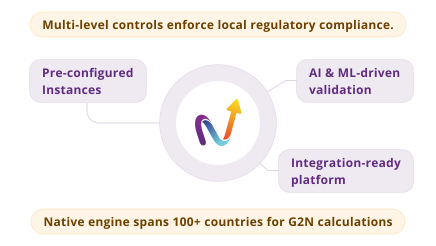
  • G2N Nova Payroll Engine: G2N Nova offers global gross-to-net payroll processing across more than 100 countries, making it one of the most advanced payroll engines available. It can be deployed as a SaaS solution or integrated seamlessly with major Human Capital Management and Workforce Management systems.

Conclusion

Mercans is your trusted Employer of Record (EOR) partner, simplifying global expansion into Sweden and 110+ countries. With 500+ specialists and innovative SaaS Products, HR Blizz™ & Mesaar™, we offer compliant, cost-effective, and personalized solutions. Eliminate complexities with our revolutionary service delivery system, and join 5,000+ global clients benefiting from success-oriented teams. Choose Mercans for a seamless entry into the Swedish market, ensuring consistent growth for your organization.

This document was prepared for informational purposes only. As local laws & regulations keeps on changing. Please consult your tax & legal advisors as well.
Contact Sales
Let's get this conversation started. Tell us a bit about your requirement, and we'll get in touch a soon as we can.

    Sample message

    1. We want to expand in $country

    2. We want you to employ 'X' number of employees on our behalf

    3. Contract duration – 3/6/9/12/18/24 months

    4. Number of legal entities (if any exist today)

    5. Employment type: EOR employee or contractor?

    6. Any benefits requirement or “standard statutory only”?

    FAQs

    What is an Employer of Record in Sweden, and what services do they provide?

    An Employer of Record in Sweden is the legal employer. They manage contracts, payroll, benefits, and compliance with Swedish laws.

    Is hiring employees through an EOR in Sweden legal, and what compliance obligations apply?

    Yes. The EOR complies with labor regulations, tax rules, and social security.

    How does an EOR in Sweden manage payroll, income tax, and social security contributions?

    The EOR calculates salaries, withholds income tax, and pays social contributions accurately.

    What are the benefits of using an EOR in Sweden compared to establishing a local entity?

    It enables fast hiring without creating a company, lowering risks and costs.

    Do EOR providers in Sweden ensure compliance with collective bargaining agreements and labor laws?

    Yes. They follow CBAs and labor rules that protect employees’ rights.

    Ready to hire in Sweden?

    No local entity needed. Our experts handle payroll, compliance, and onboarding.

    Talk to an expert
    Proven expertise in global payroll.