Employer of Record

Employer of Record (EOR) Spain

Hire compliantly, pay accurately, expand confidently.

Global Payroll Team
Written by Global Payroll Team
Last updated April 24, 2026
Expert Reviewed

An Employer of Record (EOR) is the official employer of a worker in Spain. Often known as a Global Professional Employer Organization (Global PEO), this role covers a broad range of employment responsibilities. It ensures the worker complies with local labor laws and regulations, manages payroll, taxes, statutory benefits, and drafts employment contracts.

The Employer of Record (EOR) in Spain is accountable for:
  • Ensuring the worker’s employment adheres to Spanish labor laws.
  • Managing the local payroll process smoothly.
  • Handling the filing of employment-related taxes and necessary documents.
  • Issuing accurate payslips to the worker.
  • Ensuring timely salary payments to the worker.

Simplify your global expansion with our Global PEO services – a seamless solution without the need for entity setup. Our Employer of Record (EOR) in Spain ensures legal presence, compliance, and intellectual property protection, allowing your business to concentrate on its core activities. Facilitate smooth global mobility and work visas while building a diverse and effective global workforce. Partner with Mercans, your Employer of Record in Spain, for a compliant and efficient employment experience for your international team.

Things you need to know before hiring in Spain

Employment Contracts

Under the Spanish Workers’ Statute Law, employment contracts can be formalized either orally or in writing. However, certain types of contracts, such as temporary, part-time, and training contracts, must be documented in writing. If these contracts are not provided in writing, they will generally be deemed permanent and full-time. Employers must notify the Spanish Public Employment Service (SEPE) of employment contracts within 10 days of the contract’s start date. Additionally, if the company has a legal representative of the workforce, a basic copy of all written contracts, excluding senior management contracts, must be provided to them.

Following the labor reform introduced by Royal Decree-Law 32/2021, the main types of employment contracts under Spanish law are:

  • Permanent employment contracts
  • Fixed-term employment contracts, including:
    • Temporary contracts due to production circumstances, whether foreseeable or unforeseeable
    • Substitution contracts
  • Permanent discontinuous contracts
  • Training and internship-related contracts under the current framework

Termination of the employment contract

Employment relationships can be terminated by:

  • Mutual agreement
  • Voluntary termination by the employee
  • Expiration of a fixed-term contract
  • Death, severe disability, or retirement of the employee
  • Objective dismissal (individual or collective)
  • Disciplinary dismissal

In the case of fixed-term contracts terminated at the agreed term, employees are generally entitled to severance payment of 12 days’ salary per year of service, except in cases where the law provides otherwise. For objective dismissals, the severance is 20 days’ salary per year of service, with a maximum of 12 months’ salary.

If individual dismissals are deemed unfair, the severance compensation may increase to 33 days’ salary per year of service, with a maximum of 24 months’ salary, while pre-2012 service may still carry legacy 45-day calculation effects under the applicable transitional rules.

Collective Bargaining Agreement

Under Spanish regulations, employment conditions and other aspects of the employee-employer relationship are governed by a collective bargaining agreement (CBA). Employers are required to apply the most relevant CBA for their primary activity. Each CBA may offer more favorable conditions to employees compared to the general provisions outlined in the Spanish Workers’ Statute Law.

Working Hours

Employees can work up to an average of 40 hours per week annually. The working day should not exceed nine hours, unless otherwise agreed in accordance with the law or the applicable CBA, and employees must receive a rest period of at least 15 minutes if working continuously for six hours. Additionally, there must be a minimum of 12 hours between the end of one working day and the start of the next. Night shifts are defined as work performed between 10:00 p.m. and 6:00 a.m.

Overtime

According to the CBA or, in its absence, the individual contract, overtime may be compensated either financially or with additional rest time. The total number of overtime hours cannot exceed 80 per year, excluding overtime compensated with rest within the legally allowed period.

Probation Period

In Spain, the probation period, also known as the trial period, provides employers with an opportunity to assess the abilities and suitability of a new employee before making a permanent commitment. This period allows either party to terminate the employment contract freely, without needing to provide a reason, prior notice, or indemnity, subject to legal protections. Here, Mercans outlines the essential aspects of probation periods in Spain to help employers navigate this crucial phase of employment.

General Provisions
Termination During Probation:

  • Freedom to Terminate: Both the employer and the worker have the right to terminate the contract during the probation period without alleging or proving any cause. This can be done without prior notice and without any indemnity to either party.
  • Protection for Pregnant Employees: The termination of a contract by an employer may be deemed null and void if it involves a pregnant employee or other specially protected situations, unless there are grounds unrelated to pregnancy or maternity.
Conditions for Validity
  • Prior Employment: If the employee has previously performed the same functions at the company under any type of employment contract, the probation period is considered null and void.
  • Written Agreement: The probation period must be agreed upon in writing. This ensures clarity and compliance with legal requirements.

Duration of Probation Periods

The duration of the probation period can vary based on the type of employee and the nature of the employment contract. In the absence of specific provisions in a collective labor agreement, the general rules are as follows:

Specialists
  • College and Junior College Graduates: The probation period for specialists holding college or junior college degrees can be up to six months.
Other Employees
  • Standard Employees: For non-specialist employees, the maximum probation period is two months.
  • Small Companies: In companies with fewer than twenty-five employees, the probation period for non-specialist employees can be extended to three months.
Temporary and Fixed-Term Contracts
  • Short-Term Contracts: For temporary fixed-term contracts with a duration of less than six months, the probation period cannot exceed one month, unless the applicable CBA provides otherwise within legal limits.
Special Employment Contracts
  • Training and Other Special Contracts: Specific trial periods apply to training contracts and special employment contracts, such as those for domestic workers and senior managers. These periods are outlined in the relevant legislation governing each contract type.

13th Month Salary

In Spain, extra salary payments are generally mandatory. Employees are usually entitled to two extraordinary payments per year, commonly paid in summer and at Christmas, unless the applicable collective agreement allows them to be prorated across the 12 monthly payrolls.

Who Qualifies for Extra Salary Payments?

In Spain, these extra payments are generally mandatory for most employees. There are a few important considerations:

  • General Eligibility: Most employees are typically eligible, regardless of whether they are paid directly through payroll or via an Employer of Record arrangement.
  • Exceptions or Variations: The exact structure, amount, and payment schedule may be modified by the applicable collective agreement or by lawful proration in payroll.

The eligibility criteria are governed by the labor laws of the country where the work is performed and by the applicable CBA.

Termination, Severance Pay and Notice Period

Termination of employment in Spain involves adhering to specific legal requirements, ensuring fair treatment of employees and compliance with labor laws. Severance pay serves as a crucial financial safeguard for employees, providing support during the transition period following termination. Understanding these regulations is essential for foreign employers operating in Spain to uphold fair labor practices and corporate integrity.

Severance Pay in Spain

Severance pay in Spain is mandated by law and is calculated based on the employee’s length of service. It ensures that employees are compensated fairly upon termination, mitigating sudden income loss. According to Spanish labor law:

  • Calculation Method: In objective dismissals, employees are generally entitled to receive 20 days of salary per year of service.
  • Limitation: The maximum severance pay for objective dismissal is capped at 12 months’ salary.
  • Payment Obligation: Employers must disburse severance pay in accordance with the legal rules applicable to the type of dismissal.

Notice Period Requirements

The notice period in Spain varies depending on the circumstances of termination:

  • Minimum Notice: Employers are generally required to provide 15 days’ notice in objective dismissals, unless salary in lieu or other legal rules apply.
  • Mutual Agreement: Both parties may mutually agree on a shorter notice period where legally allowed.

Legal Framework and Compliance

  • Workers Statute: Governed by the Workers’ Statute, Spanish labor law outlines the legal framework for employment termination and severance pay.
  • Collective Agreements: Supplementing the statutory provisions, collective agreements may further specify terms related to severance pay and notice periods.

Employee Onboarding

To onboard employees in Spain, companies must meet the following requirements:

  • Contract: Provide a valid employment contract detailing terms and conditions, including job position, working hours, salary, contract type, duration if temporary, and other relevant details.
  • Personal Documents: Both employer and employee must have Tax Identification Numbers in Spain. Foreign employees will also require a Foreigner Identification Number (NIE) where applicable. Employers must obtain a copy of the employee’s identification document and their bank account details for salary payments.
  • Social Security Registration: Employees need a Social Security number for interactions with the Spanish Social Security system. If an employee does not have one, the employer must apply for it. The employer must register the employee with Social Security before the start of employment, and registration can be completed up to 60 calendar days in advance through the RED system.
  • Work Permit: For foreign nationals, ensure that all necessary work permits or residence authorizations are obtained to legally work in Spain.
  • Modelo 145: This form is used to declare tax information related to an employee’s personal and family situation. Employers must provide this form to new employees to ensure accurate income tax withholding.
  • Collective Agreements: Check if the industry or job position is governed by a collective agreement (Convenio Colectivo) that specifies employment conditions such as salary scales, working hours, and benefits.

Employees vs Independent Contractors

In today’s diverse work environment, distinguishing between employees and independent contractors is crucial for effective workforce management and compliance. This section delves into the fundamental differences that define these two categories, examining aspects such as their legal definitions, work arrangements, payment structures, and tax responsibilities. By unpacking the nuances of dependence, benefit entitlements, and job security, we aim to equip both employers and workers with the knowledge needed to navigate their roles and relationships in the labor market.

Read below for a detailed comparison:

CriteriaEmployeesIndependent Contractors
Legal definitionWork under the employer’s organization and direction for remunerationCarry out an economic or professional activity on their own account, outside another person’s organization and management
Main legal frameworkWorkers’ Statute (Estatuto de los Trabajadores) and labour lawSelf-Employed Workers’ Statute (Ley 20/2007) and Civil/Commercial law
Contract typeEmployment contract: indefinite, fixed-term, training, part-time, etc.Service/professional contract; may also be a TRADE arrangement if economically dependent
Dependence / subordinationEmployer directs how, when, and where work is doneGreater autonomy over method, schedule, and organization of work
Integration into businessIntegrated into the employer’s business and structureOperates an independent business activity for clients
Personal nature of workUsually personal and non-substitutableMay sometimes delegate or subcontract, depending on the contract and activity
Economic riskEmployer bears the business riskContractor bears own economic and business risk
PaymentSalary or wages paid by employerFees/invoices paid by clients
ExclusivityNot automatic, but regular attendance and employer scheduling are typicalUsually no exclusivity unless contractually agreed; may serve multiple clients
Tax treatmentEmployer withholds personal income tax and handles payroll obligationsContractor handles own tax obligations; VAT may apply depending on the activity
Social securityEmployer registers worker and pays General Regime contributionsContractor joins RETA and chooses a contribution base within the 2026 net-income band limits
Benefits / protectionsLabour-law protections: paid leave, dismissal protection, unemployment, sick leave, etc.No employee severance or ordinary labour protections; has own self-employed rights and protections, including specific TRADE rules where applicable
TerminationSubject to labour-law procedures and severance rules where applicableGoverned mainly by the contract; no ordinary employee severance
Can hire othersNo, as part of a personal employment relationshipYes in general, though TRADE status has stricter limits
Typical use caseOngoing work under employer oversightIndependent professional, freelance, or business activity

Social Security in Spain

Employers in Spain have a legal obligation to cover social security contributions for their employees under the general social security contribution regime. These contributions are calculated based on the employees’ contribution base, which is derived from their remuneration and subject to minimum and maximum limits.

Contribution Rates

  • Employer Contributions: For permanent employees under the General Regime, employers typically contribute 23.60% for common contingencies, 5.50% for unemployment, 0.20% for FOGASA, 0.60% for occupational training, and 0.75% for the Intergenerational Equity Mechanism. In addition, a variable occupational accident and disease rate applies depending on the activity, and it is borne exclusively by the employer.
  • Employee Contributions: Employees typically contribute 4.70% for common contingencies, 1.55% for unemployment on permanent contracts, 0.10% for occupational training, and 0.15% for the Intergenerational Equity Mechanism. On fixed-term contracts, the unemployment contribution is generally 1.60% instead of 1.55%.

Contribution Bases

The social security contribution bases vary based on the professional category of the employee:

  • General Minimum Monthly Base: EUR 1,424.40 for several contribution groups in 2026, with higher minimum bases for groups 1 to 3.
  • Maximum Monthly Base: EUR 5,101.20 in 2026.

Range of Contributions

  • Minimum Contribution: Depends on the employee’s contribution group and applicable remuneration.
  • Maximum Contribution: Is limited by the maximum monthly contribution base, subject to the applicable rates and any solidarity contribution above the cap where relevant.

Intergenerational Equity Mechanism

Spain applies an Intergenerational Equity Mechanism affecting contributions for common contingencies. In 2026, this mechanism imposes a 0.90% contribution on the base, split between employer and employee.

These contributions, both from employers and employees, must be remitted to the Social Security Treasury by the employer to ensure compliance with Spanish labor laws and regulations.

Payroll in Spain

Payroll Essentials for Spain

Managing payroll in Spain involves understanding and adhering to the country’s unique regulatory framework. Spain’s payroll landscape is characterized by specific requirements related to taxation, employee benefits, and social security contributions. This guide offers a detailed look into Spain’s payroll essentials, from initial registration to ongoing compliance. It’s designed to help employers efficiently navigate the complexities of Spanish payroll, ensuring accurate and compliant processing for all employees.

Government Requirements for Onboarding Employees in Spain

Registration Requirements

All businesses operating in Spain must register with the Spanish Tax Agency before commencing their activities. Companies are required to enroll in the Census of Businessmen, Professionals, and Withholders using the 036 tax form to obtain a company tax ID number. This number consists of:

  • One letter indicating the legal status or nature of the organization
  • Seven digits
  • A control character

Spanish nationals use their national ID number as their tax ID, while non-Spanish nationals must apply for a Foreigner Identification Number (NIE).

Companies must register with the Spanish Social Security system as soon as they start employing individuals. This registration, which requires prior tax registration, results in obtaining a Contribution Account Code (CCC) necessary for enrolling employees. Registration should be completed electronically via the Social Security e-Office using a digital certificate, commonly issued by the National Mint (FNMT-RCM). Employee registration must be made prior to the start of the employment relationship, and may be submitted up to 60 calendar days in advance.
  • Tax Obligations: Companies with annual turnover above the large taxpayer threshold generally file certain withholding tax obligations monthly. Other companies usually file quarterly, within the first 20 days of April, July, October, and January. Delays in tax return submissions incur penalties and surcharges according to tax law.
  • Tax Filing: Companies acting as withholding tax agents must electronically submit Form 111 monthly or quarterly and Form 216 for non-resident income where applicable. Annual tax forms 190 and 296 must also be submitted electronically by January 31, detailing income and withholdings.
  • Tax Rate: Spanish tax residents are subject to progressive Personal Income Tax rates that combine state and regional scales. Non-residents are generally taxed at 24%, or 19% if resident in another EU or EEA state in cases where that rate applies under the non-resident rules. Special tax regimes apply in certain territories such as the Basque Country and Navarra.

Tax Registration
All businesses operating in Spain must register with the Spanish Tax Agency before commencing their activities. Companies are required to enroll in the Census of Businessmen, Professionals, and Withholders using the 036 tax form to obtain a company tax ID number. This number consists of:

  • One letter indicating the legal status or nature of the organization
  • Seven digits
  • A control character

Spanish nationals use their national ID number as their tax ID, while non-Spanish nationals must apply for a Foreigner Identification Number (NIE).

Social Security Registration
Companies must register with the Spanish Social Security system as soon as they start employing individuals. This registration, which requires prior tax registration, results in obtaining a Contribution Account Code (CCC) necessary for enrolling employees. Registration should be completed electronically via the Social Security e-Office using a digital certificate, commonly issued by the National Mint (FNMT-RCM). Employee registration must be finalized before the employee starts work and may be submitted up to 60 calendar days in advance.

Ongoing Compliance Requirements
  • Tax Obligations: Companies with annual turnover above the large taxpayer threshold generally file certain withholding tax obligations monthly. Other companies usually file quarterly, within the first 20 days of April, July, October, and January. Delays in tax return submissions incur penalties and surcharges according to tax law.
  • Tax Filing: Companies acting as withholding tax agents must electronically submit Form 111 monthly or quarterly and Form 216 for non-resident income where applicable. Annual tax forms 190 and 296 must also be submitted electronically by January 31, detailing income and withholdings.
  • Tax Rate: Spanish tax residents are subject to progressive Personal Income Tax rates that combine state and regional scales. Non-residents are generally taxed at 24%, or 19% if resident in another EU or EEA state in cases where that rate applies under the non-resident rules. Special tax regimes apply in the Basque Country and Navarra.

Pension Requirements

Registration Requirements

There is no separate registration for pension plans; Social Security registration covers the public pension contribution framework. Companies may opt to subscribe to private pension plans, which offer additional tax benefits under the applicable limits and rules.

Ongoing Compliance Requirements
Social Security Contributions Process

Social security contributions are made monthly and split between the company and the employee. Payments can be made via direct debit or electronic methods. The social security base is reviewed annually, with a maximum base of EUR 5,101.20 and a general minimum base of EUR 1,424.40 in 2026, although some contribution groups have higher minimums. Payments are managed through the RED system and SILTRA, and late submissions incur penalties and surcharges.

Social Security Rates
For permanent employees under the General Regime, the social security rates generally include:

  • Company: common contingencies 23.60%, unemployment 5.50%, FOGASA 0.20%, occupational training 0.60%, MEI 0.75%, plus the applicable occupational accident and disease rate
  • Employee: common contingencies 4.70%, unemployment 1.55%, occupational training 0.10%, MEI 0.15%

These rates are subject to annual review.

Credited Retribution Items
Companies must submit the Credited Retribution Items (CRA) file by the end of the month following the reporting period. This file details remuneration paid to employees, regardless of whether it is included in the Social Security contributions base.
Private Pension Plan Scheme
Companies offering private pension plans must comply with the tax reporting obligations applicable to those plans, including annual reporting where required.
Social Security Notifications
The Sede Electrónica de la Seguridad Social (SEDESS) is the mandatory online service for managing social security notifications, facilitating communication between companies, individuals, and the Social Security Organization.

Payroll requirement

Payment Frequency

Employees are required to receive their salaries on a monthly basis. Generally, payments are made according to the contractual payroll date and the applicable CBA.

Depending on the applicable Collective Bargaining Agreement (CBA), employees may receive their gross annual salary in either 12 monthly payments or 14 payments, which typically include 12 regular monthly payments plus additional summer and Christmas bonuses. The CBA may specify a different number of extra payments, or allow lawful proration.

Pay Slip Requirements

Companies must generate a monthly pay slip for each employee.

The pay slip should follow the official format and include:

  • Employer Information: Tax ID Number, company name, address, and Contribution Account Code.
  • Employee Information: Name, tax ID, address, social security number, and job position.
  • Remuneration Details: Description of the payment, number of payment days, and total amount to be paid.
  • Deductions: Withholding taxes, social security contributions, and any other deductions.
  • Net Payment and Employer Contributions: Information on the net payment and employer’s social security contributions.

Companies are required to distribute the pay slip to employees, with electronic distribution being common where properly implemented.

Personal Tax Information

Employees must submit the 145 Tax Form to their employer to determine the appropriate Personal Income Tax withholding rate. Typically, this form is provided upon hiring. However, employees are required to update the form if there are any changes to their previously submitted information. It is essential for companies to retain a copy of the tax form for reference, should the Tax Agency request it.

PIT Certificate

Each year, companies are required to issue an income tax certificate detailing the total income received by the employee and the withholding taxes deducted throughout the fiscal year. This certificate, signed and stamped where applicable, must be provided to employees before the start of the personal income tax filing period.

Minimum Wages

The minimum wage in Spain for 2026 is set at €1,221.00 per month before tax, or €40.70 per day, with an annual minimum of €17,094.00.

Here is a breakdown of the minimum wage across different categories:

Domestic Workers

  • Per Hour: €9.55

Contingent and Temporary Workers

  • Per Day: €57.82 for workers on contracts not exceeding 120 days with the same employer

General Workers

  • Per Day: €40.70
  • Per Month: €1,221.00

These rates are crucial for employers and employees alike, providing a baseline for fair compensation across various sectors. We encourage all businesses to ensure compliance with these regulations to uphold labor standards and support economic stability in Spain.

Payroll Cycle

Payroll management is a crucial aspect of organizational operations, ensuring timely and accurate compensation for employees. In Spain, the payroll cycle refers to the period over which an organization pays its employees, determined by the chosen pay frequency.

Frequency

In Spain, the standard payroll frequency is monthly. Employees typically receive their salaries according to the contractual and payroll schedule set by the employer and applicable CBA.

Extra Salary Cycle

A unique feature of payroll in Spain is that employees are generally entitled to two extraordinary salary payments each year, usually in summer and December, unless these extra payments are prorated over the ordinary monthly payroll.

These additional payments are outlined in employment contracts and collective agreements, providing clarity and predictability for both parties involved. This system helps in budgeting and financial planning for employees while also contributing to consumer spending during key times of the year.

For further information or assistance regarding payroll management and compliance in Spain, feel free to reach out to Mercans. We are dedicated to supporting organizations in navigating payroll regulations effectively.

Overtime Pay

Overtime pay in Spain refers to working hours that exceed the normal agreed-upon working hours. These regulations are crucial for both employers and employees to ensure fair compensation and adherence to labor laws.

  • Voluntary Nature: Overtime work in Spain is generally voluntary, except when it is stipulated in a collective agreement or is necessary under the legal exceptions.
  • Compensation: Employees are compensated for overtime either through additional pay in their paycheck, which must not be lower than the value of ordinary hours, or by receiving compensatory rest within the period established by law or agreement.
  • Maximum Hours:There is a maximum limit of 80 overtime hours per year per employee in Spain, excluding certain categories such as overtime compensated with rest in due time.
  • Exclusions: Time spent on activities aimed at preventing or remedying urgent incidents and extraordinary damage is not treated as ordinary overtime in the same way.
  • Recording and Documentation:Employers are required to maintain a daily record of hours worked where legally required, including the documentation needed for overtime and working time compliance.

For more detailed guidance on overtime regulations or assistance with payroll management in Spain, please contact Mercans. We are committed to helping organizations navigate these regulations effectively and ensure compliance with labor standards

Mercans’ payroll capabilities

Payroll Cycle
Experience the efficiency of Mercans’ comprehensive payroll cycle management. Our services ensure timely and accurate payments to both employees and contractors, all in the local currency. Trust Mercans to streamline your payroll processes, making the entire cycle seamless and tailored to Spain’s requirements.
Payroll Setup, Payroll Processing, and Payroll Administration
Mercans offers comprehensive payroll solutions tailored to your needs. From meticulous payroll setup to precise processing and efficient administration, we manage every step with a commitment to accuracy and compliance. With Mercans, your payroll is in expert hands, allowing you to focus on your core business functions.
Statutory Filings and Payments
Navigate Spain’s regulatory landscape effortlessly with Mercans. Our dedicated team takes charge of statutory filings and payments, ensuring your business stays compliant with all legal requirements. Rely on Mercans for accurate and timely submissions, providing you with peace of mind in meeting your statutory obligations.

Personal Income Tax in Spain

The Spanish system of direct taxation for individuals comprises two primary taxes: Spanish Personal Income Tax (PIT) for residents and Spanish Non-Residents’ Income Tax (NRIT) for non-residents earning income in Spain. Residents are generally liable for PIT on their global income, while non-residents are taxed only on income sourced within Spain.

Taxable Income Categories

  • General Taxable Income: Includes income from employment, lottery prizes, and other sources not classified as savings income.
  • Savings Taxable Income: Covers income from dividends, interest, capital gains, and certain capitalization transactions.

PIT Rates and Tax Brackets

The following table outlines the progressive tax rates and brackets for Spanish Personal Income Tax (PIT). In practice, the final resident PIT burden depends on the combined state and autonomous community scales:

Taxable income (EUR)State tax rate (%)
0 – 12,45019.00
12,450 – 20,20024.00
20,200 – 35,20030.00
35,200 – 60,00037
60,000 – 300,00045
Over 300,00047
  • Deductions and Allowances: PIT allows for various deductions and allowances, such as those for dependents, contributions to pension plans, and other specific circumstances.
  • Non-Residents’ Income Tax (NRIT): Non-residents earning income in Spain are subject to NRIT. The general rate is 24%, while a 19% rate applies in certain cases to residents of other EU or EEA states.

Understanding these tax rates and categories is crucial for individuals managing their tax obligations in Spain, ensuring compliance with Spanish tax laws and optimizing tax efficiency where possible.

Spain Employee Hiring Cost

When hiring in Spain, employers should consider the comprehensive costs beyond the gross annual salary. These include employer social security contributions, the applicable occupational accident rate, and other statutory payroll items depending on the employment setup. Additional onboarding and occupational risk prevention costs may also arise depending on the sector and the employer’s compliance arrangements.

DescriptionAmount (EUR)
Gross annual salary10,000.00
Annual employer costs5,328.67
1) Common contingencies3,911.56
2) Unemployment911.59
3) Wage Guarantee Fund (FOGASA)33.15
4) Professional training99
5) Intergenerational Equity Mechanism (MEI)124.31
6) Occupational accidents and diseases*249
Total annual cost15,329

Employee Benefits in Spain

Mandatory Employee Benefits in Spain

These benefits are governed by law and frequently supplemented by collective bargaining agreements (CBAs).

Supplementary Employee Benefits in Spain

Health Insurance
Private medical insurance in Spain complements public healthcare services and is highly valued for its attractive tax treatment. While the public system covers basic needs, delays in testing and non-urgent surgeries can occur. Basic policies provide access to a network of healthcare providers, while comprehensive plans offer wider reimbursement and may include dental coverage.
Typical coverage includes
  • Non-Hospital Services: Medical consultations, home visits, physiotherapy, podiatry, medical tests.
  • Hospital Services: Surgeries, ambulance services, daily hospital stay payments.
  • Additional Benefits: 24/7 medical assistance hotline, local travel insurance for short trips depending on policy terms.

Health insurance usually covers employees and can extend to their dependents. Employer contributions often cover employees’ premiums entirely, while dependents’ premiums may be fully covered, shared, or paid fully by the employee, deducted from payroll.

Life and Personal Accident Insurance
Employers typically provide group life insurance covering all employees, with premiums fully paid by the employer. Standard coverage often includes:

  • Death Benefit: Often linked to annual salary or a fixed insured amount.
  • Total and Permanent Disability Benefit: Often linked to annual salary or a fixed insured amount.

Eligibility for benefits depends on the policy terms and, where relevant, Social Security-defined disability categories.

Short-Term Sickness Benefits
Short-term sickness pay may be supplemented up to 100% of salary depending on the applicable CBA or employer policy.
Retirement Scheme
Spain operates a pay-as-you-go system for public retirement pensions, with a gradual increase in ordinary retirement age under current legislation. The pension amount is calculated based on years of Social Security contributions and the earnings base.

To bridge potential gaps, corporate pension schemes are highly valued, especially by higher-salaried employees, serving as an effective retention tool. Current legislation continues to promote occupational pension plans with incentives and tax benefits.

Work Permit in Spain

Foreign nationals seeking employment in Spain must obtain the appropriate immigration authorization, which depends on the role, nationality, and immigration route. Spain’s system distinguishes between ordinary employee work visas, highly qualified professional routes, intra-company transfer routes, entrepreneur routes, and other residence and work authorizations.

Types of Work Visas
In Spain, various types of work visas and permits cater to different employment scenarios, including:

  • Employee Work Visas: Issued for employed work in Spain, including ordinary employee work and seasonal work where applicable.
  • Highly Qualified Professional Visas: For individuals with specialized skills and qualifications under the relevant highly qualified route.
  • Entrepreneur Visas: Aimed at individuals starting a business in Spain under the applicable entrepreneurship framework.
  • Intra-Company Transfer Visas: For employees transferred to a Spanish branch of their company.
  • EU Blue Card: Available for highly qualified third-country nationals who meet the applicable conditions.
Requirements
To obtain a work permit or work visa in Spain, applicants typically need to fulfill the following criteria:

  • Job Offer: A valid job offer from a Spanish employer or contract is usually required.
  • Qualifications: Depending on the visa type, applicants must demonstrate relevant qualifications and experience.
  • Background Checks: Background and supporting checks may be conducted to verify qualifications and security requirements.
  • Health Insurance: Proof of health insurance may be required depending on the route.
  • Financial Means: Evidence of sufficient funds to support oneself during the stay in Spain, if applicable.
Application Process
The application process for a work permit or work visa in Spain involves several steps:

  • Job Offer: Obtain a job offer from a Spanish employer willing to sponsor the application where sponsorship is required.
  • Documentation: Gather necessary documents, including passport, job contract, qualifications, and supporting immigration paperwork.
  • Submission: Submit the application along with required documents to the relevant Spanish authorities or consular post, depending on the route.
  • Approval: Await approval from the authorities, which may involve verification of qualifications and legal eligibility.
  • Social Security Registration: Once approved and employment starts, register with the Social Security system to access benefits and comply with labor laws.
Mercans’ Expertise
Mercans specializes in navigating Spain’s work permit requirements, offering comprehensive support to streamline the application process and ensure compliance with local regulations. Our services include:

  • Application Handling: Managing the entire work permit application process.
  • Coordination: Liaising with Spanish authorities on behalf of employers and applicants.
  • Social Security Compliance: Ensuring registration with the Social Security system.
  • Expert Guidance: Providing expert advice and support throughout the process.

By leveraging Mercans’ expertise, employers can focus on their core business objectives while ensuring smooth and compliant entry of foreign talent into the Spanish workforce.

EOR Solutions in Spain

Mercans provides comprehensive Employer of Record (EOR) solutions tailored for businesses operating in Spain. Whether you have identified your ideal candidates or need assistance in talent acquisition, our services cover every aspect of the employee lifecycle, ensuring strict adherence to Spain’s labor laws and regulations.

EOR Services and Recruitment
For businesses seeking seamless talent acquisition, our EOR and recruitment services offer a holistic solution. Leveraging our extensive network and expertise, we assist in identifying, onboarding, and retaining top talent, facilitating your expansion into the Spanish market.
Visa Sponsorship and Global Mobility
Simplify expatriate employment complexities with our visa sponsorship and global mobility services. We manage the relocation of your international workforce, ensuring full compliance with Spain’s immigration and employment laws.
Assistance on Record (AOR) for Contractor Payments
Our Assistance on Record (AOR) services streamline contractor payments, guaranteeing precision and compliance with local regulations.
Transitioning Freelancers to Employees
Mercans facilitates the smooth transition of independent contractors to permanent employees in Spain, ensuring legal compliance throughout the process.
HCM Integration
Seamlessly integrate Mercans’ EOR services with your Human Capital Management (HCM) system in Spain for real-time data exchange, enhanced compliance, and operational efficiency. Rely on our expertise for unified and efficient workforce management and payroll operations.

Best Employer of Record Spain

Mercans is the Best Employer of Record in Spain Because of the Following Reasons:

  • Compliant with The Ministry of Labour and Social Economy (MITES) and Agencia Tributaria (AEAT): Mercans adheres to all regulations and requirements set by Spanish authorities, ensuring legal and regulatory compliance in all employment practices.
  • Own Entity: With its own established entity in Spain, Mercans provides a robust and reliable framework for managing employment, payroll, and related administrative tasks.
  • Supports All Employment Types: Mercans efficiently handles various employment arrangements, including employees, freelancers, contractors, and expats, providing flexibility to suit diverse business needs.
  • Suitable for Enterprise Businesses: Designed to cater to large-scale operations, Mercans offers tailored solutions that meet the complex requirements of enterprise-level organizations.
  • Supports Multiple Currencies: Mercans can process payroll and financial transactions in various currencies, accommodating the needs of multinational operations.
  • Global Presence and Multi-Country Payroll Capabilities: With a widespread international footprint, Mercans manages payroll across multiple countries, simplifying global workforce management.
  • GDPR Certified, SOC 1 & SOC 2 Compliant: Mercans ensures data protection and security with GDPR certification and adherence to SOC 1 and SOC 2 standards, providing peace of mind regarding data handling and privacy.
  • ISO 20000 & ISO 27001 Certified: Mercans maintains high standards of IT service management and information security with ISO 20000 and ISO 27001 certifications, ensuring efficient and secure operations.
  • OWASP ASVS 3.0 Compliant: Mercans follows OWASP Application Security Verification Standard 3.0 to uphold rigorous application security practices, safeguarding sensitive information.
  • HRBlizz: Mercans HR Blizz is a proprietary global payroll and talent management SaaS suite that streamlines payroll processes while ensuring compliance with local regulations. With over 1,000 in-country specialists, it provides expert knowledge of labor laws and business protocols.
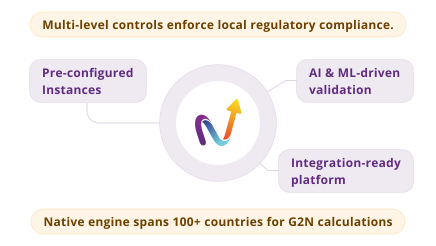
  • G2N Nova: G2N Nova provides global gross-to-net payroll processing in over 100 countries, making it the world’s most advanced native payroll engine. Available as a SaaS or service delivery platform, it can function as a stand-alone solution or integrate seamlessly with major HCM and Workforce Management systems

Conclusion

Explore Mercans’ complete Employer of Record (EOR) solutions in Spain, designed to streamline global expansion. From ensuring payroll accuracy and compliance to facilitating seamless workforce integration, Mercans offers unparalleled support and expertise for businesses entering the Spanish market, ensuring a smooth and successful journey.

This document was prepared for informational purposes only. As local laws & regulations keeps on changing. Please consult your tax & legal advisors as well.
Contact Sales
Let's get this conversation started. Tell us a bit about your requirement, and we'll get in touch a soon as we can.

    Sample message

    1. We want to expand in $country

    2. We want you to employ 'X' number of employees on our behalf

    3. Contract duration – 3/6/9/12/18/24 months

    4. Number of legal entities (if any exist today)

    5. Employment type: EOR employee or contractor?

    6. Any benefits requirement or “standard statutory only”?

    FAQs

    What is an Employer of Record in Spain, and what responsibilities do they cover?

    An Employer of Record in Spain is the legal employer. They manage contracts, payroll, taxes, benefits, and compliance.

    Is it legal to hire employees in Spain through an EOR, and what compliance requirements apply?

    Yes. The EOR complies with Spanish labor laws, social security, and tax rules.

    How does an EOR in Spain manage payroll, income tax, and social security contributions?

    The EOR calculates salaries, withholds income tax, and ensures social security payments.

    What are the benefits of using an EOR in Spain compared to setting up a local entity

    It enables quick and compliant hiring without establishing a subsidiary.

    Do EOR providers in Spain ensure compliance with CBAs and labor laws?

    Yes. They comply with CBAs and Spanish labor standards to protect employees.

    Ready to hire in Spain?

    No local entity needed. Our experts handle payroll, compliance, and onboarding.

    Talk to an expert
    Proven expertise in global payroll.