Employer of Record

Employer of Record (EOR) Qatar

Hire compliantly, pay accurately, expand confidently.

Global Payroll Team
Written by Global Payroll Team
Last updated April 24, 2026
Expert Reviewed

In the context of Qatar, our Employer of Record (EOR) Qatar services operate as the legal employer, aligning with the structure in Saudi Arabia. Functioning as a Global Professional Employer Organization (Global PEO), this key role encompasses extensive oversight of various employment aspects. The Employer of Record in Qatar ensures strict adherence to local labor laws and regulations, managing essential tasks such as payroll, statutory contributions where applicable, and mandatory benefits, while also crafting fundamental employment agreements.

In Qatar, the Employer of Record (EOR) Qatar assumes crucial responsibilities, including:
  • Ensuring rigorous compliance with the country’s employment laws.
  • Managing the intricacies of the local payroll process.
  • Overseeing the filing of employment-related documentation and necessary paperwork.
  • Providing the worker with accurate payslips.
  • Facilitating the seamless distribution of the worker’s salary payments.

Optimize your global expansion with our seamless Global PEO services, eliminating the need for entity setup. Our Employer of Record (EOR) Qatar guarantees legal presence, compliance, and Intellectual Property protection, enabling your business to concentrate on its core functions. Navigate global mobility and work visas effortlessly while cultivating a diverse and efficient global workforce. Choose Mercans as your trusted Employer of Record Qatar for a compliant and efficient employment experience for your global workforce.

Things you need to know before hiring in Qatar

EOR Solutions in Qatar

EOR for Prospective Employees
Mercans offers seamless Employer of Record (EOR) solutions for businesses that have already identified their ideal candidates in Qatar. Our services encompass every aspect of the employee lifecycle, ensuring compliance with Qatar labor laws and regulations.
EOR + Recruitment
For those seeking assistance in talent acquisition, our EOR and recruitment services provide a holistic solution. We tap into our extensive network and expertise to help you find, onboard, and retain top talent, streamlining your expansion into the Qatar market.
Visa Sponsorship and Global Mobility
Navigating the intricacies of expatriate employment is simplified through our visa sponsorship and global mobility services. We facilitate the relocation of your international workforce, ensuring compliance with Qatar immigration and employment laws.
AOR for Contractor Payments
Businesses grappling with contractor payments can leverage our Assistance on Record (AOR) services. We handle the complexities of contractor payments, guaranteeing accuracy and compliance.
Converting Freelancers to Employees
Mercans supports the transition from independent contractors to permanent employees in Qatar. Our expertise ensures smooth conversions while adhering to legal requirements.
HCM Integration
Integrate Mercans’ EOR services seamlessly with your HCM system in Qatar for real-time data exchange, enhanced compliance, and cost-efficiency. Trust our expertise for a unified, compliant, and efficient approach, elevating your workforce management and payroll operations.

Employment Contracts in Qatar

In Qatar, the process of creating and authenticating employment contracts has been streamlined through the Ministry of Labour’s multilingual E-Contract System and digital authentication services. Here’s a step-by-step guide to utilizing this service:

StepProcess
Access the Ministry of Labour e-serviceOpen the Ministry of Labour portal and use the E-Contract System / contract attestation service
Employer loginSign in using the employer’s approved digital credentials on the Ministry platform
Create the employment contractEnter the required worker and contract details in the system
Review and generate the contractGenerate the contract in the approved format and review the details before submission
Upload / submit supporting itemsSubmit the contract and any required supporting information through the online service
Ministry attestation / authenticationThe Ministry processes and authenticates the employment contract digitally
Download / print authenticated contractAfter authentication, the contract can be printed or downloaded from the contract printing portal
Payment of service feePay any applicable service fee through the Ministry’s e-service workflow, if required
Record retentionKeep the authenticated contract and receipt/reference for compliance purposes

This digitalized authentication process not only enhances efficiency but also helps ensure a secure and accessible method for both employers and employees in Qatar.

Working Hours

The maximum allowable working hours are 48 per week or eight hours per day. During the Ramadan period, working hours are shortened to 36 hours per week or six hours per day.

Employees have the right to a minimum of one day off per week, typically observed on Fridays. Additionally, employees should refrain from working on more than two consecutive Fridays.

It is mandatory for employees not to exceed five consecutive working hours without taking at least a one-hour break.

Probation Period

Probationary periods, lasting a maximum of six months, are allowed. During the probation period, the employer may terminate the contract if the worker is found not capable of carrying out the work, provided the worker is notified at least three days before the termination date.

If a worker wishes to change employer during the probation period under Qatar’s labour mobility rules, a notice period to the current employer is generally required under the applicable legal framework. Where the worker leaves Qatar instead of transferring locally, different practical requirements may apply depending on the worker’s status and process followed.

13th Monthly Salary

Salary payments must be made by the employer at least once a month for monthly paid workers. There is no legal obligation for 13-month payments, and employers have the discretion to grant bonuses as they see fit.

Employees vs Independent Contractors Compliance

FACTORSEMPLOYEEINDEPENDENT CONTRACTOR
Employment LawsPrimarily governed by Qatar Labour Law No. 14 of 2004, as amended, plus related ministerial decisions. If the employer is in the QFC, QFC employment regulations may apply.Generally governed by the Civil Code / commercial contract rules, not by the Labour Law as an employee relationship.
Hiring PracticeHired under a written employment contract. For non-Qataris, the employer handles work visa / residence permit processing and related onboarding steps.Usually engaged through a services agreement. In practice, contractors are commonly a licensed company or a person working under the sponsorship of a licensed company.
Tax Filing DocumentsNo personal income tax return is generally required for normal salary, wages, or allowances.Contractor handles own tax/business compliance if taxable in Qatar. Registration and filing would normally be through the General Tax Authority / Dhareeba where applicable.
Payer Tax Withholding and Reporting RequirementsNo payroll income tax withholding on employee salary, wages, or allowances.No payroll withholding like an employee; however, payments to a non-resident contractor/service provider may trigger Qatar withholding tax for the payer, depending on the payment type and structure.
Other Tax Filing RequirementsNone for ordinary employment income.Depends on whether the contractor has Qatar-source taxable business income, residency / PE status, and whether the contractor is resident or non-resident.
RemunerationPaid a salary or wage, usually on a monthly basis, and typically through the Wage Protection System (WPS).Paid according to contract terms, usually by invoice, milestone, or agreed payment schedule.
Workers’ RightsEntitled to Labour Law protections such as working-hours limits, overtime rules, annual leave, sick leave, public holidays, notice rules, and end-of-service rights.Not entitled to employee protections under the Labour Law; rights mainly depend on the service contract.
BenefitsStatutory/mandatory protections can include minimum wage compliance, annual leave, sick leave, maternity leave, public holiday pay, end-of-service gratuity, and employer-provided basic health insurance.No statutory employee benefits unless specifically agreed in the contract.
When PaidNormally monthly.As stated in the contract; often tied to invoice approval, milestones, or agreed due dates.
Classification CriteriaUsually exists where there is subordination/control, fixed working arrangements, employer supervision, and a registered employment relationship.Usually exists where the provider has greater autonomy, works on a service/result basis, and is not integrated as an employee.
Immigration / Work AuthorizationNon-Qatari employees must generally be sponsored by the employer and hold valid work/residence authorization.Foreign individuals generally cannot freely operate as unsponsored freelancers; in practice they usually need a licensed vehicle and/or lawful sponsorship structure to provide services in Qatar.

Note: Qatari law does not provide the same formal employee versus independent contractor framework commonly seen in some other jurisdictions. In practice, companies should exercise caution when engaging individuals outside a standard employment structure, especially where immigration sponsorship, work authorization, and labour law protections may be affected.

Social Security in Qatar

In Qatar, employers are obligated to contribute to social insurance on behalf of eligible Qatari employees and, where applicable, certain GCC national employees covered by the relevant pension coordination rules. This forms a crucial part of the employment framework for covered workers, ensuring financial security and support for the workforce.

Tax Landscape and Evolving Regulations

Qatar does not levy personal income tax on employment income. At the same time, businesses must remain aware of the wider indirect tax and customs landscape in the Gulf region, as well as any future legislative developments. Excise taxes on specific goods and customs duties continue to apply where relevant.

The General Retirement and Social Insurance Authority of Qatar has introduced changes to the Social Security and Pension Law that affect covered employees in the private sector. The revised contribution rates effective from 3 January 2023 increased the total contribution to 21% of the contributory wage, with the employer’s share at 14% and the employee’s share at 7%.

Nationality / CoverageNew RatesOld Rates
Qatari nationals (and eligible GCC nationals in scope)7% (Employee) / 14% (Employer) — calculated on basic salary + social allowance + housing allowance5% (Employee) / 10% (Employer) — calculated on basic salary + social allowance

Note: Social security contributions in Qatar are calculated according to the Social Security Law, with the contributory wage generally based on basic salary plus certain allowances and capped at a maximum limit of QAR 100,000. As of 3 January 2023, the contribution comprises 21% of the contributory wage, with the employer’s share at 14% and the employee’s share at 7% for covered employees.

Payroll in Qatar

Minimum Wages

Qatar’s minimum wage remains QAR 1,000.00 per month as the basic monthly wage. If the employer does not provide adequate housing and food, the employer must also pay a housing allowance of at least QAR 500.00 per month and a food allowance of at least QAR 300.00 per month. Where these allowances are paid rather than provided in kind, the minimum total monthly package is QAR 1,800.00. All values are denominated in Qatari Riyal.

Payroll Cycle

In Qatar, employees engaged on an annual or monthly basis are required to receive their payments at least once a month. For other employees, the payment frequency must be no less than once every two weeks. It is obligatory to conduct these transactions in the local currency, specifically the Qatari Riyal (QAR). Employers must ensure that wages are transferred in accordance with the Wage Protection System requirements and within the legally prescribed timeline.

How Mercans Can Help

Payroll Cycle
Navigating the intricacies of Qatar’s business landscape requires a nuanced understanding of the payroll cycle. Mercans, with its extensive experience, offers comprehensive solutions tailored to the unique requirements of the Qatari payroll system. From initial data input to the final disbursement, our services ensure accuracy and compliance with local regulations, providing organizations in Qatar with a seamless payroll experience.
Pay employees and contractors in the local currency
In the vibrant business environment of Qatar, smooth payroll transactions in the local currency are paramount. Mercans excels in this aspect, ensuring payments for both employees and contractors are conducted in Qatari Riyal. Our commitment to precision enhances transparency and facilitates seamless financial transactions within the country, making Mercans a reliable partner in the Qatari payroll landscape.
Payroll Setup, Payroll Processing and Payroll Administration
Managing payroll setup, processing, and administration in Qatar demands a comprehensive understanding of local nuances. Mercans, as a trusted payroll partner, provides tailored solutions to meet the specific needs of organizations in Qatar. Our dedicated team meticulously configures payroll processes, ensuring each cycle is executed with precision, guaranteeing compliance with Qatar’s regulatory framework.
Statutory Filings and Payments
Staying compliant with Qatar’s regulatory landscape is a priority for operational success. Mercans brings its expertise to the forefront by handling statutory filings and payments with meticulous care. Whether it’s navigating employment regulations, social insurance obligations where applicable, or meeting other compliance requirements, Mercans ensures that organizations in Qatar remain fully compliant, minimizing risks associated with non-compliance and providing peace of mind.

Qatar Employee Hiring Cost

In the process of expanding our team in Qatar, the employer’s total cost will depend on the employee’s salary package, benefits, immigration costs for expatriates, and any applicable social insurance contributions for covered employees. Because Qatar does not levy personal income tax on employment income and social insurance does not apply to all workers in the same way, total hiring costs vary depending on nationality, sponsorship setup, and compensation structure.

Industry Sector Average Annual Salary (In US$):

  • Education and Training: $54,600
  • Petroleum and Gas: $66,000
  • Manufacturing: $34,944
  • Mining: $46,137
  • Retail Trade: $55,965
  • Construction: $30,303

Termination, Notice Period and Severance Pay

Termination of Employment
Termination of employment in Qatar is subject to specific conditions outlined in the country’s labor regulations. Employers may terminate employment with notice in accordance with the Labour Law, and dismissal without notice is limited to the statutory grounds set out in the law. Termination by mutual consent is also a valid option.
Repatriation Responsibility
Employers in Qatar may dismiss employees summarily, without notice, only on the statutory grounds provided by the Qatari Labour Law. In addition, employers generally bear responsibility for repatriating the non-Qatari employee to the place from which the employee was recruited or to another agreed location, unless the employee joins another employer in Qatar. The employer is required to complete repatriation procedures within two weeks from the expiry date of the contract.
Notice Period and Payment
Regarding the notice period, after the probation period either party terminating an employment contract must adhere to the minimum statutory notice periods based on the employee’s duration of service. During the first and second years of service, the notice period is one month. After the second year of service, the notice period is two months. If the contract is terminated without observing these periods, the party terminating the contract must compensate the other party with an amount equal to the worker’s basic wage for the notice period or the remaining part of it.
Severance Pay (End-of-Service Gratuity)
Severance pay, referred to as end-of-service gratuity, is payable to employees who have completed one year or more of service. The gratuity must be agreed by the parties, provided that it is not less than three weeks’ wage for each year of service. The worker is also entitled to gratuity for fractions of a year in proportion to the duration of employment. The last basic wage is used as the basis for calculating the gratuity.

Employee Benefits in Qatar

Statutory Leaves in Qatar

In Qatar, statutory leaves are governed by specific regulations, encompassing annual leave, sick leave, and maternity leave to ensure employees’ well-being and work-life balance.

Annual Leave

Employees who have completed one continuous year of service are entitled to paid annual leave. Workers with less than five years of service are entitled to at least three weeks of annual leave, while those with five years or more of service are entitled to at least four weeks. Upon the worker’s written request, the employer may postpone not more than half of the annual leave to the following year. In addition to annual leave, employees are entitled to paid public holidays as provided by the Labour Law.

Sick Leave

After completing three months of service, employees in Qatar are entitled to sick leave with corresponding pay. This includes two weeks at 100% pay, followed by an additional four weeks at 50% pay. In cases where sickness extends beyond six weeks, unpaid sick leave, for a maximum of 12 weeks, becomes applicable. Employers may dismiss an employee without notice after this period, subject to the Labour Law. Medical certification remains essential for sick pay eligibility.

Maternity Leave

For female employees with at least one year of continuous service, Qatar mandates 50 days of maternity leave at full pay. A minimum of 35 days must be taken after childbirth. In situations involving pregnancy-related health issues, employees are entitled to an additional 60 days of unpaid leave. Furthermore, mothers are granted daily nursing breaks of up to one hour for one year following the child’s birth, highlighting the commitment to supporting working mothers during this significant life event.

Public Holidays

DateEnglish NameDescription
10 February 2026National Sports DayAnnual public holiday observed on the second Tuesday in February.
18 December 2026Qatar National DayNational day of Qatar.
19–21 March 2026*Eid al-FitrPublic holiday marking the end of Ramadan.
27–29 May 2026*Eid al-AdhaPublic holiday commemorating the Feast of Sacrifice.

Personal Income Tax in Qatar

Qatar does not levy personal income tax on employment income. Corporate income tax rules may apply to businesses depending on their structure and taxable presence.

Wage Protection System (WPS)

The Wage Protection System (WPS) serves as an essential tool for businesses, providing an electronic platform for streamlined salary transfers to workers through financial institutions in the State. The system is designed to help ensure accurate and timely wage payments within the private sector and supports the Ministry of Labour’s wage compliance framework.

For businesses seeking efficiency, the WPS Portal offers a convenient online solution to transfer employees’ salaries directly through the approved system, supporting timely payment and regulatory compliance.

Work Permit in Qatar

A Qatar work permit is part of the employer-sponsored process that allows a foreign national to work lawfully in Qatar. In practice, expatriate employees typically require both the appropriate entry visa or work approval and the necessary residence documentation to work and reside lawfully in the country.

Eligibility Criteria for Qatar Work Permit

Prospective applicants must meet the legal and administrative requirements applicable to the role and immigration process, including:

Valid Purpose

Applicants must have a legitimate employment purpose supported by a sponsoring employer in Qatar.

Professional Experience

Employers may require relevant qualifications or experience depending on the role, but this is not a universal statutory two-year rule for all work permit cases.

Financial Capability

Employers and applicants must satisfy the applicable immigration and employment documentation requirements for the intended category.

Intention to Return

This is not generally framed as a standard labour law eligibility criterion for all Qatar work permit cases.

Clean Record

Applicants may be required to provide supporting criminal record documentation depending on the immigration process and nationality.

Health Requirements

Applicants are commonly required to complete the applicable medical procedures linked to work and residence processing.

Best Employer of Record Qatar

Mercans Stands Out as the Leading Employer of Record in Qatar for the Following Reasons:

  • Regulatory Compliance: Mercans ensures full compliance with all regulations set by the Ministry of Labour and relevant Qatari authorities. It strictly adheres to Qatar’s employment laws and standards, guaranteeing full legal compliance.
  • Independent Operation: Operating as a distinct entity, Mercans offers reliable and customised employment services tailored to the unique needs of businesses in Qatar.
  • Diverse Employment Support: Mercans efficiently manages various forms of employment, including employees, freelancers, contractors, and expatriates, providing flexible solutions to meet a wide range of workforce needs.
  • Enterprise-Focused Solutions: Specifically designed to cater to large enterprises, Mercans delivers scalable and sophisticated services that accommodate complex organisational structures.
  • Multi-Currency Payroll Management: Mercans facilitates payroll processing in multiple currencies, ensuring seamless financial operations for businesses operating in Qatar and internationally.
  • Global Reach and Payroll Expertise: With a robust international presence, Mercans excels in managing multi-country payroll, enabling smooth operations across borders.
  • Data Protection and Compliance: Mercans adheres to rigorous data protection standards, including GDPR compliance and SOC 1 & SOC 2 certifications, ensuring the highest levels of data security.
  • ISO Certifications: Mercans holds ISO 20000 and ISO 27001 certifications, reflecting its commitment to excellence in IT service management and information security.
  • Security Standards Compliance: Mercans meets the OWASP ASVS 3.0 standards, ensuring strong security practices in application development and management.
  • HR Blizz Platform: The proprietary HR Blizz platform is a global payroll and talent management SaaS suite that streamlines payroll processes while ensuring compliance with Qatar’s regulations. With over 1,000 local experts, it provides in-depth knowledge of employment laws and business practices.
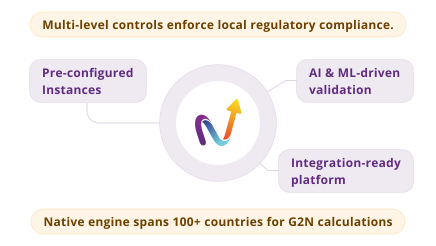
  • G2N Nova Payroll Engine: G2N Nova offers global gross-to-net payroll processing across more than 100 countries, making it one of the most advanced payroll engines available. It can be deployed as a SaaS solution or integrated seamlessly with major Human Capital Management and Workforce Management systems.

Conclusion

In conclusion, Mercans’ Employer of Record (EOR) services in Qatar offer a seamless solution for businesses aiming to expand their operations. With expertise in payroll, compliance, and comprehensive HR solutions, Mercans ensures a smooth and compliant entry into the Qatari market, allowing organizations to focus on their core objectives while leaving the complexities of employment management to the experts. Trust Mercans to navigate the intricacies of local regulations, enabling a successful and compliant business presence in Qatar.

This document was prepared for informational purposes only. As local laws & regulations keeps on changing. Please consult your tax & legal advisors as well.
Contact Sales
Let's get this conversation started. Tell us a bit about your requirement, and we'll get in touch a soon as we can.

    Sample message

    1. We want to expand in $country

    2. We want you to employ 'X' number of employees on our behalf

    3. Contract duration – 3/6/9/12/18/24 months

    4. Number of legal entities (if any exist today)

    5. Employment type: EOR employee or contractor?

    6. Any benefits requirement or “standard statutory only”?

    FAQs

    What is an Employer of Record in Qatar?

    An Employer of Record in Qatar is a third-party service provider that legally employs workers on behalf of another company. The EOR manages all employment-related responsibilities, including contracts, payroll, taxes, benefits, and compliance with Qatari labor laws, enabling businesses to hire employees without establishing a local entity.

    How can foreign companies hire employees in Qatar without setting up a local entity?

    Foreign companies can engage an EOR to hire employees in Qatar. The EOR becomes the legal employer, handling all statutory obligations, while the client company manages the employee’s daily tasks. This approach allows businesses to operate in Qatar without the need for a local branch or subsidiary.

    What compliance and payroll tasks does an EOR in Qatar handle?

    An EOR in Qatar ensures compliance with local labor laws by managing employment contracts, processing payroll, withholding and remitting taxes, making social security contributions, and providing mandatory employee benefits. They also handle statutory filings and maintain accurate records.

    What are the main benefits of using EOR services in Qatar?

    Utilizing an EOR in Qatar offers several advantages: it simplifies market entry by eliminating the need for a local entity, ensures compliance with complex labor laws, reduces administrative burdens, mitigates legal risks, and accelerates the hiring process.

    How much does it cost to hire employees through an EOR in Qatar?

    The cost of hiring through an EOR in Qatar varies depending on the provider and the services included. Generally, fees can range from $500 to $2,000 per employee per month. It’s advisable to consult with the EOR provider for a detailed pricing structure.

    Is an EOR the best solution for business expansion into Qatar?

    An EOR is an effective solution for businesses looking to expand into Qatar without the complexities of setting up a local entity. It provides a compliant and efficient way to hire employees, allowing companies to focus on their core operations while the EOR manages employment-related tasks.

    Ready to hire in Qatar?

    No local entity needed. Our experts handle payroll, compliance, and onboarding.

    Talk to an expert
    Proven expertise in global payroll.