Employer of Record

Employer of Record (EOR) Norway

Hire compliantly, pay accurately, expand confidently.

Global Payroll Team
Written by Global Payroll Team
Last updated April 24, 2026
Expert Reviewed
In Norway, the role of an Employer of Record Norway is pivotal for effective and seamless workforce management. As a distinguished Global Professional Employer Organization (Global PEO), the Employer of Record Norway assumes a comprehensive stance in overseeing various employment aspects. This encompasses stringent compliance with local labor laws, meticulous management of payroll intricacies, handling tax compliance, and provision of essential benefits to align with legal requirements.

Roles and Responsibilities of an Employer of Record (EOR) in Norway:
  • Employer of Record Norway shoulders crucial responsibilities for effective workforce management.
  • As a distinguished Global Professional Employer Organization (Global PEO), it oversees various employment aspects.
  • Responsibilities include stringent compliance with local labor laws, meticulous management of payroll intricacies, handling tax compliance, and provision of essential benefits.
  • The Employer of Record (EOR) in Norway plays a pivotal role in providing accurate, detailed payslips and ensuring timely distribution of salary payments.

Discover the myriad advantages offered by our tailored Global PEO services designed specifically for Norway, presenting a streamlined solution devoid of entity setup hassles. Serving as your trusted Employer of Record Norway, Mercans not only ensures legal compliance but also establishes a physical presence and safeguards Intellectual Property. This allows your business to focus on its core operations. Experience a simplified global mobility journey, streamlined visa processes, and the cultivation of a diverse and proficient global workforce with Mercans by your side.

Things you need to know before hiring in Norway

Employment Contracts in Norway

In accordance with the Working Environment Act in Norway, a written employment contract is mandatory for all positions. This contract must outline the terms and conditions of the employment and be provided to the employee as early as possible and no later than seven days after the start date for employment relationships lasting more than one month, or immediately for engagements lasting less than one month.

Typically, employment contracts are indefinite, granting employees the right to work until either party terminates the agreement. Temporary or fixed-term employment is restricted to specific situations, such as temporary work, replacements, traineeships, labor market schemes, sports-related roles, and CEO positions. Temporary employment is only permitted in the situations allowed by law, and the main rule in Norway remains permanent employment.

Collective agreements with unions may govern temporary employment for specific groups like artists, researchers, or sports-related workers. The Working Environment Act specifies essential elements to include in employment contracts, covering details like party identities, workplace location, job description, commencement date, expected duration for temporary roles, trial period conditions, holiday rights, termination notice periods, compensation, working hours, breaks, special working arrangements, and information about collective pay agreements if applicable.

Working Hours

Employees in Norway are entitled to clear information about their work schedule, including the timing and duration of their work. Regulations govern ordinary working hours to prevent excessive work, and provisions are in place to ensure compensation for overtime work.

Standard working hours in Norway adhere to the following legal maximum guidelines:

  • 9 hours within a 24-hour period
  • 40 hours over a 7-day period

Many workplaces operate with shorter agreed normal working hours, especially in shift, night, or Sunday work arrangements, where 38 or 36 hours per week may apply.

Probation Period

An employer has the option to hire an individual on probation for up to six months. Normally, the maximum duration of a trial period is six months, and for temporary employments, trial periods can never exceed half of the employment period. Upon completion of the probationary period, the employment continues under the agreed contract unless the employer has lawfully terminated it. Termination during probation must be objectively justified, for example by unsuitability for the work, lack of proficiency, or unreliability. The agreement concerning a trial period must be made in writing in the employment contract.

Employees vs Independent Contractors Compliance in Norway

Navigating the nuances of employee classification is crucial for compliance in Norway, distinguishing between Employees and Independent Contractors.

Criteria Employee Independent contractor
Responsibility for work result Normally works as part of the employer’s organisation and under the employer’s management; not typically engaged only to deliver a standalone result More typically engaged to deliver an agreed service or result and bears more commercial risk
Day-to-day instructions Usually subject to the employer’s direction and control Usually has greater freedom in how the work is organised and performed
Personal performance obligation Personal performance is a strong indicator of employee status May be able to use substitutes or assistants if the contract allows
Responsibility for work tools Employer may provide tools, equipment, and work resources More likely to use own tools and business resources
Number of customers Often works mainly for one employer May have multiple clients; this supports contractor status
Tax treatment Employer withholds tax through payroll and pays employer’s national insurance contributions on salary, holiday pay, and other remuneration. (Skatteetaten) Normally handles own tax affairs as business income; a sole proprietorship may also need to register for VAT depending on its activity and turnover. (Skatteetaten)
Benefit entitlement Covered by employee rules such as holiday pay and working-time protections. (Skatteetaten) Generally not entitled to employee holiday pay, dismissal protection, or other employee benefits as such
Protection from termination Protected by employment-law dismissal rules Relationship usually ends under contract terms rather than employee dismissal rules
Local limitations on use No general nationwide ban, but use of employees is governed by labour law No general nationwide ban, but classification must match the real relationship
Working hours regulation Covered by working-hours rules under the Working Environment framework. (Arbeidstilsynet) Not covered in the same way as employees, though contractual and HSE obligations can still apply
Leased or seconded employees Hiring-out and staffing arrangements are separately regulated under Norwegian labour rules A true contractor arrangement is different from labour hire; misclassification can be challenged
Regulation of different contracts Employment relationship is governed primarily by employment law Civil/commercial contract rules generally apply unless the person is in substance an employee

Payroll in Norway

Payroll Essentials for Norway

Government Requirements

Registration Requirements
  • Foreign Business Entities: Must register with the Register of Business Enterprises (Brønnøysund Register) and obtain a Norwegian legal organization number.
  • Business Number: Entities with employees need a business number in addition to the organization number. Separate business numbers may be required for different branches or locations.
  • Key Documents for Registration:
    • Complete and submit the Coordinated Register Notification form.
    • Certificate of Registration from the home country’s official authority.
    • Non-Norwegian ID number applicants should apply for a D-number to access the Altinn portal where relevant.
Ongoing Compliance Requirements
Monthly Payroll and Reporting to Norwegian Authorities:

  • Employees need a Norwegian personal ID or D-number and a tax deduction card.
  • Companies must withhold tax based on this card and pay Employer’s National Insurance Contribution (Arbeidsgiveravgift).
  • Monthly electronic reporting (A-melding) is required via Altinn.
  • Reporting deadline: the 5th of the following month, or the next working day if the 5th falls on a weekend or public holiday.
  • From January 2026, withholding tax deductions are generally due on the first working day after the salary payment, while Employer’s National Insurance Contributions are still paid every other month.
  • Additional statistical reports may be mandated.

Pension Requirements

Obligatory Occupational Pension (OTP)

  • Mandatory for companies that meet the statutory threshold, including companies with at least two employees meeting the working time and earnings conditions, or one employee without ownership interest working full-time.
  • OTP must be established once the obligation arises.
  • Minimum employer contributions are required under the occupational pension rules, and additional pension contributions can be agreed upon.

AFP (Alderspensjon fra Folketrygden)

A private sector tariff-based pension scheme supplementing the retirement pension from the National Insurance Scheme.

Employment Obligations

Labor Laws: Cover various aspects including:

  • Lay-offs
  • Employment contracts
  • Minimum salary standards in certain industries
  • Employment of foreign workers
  • Working hours
  • Compensation
  • Leave of absence and holidays
  • Sickness policies
  • Termination processes

Minimum Salary

There’s no general statutory minimum wage in Norway. However, minimum wages exist in specific industries through generally applicable collective agreements.

Mandatory Occupational Insurance

Employers must secure coverage for occupational injuries and illnesses.

Payroll Requirements

Pay Slip: Required to be issued after wages have been paid, or immediately thereafter, containing:

  • Gross salary
  • Tax deductions and other deductions made
  • Net salary
  • The calculation method for holiday pay

Minimum Wages in Norway

In Norway, there are no statutory provisions governing a general minimum wage. However, minimum wages are outlined in generally applicable collective agreements in certain sectors. Sectors with such generally applicable collective agreements include construction, maritime construction, agriculture, horticulture, cleaning, fish processing, electricians, freight and passenger transport, and hotel, restaurant, and catering.

Banking Requirements Related to Payroll

Payment to Employees
Must be transferred to employees’ bank accounts on the agreed date. Cash payment is generally not the normal compliant method for ordinary payroll.
Payment for Tax and Employers’ National Insurance Contribution
  • Withholding tax must be handled in accordance with the payroll withholding rules. Payments to the Norwegian tax authorities must be made in NOK, although foreign accounts can be used in some cases through IBAN for EU/EEA transactions.
Bank Guarantee
A bank guarantee can be applied if a withholding tax account is not set up. It must be approved by the Norwegian Tax Administration and include:

  • Guarantor bank and company details
  • Guarantee beneficiary
  • Guarantee amount
  • Continuation after termination until all salary-related tax deductions are settled.

When a collective agreement does not establish payment terms or if the work falls outside the scope of such agreements, employers and employees are free to mutually agree upon wages without specific statutory minimum requirements.

Payroll Cycle

Mercans ensures a seamless payroll cycle in Norway, aligning with the specific requirements of each client. Our expertise extends to navigating the absence of general statutory minimum wage regulations, allowing us to tailor payroll solutions based on collective agreements within relevant sectors. Whether your industry falls under construction, maritime, agriculture, or other categories, Mercans adapts payroll cycles to meet both legal and collective agreement standards, providing a comprehensive and compliant payroll experience.

Mercans’ Payroll Capabilities in Norway:

At Mercans, our payroll capabilities in Norway leverage our deep understanding of the absence of a general statutory minimum wage. We specialize in aligning with collective agreements to establish appropriate pay structures within sectors like construction, agriculture, and more. Our tailored approach ensures that payroll cycles are accurate, efficient, and fully compliant with applicable agreements, allowing businesses to navigate the nuances of wage determination in Norway seamlessly. Trust Mercans for precise and customized payroll solutions in alignment with the country’s regulatory landscape.

Note: All payroll processes are conducted within the framework of relevant collective agreements and industry-specific norms.

Social Security and Income Tax in Norway

Social Security Contributions

Employee’s Contribution
Individuals, including non-residents earning remuneration for services in Norway, may be subject to Norwegian national insurance contributions in addition to income taxes. The individual’s contribution rate for employees is currently 7.6%, while self-employed persons pay 10.8%. Foreigners may be exempt, either wholly or partially, based on social security agreements or if satisfactorily covered in their home country.
Conditions include
  • Income below NOK 99,650 is exempt, and contributions cannot exceed 25% of income beyond this threshold.
  • Individuals under 17 or over 69 years generally pay a reduced rate of 5.1%.
  • Employee contributions are not tax-deductible.
Employer’s Contribution
Employers must contribute to social security based on total Norwegian gross salary costs. The standard rate is 14.1%, but it may be lower in certain geographically differentiated zones. An additional employer’s national insurance contribution of 5.0% applies on wages exceeding NOK 750,000.

Income Tax

Employer’s National Insurance Contributions

Employers pay national insurance contributions on employees’ taxable remuneration. Rates, regionally differentiated, are set annually by the Norwegian Parliament.

  • Zone I 14.1%
  • Zone Ia 14.1% (10.6% until the tax-free amount is reached)
  • Zone II 10.6%
  • Zone III 6.4%
  • Zone IV 5.1%
  • Zone IVa 7.9%
  • Zone V 0%
  • Additional on wages over NOK 750,000 5.0%

National Insurance Contributions

Contributions fund the National Insurance Scheme and are calculated on personal income.

  • Salary income aged 17 to 69 7.6%
  • Salary and pension income under 17 or over 69 5.1%
  • Primary business income within fishing, hunting or childminding 7.6%
  • Other business income 10.8%
  • Pension income 5.1%
  • Lower limit for calculating contributions NOK 99,650

Contributions must not exceed 25% of income exceeding NOK 99,650.

Employee Benefits in Norway

Statutory Leaves

Below are the types of leaves in Norway:

Annual Leave
In Norway, the Annual Holiday Act ensures employees receive 25 working days of holiday annually, equivalent to four full weeks and one day. The Act mandates holiday payment at 10.2% of the previous year’s annual wages. Many collective agreements provide employees with five weeks of holiday, increasing the holiday payment percentage to 12%. Employees over 60 are entitled to an additional week of holiday.
Sick Leave
The employer generally pays sick pay for the first 16 days of sick leave. After this period, NAV generally pays sickness benefit. NAV sickness benefit is currently granted up to NOK 780,960, corresponding to 6G. Medical documentation rules apply, and employees may also have contractual rights to full payment during sick leave.
Maternity Leave
Parents in Norway are entitled to parental leave and parental benefit under the National Insurance rules. The exact compensated period depends on the benefit level chosen and how the leave is shared between the parents. Social Security compensates eligible parents for wage loss during the benefit period.
Paternity Leave
Fathers or co-parents are entitled to two weeks of unpaid leave in connection with childbirth. In addition, parental benefit rules reserve a specific portion of the compensated leave for each parent, subject to the current rules.
Partial Leave and Parental/Adoption Benefit
Employees may negotiate partial leave combined with partial payment of parental or adoption benefits through agreements with their employers.

Overall, Norway’s statutory leave provisions aim to support employees during significant life events, ensuring both financial security and work-life balance. Mercans assists employers in navigating and complying with these regulations, promoting a harmonious work environment.

Adoption and Foster Care
The right to leave in connection with birth also applies to adoption and foster care. Compensation from Social Security and potential contractual rights to full payment from employers remain applicable.

Overtime Pay

Overtime encompasses all hours worked beyond the regular working hours and on-call periods. The standard limit for general overtime is set at 10 hours per seven days, 25 hours per four consecutive weeks, or 200 hours within a 52-week period. Under written agreement with elected employee representatives in enterprises bound by collective agreement, higher limits may apply within the legal framework.

Special cases may warrant approval from the Labour Inspection Authority for higher overtime limits upon application. For overtime services, employees are entitled to a supplementary payment, and according to the Working Environment Act, this overtime supplement must be at least 40 percent. Many collective agreements stipulate a higher rate, often 50 percent or more.

Termination, Severance Pay and Notice Period

Employers in Norway have the option to terminate employees either with notice (discharge) or without notice (dismissal). Typically, discharge with notice is the standard termination procedure, and the Working Environment Act outlines the mandatory steps that must be followed before informing the employee of the company’s decision. Dismissal without notice (N. avskjed) is legally permissible only in cases of gross breach of duty or other serious breach of the employment contract and should be reserved for exceptional circumstances.

Termination based on objective grounds (N. saklig grunn) is allowed, with objective grounds falling into two categories: subjective personal reasons related to conduct or performance and objective reasons including redundancy, lack of work, and the employer’s economic situation. However, a discharge is not considered based on objective grounds if alternatives like reassignment within the business could have been pursued. Employers need to thoroughly explore all possibilities before deciding to discharge an employee.

In cases where termination lacks objective grounds, an employer becomes liable for damages, covering the employee’s loss, wages, and other entitled benefits. As a general rule, the employer may have to compensate for lost wages until the employee secures new employment, subject to the court’s assessment. The employer may also be responsible for non-economic losses.

Notably, Norway lacks statutory provisions requiring severance pay. However, certain businesses practice offering severance payments based on agreements. The statutory minimum notice period is generally one month, but longer notice periods apply depending on age, length of service, and the employment contract. For employees below age 50, the statutory notice period is generally one month if employed for less than 5 years, two months after more than 5 years, and three months after more than 10 years. Longer statutory periods may apply for older employees.

Work Permit

Navigating the Norwegian work permit system is essential for both employers and foreign nationals seeking opportunities in the country. Norway, being part of the common Nordic and European labour markets, has streamlined its immigration procedures.

For EU/EEA/EFTA nationals, the need for a work permit has been replaced by a registration requirement if staying for more than three months. A Norwegian personal identification number or a temporary D-number is necessary for residence and practical administration.

Foreign citizens from non-EU/EEA countries who plan to work in Norway generally require a residence permit, which should normally be obtained before starting work. Norway uses residence permits for work immigration rather than a separate standalone work permit framework for most long-term employment.

Common residence permits include:

  • Residence permit as a skilled worker: For individuals with higher education or vocational training, relevant qualifications, and a concrete job offer from a Norwegian employer. The employee may not start working until the permit has been granted, unless a confirmation of early employment start has been issued by the police.
  • Employee of a foreign company on assignment in Norway: Applies to certain foreign employees working in Norway on assignment, subject to the relevant UDI rules and permit category.

Nationals from EU/EEA/EFTA countries follow a registration scheme, allowing them to live and work in Norway without a residence permit, provided they register with the police when required.

For those seeking permanent residency, a continuous three-year stay with a relevant residence permit is generally necessary. Language and other conditions may apply. The process involves online registration, document submission, and review by the Norwegian Directorate of Immigration or the police. Processing times vary depending on the permit type and case load.

Understanding these procedures is vital for a smooth transition to working or living in Norway, ensuring compliance with immigration regulations and enhancing the overall experience for foreign nationals and their prospective employers.

EOR Solutions in Norway

EOR for Prospective Employees
Mercans offers seamless Employer of Record (EOR) solutions for businesses that have already identified their ideal candidates in Norway. Our services encompass every aspect of the employee lifecycle, ensuring compliance with Norway labor laws and regulations.
EOR + Recruitment
For those seeking assistance in talent acquisition, our EOR and recruitment services provide a holistic solution. We tap into our extensive network and expertise to help you find, onboard, and retain top talent, streamlining your expansion into the Norway market.
Visa Sponsorship and Global Mobility
Navigating the intricacies of expatriate employment is simplified through our visa sponsorship and global mobility services. We facilitate the relocation of your international workforce, ensuring compliance with Norway immigration and employment laws.
AOR for Contractor Payments
Businesses grappling with contractor payments can leverage our Assistance on Record (AOR) services. We handle the complexities of contractor payments, guaranteeing accuracy and compliance.
Converting Freelancers to Employees
Mercans supports the transition from independent contractors to permanent employees in Norway. Our expertise ensures smooth conversions while adhering to legal requirements.
HCM Integration
Integrate Mercans’ EOR services seamlessly with your HCM system in Norway for real-time data exchange, enhanced compliance, and cost-efficiency. Trust our expertise for a unified, compliant, and efficient approach, elevating your workforce management and payroll operations.

Best Employer of Record (EOR) in Norway

Mercans is the premier employer of record in Norway for the following reasons:

  • Regulatory Compliance with NAV and Arbeidstilsynet: Mercans ensures strict adherence to all regulatory requirements established by the Norwegian Labour and Welfare Administration (NAV) and the Norwegian Labour Inspection Authority (Arbeidstilsynet).
  • Independent Operation: As a standalone entity, Mercans operates independently, offering reliable and tailored employment services.
  • Diverse Employment Support: Mercans effectively manages various employment types, including employees, freelancers, contractors, and expatriates, providing flexible solutions for different business needs.
  • Designed for Large Enterprises: Tailored to meet the demands of enterprise businesses, Mercans offers scalable and sophisticated services that accommodate complex organizational structures.
  • Multi-Currency Payroll Management: Mercans manages payroll in multiple currencies, facilitating seamless financial operations for global and multinational businesses.
  • Global Reach and Payroll Expertise: With a comprehensive global network, Mercans excels in handling multi-country payroll, ensuring smooth international operations.
  • Compliance with Data Protection Standards: Mercans adheres to stringent data protection and security standards, including GDPR certification and SOC 1 & SOC 2 compliance.
  • ISO Certified for Quality and Security: Holding ISO 20000 and ISO 27001 certifications, Mercans demonstrates a commitment to high-quality IT service management and information security.
  • Robust Application Security: Mercans meets OWASP ASVS 3.0 standards, ensuring strong security practices in application development and management.
  • HRBlizz Platform: Mercans HRBlizz is a proprietary global payroll and talent management SaaS suite that streamlines payroll processes while ensuring compliance with local regulations. Supported by over 1,000 in-country specialists, it provides expert knowledge of labor laws and business protocols.
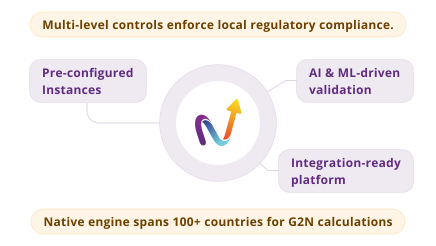
  • G2N Nova Payroll Processing: G2N Nova offers global gross-to-net payroll processing in over 100 countries, making it the world’s most advanced native payroll engine. Available as a SaaS or service delivery platform, it can function as a stand-alone solution or seamlessly integrate with major HCM and Workforce Management systems.

Conclusion

Mercans’ EOR solutions in Norway go beyond traditional services, offering a comprehensive package that addresses legal, financial, and operational aspects. Subtly embedded in our services is a commitment to supporting your business’s growth while ensuring compliance and efficiency in the dynamic Norwegian business landscape. Choose Mercans as your trusted partner for a compliant and efficient employment experience in Norway.

This document was prepared for informational purposes only. As local laws & regulations keeps on changing. Please consult your tax & legal advisors as well.
Contact Sales
Let's get this conversation started. Tell us a bit about your requirement, and we'll get in touch a soon as we can.

    Sample message

    1. We want to expand in $country

    2. We want you to employ 'X' number of employees on our behalf

    3. Contract duration – 3/6/9/12/18/24 months

    4. Number of legal entities (if any exist today)

    5. Employment type: EOR employee or contractor?

    6. Any benefits requirement or “standard statutory only”?

    FAQs

    What is an Employer of Record in Norway, and what responsibilities do they cover?

    An Employer of Record in Norway is the legal employer. They manage contracts, payroll, benefits, and compliance while your company directs daily activities.

    Is it legal to hire employees in Norway through an EOR, and what compliance requirements apply?

    Yes. The EOR complies with Norwegian labor laws, tax rules, and social security obligations.

    How does an EOR in Norway manage payroll, income tax, and social security contributions?

    The EOR calculates salaries, withholds taxes, and pays social security contributions on time.

    What advantages does using an EOR in Norway offer compared to establishing a local entity?

    It allows fast and compliant hiring without creating a subsidiary, reducing risks and costs.

    Do EOR providers in Norway ensure compliance with collective bargaining agreements and regulations?

    Yes. They follow CBAs and labor laws covering wages, hours, and employee rights.

    Ready to hire in Norway?

    No local entity needed. Our experts handle payroll, compliance, and onboarding.

    Talk to an expert
    Proven expertise in global payroll.