Employer of Record

Employer of Record (EOR) in Netherlands

Hire compliantly, pay accurately, expand confidently.

Global Payroll Team
Written by Global Payroll Team
Last updated April 24, 2026
Expert Reviewed

A Dutch Employer of Record (EOR), also known as a Global Professional Employer Organization (Global PEO), offers a simplified solution for businesses expanding into the Netherlands without the need for entity setup. Mercans provides the legal presence required for your business and ensures full Intellectual Property (IP) protection, while managing all aspects of local compliance, including payroll, taxes, statutory benefits, and employment contracts.

The Employer of Record (EOR) in the Netherlands is responsible for:

  • Ensuring compliance with Dutch employment laws and regulations.
  • Managing local payroll and statutory benefits.
  • Handling taxes and other mandatory filings.
  • Drafting and maintaining employment contracts.
  • Distributing payslips and salary payments.

By leveraging Mercans’ EOR services in Europe, businesses can efficiently navigate the complexities of Dutch employment law, ensuring compliance while focusing on core operations. Whether your goal is strategic expansion or hiring top talent in the Netherlands, Mercans’ global solutions advisors are here to guide you in making the best decisions for your organization’s growth.

Things you need to know before hiring in Netherlands

EOR Solutions in the Netherlands

EOR for Prospective Employees
Mercans offers seamless Employer of Record (EOR) solutions for businesses that have already identified their ideal candidates in the Netherlands. Our services encompass every aspect of the employee lifecycle, ensuring compliance with Dutch labor laws and regulations.
EOR + Recruitment
For those seeking assistance in talent acquisition, our EOR and recruitment services provide a holistic solution. We tap into our extensive network and expertise to help you find, onboard, and retain top talent, streamlining your expansion into the Dutch market.
Visa Sponsorship and Global Mobility
Navigating the intricacies of expatriate employment is simplified through our visa sponsorship and global mobility services. We facilitate the relocation of your international workforce, ensuring compliance with Dutch immigration and employment laws.
AOR for Contractor Payments
Businesses grappling with contractor payments can leverage our Assistance on Record (AOR) services. We handle the complexities of contractor payments, guaranteeing accuracy and compliance.
Converting Freelancers to Employees
Mercans supports the transition from independent contractors to permanent employees in the Netherlands. Our expertise ensures smooth conversions while adhering to legal requirements.
HCM Integration
Integrate Mercans’ EOR services seamlessly with your HCM system in the Netherlands for real-time data exchange, enhanced compliance, and cost efficiency. Trust our expertise for a unified, compliant, and efficient approach, elevating your workforce management and payroll operations.

Employment in the Netherlands

Employment in the Netherlands is governed by comprehensive regulations. Understanding Dutch labor laws, including working hours, minimum wages, and employee benefits like health insurance and unemployment insurance, is essential for businesses. Leave policies, taxation, and expat mobility matters demand attention. Mercans simplifies employment in the Netherlands, offering EOR solutions, recruitment, visa sponsorship, payroll services, and expertise in compliance with local laws, ensuring smooth, efficient operations for both businesses and employees.

Employees vs. Independent Contractors

Understanding the distinction between employees and independent contractors is pivotal for compliance. Mercans offers access to resources that shed light on the nuances of worker classification in the Netherlands. These insights, along with our EOR services, empower you to make informed decisions while ensuring compliance with Dutch regulations. Partner with Mercans to embark on a successful employment journey in the Netherlands, where expertise meets compliance, ensuring your business thrives in the Dutch market.

Understanding Worker Classification: Employees vs. Contractors in the Netherlands

Factors Employee Independent contractor (zzp / self-employed)
Control over work Works under the employer’s direction and supervision More autonomy; can usually decide how and when the work is done
Work arrangement Often embedded in the employer’s organisation Works more independently and with more entrepreneurial freedom
Equipment and materials Employer may provide tools and equipment More likely to invest in and use own materials and tools
Employment protections Covered by employment law protections such as minimum wage, paid leave, dismissal rules, and statutory leave schemes Generally not covered by employee protections as such
Pay and holiday allowance Entitled to at least the statutory minimum wage and usually holiday allowance Paid according to the service contract; no statutory employee holiday allowance
Contract basis Employment contract (temporary or permanent) Contract for services / assignment
Duration Can be fixed-term or permanent Often project-based or assignment-based, but duration alone is not decisive
Tax and social security Employer handles payroll taxes and employer obligations Usually responsible for own tax affairs and VAT position where applicable
Severance / end of relationship Dismissal rules apply, and transition payment may be due End of contract is mainly governed by the contract terms
Exclusivity / other clients May work exclusively or not, depending on contract and law Usually expected to be available for other clients; working for multiple clients supports zzp status
Risk and entrepreneurship Less personal business risk More entrepreneurial risk and investment are indicators of zzp status

Hiring and Recruiting in Netherlands

Top #5 Cities With Remote Talent
In the vibrant job market of the Netherlands, hiring and recruiting have never been more dynamic. Here’s a succinct overview of the top Dutch cities brimming with remote talent:

  • Amsterdam: The Dutch capital, Amsterdam, is a hotspot for IT specialists, digital marketers, and finance professionals, with a growing demand for tech-savvy talents in areas like software development and data analysis.
  • Rotterdam: Rotterdam seeks logistics and supply chain experts due to its strategic port, alongside professionals in engineering and sustainability roles, reflecting the city’s focus on innovative solutions.
  • Utrecht: Utrecht has a burgeoning demand for healthcare and life sciences professionals, as well as a need for educators and researchers in its renowned universities.
  • The Hague: The Hague’s international character drives the demand for multilingual professionals, particularly in diplomatic and legal roles. IT experts and consultants are also in high demand to support various organizations.
  • EindhovenEindhoven’s thriving tech industry fuels the demand for engineers, especially those specializing in electronics and software development. Design and creative professionals also find ample opportunities in this innovation hub.

Mercans plays a pivotal role in connecting global companies with the right talent for these in-demand job roles across Dutch cities. Our Employer of Record (EOR) services simplify recruitment, management, and compliance, making the Netherlands an attractive destination for both businesses and professionals seeking growth and career opportunities.

Top #5 Jobs on Demand
Navigating the Dutch job market reveals specific roles that are in high demand. Here are the top jobs sought after in the Netherlands:

  • Software Developers: With a flourishing tech industry, skilled software developers are highly sought after, particularly those with expertise in languages like Java, Python, and JavaScript.
  • Digital Marketers: As businesses embrace digital transformation, the demand for digital marketing professionals, including SEO and SEM specialists, continues to surge.
  • Data Analysts: Data-driven decision-making is crucial, making data analysts, data scientists, and AI specialists indispensable in various sectors.
  • Healthcare Professionals: The healthcare sector continues to require nurses, doctors, and healthcare managers.
  • Logistics Experts: Due to the Netherlands’ strategic location as a European logistics hub, professionals in supply chain management, logistics, and transportation are in high demand.

Mercans plays a pivotal role in connecting global companies with these in-demand talents, simplifying recruitment, management, and compliance. We empower businesses to thrive in the Netherlands’ dynamic job market.

Employee Onboarding

Employee onboarding in the Netherlands is streamlined with Mercans’ EOR platform. Our integrated solution offers an employee self-serve portal, simplifying the onboarding process. New hires can access essential information, submit documentation, and complete the employee take-in form with ease. This user-friendly portal ensures a smooth transition for employees, reducing administrative burdens on HR teams. It empowers individuals to manage their onboarding efficiently, from tax declarations to selecting benefits. Mercans’ commitment to innovative technology enhances the onboarding experience, setting the stage for a successful employment journey in the Netherlands.

Background Verification

In the Netherlands, hiring demands careful and lawful background checks. Mercans simplifies this through our EOR services. We offer a comprehensive suite of checks:

  • Identity Verification scrutinizes official IDs
  • Employment History confirms roles and dates
  • Education Verification validates qualifications
  • Criminal Background Checks must comply with Dutch privacy and employment laws
  • Credit Checks may be used only where justified by the role
  • and Reference Checks collect insights on abilities and character.

Mercans ensures secure, compliant, and informed hiring decisions in the Netherlands.

Payroll in Netherlands

Payroll Essentials for the Netherlands

Government Requirements
  • Registration with the Chamber of Commerce: Companies intending to supply services, engage in sales, trading, or manufacturing in the Netherlands must register with the Chamber of Commerce. This is a mandatory step for establishing a legal business presence.
  • Registration with the Dutch Tax Authorities as an Employer: Employers must register as a Dutch wage tax withholding agent with the Dutch Tax Administration. This registration allows employers to calculate and remit wage tax and employee insurance contributions on behalf of their employees.
  • Registration with the Dutch Tax Authorities as an Employee: Employees need to obtain a Dutch fiscal number, known as the “Burgerservicenummer” (BSN). Residents can obtain a BSN at their local municipality, while certain non-residents can obtain one through an RNI desk.
Ongoing Compliance Requirements
  • Wage Tax Return and Payment: Employers are required to file electronic wage tax returns and make payments within one month after each pay period. Failure to comply may result in penalties.
  • Dutch Personal Income Tax (PIT) Return: The Dutch tax year runs from January 1 to December 31. Tax returns are generally due by May 1 of the following year, and taxpayers must file a return upon receiving an invitation from the Dutch Tax Administration.
Pension Requirements

Registration Requirements

  • A Dutch employer is generally not mandated to offer a pension scheme unless a collective labor agreement applies or a mandatory industry pension fund is in place. However, many employers choose to offer pension arrangements voluntarily.

Ongoing Compliance Requirements

  • Employers must ensure the timely payment of contributions to pension funds, which are typically deducted from employee wages during the payroll process. Contribution rates vary per fund and may be paid monthly, quarterly, or annually.
Employment Obligations
  • Employment Contracts: Employers must draft employment contracts compliant with Dutch employment law and any applicable collective labor agreements.
  • Minimum Wages: As of January 1, 2026, the minimum wage for individuals aged 21 and over is €14.71 per hour. Employers must also account for the mandatory holiday allowance of at least 8%.
  • Holiday Leave and Illness: Employees are entitled to a minimum of four times their average weekly working days in paid holiday leave. Employers are also required to continue paying at least 70% of wages during the first two years of illness, subject to the statutory minimum wage rule in the first year and any higher CAO or contractual entitlement.
  • Compensation and Benefits Package: Within legal limits, employers can offer a flexible compensation and benefits package. Regular reviews of contracts, pension plans, and compensation levels are recommended.
  • Extraterritorial Costs and the Expat Scheme: Employers can reimburse employees for extraterritorial costs incurred while working in the Netherlands. Alternatively, they can apply the Dutch Expat Scheme, formerly known as the 30% ruling, for qualifying employees recruited from abroad.
  • Reimbursement of Actual Costs: Employers may reimburse actual extraterritorial costs tax-free, provided the expenses are substantiated.
  • Expat Scheme: The scheme allows a tax-free reimbursement for qualifying foreign employees, subject to statutory conditions, salary thresholds, and the annual cap that applies in 2026.
  • Immigration: European Economic Area (EEA) and Swiss nationals do not require work permits. Non-EEA employees must verify the need for work and residence permits.
  • Social Security: Employees are typically covered by the social security system of the country where they perform work. Specific regulations apply to EEA and non-EEA employees.
  • EEA and Switzerland: The social security status of individuals working in different EEA countries is determined based on EU regulations. An A1 statement may be requested for verification of coverage.
  • Social Security Treaty: Employees from countries with a social security treaty with the Netherlands may have different obligations. It is advisable to review the applicable treaty.
  • Foreign Company Pension: Contributions to foreign pension schemes may be considered taxable income in the Netherlands unless certain conditions are met for favorable tax treatment.
  • Healthcare: All residents and most workers must obtain Dutch healthcare insurance, with exceptions in limited cross-border cases such as valid A1 or certificate of coverage situations.
  • Employee File: Employers are required to maintain an employee file containing mandatory documents such as employment contracts, identification, wage tax statements, and any applicable permits.
  • Occupational Health Service: Employers must engage an occupational health service to assist with compliance regarding employee health and safety, illness, and rehabilitation.
Payroll Requirements
  • Work-Related Cost Scheme: The WKR allows employers to provide benefits and allowances to employees with specific tax-free limits. Amounts beyond the free space are subject to an 80% final levy.
  • Reporting Obligations: Employers must calculate and report any owed tax from the WKR annually in the wage tax return.
Banking Requirements Related to Payroll
Payroll net payments must be made in local currency and can be processed from either a Dutch or overseas bank account. Payments to Dutch authorities should also be made so that all transaction fees are covered to prevent interest charges or short payments.

Statutory Filings and Payments in the Netherlands

Statutory Filings

The table below outlines the various payroll-related statutory filings. Please note that statutory filings and payments are not part of the standard service scope.

Statutory body Filing description Frequency Filing deadline Purpose
Belastingdienst Payroll tax return (loonaangifte / aangifte loonheffingen) Every 4 weeks or monthly By the due date in the Belastingdienst 2026 filing/payment calendar; in practice this is tied to each monthly or 4-weekly period rather than a generic “one month after month-end” rule Report and pay payroll taxes and employee-insurance related payroll charges
Pension fund / pension administrator Pension declaration (often via UPA) Usually monthly, but depends on the pension scheme/fund Varies by pension fund or administrator; there is no single universal Dutch legal deadline of 10 days after month-end for all funds Report pensionable salary and pension premiums
Stichting PAWW PAWW contribution return 4-weekly, monthly, or quarterly According to the SPAWW employer calendar. Examples for 2026: monthly return for January 2026 due 28 February 2026; Q1 2026 due 30 April 2026; 4-weekly period 2026-3 due 22 April 2026 Report PAWW contributions for employers participating in the PAWW scheme
CBS Statistical survey return, if selected Not a universal standard payroll filing for all employers Deadline stated in the CBS survey request Collection of official statistics
UWV WAZO application for pregnancy and maternity benefit Event-based Employer applies between 4 and 2 weeks before the leave starts Apply for UWV pregnancy/maternity benefit

Registration of New Hires and Leavers with Tax and Social Security Authorities

New Hire Registration Process
New hires are registered with tax and social security authorities through periodic payroll tax filings.
Social Security Authority
The registration of new hires and leavers with the social security system occurs through the payroll tax reporting process.
Required Documents for New Hires
  • Copy of the employee’s ID
  • Completed “Model Opgaaf gegevens voor de loonheffingen” form

Note: These documents do not need to be submitted to authorities but must be retained for reference and potential tax audits.

Tax Authority
Registration of new hires and leavers with the Tax Authority also occurs automatically through periodic payroll tax reports.
Payments to Statutory Bodies
Statutory filings and payments, including money movement services and payments to third parties, are classified as add-on services. If the Client opts for these statutory filings and payments services, the following activities will be included:

Social Security Payments:

  • Due Date: Contributions are due one month after the payroll period ends.
  • Payment Options: Payments should be made via bank transfer. The payment reference is provided in the annual employer communication detailing reporting and payment due dates, including both wage taxes and employee insurance contributions.

Tax Agency:

  • Local Office Name: Belastingdienst (Tax and Customs Administration)

Wage tax and employee social security contributions are reported in a single declaration and are payable within one month after the end of the reporting period.

Declarations and Payments Required by the Tax Authority

Service description Filing frequency Due date
Payroll tax return and payment (aangifte loonheffingen) Every 4 weeks or monthly By the Belastingdienst due date for the relevant 2026 filing period
Annual final levy under the work-related costs scheme (WKR eindheffing) Annually Declared in the payroll tax return for the 2nd return period of the following calendar year
Pseudo-final levy on excessive severance payments (pseudo-eindheffing excessieve vertrekvergoeding) Event-based / annual assessment when applicable Reported via the payroll tax return once the levy becomes due; not a standard monthly filing

Payroll Taxes in Netherlands

What Are Payroll Taxes?

Payroll taxes are mandatory contributions that employers withhold from their employees’ wages to fund various social programs and government services. In the Netherlands, payroll taxes primarily consist of the following components:

  • Wage Tax
  • National Insurance Contributions
  • Employed Persons’ Insurance Contributions
  • Income-Dependent Contribution Pursuant to the Health Care Insurance Act (Zvw)
Wage Tax
Wage tax is withheld from employee wages and serves as an advance payment of income tax. Employers are responsible for deducting this tax from employees’ paychecks and remitting it to the tax authorities.
National Insurance Contributions
National insurance contributions fund social security schemes that provide financial support to residents and employees in the Netherlands. Participation in these schemes is mandatory. The national insurance schemes include:

  • General Old Age Pensions Act (AOW)
  • Surviving Dependants Act (Anw)
  • Long-Term Care Act (Wlz)
  • General Child Benefit Act (AKW)

Employers are responsible for withholding the relevant payroll tax and national insurance amounts where applicable and remitting them to the Tax Administration.

Employed Persons’ Insurance Contributions
These contributions are also mandatory and fund insurance schemes that protect employees from financial difficulties due to illness, occupational disability, and unemployment. The employed persons’ insurance schemes include:

  • Sickness Benefits Act (ZW)
  • Work and Income according to Work Capacity Act (WIA)
  • Unemployment Insurance Act (WW)

The full cost of employed persons’ insurance contributions is borne by the employer.

Income-Dependent Contribution Pursuant to the Health Care Insurance Act (Zvw)
Under the Health Care Insurance Act (Zvw), employees pay their own nominal health insurance premium to a health insurer. In addition, employers are required to pay the income-dependent employer contribution to the Tax Administration on behalf of their employees.

Cost to Hire an Employee in Netherlands

Employment in the Netherlands entails an array of obligations, from social security contributions to healthcare, disability, and unemployment insurance. These factors collectively form the employment cost in the Netherlands, requiring businesses to understand and manage these expenses carefully.

How Mercans Can Help

Social Security Contributions

The rates of social security contributions in the Netherlands can vary from year to year. Here are the main contributions to consider for 2026:

  • The wage tax and national insurance withholding follow the current Dutch payroll tax tables.
  • Employers must pay AWf premiums of 2.74% for the low rate or 7.74% for the high rate, depending on the contract type.
  • Employers must also account for employer-side contributions such as Zvw, Aof, Whk and any applicable sector or pension charges.
  • Employees must maintain mandatory Dutch health insurance unless an exception applies.

The realm of social security contributions (SSC) in the Netherlands is extensive and multifaceted, encompassing a range of vital contributions crucial for both employees and employers. Among these are:

Healthcare Insurance Act (Zvw)

Provides essential healthcare coverage in the Netherlands through the mandatory health insurance framework and employer-side income-dependent contribution.

Disability Fund (Aof)

Supports disability-related benefits and employer financing obligations under Dutch payroll law.

Work and Income according to Work Capacity Act (WIA)

Provides long-term support for employees with reduced work capacity.

General Unemployment Fund (Awf)

Funds unemployment insurance and uses differentiated low and high premiums.

Work Resumption Fund (Whk)

Helps finance return-to-work and sickness-related schemes.

National Insurance Schemes

Include AOW, Anw, and Wlz within the broader Dutch social protection system.

Comprehensive Understanding

Our experts provide an in-depth understanding of SSCs, enabling you to grasp the intricacies and implications of each contribution.

Conversion Assistance

We help your organization remain informed and compliant as Dutch payroll rules evolve.

Additional Key Terms

  • Unemployment Benefit Scheme (WW): Mercans assists in managing the Dutch Unemployment Benefit Scheme (WW – Werkloosheidswet), a crucial element of social security.
  • State Pension (AOW): We guide you through the State Pension (AOW – Algemene Ouderdomswet), ensuring your employees’ future retirement is secure.
  • Dutch Occupational Pension: Mercans’ expertise extends to managing Dutch occupational pension schemes, aligning with Dutch pension regulations.
  • Dutch Holiday Allowance (Vakantiegeld): We help administer the Dutch holiday allowance of at least 8%, a significant component of employee compensation.
  • Employing staff in the Netherlands can be intricate, but with Mercans as your trusted partner, you can focus on core business activities while we efficiently manage the complexities, saving you valuable time and resources.

Employee Cost Calculation in Netherlands

Employer Cost

Employer costs encompass the expenses borne by an employer, over and above the employee’s base salary. These are the additional payments made in support of your workforce. Wage-related expenses can fluctuate, influenced by individual agreements with employees and obligations stipulated in collective agreements or industry regulations. Notably, the Dutch system imposes a range of responsibilities on employers in support of their staff.

In the Netherlands, employers’ costs can be categorized into two main types: fixed (mandatory) and supplementary (optional), which together constitute the total outlay for employers. Here’s a breakdown:

  • Gross monthly salary
  • Holiday allowance (at least 8%)
  • Pension contribution (if mandatory or offered)
  • Employer insurance contributions such as AWf, Aof, Whk, and Zvw
  • Expense allowances

Now, let us assume an employee has a gross salary of € 2.400,00. Here is the cost per month for that employee based on that salary:

GROSS SALARY €2,400.00
Holiday allowance (8%) 192.00
Pension contribution Variable / scheme-dependent
Employer insurance and healthcare contributions € 444.01 to € 608.86
Expense allowances Variable / only if agreed
Total employer cost € 3,036.01 to € 3,200.86

Employment Contracts in Netherlands

An employment contract (arbeidscontract) is a formal agreement between an employee and an employer that outlines the conditions of employment (arbeidsvoorwaarden). These contracts can be categorized primarily into two types: fixed-term and permanent contracts.

Types of Employment Contracts
  • Fixed-term Contracts: These are temporary agreements that specify a duration of employment. Fixed-term contracts can be written or verbal.
  • Permanent Contracts: This type of contract has no predetermined end date, providing employees with greater job security.
Transitioning from Temporary to Permanent Contracts
Employers cannot extend temporary contracts indefinitely. According to Dutch law, an employee is entitled to a permanent contract after:

  • More than 3 consecutive temporary contracts, or
  • A total duration of more than 3 years of temporary contracts.

This regulation may be subject to variation based on stipulations within a collective labor agreement (Collectieve Arbeidsovereenkomst, CAO).

Written Statement of Employment Details
Employers are required to provide employees with clear information regarding their employment conditions. The written employment contract must include the following details:

  • Employer and Employee Information: Names and places of residence.
  • Work Location: Specify if there are multiple workplaces and if the employee can choose their work location.
  • Job Description: A clear outline of the employee’s role or nature of work.
  • Working Hours: Usual hours per day or week, including arrangements for overtime and shift swapping.
  • Salary Details: Starting salary, components of salary, and payment frequency.
  • Variable Hours and Overtime: Terms for irregular working hours and salary for overtime.
  • Work Schedule: Days and hours when the employee may be required to work.
  • Start Date: The date the employee joined the company.
  • Contract Term: The duration of the contract if it is fixed-term.
  • Type of Contract: Whether it’s temporary, payroll, or permanent.
  • Trial Period: Duration and conditions if applicable.
  • Training Entitlement: Any educational training offered by the employer.
  • Holidays: Holiday entitlement and allowance, including paid leave and calculation methods.
  • Termination Procedures: Notice periods and procedural requirements for ending the employment agreement.
  • Pension Information: Details if applicable.
  • Non-Compete/Non-Solicitation Clauses: Conditions if applicable.
  • Restrictions on Ancillary Activities: Objective justifications for any restrictions.
  • Collective Labor Agreement (CAO): If applicable, reference to any relevant CAO.

Collective Labor Agreements (CAOs) in the Netherlands

If you operate a business in the Netherlands and hire employees, you may be required to engage with a Collective Labor Agreement (Collectieve Arbeidsovereenkomst, CAO). It’s crucial to determine whether a CAO applies to your business and understand the conditions under which your employment terms may differ from the CAO.

What is a CAO?

A CAO is a collective agreement between employers (or employers’ organizations) and employees (trade unions) that outlines key employment conditions, including:

  • Wages
  • Working hours
  • Notice periods
  • Pensions

There are two primary types of collective agreements:

  • Sectoral Collective Agreements These are agreements that apply within a specific sector, covering all companies and employees within that industry.
  • Company Collective Agreements These agreements are tailored to a specific company, outlining employment conditions unique to that organization.

When Does a CAO Apply?

A CAO can be applicable to either a single company or an entire business sector. You must comply with a CAO if:

  • You have directly concluded it with trade unions.
  • You are a member of an employer’s organization that has established a CAO for your business sector.
  • You are not a member of an employer’s organization, but the Ministry of Social Affairs and Employment has declared a CAO binding for your sector (Algemeen Verbindend Verklaring or AVV).
  • You are not a member of an employer’s organization, and no binding CAO exists for your sector, but you implement your own CAO.

Employee Benefits in Netherlands

Overview of Mandatory Employee Benefits in the Netherlands

The Dutch social security system is one of the most comprehensive in Europe, comprising two main parts: the National Insurance Scheme (volksverzekeringen) and the Employee Insurance Scheme (werknemersverzekeringen). Here’s a breakdown of the mandatory benefits provided under these schemes:

National Insurance Benefits
National insurance contributions are applicable when an individual is considered a resident of the Netherlands or is subject to Dutch payroll tax for work performed in the country. The key national insurance schemes include:

  • General Old Age Pension (AOW): This act ensures that residents accrue rights to a state pension.
  • Surviving Dependents’ Pension (ANW): This act provides financial support to qualifying surviving dependents.
  • Long-Term Care Benefits (Wlz): This scheme offers care and support for residents needing significant daily assistance due to mental or physical limitations.
  • Child Support Payments (Kinderbijslag): Child benefit is a financial aid designed to help cover the costs associated with raising children.
Employee Insurance Benefits
Employee insurance benefits are mandatory for those employed in the Netherlands, with employers responsible for paying the related premiums. Key employee insurance schemes include:

  • Unemployment Benefits (WW): Employees who lose their jobs may qualify for unemployment benefits, subject to the statutory conditions.
  • Disability Income Benefits (WIA): This act supports employees with income loss due to disability after the statutory waiting period of illness.
  • Sick Leave Benefits: Employers are required to continue paying at least 70% of wages during the first two years of sickness, subject to the statutory rules and any more favorable CAO terms.
Mandatory Health Insurance

Mandatory Health Insurance

In addition to the aforementioned benefits, every resident and most workers in the Netherlands must have basic health insurance, which covers standard medical care. Supplemental health insurance policies are also available for additional coverage.

Additional Employee Benefits Offered by Employers

Beyond the mandatory benefits provided by the state, many employers in the Netherlands offer supplementary employee benefits to attract and retain talent. These may include:

  • Retirement Pension Plans: Employers may be obligated to offer a pension plan based on collective labor agreements (CAOs) or compulsory industry pension funds. Since the introduction of the new pension law, employers and pension providers are transitioning existing arrangements to the new framework within the statutory transition period.
  • Supplemental Disability Insurance: Beyond the WIA benefits, employers may provide additional disability insurance to supplement legal benefits.
  • Accident Insurance Policies: This policy pays out benefits in cases of death or disability resulting from accidents.
  • Group Health Insurance: Employers may choose to cover or subsidize health insurance costs for employees.

Common Employee Perks and Incentives

In addition to mandatory and supplementary benefits, employers often provide various perks to enhance employee satisfaction and engagement. Common perks include:

  • Transport Allowance: Reimbursement for business-related travel.
  • Working from Home Allowance: Financial support for remote work-related expenses.
  • Education Reimbursement: Funding for job-related training and courses.
  • Company Devices: Provision of mobile phones, laptops, and company cars based on business needs.
  • Flexible Working Arrangements: Options to tailor work schedules.
  • Flexible Leave Policies: Opportunities to purchase extra holidays or take care-related leave.
  • Employer-Sponsored Training: Programs focused on work-life balance and stress reduction.
  • Gym Membership Discounts: Promoting health and wellness.
  • Bike Plans: Initiatives encouraging cycling to work.
  • Financial Support Initiatives: Assistance in various forms, including financial planning resources.

Best Employer of Record Netherlands

Mercans is the best employer of record in the Netherlands for the following reasons:

  • Compliant with Dutch Labor Laws: Mercans strictly adheres to all regulations set forth by the Dutch labor authorities, ensuring complete compliance and legal security.
  • Compliant with Belastingdienst: Mercans ensures full compliance with the Dutch tax authority, Belastingdienst, handling all payroll tax obligations accurately and efficiently.
  • Independent Entity: Operating as a standalone entity, Mercans provides tailored and reliable employment services, ensuring flexibility and responsiveness to client needs.
  • Supports Diverse Employment Types: Mercans effectively manages a variety of employment arrangements, including employees, freelancers, contractors, and expats, offering customized solutions to meet different requirements.
  • Enterprise-Ready Solutions: Designed for large enterprises, Mercans offers scalable and sophisticated services that cater to complex organizational structures and diverse workforce needs.
  • Multi-Currency Payroll Management: Mercans facilitates payroll processing in multiple currencies, supporting seamless financial operations for global and multi-national businesses.
  • Extensive Global Reach and Multi-Country Payroll Expertise: With a strong international presence, Mercans excels in managing multi-country payroll, ensuring smooth operations across borders.
  • Data Protection and Compliance Standards: Mercans adheres to stringent data protection measures, ensuring compliance with GDPR, and maintains high-security standards with SOC 1 & SOC 2 certifications.
  • ISO Certifications: Holding ISO 20000 and ISO 27001 certifications, Mercans demonstrates a commitment to exceptional IT service management and information security.
  • Robust Security Practices: Mercans meets the OWASP ASVS 3.0 standards, ensuring that application development and management follow best security practices.
  • HRBlizz: Mercans HR Blizz is a proprietary global payroll and talent management SaaS suite that streamlines payroll processes while ensuring compliance with local regulations, backed by over 1,000 in-country specialists with expertise in labor laws and business practices.
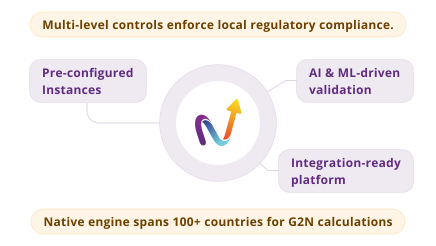
  • G2N Nova: G2N Nova offers advanced global gross-to-net payroll processing in over 100 countries, recognized as the world’s most sophisticated native payroll engine. It is available as a SaaS or service delivery platform, functioning as a standalone solution or integrating seamlessly with major HCM and Workforce Management systems.

Conclusion

In conclusion, Mercans stands as a steadfast partner in navigating the intricacies of employment in the Netherlands. Our Employer of Record (EOR) services offer businesses a comprehensive solution to manage the entire employment lifecycle. From employment contracts and labor law compliance to payroll management, employee benefits, and global mobility services, Mercans provides tailored solutions to meet diverse needs. By leveraging our expertise, businesses can confidently expand their operations in the Netherlands, ensuring compliance with local regulations and offering employees a seamless and rewarding employment experience. Mercans is your trusted ally in the Netherlands’ dynamic employment landscape, simplifying complexities and enhancing operational efficiency.

This document was prepared for informational purposes only. As local laws & regulations keeps on changing. Please consult your tax & legal advisors as well.
Contact Sales
Let's get this conversation started. Tell us a bit about your requirement, and we'll get in touch a soon as we can.

    Sample message

    1. We want to expand in $country

    2. We want you to employ 'X' number of employees on our behalf

    3. Contract duration – 3/6/9/12/18/24 months

    4. Number of legal entities (if any exist today)

    5. Employment type: EOR employee or contractor?

    6. Any benefits requirement or “standard statutory only”?

    FAQs

    What is an Employer of Record in the Netherlands, and what responsibilities do they handle?

    An Employer of Record in the Netherlands is the legal employer. They handle contracts, payroll, taxes, and compliance.

    Is it legal to hire employees in the Netherlands through an EOR, and what compliance rules must be followed?

    Yes. The EOR complies with Dutch labor law, tax obligations, and social security.

    How does an EOR in the Netherlands manage payroll, income tax, and social security contributions?

    The EOR calculates wages, withholds income tax, and remits contributions accurately.

    What advantages does using an EOR in the Netherlands offer compared to setting up a local entity?

    It allows compliant hiring without creating a subsidiary, saving time and costs.

    Do EOR providers in the Netherlands ensure compliance with collective labor agreements and employment laws?

    Yes. They follow CLAs and ensure adherence to Dutch employment rules.

    Ready to hire in Netherlands?

    No local entity needed. Our experts handle payroll, compliance, and onboarding.

    Talk to an expert
    Proven expertise in global payroll.