Employer of Record

Employer of Record (EOR) Malaysia

Hire compliantly, pay accurately, expand confidently.

Global Payroll Team
Written by Global Payroll Team
Last updated April 24, 2026
Expert Reviewed

As the premier Employer of Record in Malaysia, Mercans proudly assumes the role of the legal employer for workers in this dynamic nation. Recognized as a leading Global Professional Employer Organization (Global PEO), our comprehensive services encompass the meticulous management of various employment aspects.

Upholding strict adherence to local labor laws and regulations, our responsibilities span crucial tasks such as:
  • Payroll administration
  • Tax compliance
  • Statutory benefits oversight
  • Formulation of meticulous employment agreements

Key responsibilities integral to Mercans as the Employer of Record (EOR) Malaysia include ensuring seamless alignment of the worker’s employment with Malaysia’s legal requirements, adept management of local payroll procedures, meticulous handling of employment-related tax filing, and the provision of accurate payslips. Prompt and reliable disbursement of workers’ salary payments is an additional commitment that defines our commitment to excellence.

Simplify your global expansion endeavors with Mercans’ unrivaled Global PEO services, providing a streamlined solution that eliminates the need for complex entity setup. Serving as your trusted Employer of Record (EOR) in Malaysia, we guarantee unwavering legal compliance and Intellectual Property protection, allowing your business to focus on its core functions. With expertise in facilitating global mobility, handling work visas, and establishing a diverse and efficient global workforce, partnering with Mercans ensures a compliant and efficient employment experience in Malaysia.

Things you need to know before hiring in Malaysia

EOR Solutions in Malaysia

EOR for Prospective Employees
Mercans offers seamless Employer of Record (EOR) solutions for businesses that have already identified their ideal candidates in Malaysia. Our services encompass every aspect of the employee lifecycle, ensuring compliance with Malaysia labor laws and regulations.
EOR + Recruitment
For those seeking assistance in talent acquisition, our EOR and recruitment services provide a holistic solution. We tap into our extensive network and expertise to help you find, onboard, and retain top talent, streamlining your expansion into the Malaysia market.
Visa Sponsorship and Global Mobility
Navigating the intricacies of expatriate employment is simplified through our visa sponsorship and global mobility services. We facilitate the relocation of your international workforce, ensuring compliance with Malaysia immigration and employment laws.
AOR for Contractor Payments
Businesses grappling with contractor payments can leverage our Assistance on Record (AOR) services. We handle the complexities of contractor payments, guaranteeing accuracy and compliance.
Converting Freelancers to Employees
Mercans supports the transition from independent contractors to permanent employees in Malaysia. Our expertise ensures smooth conversions while adhering to legal requirements.
HCM Integration
Integrate Mercans’ EOR services seamlessly with your HCM system in Malaysia for real-time data exchange, enhanced compliance, and cost-efficiency. Trust our expertise for a unified, compliant, and efficient approach, elevating your workforce management and payroll operations.

Employment Contracts in Malaysia

Malaysia remains a compelling destination for foreign direct investment in Southeast Asia, providing overseas employers access to a skilled workforce at competitive rates.

However, the country’s historical concern over exploitative labor practices and the subsequent legal ramifications necessitates caution among foreign investors. There is a need to navigate carefully to avoid running afoul of local employment laws or triggering costly labor disputes. In response to these challenges, Malaysia has continued to strengthen employment protections and documentation requirements.

They mandate the necessity of a formal, written employment contract signed by all relevant parties for any employment arrangement lasting more than one month. When crafted with a thorough understanding of Malaysia’s regulatory landscape and labor laws, these formal contracts can establish a robust foundation for effective HR management in the country.

It is crucial to note that any employment arrangement lasting more than one month in Malaysia must be formalized through a written contract. This approach ensures clarity, compliance, and a structured framework for employer-employee relationships in the dynamic business environment of Malaysia.

Probation Period

The length of the probationary period is subject to variation among different companies and relies on the terms outlined in the employment contract. As there is no statutory maximum probation period under the Employment Act, it typically spans from three (3) to six (6) months in Malaysia, as indicated in the employment agreement.

In today’s dynamic work landscape, there is a growing trend towards greater flexibility in the duration of probationary periods. Organizations are acknowledging the importance of customizing probation lengths to align with the complexity of roles and the adaptability demanded by various job functions.

Notice Period

The termination notice period should be equal for both the employer and employee, and its duration can be specified in the contract. In cases where the contract is silent on this matter, the statutory termination notice periods come into effect:

  • 4 weeks’ notice for employment of less than 2 years.
  • 6 weeks’ notice for employment between 2 to less than 5 years.
  • 8 weeks’ notice for employment of 5 years or more.

Alternatively, either party can opt for a payment in lieu of notice. Termination notice is not obligatory in instances of serious misconduct or a wilful breach of the employment contract.

Severance Payments

In Malaysia, there is no equivalent to ARD/TUPE, which means there is no automatic transfer of employment in asset or business sales. In such transactions, employees will typically continue their employment with the seller by default. Any employee transfer is executed through termination by the seller and subsequent rehiring by the buyer. The seller is exempt from statutory termination or lay-off benefits if the buyer’s offer matches or surpasses the terms and conditions of the original employment and recognizes the employee’s previous service. An employee who unreasonably refuses such an offer may lose entitlement to statutory termination or lay-off benefits.

Working Hours

  • Regular work hours: 8 hours/day, 45 hours/week, with a maximum spread of 10 hours/day.
  • Overtime may be required in specific circumstances permitted by law.
  • Flexibility is allowed within legal limits, but employees should not be required to work beyond the statutory daily and weekly limits except as permitted for overtime.
  • Shift work is subject to special rules and may be averaged in accordance with the Employment Act and related regulations.
  • Employees can request changes in work hours, days, or location under the flexible working arrangement provisions.
  • Flexible work requests must be responded to within 60 days, and reasons for refusal are required.
  • Employers must maintain employee registers and prescribed employment records for at least 6 years.

Overtime Pay

Overtime is any work beyond the standard 8 hours per day or 45 hours per week. Employees may be asked to work overtime in cases of accidents, continuous operations, community well-being, or urgent tasks.

If work extends beyond a 10-hour spread over period, the time from the end of the spread over period until the employee stops working is considered overtime.

The maximum monthly overtime hours for an employee should not exceed 104 hours. Work on rest days, public holidays, or substituted paid holidays is not counted towards the 104-hour limit.

No employee should be required to work more than 12 hours in a day, inclusive of overtime.

For overtime work, employees are entitled to a premium payment at a rate not less than 1.5 times their hourly pay, as per the Employment Act 1955 and the Employment (Limitations on Overtime Work) Regulations.

Employees vs Independent Contractors in Malaysia

Factors Employee Independent contractor
Legal basis Engaged under a contract of service Engaged under a contract for service
Relationship Employer–employee relationship Client–service provider relationship
Control Employer directs and controls the work relationship Service provider is generally free from the client’s control and monitoring in how the service is carried out
Work arrangement Usually works as part of the employer’s organisation under employment terms Usually engaged to deliver agreed services or results under the service contract
Payment Paid wages/salary under the contract of service Paid fees or contract payments under the service agreement
EPF Employer must make EPF contributions for persons engaged under a contract of service or apprenticeship No ordinary employer EPF obligation as an employee arrangement under a contract for service
Social security Employees are generally covered under the employee social security framework based on a contract of service Independent contractors are not treated as ordinary employees for that purpose; self-employed persons may instead fall under PERKESO’s Self-Employed Protection Scheme, depending on the scheme rules
Employment law rights Protected by the Employment Act 1955 if engaged under a contract of service; however, some benefits such as overtime, rest-day/public-holiday pay, shift allowance, and termination/lay-off benefits do not apply to employees earning over RM4,000 unless they fall within the specified categories Generally not entitled to employee rights under the Employment Act merely because they provide services under a contract for service
Termination Governed by the employment contract and employment law rules Governed mainly by the service contract
Business risk / tools Usually lower personal business risk as an employee More likely to bear their own business and operating risk under the service arrangement

Payroll in Malaysia

Minimum Wages

Malaysia’s current national minimum wage is RM1,700 per month. Under the Minimum Wages Order 2024, this rate applies generally with effect from 1 August 2025, while a temporary RM1,500 rate applied from 1 February 2025 to 31 July 2025 for certain employers with fewer than five employees, except employers carrying out specified professional activities.

The current minimum daily rates based on the monthly minimum wage of RM1,700 are:

  • RM65.38 per day for six-day workweeks
  • RM78.46 per day for five-day workweeks
  • RM98.08 per day for four-day workweeks

Micro-enterprises remain an important part of Malaysia’s economy, but the current minimum wage framework is now materially different from the old RM1,500 structure for most employers.

Payroll Cycle

In Malaysia, payroll commonly operates on a monthly schedule. Under the Employment Act, wages must be paid not later than the seventh day after the last day of the wage period. Salaries are commonly paid through bank credit, while payment in cash or by cheque is subject to the legal requirements in force.

Mercans’ Payroll Capabilities in Malaysia

Payroll Frequencies
Mercans provides adaptable payroll frequencies, offering options such as monthly, bi-weekly, or weekly, to meet the diverse requirements of businesses operating in Malaysia, while ensuring compliance with statutory wage payment rules.
Timely Disbursements
Our payroll services ensure punctual and accurate salary payments, aligning with the regulatory stipulation that wages be paid no later than the seventh day after the wage period.
Compliance Assurance
Mercans guarantees strict compliance with Malaysian payroll regulations, managing tasks such as tax calculations, statutory contribution administration, and adherence to labor laws.
Experienced Team
With a team of seasoned professionals, Mercans delivers customized payroll solutions, addressing the specific needs of businesses in Malaysia.
Error-Free Processing
Our streamlined payroll processes are designed to minimize errors, providing a dependable and efficient system for managing payroll operations.
Multi-Currency Payments
Mercans facilitates multi-currency payments, enabling businesses to operate seamlessly in a global environment, ensuring flexibility in handling diverse currencies as required.
Focus on Core Business
Partnering with Mercans allows businesses to concentrate on their core activities, assured that their payroll operations are managed with precision and efficiency in Malaysia.

Social Security in Malaysia

Social security in Malaysia encompasses various programs and initiatives designed to provide financial protection and support to the country’s workforce. The key components of social security in Malaysia include:

Employees Provident Fund (EPF)
The EPF is a mandatory savings scheme for employees in Malaysia. For Malaysian employees below age 60, employee contributions are generally 11% of monthly wages, while employer contributions are generally 13% for wages of RM5,000 and below and 12% for wages above RM5,000. For non-Malaysian citizen employees who fall under the current coverage rules, both employer and employee generally contribute 2%.
Social Insurance Programs
Malaysia has implemented various social insurance programs to provide financial assistance to individuals facing specific life events. For instance, the Employment Insurance System (EIS) provides temporary financial relief to employees who lose their jobs. EIS contributions are generally 0.2% by the employer and 0.2% by the employee, subject to the applicable wage ceiling.
SOCSO (Social Security Organization)
SOCSO, also known as PERKESO, is responsible for implementing and managing the country’s social security schemes. It provides protection to employees against occupational injuries and diseases and offers financial assistance and medical benefits. The wage ceiling for contribution schedules increased to RM6,000 with effect from 1 October 2024.
Medical Coverage
Malaysia has both public and private healthcare systems. Public healthcare is primarily government-funded rather than run through a universal national health insurance scheme. Many employers also provide private medical coverage as an additional employee benefit.
Pension Schemes
In addition to EPF, there are various pension schemes in place for specific groups, such as government employees and members of the armed forces. These schemes provide retirement benefits to eligible individuals.
Financial Aid for Vulnerable Groups
The government also offers financial aid and assistance to vulnerable groups, including the elderly, disabled, and low-income families. These programs aim to alleviate poverty and improve the overall well-being of these individuals.
Housing Assistance
The government provides housing assistance programs, including subsidies and affordable housing schemes, to support citizens in acquiring suitable accommodation.

Employee Hiring Cost in Malaysia

Total Annual Employer Costs

  • Employees Provident Fund (EPF) Contribution: MYR [X] (this depends on the employee’s status, age, and salary band. For many Malaysian employees below age 60, it is generally 12% or 13% of monthly wages)
  • SOCSO Contribution: MYR [Y] (this depends on the applicable contribution table and wage ceiling)
  • Employment Insurance System (EIS) Contribution: MYR [Z] (employer contribution is generally 0.2% subject to the applicable wage ceiling)

Total Annual Cost

Here’s a hypothetical breakdown of the costs to hire an employee in Malaysia based on the provided figures:

Gross Annual Salary + Total Annual Employer Costs

Using current statutory contributions, the total annual employer cost will depend on EPF status, SOCSO category, EIS applicability, and any additional insured benefits.

Total Annual Employer Costs

  • EPF Contribution: This is calculated according to the applicable EPF schedule
  • SOCSO Contribution: This is calculated according to the applicable PERKESO contribution table
  • Other Contributions: This may include EIS and any additional employer-provided insurances or benefits

Total Annual Employer Costs

  • The final annual employer cost is variable and should be calculated using the current statutory schedules
  • Total Annual Cost: Gross Annual Salary + Total Annual Employer Costs

Gross Annual Salary

MYR 9,999.96

Therefore, the total annual cost to hire an employee with a gross annual salary of MYR 9,999.96 will depend on the applicable EPF, SOCSO, and EIS schedules, together with any additional insured benefits. It is recommended to calculate the final figure using the current statutory tables and the employee’s profile.

Personal Income Tax

Taxable income (MYR) – Over Not over Tax on first amount (MYR) Tax on excess (%)
0 €5,000.00 0 0
5,000 €20,000.00 0 1
20,000 €35,000.00 150 3
35,000 50,000 600 6
50,000 70,000 1,500 11
70,000 100,000 3,700 19
100,000 400,000 9,400 25
400,000 600,000 84,400 26
600,000 2,000,000 136,400 28
2,000,000 528,400 30

Non-resident individuals are subject to a flat tax rate of 30% on total taxable income. Certain incentive regimes may provide reduced employment tax rates for qualifying individuals, such as eligible knowledge workers in Iskandar Malaysia or other approved incentive programs, subject to current conditions and approvals.

Employee Benefits in Malaysia

Malaysia stands out as a business-friendly destination globally. Nevertheless, compliance with the Malaysian Employment Act is imperative for any company operating or hiring in the country. This legislation outlines the compulsory benefits that employers must provide to their workforce, encompassing:

Leave Entitlements

The duration of paid leave hinges on the tenure of the employment. The leave entitlements are structured as follows:

  • Up to 2 years of employment 8 days of annual paid leave
  • 2 to 5 years of employment 12 days of annual paid leave
  • 5 or more years of employment 16 days of annual paid leave

Maternity and Paternity Leave

Maternity leave is 98 consecutive days of paid leave under the Employment Act, subject to the qualifying conditions in the law. Paternity leave is 7 consecutive days of paid leave for a married male employee, subject to the statutory conditions.

Pension Plans and Retirement Contributions

Retirement contributions, comprising the Employees’ Provident Fund (EPF) and the Social Security Organization (SOCSO), are automatically deducted from monthly salaries where applicable. For many Malaysian employees below age 60, EPF employer contributions are generally 12% or 13% depending on the wage band, while the employee contribution is generally 11%. Employees can generally access EPF retirement savings from age 55, subject to EPF withdrawal rules.

Minimum Wage

The current monthly minimum wage in Malaysia is MYR 1,700. Working hours are capped at eight hours daily and 45 hours weekly under the Employment Act, subject to the relevant exceptions and permitted overtime.

Overtime

In situations requiring employees to exceed the standard working hours, overtime pay is mandated. Beyond the legal daily or weekly limits, employees are entitled to overtime wages at a rate of at least 1.5 times their ordinary rate of pay.

Insurance

While supplementary private insurance is not universally mandatory for every employee category, employers commonly provide insurance coverage to safeguard employees. Common insurance benefits include medical, dental, optical, and personal accident coverage.

Sick Leave and Hospitalization

Employees in Malaysia are entitled to sick leave and hospitalization leave, subject to medical practitioner approval:

  • Less than two years of employment 14 days of annual sick leave
  • Two to five years of employment 18 days of annual sick leave
  • Over five years of employment 22 days of annual sick leave

Hospitalized employees are entitled to up to 60 days of hospitalization leave at their regular pay rate in the aggregate together with ordinary sick leave entitlement. Employers should clearly communicate these benefits during the hiring process, emphasizing them in the letter of employment or offer letter. Employers should also determine whether EIS, SOCSO, EPF, and any other required schemes apply based on the employee’s category and legal status.

Termination Policy in Malaysia

In Malaysia, the employment landscape operates without an at-will employment system. Employers cannot hire and fire employees at their discretion. However, termination is permissible if justified, carried out in good faith, and follows fair procedures.

Management Prerogatives
Section 13(3) of the Industrial Relations Act establishes that dismissal and termination are considered management prerogatives, allowing employers to make decisions in the commercial interest of the business.
Substantive Fairness
Acceptable reasons for termination fall under substantive fairness. The court typically permits employers to make decisions in running their business effectively, intervening only if the dismissal is deemed unfair. Dismissal must be for just cause or excuse, a term not precisely defined in the law but encompassing major misconduct, negligence, poor performance, redundancy, or business closure.
Procedural Fairness
Besides having a fair reason, the termination process must adhere to procedural fairness. This involves issuing a termination notice where required, requesting an explanation from the employee, allowing time for a response, and conducting a fair domestic inquiry if necessary.
Termination Notice
Under Malaysian labor law, employers must provide a termination notice that complies with the contract or the statutory minimum notice rules, unless termination without notice is justified by serious misconduct.
Domestic Inquiry
A fair process may involve a domestic inquiry, especially in misconduct cases. The inquiry, impartial and objective, investigates alleged misconduct or poor performance, ensuring the fairness of the dismissal process.
Employee’s Recourse
If an employee perceives the dismissal as unfair, they can file a representation with the Director-General for Industrial Relations within sixty days of termination. A conciliation meeting is arranged, and if no settlement is reached, the case may proceed to the Industrial Court.
Industrial Court Proceedings
The Industrial Court operates with a focus on equity, good conscience, and the substantial merits of the case. Remedies may include reinstatement, back wages, or compensation in lieu of reinstatement, depending on the facts of the case.
Constructive Dismissal
Constructive dismissal arises when an employee resigns due to a serious breach of the employment contract, such as a fundamental unilateral change or intolerable working conditions. To succeed in a constructive dismissal claim, the breach must be substantial, and the employee must act without undue delay.
Unfair Dismissal Defenses
Employers can successfully defend against unfair dismissal claims by demonstrating proper justification, adherence to a fair procedure, and the existence of just cause and excuse for termination.

In essence, Malaysian labor law aims to balance the rights of both employers and employees, recognizing the prerogatives of employers while safeguarding employees against unfair dismissals. It provides a structured framework to resolve disputes and ensures fairness in the employment termination process.

Work Permit in Malaysia

Foreign nationals aspiring to work in Malaysia need to obtain the appropriate Malaysian work authorization before commencing employment. Before working, a foreign national must find employment with a Malaysian company willing to hire them. Subsequently, the employer applies for the relevant Malaysia work pass on behalf of the employee, subject to approval by the relevant authorities.

Employment Pass

  • Issued for skilled and professional expatriate positions.
  • Valid for up to 60 months, depending on the employment contract and approval.
  • Requires approval by the Expatriate Committee or relevant regulatory agency before issuance by the Immigration Department.

Temporary Employment Pass

  • Issued for specified categories of temporary foreign workers.
  • Categories include Foreign Worker Temporary Employment Pass and Foreign Domestic Helper Temporary Employment Pass.

Professional Visit Pass

  • Issued for temporary work, usually where the foreign national remains employed by an overseas employer.
  • Applicable to specific categories such as foreign artists, film workers, religious workers, government workers, students undergoing training, guest lecturers, or volunteers, subject to current rules.

Employment Pass

Qualifications for the position, relevant work experience, and minimum monthly salary requirements based on the current Employment Pass category.

Temporary Employment Pass

Conditions vary based on nationality, age, sector, and category of work.

Professional Visit Pass

Temporary work with a foreign employer, for specific categories of eligible work.

Expatriate Post or Quota Approval

  • Employer applies for expatriate post or quota approval from the relevant authority, where required.
  • Agencies such as the Expatriate Committee or sector regulators handle approvals, depending on the industry.

Approval of Malaysia Work Permit

  • The Immigration Department issues the relevant pass after the required approvals are obtained.
  • A Visa with Reference may be issued for travel to Malaysia where the employee’s nationality requires one.

Applying for Malaysian Work Visa (Visa With Reference)

  • Visa-required nationals apply for a Malaysia Visa With Reference from the nearest Malaysian Embassy or Consulate.
  • Non-visa-required nationals may travel to Malaysia with the approval documents, subject to immigration procedures.

Issuance of Work Permit

  • Upon arrival in Malaysia, the employee completes the immigration endorsement process.
  • The relevant work pass endorsement then allows commencement of work for the sponsoring employer.

Types of Malaysia Work Permits

Employment Pass

  • Issued for skilled and professional expatriate positions.
  • Valid for up to 60 months, depending on the employment contract and approval.
  • Requires approval by the Expatriate Committee or relevant regulatory agency before issuance by the Immigration Department.

Temporary Employment Pass

  • Issued for specified categories of temporary foreign workers.
  • Categories include Foreign Worker Temporary Employment Pass and Foreign Domestic Helper Temporary Employment Pass.

Professional Visit Pass

  • Issued for temporary work, usually where the foreign national remains employed by an overseas employer.
  • Applicable to specific categories such as foreign artists, film workers, religious workers, government workers, students undergoing training, guest lecturers, or volunteers, subject to current rules.

Conditions for Work Visa

Employment Pass

Qualifications for the position, relevant work experience, and minimum monthly salary requirements based on the current Employment Pass category.

Temporary Employment Pass

Conditions vary based on nationality, age, sector, and category of work.

Professional Visit Pass

Temporary work with a foreign employer, for specific categories of eligible work.

Application Process

Expatriate Post or Quota Approval

  • Employer applies for expatriate post or quota approval from relevant authorities.
  • Agencies such as the Expatriate Committee or sector regulators handle approvals, depending on the industry.

Approval of Malaysia Work Permit

  • The Immigration Department issues the relevant pass after the required approvals are obtained.
  • A Visa with Reference may be issued for travel to Malaysia where required.

Applying for Malaysian Work Visa (Visa With Reference)

  • Visa-required nationals apply for a Malaysia Visa With Reference from the nearest Malaysian Embassy or Consulate.
  • Non-visa-required nationals may travel to Malaysia with the approval documents, subject to immigration procedures.

Issuance of Work Permit

  • Upon arrival in Malaysia, the employee completes the immigration endorsement process.
  • The endorsed work pass then allows commencement of work.

Family Members and Work Visa

  • Employment Pass holders may bring eligible family members, subject to the applicable Immigration rules.
  • Dependants commonly include the spouse and dependent children under 18 through the Malaysia Dependant Pass.
  • The Long Term Social Visit Pass may be available for certain other family members under the current policy.
  • A spouse who wishes to work in Malaysia generally requires separate work authorization.

Exemptions from Malaysian Work Visa

Citizens of certain countries may be exempt from applying for a Visa With Reference, depending on nationality and the type of pass involved.

Understanding the intricacies of Malaysia’s work permit system is crucial for foreign nationals seeking employment in the country. The process involves employer-initiated applications, regulatory approvals, and adherence to specific conditions for different permit types. Additionally, considerations for family members and visa exemptions contribute to a comprehensive understanding of Malaysia’s work permit landscape.

Top Skills In demand in Malaysia

In this ever-evolving market, staying ahead requires a keen understanding of the top skills that remain in demand. From the art of selling to the intricacies of digital marketing, professionals in Malaysia continue to build a range of capabilities to make a significant impact. Here are the skills that continue to be widely sought after in Malaysia:

  • Sales: The ability to effectively sell products or services remains a cornerstone skill, with professionals constantly refining their approaches to meet the evolving needs of the market.
  • Marketing Strategy: Crafting innovative and effective marketing strategies is crucial for businesses to stand out in the competitive Malaysian market.
  • Digital Marketing: In the age of technology, proficiency in digital marketing is essential. From online advertising to social media campaigns, digital marketing skills are highly sought after.
  • Business Development: Driving growth and creating opportunities is at the forefront of business development, a skill that continues to be in high demand across various industries.
  • Social Media Marketing: Leveraging the power of social media is integral to reaching and engaging with a wider audience. Social media marketing skills are instrumental in building brand presence and driving customer engagement.
  • Strategic Sales Plans: Developing and implementing strategic sales plans ensures a focused and effective approach to meeting sales targets and business objectives.
  • C#: In the realm of programming, C# remains a valuable skill. Proficiency in this versatile programming language is sought after in various software development projects.
  • MySQL: Database management is a critical aspect of many businesses, and expertise in MySQL, a popular relational database management system, is highly valued in the Malaysian job market.

As professionals navigate the competitive landscape of Malaysia, mastering these skills can open doors to exciting opportunities and contribute to the continued success of businesses across the nation.

Best Employer of Record Malaysia

Mercans Stands Out as the Leading Employer of Record in Malaysia for the Following Reasons:

  • Regulatory Compliance: Mercans ensures full compliance with all regulations set by the Department of Labour of Peninsular Malaysia (Jabatan Tenaga Kerja Semenanjung Malaysia – JTKSM) and relevant Malaysian authorities. It strictly adheres to Malaysia’s employment laws and standards, guaranteeing full legal compliance.
  • Independent Operation: Operating as a distinct entity, Mercans offers reliable and customised employment services tailored to the unique needs of businesses in Malaysia.
  • Diverse Employment Support: Mercans efficiently manages various forms of employment, including employees, freelancers, contractors, and expatriates, providing flexible solutions to meet a wide range of workforce needs.
  • Enterprise-Focused Solutions: Specifically designed to cater to large enterprises, Mercans delivers scalable and sophisticated services that accommodate complex organisational structures.
  • Multi-Currency Payroll Management: Mercans facilitates payroll processing in multiple currencies, ensuring seamless financial operations for businesses operating in Malaysia and internationally.
  • Global Reach and Payroll Expertise: With a robust international presence, Mercans excels in managing multi-country payroll, enabling smooth operations across borders.
  • Data Protection and Compliance: Mercans adheres to rigorous data protection standards, including GDPR compliance and SOC 1 & SOC 2 certifications, ensuring the highest levels of data security.
  • ISO Certifications: Mercans holds ISO 20000 and ISO 27001 certifications, reflecting its commitment to excellence in IT service management and information security.
  • Security Standards Compliance: Mercans meets the OWASP ASVS 3.0 standards, ensuring strong security practices in application development and management.
  • HR Blizz Platform: The proprietary HR Blizz platform is a global payroll and talent management SaaS suite that streamlines payroll processes while ensuring compliance with Malaysian regulations. With over 1,000 local experts, it provides in-depth knowledge of employment laws and business practices.
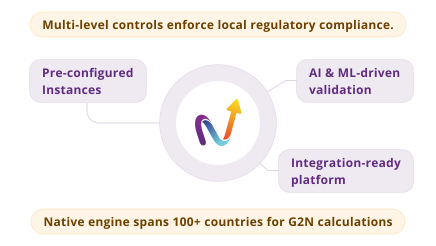
  • G2N Nova Payroll Engine: G2N Nova offers global gross-to-net payroll processing across more than 100 countries, making it one of the most advanced payroll engines available. It can be deployed as a SaaS solution or integrated seamlessly with major Human Capital Management and Workforce Management systems.

Conclusion

In conclusion, Mercans EOR in Malaysia provides a comprehensive and reliable solution for businesses seeking efficient and compliant expansion into the Malaysian market. With their Employer of Record services, Mercans simplifies the complexities of international employment, ensuring legal compliance, payroll management, and seamless operations. The company’s commitment to excellence is evident in its tailored services, addressing the unique needs of each client. By choosing Mercans EOR, businesses can confidently navigate the Malaysian employment landscape, focusing on their core operations while leaving the intricacies of human resource management in capable hands.

This document was prepared for informational purposes only. As local laws & regulations keeps on changing. Please consult your tax & legal advisors as well.
Contact Sales
Let's get this conversation started. Tell us a bit about your requirement, and we'll get in touch a soon as we can.

    Sample message

    1. We want to expand in $country

    2. We want you to employ 'X' number of employees on our behalf

    3. Contract duration – 3/6/9/12/18/24 months

    4. Number of legal entities (if any exist today)

    5. Employment type: EOR employee or contractor?

    6. Any benefits requirement or “standard statutory only”?

    FAQs

    What is an Employer of Record (EOR) in Malaysia?

    An Employer of Record (EOR) in Malaysia is a third-party service provider that legally employs workers on behalf of another company. The EOR manages all employment-related responsibilities, including contracts, payroll, taxes, benefits, and compliance with Malaysian labor laws, enabling businesses to hire employees without establishing a local entity.

    How can foreign companies hire employees in Malaysia without establishing a local entity?

    Foreign companies can engage an EOR to hire employees in Malaysia. The EOR assumes the legal employer role, handling all statutory obligations, while the client company manages the employee’s daily tasks. This approach allows businesses to operate in Malaysia without the need for a local branch or subsidiary.

    What compliance, payroll, and HR tasks does an EOR in Malaysia handle?

    An EOR in Malaysia ensures compliance with local labor laws by managing employment contracts, processing payroll, withholding and remitting taxes, making social security contributions, administering mandatory benefits, and completing statutory filings. They also handle work permits and visa sponsorship for expatriate employees.

    What are the benefits of using EOR services in Malaysia?

    Utilizing an EOR in Malaysia offers several advantages: it simplifies market entry by eliminating the need for a local entity, ensures compliance with complex labor laws, reduces administrative burdens, mitigates legal risks, and accelerates the hiring process.

    How much does it cost to hire employees through an EOR in Malaysia?

    The cost of hiring through an EOR in Malaysia varies depending on the provider and the services included. Generally, fees can range from $500 to $2,000 per employee per month. It’s advisable to consult with the EOR provider for a detailed pricing structure.

    Is an EOR the right solution for expanding a business into Malaysia?

    An EOR is an effective solution for businesses looking to expand into Malaysia without the complexities of setting up a local entity. It provides a compliant and efficient way to hire employees, allowing companies to focus on their core operations while the EOR manages employment-related tasks.

    Ready to hire in Malaysia?

    No local entity needed. Our experts handle payroll, compliance, and onboarding.

    Talk to an expert
    Proven expertise in global payroll.