Employer of Record

Employer of Record (EOR) Kuwait

Hire compliantly, pay accurately, expand confidently.

Global Payroll Team
Written by Global Payroll Team
Last updated April 23, 2026
Expert Reviewed

An Employer of Record (EOR) in Kuwait serves as the legal employer for workers, playing a crucial role in ensuring comprehensive compliance with local labor laws and regulations. As a trusted Global Professional Employer Organization (Global PEO), our EOR services extend beyond mere legal representation. We actively oversee various employment aspects, including meticulous management of payroll processes, handling taxes, benefits administration, and the creation of essential employment agreements.

In Kuwait, our dedicated Employer of Record takes charge of pivotal responsibilities, including:
  • Rigorously ensuring adherence to Kuwait’s employment laws to maintain legal compliance.
  • Efficiently managing the intricacies of local payroll procedures with precision.
  • Expertly handling the submission of employment-related taxes and essential documentation.
  • Providing workers with detailed payslips for transparent and accurate financial reporting.
  • Promptly distributing workers’ salary payments to ensure financial stability.

Opting for our Global PEO services with an Employer of Record in Kuwait empowers your business with a hassle-free expansion solution that eliminates the need for entity setup. Our EOR guarantees legal presence, compliance, and Intellectual Property protection, enabling your business to focus on core functions. Additionally, our services facilitate smooth global mobility and work visa processes, contributing to the establishment of a diverse and efficient global workforce.

Things you need to know before hiring in Kuwait

EOR Solutions in Kuwait

EOR for Prospective Employees
Mercans offers seamless Employer of Record (EOR) solutions for businesses that have already identified their ideal candidates in Kuwait. Our services encompass every aspect of the employee lifecycle, ensuring compliance with Kuwait labor laws and regulations.
EOR + Recruitment
For those seeking assistance in talent acquisition, our EOR and recruitment services provide a holistic solution. We tap into our extensive network and expertise to help you find, onboard, and retain top talent, streamlining your expansion into the Kuwait market.
Visa Sponsorship and Global Mobility
Navigating the intricacies of expatriate employment is simplified through our visa sponsorship and global mobility services. We facilitate the relocation of your international workforce, ensuring compliance with Kuwait immigration and employment laws.
AOR for Contractor Payments
Businesses grappling with contractor payments can leverage our Assistance on Record (AOR) services. We handle the complexities of contractor payments, guaranteeing accuracy and compliance.
Converting Freelancers to Employees
Mercans supports the transition from independent contractors to permanent employees in Kuwait. Our expertise ensures smooth conversions while adhering to legal requirements.
HCM Integration
Integrate Mercans’ EOR services seamlessly with your HCM system in Kuwait for real-time data exchange, enhanced compliance, and cost-efficiency. Trust our expertise for a unified, compliant, and efficient approach, elevating your workforce management and payroll operations.

Employment Contracts in Kuwait

The Labour Law stipulates the requirement for a written employment contract in both Arabic and a second language upon the employee’s request. In the event of a dispute, the Arabic version takes precedence over any contract in another language.

Employment contracts can be either for a definite or indefinite term. Definite-term contracts must not exceed five years, with a minimum duration of one year. Renewal of a definite-term contract is possible by mutual agreement after the initial fixed period. However, if both parties continue performance after the expiry date, the contract is automatically considered renewed on the same terms, except that the period becomes indefinite.

Private-sector employees are entitled to a minimum wage of KD75 per month. Foreign employees working in Kuwait under a foreign employer usually sign two contracts: one with the foreign (primary) employer and another with the local (secondary) employer or agent. The local contract is an integral part of the work permit application, registered with the relevant Kuwaiti authorities, and outlines essential details such as name, position, salary, payment category, and the contract’s term. While the first employment contract is optional, it is commonly used by foreign employers to align with the Labour Law while providing a comprehensive employment structure and benefits to employees.

Working Hours

Typically, the working week in Kuwait ranges from 40 to 48 hours, depending on the specific policies of the company and the legal maximum. Office hours generally commence at 8:30 am or 9:00 am and conclude at 5:30 pm or 6:00 pm.

Probation Period

The Kuwait Labor Law recognizes the significance of the probation period by offering guidelines regarding its duration. In general, the probation period should not extend beyond 100 working days.

13th Month Salary

As per the legislation, there are no stipulations for the provision of a 13th salary.

Termination and Severance Pay ( End-of-service payments)

Termination

Distinct rules apply to the termination of definite-term and indefinite-term employment contracts.

For definite-term contracts, termination occurs upon the expiration of the agreed term. Either party can terminate for cause, but unjustified termination may obligate the terminating party to compensate the other for damages, usually subject to the limits set by the Labour Law.

Indefinite-term contracts require written notice for termination, with a minimum of three months for monthly-paid employees and one month for others. The employer can excuse the employee from work during the notice period, counting it as work service, with entitlement to salary and benefits.

End-of-Service Payments

Upon termination or contract expiration, employees receive end-of-service payments. Daily, weekly, hourly, or piecework employees get 10 days’ remuneration for each of the first five years and 15 days thereafter, up to a maximum of one year’s remuneration. Monthly-paid employees receive 15 days’ remuneration for each of the first five years and one month thereafter, up to a maximum of 1.5 years’ remuneration.

For Kuwaiti employees, the end-of-service payment may be affected by pension contributions under the Social Insurance Law. For expatriate employees, end-of-service indemnity remains a key statutory entitlement because they are generally outside the Kuwaiti social security system.

Social Security in Kuwait

In Kuwait, Social Security Law mandates monthly contributions for Kuwaiti employees, with both employer and employee contributing. Employers generally contribute 11.5%, and employees contribute 8% of their monthly salary, up to the applicable salary ceiling of KWD 2,750. These contributions cover retirement pensions, as well as allowances for disability, sickness, and death.

In addition, employee-side pension increase contributions apply under the social security framework. The Public Institution for Social Security shows a 2.5% employee contribution on the pension increase component up to the applicable ceiling, alongside other category-based contribution elements where relevant.

Presently, expatriate workers in Kuwait do not have general social security obligations under the Kuwaiti system. However, the Kuwait Labour Law mandates terminal indemnity payments for eligible expatriate workers, calculated under the end-of-service benefit rules applicable to the worker’s pay basis.

Other Taxes and Social Security contribution

Tax / contributionEmployer contribution
Social security / pension-related contributions (up to a salary ceiling of KWD 2,750)11.50%
Unemployment insurance (private and oil sectors only)0.50%
Total employment cost12.00%
ContributionRate
Social Security (up to ceiling of 1,500 KWD)2.50%
Pensions (up to a ceiling of 2,750 KWD)8.00%
Unemployment0.5%
Total Employee Cost8.50% – 11%

Payroll in Kuwait

Minimum Wages

Kuwait’s robust currency and a private-sector minimum wage of KWD 75 make it an attractive destination for expatriates seeking employment opportunities. The country’s labor law further enhances its appeal by providing favorable provisions for employees. According to the law, workers who exceed their regular working hours are entitled to additional compensation, ranging from 25% to 100% of normal remuneration based on the day of overtime, weekday, weekly rest day, or public holiday.

The legislation also ensures timely payment, specifying that monthly salaried employees should be paid at least once a month, while those on different pay frequencies should receive payment at least every two weeks. The government emphasizes the prompt payment of salaries, and payment may not be delayed beyond seven days after the due date. This commitment reflects the government’s dedication to safeguarding the welfare of private-sector workers in Kuwait.

Additionally, Kuwait has established separate minimum wage standards for domestic workers, which differ from the private-sector minimum wage applicable under the Labour Law.

Payroll Cycle

According to Kuwaiti labor law, compensation for employees is structured as follows:

  • Monthly-paid employees must receive their wages at least once a month.
  • Workers falling into other categories are required to be paid at least once every two weeks.

Overtime Pay

Employers can request employees to work overtime when necessary, with a formal agreement or order in place. The compensation for overtime is as follows:

  • 125% of the basic hourly rate for excess hours worked on regular working days
  • 150% of the basic hourly rate for all hours worked on the weekly day off
  • Twice the basic hourly rate for all hours worked on public holidays

Overtime is restricted to a maximum of 2 hours per day, 6 hours per week, and 180 hours per year, with a yearly limit of 90 days. Employees retain the right to refuse overtime work.

WPS Kuwait

Kuwait has strengthened salary payment monitoring for private-sector workers through electronic salary transfer and compliance controls overseen by the Public Authority for Manpower and related authorities.

With salary transfer compliance requirements, employers are expected to pay wages through approved channels and in line with the registered employment terms. This helps support timely payment, improves transparency, and reduces payroll disputes.

Employers should ensure salary records, transfer timing, and payroll data remain aligned with the employee’s registered work permit and employment terms to avoid compliance issues.

Payroll Cycle

Experience the efficiency of Mercans’ comprehensive payroll cycle management. Our services ensure timely and accurate payments to both employees and contractors, all in the local currency. Trust Mercans to streamline your payroll processes, making the entire cycle a seamless and localized experience.

Payroll Setup, Payroll Processing, and Payroll Administration

Mercans goes beyond conventional payroll services, offering end-to-end solutions. From meticulous payroll setup to precise processing and efficient administration, we manage every step with a commitment to accuracy and compliance. With Mercans, your payroll is in expert hands, allowing you to focus on your core business functions.

Statutory Filings and Payments

Navigate Kuwait’s regulatory landscape effortlessly with Mercans. Our dedicated team takes charge of statutory filings and payments, ensuring your business stays compliant with all legal requirements. Rely on Mercans for accurate and timely submissions, providing you with peace of mind in meeting your statutory obligations.

Kuwait Employee Hiring Cost

In Kuwait, considering an employee with a Monthly Net Salary of $8,950.00 USD or 2,756.87 KWD, the Monthly Payroll Cost extends beyond the net salary. This comprehensive cost includes the base salary, additional costs such as allowances and benefits, social security contributions from both the employer and employee where applicable, and other statutory obligations. Taking all these components into account, the total Monthly Payroll Cost for the employee depends on nationality, pay structure, and benefit design, providing businesses with a clearer understanding of the overall financial commitment associated with employing in Kuwait.

Employee Benefits in Kuwait

Every employee needs a break to relax and spend time with their loved ones, especially if they are spending excessive hours at their office. A stressed and hectic mind will have a negative impact on job performance and can even result in costly mistakes. Hence, leaves are more than mandatory not just for the well-being of the employee but for the employer as well.

Annual Leave
As per Article 70, workers in Kuwait are entitled to a 30-day paid annual leave. The entitlement for the first year of work begins after at least 9 months of service for the employer. Official holidays and sick leaves during the year are not counted as annual leave. The worker is entitled to leave for the fraction’s year in proportion to the period spent in actual service, even in the first year.
Hajj Leave
A worker who spent two continuous years working for the same employer shall be entitled to 21 days leave with pay to perform Hajj provided that he had not performed Hajj before.
Compassionate Leave
According to Article 77, the employer may grant an employee a special leave of three days in the event of a first- and second-degree relative’s death.
Sick Leave
Article 69 states that an employee is entitled to sick leaves at the following rate per annum: First 15 days at full pay, following 10 days at three-quarters of the pay, following 10 days at half pay, following 10 days at quarter pay, and following 30 days without pay (sick leave unpaid).
Maternity Leave
Under the Kuwait Labour Law, a pregnant working woman is entitled to a paid maternity leave of 70 days, not included in her other leaves, if she gives birth within this period. After the end of the maternity leave, the employer may give the working woman, at her request, an unpaid leave for a period not exceeding four months to take care of the baby.
Public Holidays
Hijri New Year, Isra’ and Mi’raj, Eid Al-Fitr, Arafat Day, Eid Al-Adha, Prophet’s Birthday, National Day, Liberation Day, and Gregorian New Year are among the public holidays commonly observed in Kuwait, subject to official announcements.
Academic Leave
The employer may grant an employee a paid academic leave to obtain a higher degree in his work field, provided the worker shall return and work for the employer for a similar length of time that should not exceed five years.

End of the service benefits

Article 51 of Kuwait Labour Law outlines the end-of-service benefits, specifying entitlements based on the worker’s payment structure. For those paid on a daily, weekly, hourly, or piecework basis, the benefit is 10 days for each of the first five years, increasing to 15 days for each subsequent year, not exceeding one-year remuneration. Monthly-paid workers are entitled to 15 days for the initial five years and one month for each subsequent year, with a cap at one-and-a-half-year remuneration. Fractional-year entitlements are proportional to the service period. Deductions include loans and credits, with consideration for Social Security Law provisions. Employers are responsible for the net difference between social security subscriptions and end-of-service benefits where relevant. Gratuity, a lawful employer obligation, hinges on the last drawn remuneration and years of service, calculated upon resignation or termination. Our Kuwait-based payroll experts provide comprehensive insights in the following Q&A, addressing common queries related to end-of-service gratuity in Kuwait.

Work Permit in Kuwait

For companies expanding into Kuwait, navigating the immigration process is crucial to secure the required work authorization and residency documents. In Kuwait, foreign employees working in the private or civil sector generally require an entrance visa to work, a work permit, and an Article 18 residence permit before lawful employment can continue in practice.

The work authorization process typically starts with the employer or sponsor in Kuwait. The application usually involves a work permit issued through the competent labor authority, followed by an entrance visa to work in the civil sector and then the first-time residence permit process after the employee arrives in Kuwait. Official requirements commonly include the work permit, sponsor documents, passport copies, medical and health insurance documents, police clearance, photographs, and the required application forms.

A first-time residence permit for employees in the civil sector is issued under Article 18 of the Executive Regulations of the Foreigners’ Residence Law. The official government process requires the sponsor-signed residence application form and supporting documents such as the work permit, health insurance certificate, disease-free certificate, police record certificate, photographs, passport, and the entrance visa used to enter Kuwait.

The official fees published on Kuwait Government Online include KD 3 fixed fees for the entrance visa to work in the civil sector and KD 10 fixed annual fees for the first-time or renewed residence permit for employees in the civil sector.

Work permits and residence status in Kuwait are employer-sponsored. As a result, employers should ensure the immigration file, labor file, and payroll records are consistent at all stages of onboarding and employment.

Best Employer of Record Kuwait

Mercans Stands Out as the Leading Employer of Record in Kuwait for the Following Reasons:

  • Regulatory Compliance: Mercans ensures full compliance with all regulations set by the Public Authority for Manpower and relevant Kuwaiti authorities. It strictly adheres to Kuwait’s employment laws and standards, guaranteeing full legal compliance.
  • Independent Operation: Operating as a distinct entity, Mercans offers reliable and customised employment services tailored to the unique needs of businesses in Kuwait.
  • Diverse Employment Support: Mercans efficiently manages various forms of employment, including employees, freelancers, contractors, and expatriates, providing flexible solutions to meet a wide range of workforce needs.
  • Enterprise-Focused Solutions: Specifically designed to cater to large enterprises, Mercans delivers scalable and sophisticated services that accommodate complex organisational structures.
  • Multi-Currency Payroll Management: Mercans facilitates payroll processing in multiple currencies, ensuring seamless financial operations for businesses operating in Kuwait and internationally.
  • Global Reach and Payroll Expertise: With a robust international presence, Mercans excels in managing multi-country payroll, enabling smooth operations across borders.
  • Data Protection and Compliance: Mercans adheres to rigorous data protection standards, including GDPR compliance and SOC 1 & SOC 2 certifications, ensuring the highest levels of data security.
  • ISO Certifications: Mercans holds ISO 20000 and ISO 27001 certifications, reflecting its commitment to excellence in IT service management and information security.
  • Security Standards Compliance: Mercans meets the OWASP ASVS 3.0 standards, ensuring strong security practices in application development and management.
  • HR Blizz Platform: The proprietary HR Blizz platform is a global payroll and talent management SaaS suite that streamlines payroll processes while ensuring compliance with Kuwait’s regulations. With over 1,000 local experts, it provides in-depth knowledge of employment laws and business practices.
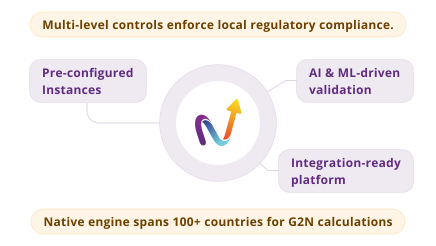
  • G2N Nova Payroll Engine: G2N Nova offers global gross-to-net payroll processing across more than 100 countries, making it one of the most advanced payroll engines available. It can be deployed as a SaaS solution or integrated seamlessly with major Human Capital Management and Workforce Management systems.

Conclusion

In conclusion, Mercans’ Employer of Record (EOR) services in Kuwait offer a seamless and compliant solution for businesses expanding their global presence. With a deep understanding of Kuwait’s labor landscape and regulations, Mercans ensures legal compliance, intellectual property protection, and hassle-free global mobility. Our EOR services encompass payroll cycle management, statutory filings, and payments, providing a comprehensive solution for paying employees and contractors in the local currency. By leveraging Mercans’ expertise, businesses can navigate the complexities of Kuwait’s employment landscape with confidence, focusing on their core operations while entrusting critical HR and payroll functions to a trusted partner.

This document was prepared for informational purposes only. As local laws & regulations keeps on changing. Please consult your tax & legal advisors as well.
Contact Sales
Let's get this conversation started. Tell us a bit about your requirement, and we'll get in touch a soon as we can.

    FAQs

    What is an Employer of Record in Kuwait?

    An Employer of Record in Kuwait is a third-party service provider that legally employs workers on behalf of another company. The EOR manages all employment-related responsibilities, including contracts, payroll, taxes, benefits, and compliance with Kuwaiti labor laws, enabling businesses to hire employees without establishing a local entity.

    How can foreign companies hire employees in Kuwait without opening a local entity?

    Foreign companies can engage an EOR to hire employees in Kuwait. The EOR assumes the legal employer role, handling all statutory obligations, while the client company manages the employee’s daily tasks. This approach allows businesses to operate in Kuwait without the need for a local branch or subsidiary.

    What compliance and payroll responsibilities does an EOR in Kuwait handle?

    An EOR in Kuwait ensures compliance with local labor laws by managing employment contracts, processing payroll, withholding and remitting taxes, making social security contributions, administering mandatory benefits, and completing statutory filings. They also handle work permits and visa sponsorship for expatriate employees.

    What are the benefits of using EOR services in Kuwait?

    Utilizing an EOR in Kuwait offers several advantages: it simplifies market entry by eliminating the need for a local entity, ensures compliance with complex labor laws, reduces administrative burdens, mitigates legal risks, and accelerates the hiring process.

    How much does it cost to hire employees through an EOR in Kuwait?

    The cost of hiring through an EOR in Kuwait varies depending on the provider and the services included. Generally, fees can range from $500 to $2,000 per employee per month. It’s advisable to consult with the EOR provider for a detailed pricing structure.

    Is an EOR the right solution for business expansion into Kuwait?

    An EOR is an effective solution for businesses looking to expand into Kuwait without the complexities of setting up a local entity. It provides a compliant and efficient way to hire employees, allowing companies to focus on their core operations while the EOR manages employment-related tasks.

    Ready to hire in Kuwait?

    No local entity needed. Our experts handle payroll, compliance, and onboarding.

    Talk to an expert
    Proven expertise in global payroll.