Employer of Record

Employer of Record (EOR) Finland

Hire compliantly, pay accurately, expand confidently.

Global Payroll Team
Written by Global Payroll Team
Last updated April 24, 2026
Expert Reviewed

An Employer of Record (EOR) acts as the legal employer for workers in Finland. Also known as a Global Professional Employer Organization (Global PEO), this role encompasses comprehensive employment oversight. It ensures strict adherence to local labor laws, manages essential tasks like payroll, taxes, and mandated benefits, and formulates employment agreements.

Key responsibilities of the Employer of Record (EOR) in Finland include:
  • Guaranteeing compliance with Finnish employment laws.
  • Managing the intricacies of local payroll processes.
  • Handling the filing of employment-related taxes and necessary documentation.
  • Issuing payslips to the worker.
  • Distributing salary payments to the worker.

Optimize your global expansion seamlessly with our Global PEO services – a hassle-free solution that eliminates the need for entity setup. Our Employer of Record (EOR) services in Finland ensure legal compliance, a strong presence, and Intellectual Property protection, allowing your business to concentrate on its core functions. Facilitate smooth global mobility, obtain work visas efficiently, and build a diverse and effective global workforce. Partner with Mercans, your Employer of Record in Finland, for a compliant and streamlined employment experience for your global workforce.

Things you need to know before hiring in Finland

Employee vs Independent Contractor Classification

FactorsEmployeeIndependent Contractor
Employment LawsGoverned mainly by the Employment Contracts Act, Working Hours Act, Annual Holidays Act, Occupational Safety and Health Act, and applicable collective agreements.Usually governed by a service agreement / assignment agreement and general contract law, not by Finnish employment legislation unless the relationship is actually employment in substance.
Hiring PracticeEmployment can be agreed orally, in writing, or electronically, but if there is no written contract, the employer must provide a written statement of the principal terms. A trial period may be agreed, generally up to 6 months.Usually engaged directly as a sole trader, through a company, or via an invoicing/light-entrepreneurship setup. The contract typically sets out scope of services, fees, invoicing, IP/confidentiality, duration, and termination terms.
Tax DocumentsEmployee typically receives a tax card and a pre-completed tax return. The employer reports pay data through the Incomes Register.Contractor generally handles their own prepayments (ennakkovero), business tax filings, and VAT obligations where applicable. Sole traders also receive / use the normal Finnish tax return system, and business operators may need to file a business tax return.
Payer’s Tax Withholding & Reporting RequirementsEmployer withholds tax from wages based on the employee’s tax card, pays employer-side statutory contributions, withholds employee-side contributions as required, and reports pay to the Incomes Register.If the contractor is entered in the Prepayment Register, the client usually does not withhold tax from non-wage compensation. If the contractor is not in the register, withholding may be required. The contractor is generally responsible for their own tax prepayments and filings.
RemunerationPaid as wages/salary under the employment contract. Pay level is affected by the applicable collective agreement; Finland generally has no statutory minimum wage, but collective agreements often set minimum terms.Paid according to the service contract, usually against an invoice and based on project, deliverables, time spent, or another agreed pricing model.
Workers’ RightsEntitled to statutory rights such as working-time protections, annual leave, sick pay, family leave, notice protections, occupational safety protections, and other rights under labour law and collective agreements.Not automatically entitled to employee rights such as paid annual leave, statutory sick pay from the client, or employment-law notice/termination protections. Rights depend mainly on the contract and the contractor’s own social-insurance status.
BenefitsEmployer must arrange occupational health care and handle statutory social insurance obligations (such as earnings-related pension and other required employer-side contributions). Employees may also receive contractual/company benefits.The client does not provide employee benefits by default. The contractor is generally responsible for arranging their own social-security and insurance setup. If self-employment meets the legal conditions, the contractor must take out YEL pension insurance.
When PaidPay is made on the agreed payday. In practice, a salaried employee is generally paid once a month; if pay is based on a shorter period such as hourly/daily work, wages must be paid at least twice a month.Paid according to the contract and invoice terms. In practice, contractors are usually paid after invoicing, often under agreed payment terms such as 14–30 days.

Employment Contracts in Finland

Working Hours
Under the Finnish Working Hours Act, regular working hours are generally no more than 8 hours per day and 40 hours per week. Working hours can be arranged more flexibly under applicable law and collective agreements, including averaging arrangements in relevant cases.
13th Month Salary
There is no legal obligation to provide a 13th or 14th-month salary. However, it is common practice in Finland to provide holiday bonus where required by a collective agreement or employer policy.
Probation Period
Both employer and employee can agree on a trial period at the start of the employment. It must be clearly agreed before work begins, and both parties can terminate the contract during this period. The maximum trial period is six months. If the employee is absent due to incapacity for work or family leave during the trial period, the employer may extend it by one month for each 30 calendar days of absence. In fixed-term contracts, the trial period may not exceed half of the contract term and never more than six months. Termination during the trial period is not allowed on discriminatory or otherwise improper grounds.

Payroll in Finland

Minimum Wages

In Finland, there is no universally applicable statutory national minimum wage. Minimum pay is generally determined by the applicable collective agreement. If no generally binding collective agreement applies, the employer must pay normal and reasonable remuneration for the work performed.

Payroll Cycle

In Finland, wages are typically paid on the last day of each pay period, with pay periods commonly lasting two weeks or a month. Under the Employment Contracts Act, time-based pay, such as hourly or daily pay, must generally be paid at least twice a month, while monthly salary can be paid once a month. Performance-based work usually follows a pay period of no longer than two weeks unless otherwise agreed or provided by a collective agreement.

Wages must be paid to the employee’s designated bank account and be available on the due date. If the due date falls on a Sunday, other religious holiday, Independence Day, May Day, Christmas Eve, Midsummer Eve, or a non-business Saturday, wages must be paid on the preceding weekday. Cash payments are allowed only for compelling reasons, and the employer must provide a receipt or other verification if wages are paid in cash.

Employers are required to issue a pay slip with every wage payment, detailing the employee’s earnings during the relevant pay period. The pay slip should show the grounds on which the wages were determined.

Upon termination of an employment relationship, the employee’s receivables generally fall due on the termination date unless a post-termination payment date has been agreed during the employment relationship or follows from a collective agreement.

Additionally, employers must report wage details to the Incomes Register. Employees can verify this information through the Incomes Register or by confirming with their employer or payer. This reporting supports transparency and compliance with tax regulations.

Mercans’ Payroll Capabilities

Mercans offers extensive payroll capabilities in Finland, catering to various needs:

Paying in Local Currency
Mercans facilitates payments in the local currency (Euro) to ensure compliance with Finnish regulations and convenience for employees.
EOR (Employer of Record)
Acting as an Employer of Record, Mercans manages all employer responsibilities, including compliance, HR, and payroll, allowing companies to expand into Finland without establishing a legal entity.
Payroll Outsourcing
Mercans provides comprehensive payroll outsourcing services in Finland, handling payroll calculations, tax deductions, compliance with local laws, and ensuring timely payments to employees.
Payroll SaaS (Software as a Service)
Mercans might offer a Payroll SaaS solution tailored to Finnish regulations, providing a user-friendly platform for managing payroll processes efficiently. This software could include features like automated calculations, tax compliance tools, and reporting capabilities.

Social Security in Finland

The Finnish social security system combines residence-based and employment-based protection. Kela administers many residence-based benefits, while employment-related coverage includes earnings-related pensions, unemployment insurance, occupational accident insurance, occupational disease insurance, and occupational health obligations. Eligibility depends on the nature of the benefit and the employee’s circumstances.

Residence in Finland or employment may form the basis for access to social security benefits. Kela and wellbeing services counties handle many residence-based services and benefits, while employment-based security involves unemployment funds, pension providers, private insurers, and other statutory institutions.

Social security aims to provide financial stability in situations related to old age, disability, illness, unemployment, childcare, loss of a provider, rehabilitation, or education.

Employers may receive reimbursement for some expenses related to occupational health services and certain family-related absences where the applicable statutory conditions are met.

Social Security Contributions

Employer’s Social Security Payments
  • Employment Pension Insurance: The average employer TyEL contribution is approximately 17.38%, but the final rate depends on the employer category and pension provider.
  • Unemployment Insurance:
    • 0.31% up to EUR 2,509,500 of annual payroll
    • 1.23% on the exceeding payroll amount
  • Statutory Accident Insurance: Rate varies by risk and insurer.
  • Statutory Group Life Premium: Rate varies by insurer and sector arrangements.
  • Employer’s Health Insurance Contribution: 1.91%
Employee’s Social Security Payments
  • Pension Insurance:
    • 7.15% for employees aged 17 to 52 and 63 to 69
    • 8.65% for employees aged 53 to 62
  • Health Insurance Contribution: The insured person’s health care contribution on wage income is 1.10%.
  • Daily Allowance Contribution: 0.88%, waived if annual wage income is below the applicable threshold for 2026.
  • Unemployment Insurance Contribution: 0.89%

For employees taxed under the foreign key employee regime, the special tax-at-source rate is 25% from 1 January 2026 if the statutory conditions are met. Separate social insurance contribution rules still need to be reviewed case by case.

In terms of consumption taxes
  • Value-Added Tax (VAT): Finland applies a standard VAT rate and reduced rates for specific goods and services under current tax law.
  • Net Wealth/Worth Taxes: None in Finland.
  • Inheritance, Estate, and Gift Taxes: Tax rates vary based on the value of taxable property received.
  • Property Taxes: Collected by municipalities on real estate within statutory rate ranges.
  • Transfer Tax: Imposed on certain transfers of real property and securities.
  • Excise Duties: Levied on various products such as alcohol, tobacco, fuels, and other specifically taxed goods.

Employee Hiring Cost in Finland

Let’s consider an example to understand the comprehensive nature of employee hiring costs in Finland. Imagine hiring an employee with a Gross Annual Salary of EUR 9,999.96. When factoring in typical statutory employer-side costs such as employer pension insurance, unemployment insurance, employer health insurance contribution, accident insurance, and group life premium, the total employment cost will exceed the gross salary. The precise annual employer cost depends on the applicable pension provider, accident insurance rate, industry risk class, and other employer-specific factors, so it should be calculated case by case using the current contribution rates.

Employee Hiring Cost in FinlandAmount
Gross Annual SalaryEUR 9,999.96
Employer’s Health Insurance Contribution (1.91%)EUR 191.00
Pension Insurance Contribution – employer share, average TyEL (17.10%)EUR 1,709.99
Unemployment Insurance Contribution (0.31%)EUR 31.00
Accident Insurance Contribution (average 0.70%)EUR 70.00
Group Life Insurance Contribution (average 0.06%)EUR 6.00
Occupational Health CareVariable – not a fixed statutory rate
Total Annual Employer Costs (statutory items above, excluding occupational health care)EUR 2,007.99
Total Annual Cost (salary + statutory employer costs, excluding occupational health care)EUR 12,007.95

Personal Income Tax

Finland employs a comprehensive personal income tax system that applies to residents on their worldwide income. Earned income for residents is subject to progressive state taxation and municipal taxation, together with other applicable charges such as church tax for members and the public broadcasting tax.

For earned income, the effective total burden depends on the individual’s tax card, municipality, deductions, and other personal factors. Investment income is generally taxed at rates of 30% and 34%, with the higher rate applying to capital income exceeding EUR 30,000 annually.

Municipal tax rates vary by municipality. Church tax applies to members of certain churches. Public broadcasting tax is charged under the applicable statutory rules, subject to thresholds and caps.

For foreign employees under the foreign key employee regime, the special tax-at-source rate is 25% from 1 January 2026 if the statutory conditions are met.

Non-resident individuals are taxed on Finnish-source income only, unless otherwise modified by tax treaty rules or specific Finnish tax provisions. Non-residents may be taxed either at source or under progressive taxation depending on the case and elections available.

Other Finnish-source incomes, such as rental income, are also taxed according to applicable Finnish rates unless otherwise specified in a tax treaty.

Employee Benefits in Finland

In Finland, statutory leaves encompass a wide range of scenarios, ensuring employees have dedicated time off for various life events and responsibilities. Here’s an overview:

Pregnancy Leave

Pregnant employees are entitled to pregnancy leave. Kela pays pregnancy allowance for 40 working days.

Parental Leave

Parents are covered by the current parental allowance system. For one child, parental allowance is paid for a total of 320 working days, which are generally divided equally between the parents unless days are transferred under the statutory rules.

Childcare Leave

Employees may take childcare leave to care for a child, subject to the rules of the Employment Contracts Act and related family leave provisions.

Sick Leave

Employers generally pay sick pay under the Employment Contracts Act for the day of falling ill and the following 9 working days, unless a collective agreement provides more favorable terms. After that, Kela sickness allowance may apply if the statutory conditions are met.

Partial Childcare Leave

Can be taken under the Employment Contracts Act subject to the statutory eligibility rules.

Temporary Childcare Leave

Up to 4 working days for the care of an unexpectedly ill child under the applicable statutory conditions.

Family Care Leave

Provided for caring for a family member or close relative due to illness or accident.

Paid Time Off

Employees are entitled to annual holiday under the Annual Holidays Act. In general terms, holiday accrues at 2 or 2.5 weekdays per holiday credit month depending on the length of service relationship under the applicable rules.

Termination PTO Payout

Upon termination, accrued but unused holiday compensation is paid in accordance with the Annual Holidays Act and any applicable collective agreement.

Termination and Notice Period

Employer Termination
Finnish labor law allows employers to terminate employment contracts only on proper and weighty grounds related to the employee or due to production-related and financial reasons. Fixed-term contracts generally expire at the agreed end date and cannot usually be terminated prematurely unless this has been specifically agreed or there is statutory grounds for cancellation.
Requesting a Written Certificate
Upon the conclusion of employment, employees have the right to request a written certificate from their employer. This document outlines the duration of their employment and, if requested, the nature of their work and the reason for termination.
Notice Periods
The notice periods for termination vary based on the duration of employment:

Employer’s Notice

The period of notice provided by the employer is contingent upon the length of service:

  • 14 days for employment up to one year,
  • 1 month for 1–4 years of service,
  • 2 months for 4–8 years,
  • 4 months for 8–12 years,
  • 6 months for over 12 years.

Employee’s Resignation Notice

Employees adhering to resignation notices should observe:

  • 14 days for employment lasting up to five years,
  • 1 month for employment extending beyond five years.

Adherence to Notice Periods

Both employers and employees must adhere to the specified notice periods unless otherwise outlined in formal agreements, employment contracts, or applicable collective agreements. During the notice period, the employment relationship continues normally unless otherwise agreed.

EOR Solutions in Finland

EOR for Prospective Employees
Mercans offers seamless Employer of Record (EOR) solutions for businesses that have already identified their ideal candidates in Finland. Our services encompass every aspect of the employee lifecycle, ensuring compliance with Finnish labor laws and regulations.
EOR + Recruitment:
For those seeking assistance in talent acquisition, our EOR and recruitment services provide a holistic solution. We tap into our extensive network and expertise to help you find, onboard, and retain top talent, streamlining your expansion into the Finnish market.
Visa Sponsorship and Global Mobility
Navigating the intricacies of expatriate employment is simplified through our visa sponsorship and global mobility services. We facilitate the relocation of your international workforce, ensuring compliance with Finnish immigration and employment laws.
AOR for Contractor Payments:
Businesses grappling with contractor payments can leverage our Assistance on Record (AOR) services. We handle the complexities of contractor payments, guaranteeing accuracy and compliance.
Converting Freelancers to Employees
Mercans supports the transition from independent contractors to permanent employees in Finland. Our expertise ensures smooth conversions while adhering to legal requirements.
HCM Integration
Integrate Mercans’ EOR services seamlessly with your HCM system in Finland for real-time data exchange, enhanced compliance, and cost-efficiency. Trust our expertise for a unified, compliant, and efficient approach, elevating your workforce management and payroll operations.

Work Permit in Finland

Obtaining work authorization in Finland often requires a residence permit for employed persons or another appropriate residence permit category for stays exceeding 90 days. For certain types of work lasting up to 90 days, a visa or visa-free stay may be sufficient if the work falls within a category that can be performed without a residence permit, but this must be checked case by case. Applications are typically submitted through Enter Finland, and employers add terms of employment and supporting documents through Enter Finland for Employers. Family members must submit their own applications, and financial sufficiency requirements may apply. The types of residence permits vary based on the nature of employment:

Residence Permit for an Employed Person (TTOL)
This is the standard route for many employees. The process commonly involves a partial decision by the employment authority before the Finnish Immigration Service makes the final decision.
Residence Permit for Persons Employed as a Specialist or EU Blue Card Application
This route is designed for specialists and highly qualified workers. In 2026, the specialist route referred to by the Finnish Immigration Service requires a salary of at least EUR 3,937 per month under the current threshold.
Residence Permit for Seasonal Work
Applicable for seasonal workers in sectors such as agriculture and tourism, depending on the duration and type of work.
Residence Permit Application for Internship or Voluntary Work
For individuals undertaking internships, voluntary work, or participating in other eligible mobility schemes.
Residence Permit for Researchers, Au Pair Status, Entrepreneurs, and Startup Entrepreneurs
Tailored permits exist for researchers, au pairs, entrepreneurs, startup entrepreneurs, athletes, coaches, and certain other categories.
Residence Permit on the Basis of Other Employment
This category can cover various professional roles depending on the statutory residence permit ground, including intracompany transferees and other specific employment categories.

Best Employer of Record Finland

Mercans Stands Out as the Leading Employer of Record in Finland for the Following Reasons:

  • Regulatory Compliance: Mercans ensures full compliance with all regulations set by TE Services, the Finnish Immigration Service, the Tax Administration, and other relevant Finnish authorities. It strictly adheres to Finland’s employment laws and standards, guaranteeing full legal compliance.
  • Independent Operation: Operating as a distinct entity, Mercans offers reliable and customised employment services tailored to the unique needs of businesses in Finland.
  • Diverse Employment Support: Mercans efficiently manages various forms of employment, including employees, freelancers, contractors, and expatriates, providing flexible solutions to meet a wide range of workforce needs.
  • Enterprise-Focused Solutions: Specifically designed to cater to large enterprises, Mercans delivers scalable and sophisticated services that accommodate complex organisational structures.
  • Multi-Currency Payroll Management: Mercans facilitates payroll processing in multiple currencies, ensuring seamless financial operations for businesses operating in Finland and internationally.
  • Global Reach and Payroll Expertise: With a robust international presence, Mercans excels in managing multi-country payroll, enabling smooth operations across borders.
  • Data Protection and Compliance: Mercans adheres to rigorous data protection standards, including GDPR compliance and SOC 1 & SOC 2 certifications, ensuring the highest levels of data security.
  • ISO Certifications: Mercans holds ISO 20000 and ISO 27001 certifications, reflecting its commitment to excellence in IT service management and information security.
  • Security Standards Compliance: Mercans meets the OWASP ASVS 3.0 standards, ensuring strong security practices in application development and management.
  • HR Blizz Platform: The proprietary HR Blizz platform is a global payroll and talent management SaaS suite that streamlines payroll processes while ensuring compliance with Finland’s regulations. With over 1,000 local experts, it provides in-depth knowledge of employment laws and business practices.
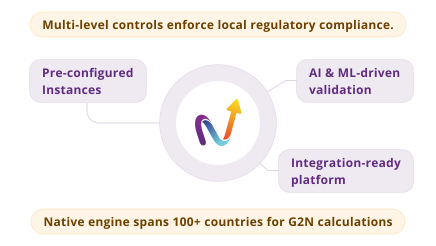
  • G2N Nova Payroll Engine: G2N Nova offers global gross-to-net payroll processing across more than 100 countries, making it one of the most advanced payroll engines available. It can be deployed as a SaaS solution or integrated seamlessly with major Human Capital Management and Workforce Management systems.

Conclusion

Mercans offers comprehensive and meticulously crafted Employer of Record (EOR) services in Finland, providing a seamless bridge for businesses venturing into this dynamic market. Our dedication to compliance, coupled with unparalleled expertise, ensures a smooth and efficient entry into Finland’s employment landscape. Partner with Mercans for expert guidance and tailored solutions that empower your business growth in Finland.

This document was prepared for informational purposes only. As local laws & regulations keeps on changing. Please consult your tax & legal advisors as well.
Contact Sales
Let's get this conversation started. Tell us a bit about your requirement, and we'll get in touch a soon as we can.

    FAQs

    What is an Employer of Record in Finland?

    An Employer of Record in Finland is a third-party service provider that legally employs workers on behalf of another company. The EOR manages all employment-related responsibilities, including contracts, payroll, taxes, benefits, and compliance with Finnish labor laws, enabling businesses to hire employees without establishing a local entity.

    How can foreign companies hire employees in Finland without establishing a local entity?

    Foreign companies can engage an EOR to hire employees in Finland. The EOR assumes the legal employer role, handling all statutory obligations, while the client company manages the employee’s daily tasks. This approach allows businesses to operate in Finland without the need for a local branch or subsidiary.

    What compliance, payroll, and HR services does an EOR in Finland provide?

    An EOR in Finland ensures compliance with local labor laws by managing employment contracts, processing payroll, withholding and remitting taxes, making social security contributions, administering mandatory benefits, and completing statutory filings. They also handle work permits and visa sponsorship for expatriate employees.

    What are the advantages of using EOR services in Finland?

    Utilizing an EOR in Finland offers several advantages: it simplifies market entry by eliminating the need for a local entity, ensures compliance with complex labor laws, reduces administrative burdens, mitigates legal risks, and accelerates the hiring process.

    How much does it cost to hire employees through an EOR in Finland?

    The cost of hiring through an EOR in Finland varies depending on the provider and the services included. Generally, fees can range from $599 to $2,000 per employee per month. It’s advisable to consult with the EOR provider for a detailed pricing structure.

    Is an EOR the best option for expanding a business into Finland?

    An EOR is an effective solution for businesses looking to expand into Finland without the complexities of setting up a local entity. It provides a compliant and efficient way to hire employees, allowing companies to focus on their core operations while the EOR manages employment-related tasks.

    Ready to hire in Finland?

    No local entity needed. Our experts handle payroll, compliance, and onboarding.

    Talk to an expert
    Proven expertise in global payroll.