Employer of Record

Employer of Record (EOR) Angola

Hire compliantly, pay accurately, expand confidently.

Global Payroll Team
Written by Global Payroll Team
Last updated April 24, 2026
Expert Reviewed

In Angola, the concept of a legal employer takes center stage through the role of an Employer of Record. Commonly recognized as a Global Professional Employer Organization (Global PEO), this crucial function encompasses various facets of employment. It entails ensuring compliance with local labor laws, managing payroll obligations, handling tax and social security requirements, providing mandatory benefits, and crafting employment agreements in line with Angola’s legal framework.

The responsibilities of the Employer of Record (EOR) in Angola include:
  • Guaranteeing adherence to local employment laws.
  • Overseeing the local payroll procedures.
  • Managing the filing of employment-related taxes and essential documentation.
  • Supplying the worker with accurate payslips.
  • Timely distribution of the worker’s salary payments.

Explore a simplified global expansion with our Global PEO services in Angola, offering a seamless solution without the need for entity setup. As your Employer of Record (EOR) in Angola, we ensure legal compliance, establish a physical presence, and safeguard Intellectual Property, allowing your business to concentrate on its core operations. Experience a streamlined global mobility process, including work visas, while fostering a diverse and proficient global workforce. Trust our expertise as the leading Employer of Record in Angola for a hassle-free expansion journey.

Things you need to know before hiring in Angola

Employment Contracts in Angola

Working Hours

The standard working time in Angola is generally 44 hours per week and 8 hours per day, with daily and weekly rest rules applying under the General Labour Law. Employers must also observe statutory rules on overtime, weekly rest, night work, and meal breaks in practice.

Probation Period

For indefinite-term employment agreements, the probationary period is generally 60 days. By written agreement, it may be reduced, removed, or extended up to 120 days, and up to 180 days for employees performing management functions or other roles requiring a longer assessment period.

13th Month Salary

In Angola, employees are commonly entitled to a holiday bonus and a Christmas bonus. In practice, each is generally calculated at 50% of the employee’s base salary, subject to the employment contract, collective arrangements, and the applicable legal treatment for payroll and tax purposes.

Employees vs Independent Contractors Compliance

CriteriaIndependent ContractorsEmployees
Legal StatusSelf-employed individuals providing services under civil/commercial contractsIndividuals under an employment contract governed by the General Labour Law (Law 12/23)
Governing LawCivil / Commercial LawLabour Law (General Labour Law 2023, in force since March 2024)
Subordination (Key Test)No subordination; independent in how work is performedWork under employer’s authority (direction, control, schedule)
Employment RelationshipNo employment relationshipFormal employment relationship with statutory rights and obligations
Labour Regime ApplicabilityNot subject to labour law protectionsFully subject to labour law (working hours, leave, termination rules, etc.)
Temporary / Agency WorkNot applicableRegulated; only licensed agencies may assign temporary workers (updated rules)
Types of ContractsService agreements (freely negotiated)Indefinite contracts are the default; fixed-term contracts allowed only in specific justified cases
Fixed-Term Contract RulesNot applicableStrictly regulated; must meet legal justification requirements
Renewal LimitsNot applicableImproper or unjustified renewals can convert contract into indefinite automatically
Transition to Indefinite ContractNot applicableAutomatic if legal requirements for fixed-term contracts are not met
Form of AgreementFlexible; parties define terms freelyMust meet legal requirements; specific clauses required by law
Written Contract RequirementStrongly recommended (best practice)Mandatory in key cases (e.g., fixed-term contracts, foreign workers)
Control Over WorkControls own schedule, tools, and methodsEmployer controls work conditions, schedule, and execution
Payment StructurePaid per project, milestone, or invoicePaid salary (monthly), subject to minimum wage and payroll rules
Tax ObligationsPays own income tax (IRT)Employer withholds income tax (IRT)
Social Security (INSS)Self-managed (if registered)Employer contributes (~8%) and employee contributes (~3%)
Employee BenefitsNo statutory benefitsEntitled to paid leave, sick leave, maternity leave, etc.
Annual LeaveNot applicable~22 working days per year
Maternity ProtectionNot applicableProtected; maternity leave (approx. 3–4 months)
Termination RulesBased on contract termsStrict legal procedures, notice periods, and severance rules apply
Severance PayNot applicableApplicable depending on termination conditions
ExclusivityCan work for multiple clientsMay be restricted by employment contract
Misclassification RiskHigh risk if relationship resembles employmentEmployer liable for penalties if contractor is reclassified as employee

Social Security in Angola

In Angola, social security contributions play a crucial role in providing protection for individuals in areas such as family benefits, maternity, old age, disability, and survivor-related protection under the mandatory social protection regime. Here’s an overview of social security in Angola:

Social Security Contributions:

Individuals in Angola are generally subject to mandatory social security contributions based on gross remuneration, with standard rates of 3% for employees and 8% for employers. The contribution base and treatment of specific pay items should be reviewed carefully during payroll setup, as special contribution regimes may apply to certain categories of workers.

Payroll in Angola

  • Minimum Wages: Angola’s minimum wage framework was revised under Presidential Decree No. 152/24. For 2026, the general national minimum wage is AOA 100,000 per month. A lower threshold of AOA 50,000 may apply to microenterprises and startups, and employers should verify whether any special category or temporary authorization applies before processing payroll.
  • Payroll Cycle: Typically, the payroll cycle follows a monthly schedule, with remunerations disbursed by the agreed payday and usually no later than the end of each monthly pay period.
  • Mercans Payroll Services: Leverage Mercans’ robust payroll capabilities for seamless payroll management. Our services include local currency payment for employees and contractors, comprehensive payroll setup, meticulous payroll processing, efficient payroll administration, and timely handling of statutory filings and payments. Trust Mercans to streamline your payroll processes, ensuring compliance and reliability.

Payroll Compliance in Angola

Following are the essential compliance and reporting requirements for payroll operations in Angola.

Government requirements

Managing payroll in Angola requires adherence to specific government-mandated procedures related to employee registration and continuous compliance. Below are the key elements employers must address:

Registration Requirements

Company and Employee Registration Protocols

Before commencing employment in Angola, it is mandatory for companies to complete formal registration with relevant government authorities:

  • Tax Authority (AGT): Both the employer and employees must obtain a Taxpayer Identification Number (NIF) by registering with the General Tax Administration.
  • Social Security Authority (INSS): Employers are required to register themselves and their employees with the National Social Security Institute to enable social contributions and benefit entitlements.

Depending on the company’s operating model and available administrative channels, registration may be handled through the relevant authority’s digital tools or by filing the required forms and supporting documents with the competent offices.
Required documents generally include:

  • Employee’s Identity Card (BI) or passport, as applicable
  • Taxpayer Number (NIF)
  • Social Security registration form or employee registration details
  • Dependents’ documents, if applicable

Ongoing Compliance Requirements

Monthly and Annual Compliance Obligations

Once registered, employers must fulfill recurring legal duties related to payroll reporting and contributions:

Personal Income Tax (PIT)

  • Employment income tax (IRT) must be withheld from employee wages on a monthly basis.
  • Payments and declarations must follow the filing deadlines published by the AGT in its annual fiscal calendar.
  • Withholding is based on Angola’s applicable IRT rules and current tax tables issued by the tax authority. From 1 January 2026, the monthly exemption threshold was increased to AOA 150,000, and payroll calculations should therefore be aligned with the current tables in force.

Social Security Contributions

  • Employers generally contribute 8%, and employees contribute 3% of gross monthly remuneration under the standard employee regime.
  • Reports and payments must be submitted in accordance with INSS rules and the applicable monthly deadline.

Monthly Payroll Report (to AGT)

  • A breakdown of salaries, taxes, and deductions must be maintained and, where required, reported to the Tax Authority in line with the AGT compliance framework.

Annual Tax Reporting

  • Employers must complete annual employment tax reporting in accordance with AGT requirements and the deadlines set in the applicable fiscal calendar for the relevant year.

RENT Submission (Worker Register)

  • Employers should also verify whether annual worker-register filings and related labor reporting requirements apply to their organization for the relevant year and submit them within the prescribed period.

Pension requirements

Registrations Requirements

All companies operating in Angola are required to register their employees with the Angolan Social Security Authority. This registration ensures that both local and eligible foreign employees are covered under the national pension and social protection system. To complete the registration process, employers must provide relevant documents such as the employee’s identity document, tax number, and the information required by the social security authority. In some cases, dependent information may also be required. This process allows employees to start accruing social security protection from the beginning of their employment.

Ongoing Compliance Requirement

Employers must submit monthly contribution information to the Social Security Authority, reflecting each employee’s contributory remuneration and any relevant earnings. Under the standard regime, social security contributions total 11% of salary, with 8% paid by the employer and 3% deducted from the employee’s wages. Accurate and timely submissions are essential to ensure that employees’ social protection rights are properly tracked and maintained.

Employment obligations

General employer obligations

Employers in Angola are required to comply with several legal duties to ensure workplace safety, health, and proper employee management. One of the primary obligations is to provide accident insurance or otherwise ensure legally required employment injury protection where applicable from the start of employment. Additionally, employers are responsible for implementing effective occupational health and safety measures in the workplace, including medical checks where required by law or by the nature of the role.

Furthermore, employers must adhere to local labor laws concerning working hours, rest periods, and public holidays. Employees are entitled to paid annual leave under the General Labour Law, commonly reflected as 22 working days per year in standard practice, subject to accrual rules and any more favorable collective or contractual terms. Employers must also respect Angola’s minimum wage rules and any specific labor conditions applicable to their industry.

Payroll Requirement

Payroll processing in Angola must align with the regulations set forth by the General Labour Law, which governs all contractual aspects between employers and employees. This includes the determination of wages, allowable deductions, reasons for termination, and entitlement to paid leave.

Employees in Angola are generally entitled to 12 months of base salary annually, along with additional compensation in the form of bonuses, specifically a holiday bonus and a Christmas bonus, each commonly calculated at 50% of base salary. These benefits may be adjusted if there is a collective labor agreement or another legally applicable arrangement in place.

Employers are also required to provide employees with detailed monthly pay slips. These pay slips must outline the total gross earnings, any bonuses, statutory deductions such as social security and income tax, and the final net pay.

Salaries must be paid promptly on the agreed payday or, if it falls on a non-working day, in line with the applicable wage-payment rules and company payroll practice.

Banking Requirements Related to Payroll

In Angola, salary payments are typically processed in the local currency, Kwanza, and paid into a bank account designated for the employee, in accordance with local payroll and exchange-control practice.

Payroll transactions are usually executed using the banking file format accepted by the employer’s banking institution. Employers must ensure that their payroll systems are compatible with local banking standards to facilitate timely salary transfers.

To maintain compliance with wage payment regulations and ensure proper tracking, companies are expected to work with licensed financial institutions operating under the oversight of the Angolan monetary and financial authorities.

Ensuring seamless payroll in Angola requires a thorough understanding of the country’s employment laws, statutory contributions, and regulatory obligations. Mercans offers end-to-end payroll solutions in Angola, helping businesses stay fully compliant while focusing on their core operations.

Angola Employee Hiring Cost

In Angola, the total employment cost of hiring an employee depends on the agreed gross salary, mandatory employer social security contributions, any required insurance coverage, and optional service-provider or administration fees. Under the standard social security regime, employers generally budget 8% on top of gross salary for mandatory social security, while employees are subject to their own payroll deductions such as social security and employment income tax. The final net salary therefore depends on the employee’s gross pay, applicable IRT bracket, contribution treatment, and any contractual allowances or bonuses. Understanding these variables is essential for businesses navigating the employment landscape in Angola.

Termination, Notice Period and Severance Pay

Termination

The Angolan Constitution and the General Labour Law explicitly outline the right to employment, work, and employment stability, specifying the grounds for termination in the applicable law. Both parties are prohibited from using termination methods not provided for by the applicable law, including the General Labour Law.
In terms of termination grounds, excluding dismissal for serious disciplinary cause or termination agreements, employers may opt for dismissal based on objective grounds and engage in collective redundancies.

Individual Dismissal on Objective Grounds:

The compensation structure for individual dismissal on objective grounds is a critical aspect of the provided example and should be retained. In the event of such dismissals, the calculation of compensation varies based on the type of company and the duration of an individual’s service to the company. The terms are as follows:

For large companies

One base wage for each year of seniority, up to a maximum limit of five years, along with an additional 50% of the base wage multiplied by the number of years of service exceeding the five-year limit.

For medium companies

One base wage for each year of seniority, up to a maximum limit of three years, plus 40% of the base wage multiplied by the number of years of service exceeding the three-year limit.

For small companies

Two base wages plus 30% of the base salary, multiplied by the number of years of service exceeding the two-year limit.

For micro companies

Two base wages plus 20% of the base wage, multiplied by the number of years of service exceeding the two-year limit.

This structure ensures a fair and graduated approach to compensation based on the company’s size and the employee’s tenure, providing clarity and transparency in the event of individual dismissals.

Collective Redundancy

Collective redundancy is employed when the extinction or transformation of jobs is motivated by proven economic, technological, or structural reasons affecting more than 20 employees. The procedure for collective redundancy mirrors that of individual dismissal on objective grounds, including compensation terms and calculation.

In terms of procedure, collective redundancy requires adherence to the General Labour Law, involving prior communication to the labour authorities and worker representatives and observance of the applicable statutory process before the termination date. The Inspectorate-General of Labour may intervene after the mandatory communication to clarify the situation. Additionally, employers can engage in meetings with employee representative bodies to exchange information and insights, subsequently sharing their conclusions with the competent labour authority.

Notice Period

During a trial period, either party may terminate the employment agreement without the requirement of notice, compensation, or justification, unless the parties have agreed otherwise in writing.

Employers
  • Employers cannot terminate agreements except in situations expressly provided for in the applicable law, with notice periods and severance payments applying in certain cases.
  • For fixed-term employment agreements, notice and end-of-term rules should be reviewed carefully against the contract wording and the current General Labour Law before termination is actioned.
Employees
  • Employees should provide written notice in accordance with the employment contract and the applicable legal framework when resigning.
  • Where notice is not properly observed, payment in lieu or other contractual consequences may apply, depending on the facts and the governing legal provisions.
  • If an employee terminates with legally justified cause, different rules may apply to notice and indemnity.
Dismissal for (Serious) Cause
  • Dismissal for disciplinary reasons must be based on serious disciplinary offenses or objective reasons making it impossible to maintain the employment relationship.
  • A formal procedure, including notification, the opportunity to be heard, and a documented decision, must precede disciplinary dismissal, with specific timeframes and communication requirements.
  • Additional formalities may be required for protected employees.
Appeal Process
  • Employees may challenge termination through the competent labor and judicial channels if they dispute the allegations, the proportionality of the dismissal, or the legality of the procedure.
  • Nullity and abusive causes may include procedural infringements, discriminatory motives, retaliation linked to employee rights, and other rights violations recognized under applicable law.

Employee Benefits in Angola

  • Annual Leave Employees in Angola are generally entitled to paid annual leave, commonly reflected as 22 working days per year under standard labor-law practice, together with the holiday bonus usually calculated at 50% of one month’s base wage. Accrual, scheduling, and carryover should be administered in line with the General Labour Law and any applicable collective arrangements.
  • Paternity Leave Fathers in Angola are entitled to 1 day of paid leave in the event of the imminent or actual birth of a child, plus an additional 7 working days of unpaid leave, whether consecutive or interpolated, subject to the applicable legal conditions.
  • National Service Employees may be entitled to leave for legally mandated civic or military duties where applicable under Angolan law.
  • Maternity Leave Maternity protection in Angola should be administered in accordance with the General Labour Law and related maternity-protection rules, including the applicable paid leave entitlement, any complementary leave rights, and protection against dismissal connected to pregnancy and maternity.
  • Employee Benefits Workers in Angola commonly benefit from holiday and Christmas bonuses, each generally amounting to 50% of a month’s base wage, subject to the employment terms and applicable legal treatment.
  • Education Leave Employees may in certain cases request leave for education or training purposes, subject to company approval and the governing legal or contractual framework.
  • Bonus All workers are generally entitled to a holiday bonus and a Christmas bonus, each calculated as 50% of a month’s base wage, thereby totaling an extra month’s salary over the year.

Personal Income Tax in Angola

For tax purposes in Angola, the rules on tax residence and employment income taxation should be reviewed under the current Angolan tax code and AGT guidance. In practice, employment income tax (IRT) applies to salary and salary-related remuneration earned from employment in Angola, regardless of the employee’s nationality, and the withholding obligation generally falls on the employer.
Personal income tax is applicable to remuneration from employment, including wages, salaries, fees, bonuses, and certain benefits in kind, subject to the applicable exemptions, exclusions, thresholds, and withholding rules. For 2026 payroll, employers should note that the IRT exemption threshold was increased to AOA 150,000 per month and should apply the current AGT tables and instructions in force for the relevant payroll year.

Residents

Monthly Taxable Income (AOA)Payable Tax (AOA)
Up to 34,450Exempt
34,451 – 35,000Amount exceeding 34,450 × 7%
35,001 – 40,000550 + 7% on excess over 35,000
40,001 – 45,000900 + 8% on excess over 40,000
45,001 – 50,0001,300 + 9% on excess over 45,000
50,001 – 70,0001,750 + 10% on excess over 50,000
70,001 – 90,0003,750 + 11% on excess over 70,000
90,001 – 110,0005,950 + 12% on excess over 90,000
110,001 – 140,0008,350 + 13% on excess over 110,000
140,001 – 170,00012,250 + 14% on excess over 140,000
170,001 – 200,00016,450 + 15% on excess over 170,000
200,001 – 230,00020,950 + 16% on excess over 200,000
Above 230,00025,750 + 17% on excess over 230,000

Non-Residents

For non-residents, the tax treatment of employment income depends on the source of income, the nature of the services performed, and the applicable Angolan tax rules. Employers should apply the current AGT withholding rules and review whether any treaty or specific tax treatment is available.

Tax Reporting

Tax reporting in Angola requires employers to apply the current AGT withholding framework, use the tax tables and instructions in force for the relevant year, and complete monthly and annual reporting within the prescribed statutory deadlines. It is important to accurately classify taxable and non-taxable earnings for proper taxation.

Work Permit in Angola

Work permits and work visas in Angola are issued to expatriates engaged in employment with an Angolan sponsoring entity or other qualifying local sponsor. The exact duration, renewability, and permitted activity depend on the visa category granted, the immigration approval obtained, and the sector involved. In practice, work-visa applications require supporting documentation such as the employment contract, sectoral approvals where applicable, criminal record certificate, medical certificate, proof of means, passport copies, and immigration fees.

It’s crucial to emphasize that work authorization and residence status should be assessed separately where required. Expatriates desiring to reside in the country for a longer period may need to undergo a separate or additional process for residence authorization in Angola, depending on the immigration route used.

EOR Solutions in Angola

  • EOR Solutions Tailored for Angola: Mercans extends premium Employer of Record (EOR) services in Angola, overseeing the entire employment journey once your chosen candidate is identified. Our all-encompassing solutions encompass payroll, benefits, tax adherence, and HR administration, guaranteeing a smooth and lawful transition. Possessing extensive knowledge of Angola labor regulations, we expertly handle contracts, salaries, and perks, ensuring both legal compliance and operational efficiency.
  • EOR and Professional Recruitment Support in Angola: Mercans delivers unparalleled Employer of Record (EOR) services in Angola, streamlining the onboarding process for top-notch talent. Our adept team oversees the entire spectrum, from selecting candidates to seamless integration. We manage contracts, payroll, benefits, tax compliance, and HR administration, guaranteeing a seamless transition.
  • Facilitating Expat Visa Sponsorship and Global Mobility: Mercans offers comprehensive Employer of Record (EOR) services, simplifying visa sponsorship for expatriates and global mobility. We navigate the journey, handling visa processes and ensuring conformity with local regulations. Our specialized services bridge the gap between talent and opportunities, facilitating a smooth transition for expatriate employees.
  • Transforming Independent Contractors into Permanent Employees: Mercans’ EOR in Angola acts as a catalyst for converting independent contractors into permanent employees, effortlessly navigating the complex regulatory landscape. Combining experience with technology-driven efficiency, we ensure a seamless transition, prioritizing compliance and accuracy throughout.
  • HCM Integration: Seamlessly integrate Mercans’ EOR services with your HCM system in Angola for real-time data exchange, enhanced compliance, and cost-efficiency. Rely on our expertise for a unified, compliant, and efficient approach, enhancing your workforce management and payroll operations.

Best Employer of Record Angola

Mercans Stands Out as the Leading Employer of Record in Angola for the Following Reasons:

  • Regulatory Compliance: Mercans ensures full compliance with all regulations set by the Ministry of Public Administration, Labour and Social Security (MAPTSS) and relevant Angolan authorities. It strictly adheres to Angola’s employment laws and standards, guaranteeing full legal compliance.
  • Independent Operation: Operating as a distinct entity, Mercans offers reliable and customised employment services tailored to the unique needs of businesses in Angola.
  • Diverse Employment Support: Mercans efficiently manages various forms of employment, including employees, freelancers, contractors, and expatriates, providing flexible solutions to meet a wide range of workforce needs.
  • Enterprise-Focused Solutions: Specifically designed to cater to large enterprises, Mercans delivers scalable and sophisticated services that accommodate complex organisational structures.
  • Multi-Currency Payroll Management: Mercans facilitates payroll processing in multiple currencies, ensuring seamless financial operations for businesses operating in Angola and internationally.
  • Global Reach and Payroll Expertise: With a robust international presence, Mercans excels in managing multi-country payroll, enabling smooth operations across borders.
  • Data Protection and Compliance: Mercans adheres to rigorous data protection standards, including GDPR compliance and SOC 1 & SOC 2 certifications, ensuring the highest levels of data security.
  • ISO Certifications: Mercans holds ISO 20000 and ISO 27001 certifications, reflecting its commitment to excellence in IT service management and information security.
  • Security Standards Compliance: Mercans meets the OWASP ASVS 3.0 standards, ensuring strong security practices in application development and management.
  • HR Blizz Platform: The proprietary HR Blizz platform is a global payroll and talent management SaaS suite that streamlines payroll processes while ensuring compliance with Angola’s regulations. With over 1,000 local experts, it provides in-depth knowledge of employment laws and business practices.
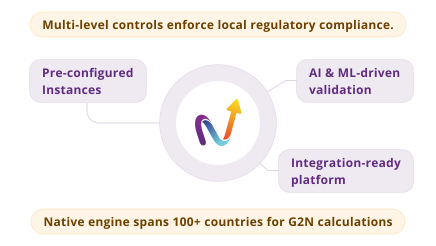
  • G2N Nova Payroll Engine: G2N Nova offers global gross-to-net payroll processing across more than 100 countries, making it one of the most advanced payroll engines available. It can be deployed as a SaaS solution or integrated seamlessly with major Human Capital Management and Workforce Management systems.

Conclusion

In conclusion, Mercans’ Employer of Record (EOR) solutions offer a strategic and efficient approach for businesses seeking to establish their presence in Angola. Our comprehensive services, ranging from legal compliance and payroll management to tax-related matters, provide a hassle-free entry into the Angolan market. By leveraging Mercans as your trusted EOR partner, you can focus on your core business activities while we navigate the intricacies of local employment regulations. Our commitment to excellence ensures that your expansion into Angola is not only seamless but also compliant and tailored to your unique business needs. With Mercans, embrace a reliable and cost-effective solution to unlock the full potential of your global workforce.

This document was prepared for informational purposes only. As local laws & regulations keeps on changing. Please consult your tax & legal advisors as well.
Contact Sales
Let's get this conversation started. Tell us a bit about your requirement, and we'll get in touch a soon as we can.

    FAQs

    What is an Employer of Record in Angola?

    An Employer of Record in Angola is a service provider that legally employs staff on behalf of another company. The EOR handles contracts, payroll, taxes, social security, and compliance with Angolan labor laws, allowing businesses to hire employees without setting up a local entity.

    How can foreign companies hire employees in Angola without a legal entity?

    Foreign companies can hire through an EOR which assumes the legal responsibilities of employment while the company manages day-to-day work. This allows businesses to operate compliantly without registering a local branch.

    What compliance and payroll responsibilities does an EOR in Angola manage?

    An EOR ensures that employment contracts comply with Angolan labor laws, calculates salaries, withholds taxes, manages social security contributions, administers mandatory benefits, and completes statutory filings.

    What are the benefits of using EOR services in Angola?

    Using an EOR allows companies to hire quickly, stay compliant, reduce administrative and legal risks, and avoid the time and cost of establishing a local entity. It provides a flexible and scalable solution for market entry.

    How much does it cost to hire through an EOR in Angola?

    Costs vary depending on the provider and services offered, typically ranging from five hundred to two thousand US dollars per employee per month. Businesses should consult with the EOR provider to confirm pricing.

    Is an EOR the best option for expanding a business into Angola?

    An EOR is often the fastest and safest way to enter the Angolan market. It allows businesses to hire talent immediately while ensuring full compliance with labor laws and reducing operational risk.

    Ready to hire in Angola?

    No local entity needed. Our experts handle payroll, compliance, and onboarding.

    Talk to an expert
    Proven expertise in global payroll.